Sense and Somatic Nervous System (Hearing and Vestibular)
By: Asfand Gul Kasi
Sense and Somatic Nervous System (Hearing and Vestibular)
By: Asfand Gul Kasi
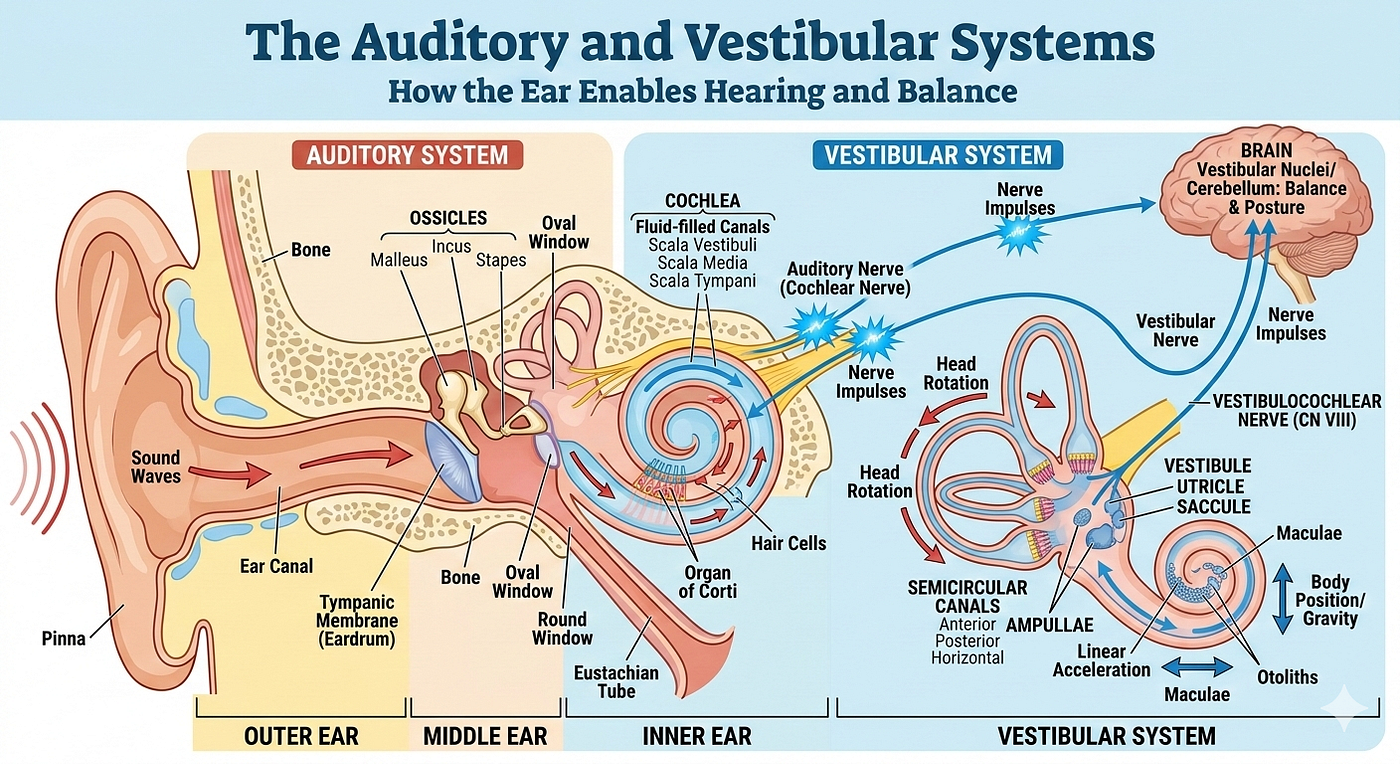
An anatomical diagram of the human ear, detailing how the auditory system processes sound waves and the vestibular system maintains balance and spatial orientation.
The Auditory and Vestibular Systems: How the Ear Enables Hearing and Balance
The ear is a remarkable sensory organ responsible not only for hearing but also for maintaining balance. The auditory system detects sound waves and converts them into electrical signals, while the vestibular system monitors head movement and body position. Together, these systems allow us to interpret sounds, maintain posture and move confidently through space.
The Auditory System: Detecting Sound


A. Nature of Sound Waves
Sound travels as waves formed by alternating compression and expansion of air molecules.
- Amplitude (wave height) → Determines volume (loudness)
- Frequency (wave rate) → Determines pitch (high or low sound)
The brain interprets these mechanical waves as meaningful sounds.
B. Anatomy of the Ear
The ear has three main parts:
1. Outer Ear
- Auditory canal directs sound waves toward the tympanic membrane (eardrum).
2. Middle Ear
- Contains three small bones (ossicles):
- Malleus
- Incus
- Stapes
These bones:
- Amplify vibrations from air
- Transfer vibrations to the oval window
- Help convert air vibrations into fluid vibrations
3. Inner Ear
- Contains the cochlea, a fluid-filled structure.
- Vibrations enter through the oval window.
Fluid moves through:
- Scala vestibuli
- Scala tympani
C. The Organ of Corti and Hair Cells
Inside the cochlea lies the Organ of Corti, the true sensory organ of hearing.
- Hair cells sit on the basilar membrane
- Their stereocilia (hair-like projections) touch the tectorial membrane
- When the basilar membrane vibrates:
- Hair cells bend
- This causes depolarization or hyperpolarization
- Action potentials are generated
Key Points:
- Pitch depends on which region of the basilar membrane vibrates most.
- Loudness depends on the frequency of action potentials.
- Signals travel through the cochlear nerve to the brain.
The Vestibular System: Maintaining Balance

The vestibular system, located in the inner ear next to the cochlea, detects motion and body position.
It senses:
- Angular acceleration (rotational movement)
- Linear acceleration (straight-line movement)
- Head tilt and orientation
A. Semicircular Canals (Rotation Detection)
There are three semicircular canals, positioned at 90-degree angles.
They detect:
- Nodding “yes”
- Shaking “no”
- Tilting side to side
How They Work:
-
Canals are filled with fluid.
-
When the head rotates:
- The canal moves
- Fluid lags behind due to inertia
-
This movement bends hair cells in the cupula
-
Action potentials signal rotational movement to the brain
B. Otolith Organs (Linear Movement & Tilt)
There are two otolith organs:
- Utricle Detects horizontal movement
- Saccule Detects vertical movement
Structure:
- Hair cells embedded in gel
- On top of gel are otoliths (calcium carbonate crystals)
Because otoliths are heavy:
- Gravity pulls them during head tilt
- Inertia affects them during acceleration or deceleration
- This bends stereocilia
- Signals are sent to the brain
Examples:
- Tilting head backward → Similar effect as forward acceleration
- Tilting head forward → Similar to deceleration
Summary: Hearing and Balance Working Together
The ear performs two vital sensory roles:
Auditory System
- Breaks complex sounds into basic frequencies
- Converts mechanical vibrations into electrical signals
Encodes:
- Pitch by location on basilar membrane
- Loudness by frequency of action potentials
Vestibular System
- Detects head position and movement
- Maintains balance and posture
Uses hair cells in:
- Semicircular canals
- Utricle
- Saccule
The end
Thank you for reading..
메타데이터
- post_id
- e75bf6aebcb7
- slug
- sense-and-somatic-nervous-system-hearing-and-vestibular-e75bf6aebcb7
- url
- https://medium.com/@arbabasfand1/sense-and-somatic-nervous-system-hearing-and-vestibular-e75bf6aebcb7
- canonical_url
- https://medium.com/@arbabasfand1/sense-and-somatic-nervous-system-hearing-and-vestibular-e75bf6aebcb7
- author_url
- https://medium.com/@arbabasfand1
- status
- ok
- fetched_at
- 2026-07-30 08:39:08