imageThree Days of Work. Two Turned-Down Projects. Then Three Sentences That Cost Me $1,400.
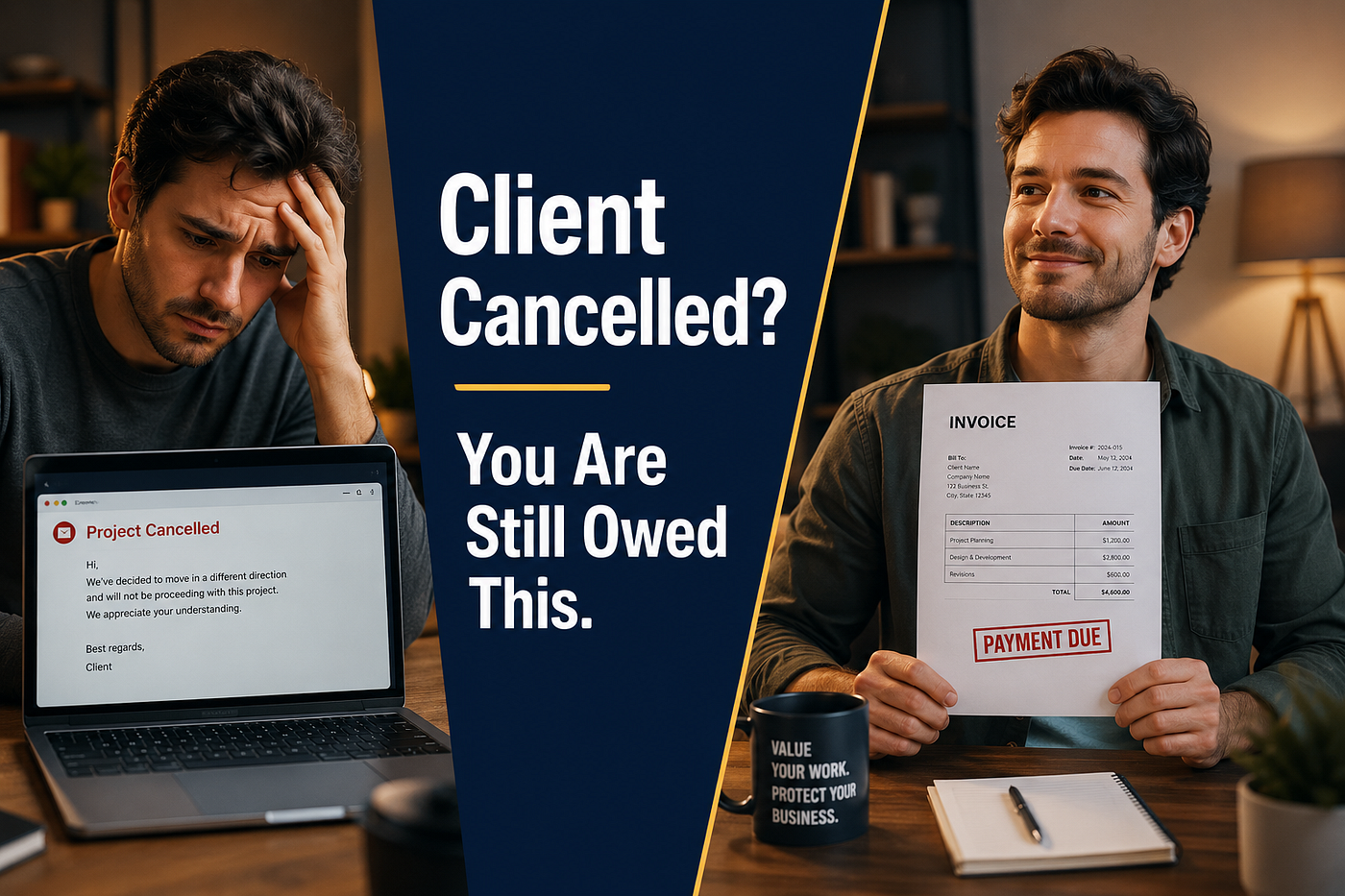
I remember exactly what the email said.
imageThree Days of Work. Two Turned-Down Projects. Then Three Sentences That Cost Me $1,400.

I remember exactly what the email said.
“Hey, we are going to pass on this one. Thanks so much!”
I had cleared my entire schedule for that client. Turned down two other jobs that week because I wanted to give this one my full attention. Spent three full days building exactly what they had asked for. Deep research. A full strategy document. Detailed outlines they had specifically requested in our kickoff brief.
And then those three sentences arrived with nothing attached. No partial payment. No acknowledgment. Just a casual thanks and a door closing.
$1,400. Gone.
And the reason I had no recourse at all was simple. I had never added a kill fee clause to my contract.
What I did not know
A kill fee is money a client pays you when they cancel a project after work has already started. It is one paragraph. It is standard practice across advertising, media, design, photography, copywriting, and web development. It has been used in journalism and publishing for decades. And I had freelanced for two years without ever adding one to a single contract.
The fear that stops most freelancers from including it is the same one that stopped me. They think it will push clients away.
It will not. Good clients understand it immediately. The clients who push back hardest against it are actually doing you a favor by revealing something about their character before you invest weeks of your time.
How the numbers work
The percentage depends on when the cancellation happens.
Before first deliverables, 25 to 30 percent covers the planning and opportunity cost. After initial work is delivered, 50 percent is the industry standard in the United States across most creative fields. After final delivery, 75 to 100 percent is appropriate because the work is complete and the client is choosing not to use something you fully created.
I use a tiered system in my contracts that specifies each stage. The clarity alone prevents most disputes because there is nothing to argue about.
What nobody tells you about your work rights
When a kill fee is paid rather than the full project fee, the rights to the work revert to you. The client cannot use your content, adapt your designs, or hand your code to another developer without your permission. That permission arrives with the full payment. Not the kill fee. The full payment.
This is your negotiating position and your contract needs to say it explicitly. Most freelancers do not know it exists.
The $1,400 morning changed everything
I added a kill fee clause to every contract after that day. In the years since, I have had exactly two clients push back against it. I was polite. I explained it calmly as protection for both parties. One accepted it. One walked away.
I later found out the one who walked away had a pattern of cancelling on freelancers mid-project without payment.
The clause did not just protect my income. It protected my time and my energy before I had committed either.
The complete guide covering what a kill fee is, how to calculate the right percentage, a copy-paste clause template, and the exact conversation script for new clients is here:
https://giglawguide.com/what-is-a-kill-fee-freelance-the-complete-guide/
Written by Muzammil — freelance legal content writer and independent contractor rights advocate. Gig Law Guide publishes plain-language resources for freelancers worldwide.
📩 info@giglawguide.com 📞 +92 334–6918600
메타데이터
- post_id
- e75e9a3f9716
- slug
- imagethree-days-of-work-two-turned-down-projects-then-three-sentences-that-cost-me-1-400-e75e9a3f9716
- url
- https://medium.com/@giglawguide/imagethree-days-of-work-two-turned-down-projects-then-three-sentences-that-cost-me-1-400-e75e9a3f9716
- canonical_url
- https://medium.com/@giglawguide/imagethree-days-of-work-two-turned-down-projects-then-three-sentences-that-cost-me-1-400-e75e9a3f9716
- author_url
- https://medium.com/@giglawguide
- status
- ok
- fetched_at
- 2026-06-09 15:37:30