Green Magazine
Fashions Footprint
Green Magazine

Fashions Footprint
Industries such as fur and fast fashion are steadily damaging our environment, with little remorse from either producers or consumers. Beyond their unsustainable environmental impact, these industries frequently rely on unethical practices as well. Green is a fashion publication that critiques overconsumption and exploitative production while exploring how industry practices can harm the planet if not handled responsibly. The publication targets young consumers, encouraging them to consider the environmental consequences of their purchasing habits.
With the advancement of different technologies and social media, consumerism is at an all-time high, and the “rapid expansion has come at a significant environmental cost.”³ The fashion industry is a major environmental polluter and is “responsible for 8–10% of global carbon emissions — more than all international flights and maritime shipping combined. It causes 20% of global industrial water pollution, consumes 79–93 trillion liters of water annually, and contributes 35% of all microplastics in the ocean.”⁴
Why go Green?
As an outdoor and fashion fanatic, I often feel heavily conflicted when shopping for clothing. With new brands emerging every day, along with advances of technology and the influence of social media, it’s easy to shop until you drop. It’s important that people stay conscious and educated about what they buy. Large corporations often prioritize profit over environmental responsibility, making it essential for consumers to take matters into their own hands. I decided to create a fashion publication that informs the public about the harm being done to the planet, since many consumers remain unaware of the industry’s environmental impact. It was crucial that the production of the publication aligned with Green’s environmental standards.
Sustainable by Design
The publication is printed on newsprint, which is generally more eco-friendly than other types of paper due to a highly recyclable, biodegradable pulp. Along with the paper being sustainable, the inks used are soy-based rather than the harmful, oil-based inks used in other printing applications. Soy-based inks are non-toxic and environmentally safer. This publication, 9.5x15in, mimicking the standard newspaper size, informs while also expresses distaste for current production methods.

Right away, the cover of the publication makes its intentions clear, showing a model lying atop a sea of trash bags full of clothing. This publication contains three articles organized into the themes Before, During, and After. The first examines past pollution during the 1950s fur industry boom, the second focuses on the rise of fast fashion today, and the third looks ahead, critiquing the effects of consumerism on future generations.


Before
While it’s commonly known that fur is unethical in terms of animal cruelty, it has been an ongoing source of pollution since the 1950s. The article speaks on the different ways that fur is bad for the environment by stating that, “across multiple environmental indicators — including greenhouse gas emissions, water consumption, and pollution — fur consistently ranks as the most damaging textile material.”² In order to highlight the fur in the imagery, I cut it out, replaced it with fur from actual animals, then recolored to resemble harsh dyes. I wanted to create a feeling of distaste for the luxury material and draw attention to the environmental and ethical harm it causes. The photos and type in the section reflect themes of the past: using archived photos and a vintage script font, in reference to the before, during, and after organization of the publication.


During
While the fur industry highlights the long-term environmental cost of luxury materials, the second article shifts focus to the rapid production cycles of fast fashion. This industry “produces low-quality textiles in excessive amounts to maximize profits and adhere to the latest trends.”³ Similarly to fur processing, “the dyeing of textiles [in fast fashion] is, without a doubt, the stage of manufacturing that is most damaging. It is the number one polluter of clean water.”³ I wanted to communicate that in the illustrations by creating a swirling watery pattern, which represents toxic chemicals invading water sources. The article also speaks on the effects of packaging, which can take up to thousands of years to decompose, and the effects of transit after and during production, which create air pollution and water pollution. I implemented modern and editorial images and typefaces to reflect the present time frame, with the advancement of technology and fast-paced production of fast fashion in the current world.


After
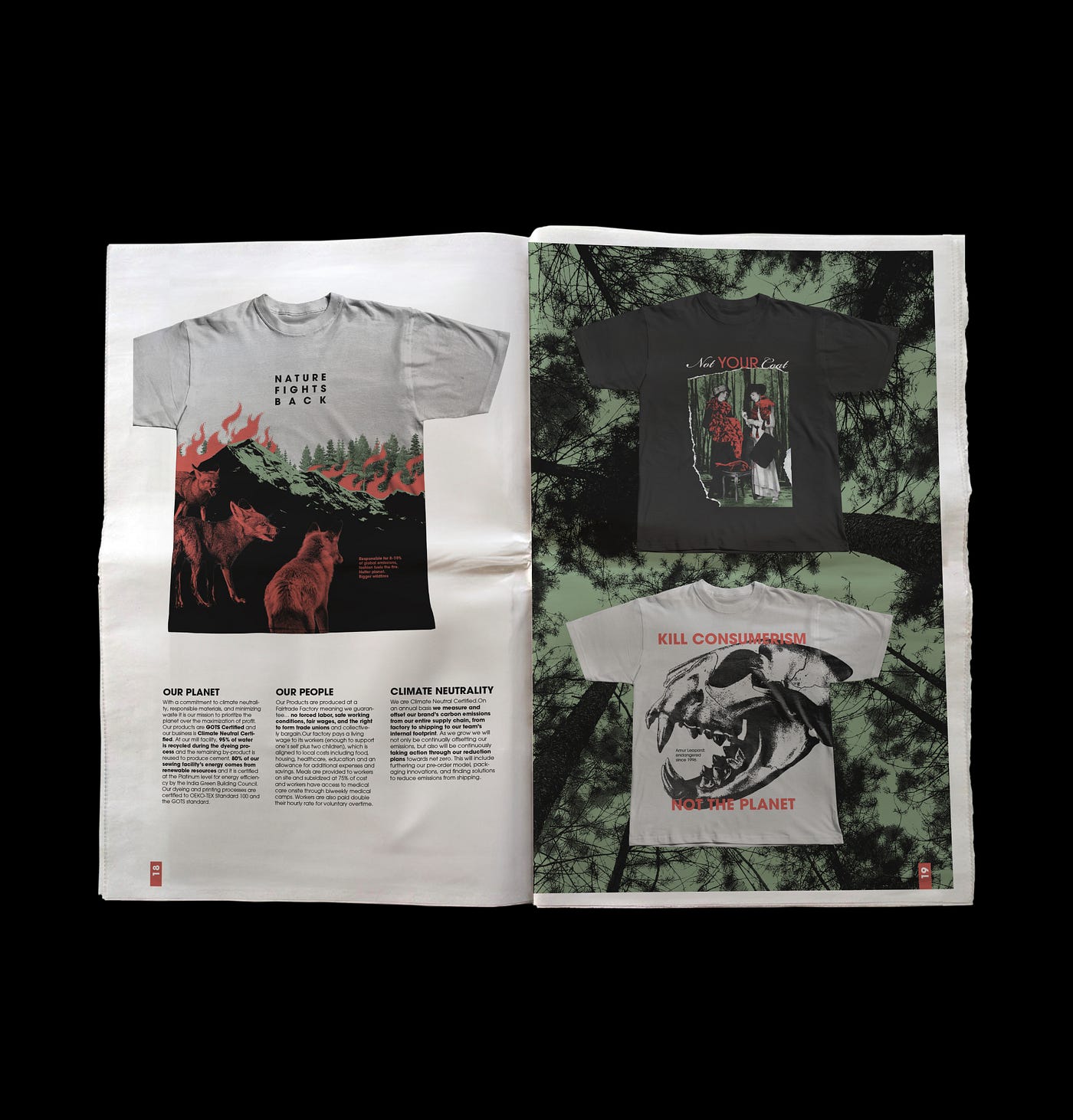
The third article looks towards a brighter future with a line of t-shirts that help spread the message and are sustainably produced. This collab between Green and the eco-friendly brand CHNGE uses clothing as a medium to communicate awareness and encourage reflection on the impact of fashion and consumption. The brand CHNGE takes extra measures to ensure its production is ethical, while critiquing social and environmental injustices through its designs. The company is “GOTS Certified” and “Climate Neutral Certified,” and at their mill facility, “95% of water is recycled during the dyeing process, and the remaining by-product is reused to produce cement” (CHNGE). The shirts I’ve created reflect sustainability similarly to the way CHNGE does, in a bold, punchy manner.



Breaking the Cycle
Ultimately, this publication demonstrates that the environmental and ethical harm caused by the fashion industry is not the result of a single practice, but of a larger system sustained by both production and consumption. From the lasting pollution of the fur industry to the excessive waste and resource depletion driven by fast fashion, each aspect reflects an ongoing cycle of overproduction and disregard for environmental impact. While regulation and industry shifts are necessary, they remain incomplete without a change in consumer behavior. By concluding with a sustainable t-shirt brand, this thesis not only critiques these systems but also proposes an alternative, using design as a means of communication and accountability. In doing so, it reinforces that addressing the impact of fashion is not solely about how clothing is made, but about how it is valued, consumed, and understood.

Expansion
If this publication were to expand, I imagine it would move further into current events and larger global issues — exploring topics like politics, social media, technology, micro-trends, and labor conditions in the fashion industry. In doing so, the magazine would continue to highlight how connected these systems are, showing that the impact of fashion doesn’t exist on its own, but is deeply tied to broader social and environmental realities.
Marketing Posters


T-Shirt Designs


What we wear has consequences—
BEFORE, DURING, and AFTER US


Credits:
Instructor: Paul Kepple
Photography: Lia Long
Model: Anya Wojciechowsky
References:
- BOF Team. (2023, December 7). The year ahead: Why fashion can no longer ignore the climate crisis. The Business of Fashion. https://www.businessoffashion.com/articles/sustainability/the-state-of-fashion-2024-report-climate-crisis-supply-chain-sustainability-environment/
- Kromhof, S. K. (2019, July 1). The true cost of fur: A hidden environmental threat. Faunalytics. https://faunalytics.org/the-true-cost-of-fur-a-hidden-environmental-threat/?
- Mitchell, L. (2023, July 28). The environmental impacts of fast fashion. Essex Student Journal. https://publications.essex.ac.uk/esj/article/id/257/?utm
- Plummer, D. (2025, April 18). Google search. Forbes. https://www.forbes.com/sites/dianneplummer/2025/04/18/the-hidden-crisis-of-fashion-climate-water--microplastic-impact/
- Stelios Andreadakis and Prince Owusu-Wiredu. (2023, July 13). Fashion footprint: How clothes are destroying our planet and the growing impacts of fast fashion. IntechOpen — Open Science Open Minds | IntechOpen. https://www.intechopen.com/chapters/1144940
- Tashjian, R. (2026, January 23). Everyone’s trying to feel good about wearing fur. CNN. https://edition.cnn.com/2026/01/23/style/vintage-fur-shearling-trend
- Webb, B. (2025, February 25). Fashion is neglecting nature. Now what? Vogue. https://www.vogue.com/article/fashion-is-neglecting-nature-now-what-textile-exchange?utm
메타데이터
- post_id
- e767a15cca2e
- slug
- green-magazine-e767a15cca2e
- url
- https://medium.com/tylerdi/green-magazine-e767a15cca2e
- canonical_url
- https://medium.com/tylerdi/green-magazine-e767a15cca2e
- author_url
- https://medium.com/@lialong
- status
- ok
- fetched_at
- 2026-06-09 15:37:30