Are Narcissists Truly Mentally Ill or Simply Evil: The Buried Truth Society Refuses to Tell You
The psychiatric label shields them from accountability, but the buried truth society refuses to face is not what they have — it’s what they…
Are Narcissists Truly Mentally Ill or Simply Evil: The Buried Truth Society Refuses to Tell You
The psychiatric label shields them from accountability, but the buried truth society refuses to face is not what they have — it’s what they have coldly, knowingly chosen to become.

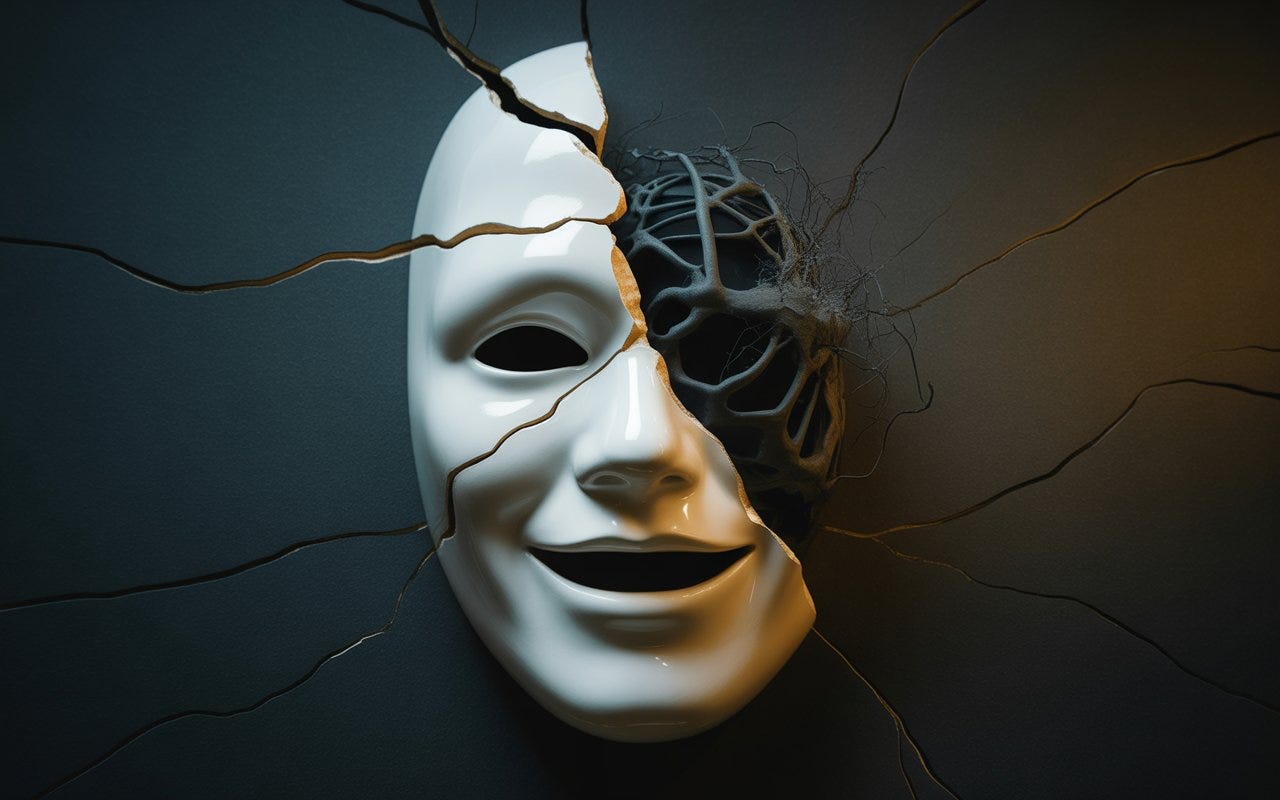
This image is generated via GPT-2
There is a question that sits in the back of the throat of every survivor of narcissistic abuse, a question that trembles on the lips of the discarded partner, the scapegoated child, the exhausted employee who has been gaslit into believing they are the problem. It is a question that the mental health industry dances around with careful diagnostic language, that philosophers fence with abstract arguments about free will, and that the spirituality community cloaks in talk of wounded inner children. The question is this: are narcissists truly mentally ill, or are they simply evil?
You are not supposed to ask that. The moment you do, a great machinery of social correction whirs into motion. “They are suffering from a personality disorder,” the therapist says with practiced neutrality. “Hurt people hurt people,” the Instagram infographic reminds you. “We must have compassion for those with mental health conditions,” the corporate wellness email insists. And you nod, because you want to be a good person, a kind person, a person who does not stigmatize mental illness. But late at night, when you replay the thousand tiny cruelties, the smiling betrayals, the eerie calm with which they dismantled your self-worth, the question returns, burning: Did they know exactly what they were doing? Did they choose it? Did they enjoy it?
This article is the buried answer. Not the sanitized, compassion-saturated answer designed to keep the peace in a culture that has confused empathy with self-erasure. The real answer, pulled from the deep web of survivor testimony, from the unflinching confessions of self-aware narcissists, from the neuroscience labs and the courtrooms and the secret forums where the victims gather, is far more disturbing — and far more liberating — than you have been told. Narcissism is not merely a mental illness. It is a pattern of chosen predation that hides behind the mask of diagnostic language to evade the one label that would demand moral outrage: evil.
And that is precisely the truth society refuses to tell you.
The Great Diagnostic Shield: How NPD Became a Get-Out-of-Accountability-Free Card
In 1980, the American Psychiatric Association voted Narcissistic Personality Disorder into the third edition of the Diagnostic and Statistical Manual of Mental Disorders. It was a landmark moment. A constellation of behaviors — grandiosity, need for admiration, lack of empathy, exploitation of others — was officially medicalized. The person who systematically destroyed the lives of those around them was no longer a tyrant, a monster, or a moral failure; they were a patient. They had a condition. They deserved treatment, not condemnation.
This medicalization was well-intentioned. It promised a path toward understanding and, theoretically, healing. But over the decades, something unintended happened. The diagnosis became a rhetorical shield, wielded not by suffering patients seeking help, but by abusers, their enablers, and a conflict-averse therapeutic culture to deflect the most fundamental question of all: culpability.
Visit any survivor support group on the deep web — the locked forums, the encrypted chat channels, the pseudonymous Reddit communities with half a million members — and you will hear the same furious lament. “My therapist says I need to understand that he has a mental illness and can’t help it.” “The custody evaluator said her narcissistic traits don’t make her an unfit mother, just someone who struggles.” “Our pastor told me that labeling him evil was un-Christian because he’s spiritually sick.” The message to the victim is chillingly consistent: your abuser’s pathology absolves them, and your anger, your righteous desire for justice, is the real problem.
This is not an accident. It is a structural feature of how we have chosen to talk about Cluster B personality disorders. By framing narcissistic abuse as a tragedy of brain wiring, we imply a helplessness that does not exist. We collapse the distinction between a schizophrenic person hearing persecutory voices and a narcissist coldly calculating the precise words that will make their partner doubt their sanity. Both are labeled “mentally ill.” Both are given the unearned grace of diminished responsibility. And the victim who dares to say “these two things are not the same” is shamed into silence.
But the deep web tells a different story. It is filled with millions of words of survivor testimony, and if you spend enough time submerged in that ocean of pain, a clear pattern emerges. Narcissists, survivors insist, possess a terrifyingly precise theory of mind. They can read your emotional state better than most empaths. They know what will wound you, what will soothe you, what will make you stay and what will make you flee. They use that knowledge with surgical precision. This is not the blundering of a disordered mind. This is the craftsmanship of a predator.
The Confession of the Self-Aware: “We Know Exactly What We Do”
Perhaps the most explosive evidence that narcissists are not merely “ill” but actively choose harm comes from a source the mainstream mental health establishment often ignores or dismisses: self-aware narcissists themselves.
There is a shadowy corner of the internet where diagnosed narcissists and psychopaths speak freely, under conditions of radical anonymity, about their inner worlds. Some of these individuals have been in therapy for years. Some run blogs or YouTube channels where they dissect their own psychology with a candor that is as fascinating as it is nauseating. They are not the “narcissists in denial” that pop psychology describes. They know what they are. They can tell you, in granular detail, the mechanics of their manipulation, the thought processes behind their gaslighting, the precise moment they decided to discard a partner they had professed to love.
One such self-described malignant narcissist, who has written extensively in obscure forums under a rotating set of pseudonyms, offered this confession: “I can feel the moment empathy would kick in, and I just… switch it off. It’s a choice. I decide that their feelings are not useful to me right now. It’s like turning off a light. I know they’re hurting. I can see it. I just don’t care, because caring would interfere with what I want. And I always choose what I want.”
“I decide.” “I choose.” This is the language of agency, of moral cognition intact and deliberately overridden. This is not the language of someone who cannot understand the impact of their actions. It is the language of someone who understands perfectly and proceeds anyway.
The most famous voice in this space is undoubtedly Sam Vaknin, a self-proclaimed narcissist and author of Malignant Self-Love: Narcissism Revisited. Vaknin, who holds a Ph.D. in psychology and has been a visiting professor, has spent decades articulating the inner experience of pathological narcissism with a frankness that has made him both a pariah and an indispensable resource for survivors. His testimony is devastating to the “mental illness as helplessness” narrative.
Vaknin describes the narcissist’s interactions with others as “narcissistic supply transactions.” He explains that the narcissist does not form genuine emotional attachments but rather views people as objects to be mirrored, extracted from, and discarded when their utility is exhausted. Crucially, he insists that the narcissist is not delusional in a psychotic sense. The narcissist knows the difference between the False Self they project and the fragmented True Self they hide. They know they are lying when they profess love. They know they are manipulating when they feign tears. The fact that their internal emotional landscape is barren and that they are perpetually empty does not negate their cognitive awareness of the external reality they exploit.
“The narcissist is fully cognizant of the consequences of his acts,” Vaknin writes. “He simply does not care. He is, in the purest sense, amoral — not immoral, because morality implies a framework one can violate. The narcissist has no framework. There is only winning and losing, feeding and starving.”
This aligns with the voices of a thousand anonymous commenters on survivor boards. “He never apologized with real feeling, but he could mimic an apology perfectly when he needed to get out of trouble,” writes one survivor of a twenty-year marriage. “That’s not a sickness. That’s a skill.”
The Empathy Switch: Neuroscience Meets Moral Choice
The “mental illness” defense of narcissism leans heavily on the assertion that narcissists lack empathy. This is, at first glance, a powerful argument. If a person cannot feel what another person feels, how can they be expected to care about causing pain? How can you be evil if you are emotionally blind?
But the deep web research — and increasingly, the peer-reviewed neuroscience — reveals that this framing is a grotesque oversimplification. The truth is far more unsettling: most narcissists do not lack empathy. They possess what is called cognitive empathy while lacking affective empathy.
Cognitive empathy is the ability to understand what another person is thinking and feeling. It is perspective-taking. It is theory of mind. It is, in essence, the ability to read people like a book. Affective empathy, on the other hand, is the capacity to share in another person’s emotional state — to feel distress when they feel distress, joy when they feel joy. It is the emotional contagion that motivates altruism.
When you listen to the self-aware narcissists and the survivors who have studied their abusers like forensic scientists, a chilling picture emerges. The narcissist’s cognitive empathy is often exceptionally high. They are master readers of micro-expressions, of vocal tone, of psychological vulnerability. They can enter a room and within minutes identify the insecure, the people-pleaser, the person starving for validation. They know precisely which compliment will open which door. They know exactly which subtle insult will lodge in your brain and corrode your self-esteem for months.
What they lack is the affective empathy that would make them care about the emotional data they are harvesting. They see your vulnerability not as a call to tenderness, but as an opportunity. They understand your pain and use it. This is not a deficit in the hardware of perception. It is a deficit in the software of moral feeling, which they have either never installed or — as the self-aware confessions suggest — have learned to disable at will.
A landmark neuroimaging study, replicated and discussed endlessly in the darker academic corners of the web, found that when narcissists were asked to empathize with someone in distress, the brain regions associated with affective empathy (such as the anterior insula and anterior cingulate cortex) showed reduced activation compared to controls. However, their ability to accurately identify the emotion in the photo was intact. They knew the person was sad. Their brain simply did not light up with shared sadness. But here is the critical, often ignored point: the same study showed that when these narcissists were instructed to try to empathize, some of those brain regions did activate. The capacity was not entirely absent; it was dormant, suppressed, or selectively deployed.
This is the neurobiological correlate of the switch that self-aware narcissists describe. Empathy, for them, is not a missing limb. It is a tool they can pick up or put down depending on whether it serves their goals. When they need to charm a new source of supply, they can perform empathy brilliantly, reading needs and mirroring emotions. When that source is secured, and they want to devalue and control, the tool is discarded. The cruelty that follows is not a symptom. It is an operational decision.
If this is true, then the “they can’t help it because they lack empathy” argument collapses into dust. They can help it. They choose not to. And when you listen to the survivors, they will tell you about the moments that proved it: the ex-husband who was a careless monster in private but a devoted father whenever a social worker visited; the female narcissist boss who eviscerated her staff but could turn on a dime into a gracious mentor when her own boss was in the room; the narcissistic mother who tortured her scapegoat child but maintained a flawless, loving public persona that fooled the entire church. These are not people who cannot control their behavior. These are people who control it exquisitely, deploying cruelty and charm with strategic precision.
The Banality of Evil and the Architecture of Calculated Cruelty
Hannah Arendt, reporting on the trial of Adolf Eichmann, coined the phrase “the banality of evil.” Her insight was not that Eichmann’s actions were banal, but that his motivations were. He was not a frothing demon but a dull bureaucrat who had abandoned his capacity for independent moral thought. His evil lay in his thoughtlessness, his willing surrender of conscience to the machinery around him.
The narcissist presents a more intimate, more terrifying version of this banality. The evil they perpetrate is not the grand, genocidal evil of history’s monsters. It is the kitchen-table evil, the bedroom evil, the office-cubicle evil. It is the systematic, unglamorous dismantling of another human soul, carried out not for ideology or state power, but for something far more pedestrian: supply. Attention. Adoration. Control. The maintenance of a grandiose but fragile self-image that must be continually fed by the emotional energy of others.
What makes this evil banal in Arendt’s sense is the narcissist’s relationship to conscience. Just as Eichmann had compartmentalized his moral sense, the narcissist has learned to override or disown theirs. The deep web forums are full of survivors describing the almost bureaucratic language their abusers used to justify their actions. “I had to teach you a lesson.” “You made me do this by not respecting me.” “This is just how relationships work — everyone plays these games.” The narcissist constructs a parallel moral universe in which they are always the wronged party, the victim of others’ failings, and their cruelty is merely reactive self-defense.
This is not psychosis. This is not a break from reality. This is a sustained, internally coherent system of self-exoneration. And it is a choice to inhabit that system rather than do the painful work of self-examination. As one survivor put it in a long, anguished post that went viral in the dark corners of the support community: “He doesn’t hear my tears because he has a head injury. He hears them. He just has a thousand pre-written scripts in his head that transform my tears into evidence that I’m manipulating him. He works to misunderstand me. That work is his evil.”
The Legal System’s Unspoken Truth: Personality Disorders Are Not Insanity
When the question of narcissism and evil escapes the therapeutic consulting room and enters the courtroom, the compassionate obfuscations of the mental health industry suddenly collide with the hard requirements of law. And the law, in its brutal pragmatism, has already answered the question society refuses to speak aloud.
The insanity defense — the legal mechanism by which a mental illness can nullify criminal responsibility — rests on specific tests. The most famous is the M’Naghten rule, which asks whether the defendant, at the time of the act, was laboring under such a defect of reason, from disease of the mind, as to not know the nature and quality of the act, or, if they did know it, to not know that what they were doing was wrong. Other tests, like the irresistible impulse test or the Model Penal Code test, have variations, but they all center on a core idea: did the mental illness render the person unable to understand their actions or unable to conform their conduct to the law?
Here is the buried truth the legal system knows and the therapeutic culture often fudges: personality disorders almost never qualify for an insanity defense. The American legal system, and indeed most legal systems worldwide, draw a sharp line between Axis I disorders (major mental illnesses like schizophrenia, bipolar disorder with psychotic features, severe delusional states) and Axis II disorders (personality disorders like narcissistic, borderline, antisocial). The former can, in extreme cases, negate mens rea — the guilty mind. The latter almost never do.
Why? Because a person with Narcissistic Personality Disorder knows the nature of their actions. They know that lying is wrong, that hitting is assault, that stealing is theft, that destroying someone’s reputation with calculated slander is defamation. They know the difference between reality and fantasy; they are not hallucinating justifications, they are manufacturing them. They have, in the eyes of the law, the substantial capacity to appreciate the criminality of their conduct and to conform their conduct to the requirements of the law. They simply choose not to, because their moral compass is not broken but intentionally ignored.
Survivors who have tried to use their abuser’s diagnosis to achieve justice in family court have encountered this terrible irony firsthand. The narcissistic ex-spouse who subjected them to years of psychological torture is deemed by the same system to be mentally competent enough to seek custody, to manage finances, to stand trial for domestic violence if physical evidence exists. The diagnosis that therapists use to explain the abuse is legally irrelevant to proving the abuse. The system knows, on some level, that the narcissist is not crazy. They are dangerous.
This legal reality exposes the soft bigotry of the “mental illness” excuse. If narcissism truly were an insanity-level condition that robbed a person of moral agency, our courts would treat it as such. They do not. They treat the narcissistic abuser as a moral agent who made bad choices. The refusal of society to extend this logic into the cultural conversation about narcissism is a form of collective cowardice. We want to believe that cruelty is always a product of brokenness, because that belief lets us off the hook. It allows us to sidestep the terrifying possibility that some people, fully knowing what they do, choose to break others for sport.
The Wound-Defense and the Culture of Trauma-Absolution
One of the most seductive narratives protecting narcissists from the “evil” label is the trauma narrative. “Narcissists are made, not born,” the saying goes. “Behind every narcissist is a wounded child.” This is the core of the pop-psychology defense: narcissism is a maladaptive coping mechanism for early attachment trauma. The grandiose self is a brittle armor over a core of toxic shame. Deep down, the narcissist is a terrified toddler, and to call them evil is to re-traumatize them.
There is truth here. The developmental origins of pathological narcissism often do lie in some combination of early emotional neglect, excessive and conditional praise, enmeshment, or outright abuse. The research is robust. The False Self is constructed as a survival mechanism. The narcissist’s adult behaviors are, in a genealogical sense, the echoes of childhood wounds.
But the buried truth — the one that survivors scream into the void of therapeutic enabling — is that an explanation is not an excuse. A genesis is not a justification. Many, many people survive horrific childhoods and do not become predators. Many develop deep empathy from their own suffering and dedicate their lives to reducing the pain of others. The path from trauma to abuser is not a railroad track; it is a fork in the road, and at that fork, choices are made.
One survivor, in a deeply researched post that circulated through the encrypted survivor networks, compared the narcissist to a childhood friend who had been bitten by a dog and grew up to run a dog-fighting ring. The friend’s fear and distorted relationship with dogs was understandable. The cruelty he chose to inflict was not. The narcissist’s childhood wound might explain why they feel empty, why they crave admiration, why intimacy terrifies them. It does not explain why they choose to heal that emptiness by methodically destroying the people who love them. That choice is a separate moral event, and it must be judged as such.
The culture of trauma-absolution has infected the mental health conversation to a degree that is genuinely dangerous. It has created a world where the designation “survivor of childhood trauma” is a permanent get-out-of-accountability-free card. Abusers are recast as fellow victims, and the actual victims are coerced into a grotesque solidarity with their tormentors. “We are all healing,” the therapist says. “Both of you are in pain.” This false equivalence is a form of spiritual violence against the real victim. It erases the asymmetry of agency. The narcissist’s pain drives them to inflict pain. The victim’s pain is the result of having pain inflicted upon them. These are not the same thing. Calling both “wounded” is a semantic trick that dissolves moral reality into a puddle of unearned compassion.
The Gaslighting of a Culture: How “Destigmatizing Mental Illness” Got Weaponized
There is a noble social movement, decades in the making, to destigmatize mental illness. Its goals are to reduce shame, increase access to treatment, and affirm the humanity of those who suffer from psychiatric conditions. This movement has been, on balance, a force for good.
But in the hidden corners of the support forums, there is a growing backlash, and it is essential to understand its reasoning. Survivors of narcissistic abuse are increasingly furious that their abusers are being retrofitted into the destigmatization narrative. They see their ex-husband’s gaslighting being reframed as “his mental health struggle.” They see their narcissistic mother’s decades of emotional terrorism being recast as “her unhealed trauma.” The very language designed to protect the vulnerable is being used to shield the predatory.
This is not an accident of well-meaning confusion. The self-aware narcissists in the deep web forums talk openly about how they exploit this cultural shift. One anonymous commenter on a forum for diagnosed Cluster B individuals wrote: “The trauma card is the best thing that ever happened to us. All you have to do is cry in therapy about your own childhood, and suddenly everyone forgets what you did. Your victim becomes your ‘unsupportive partner.’ It’s almost too easy.”
The weaponization of mental health language is a form of meta-gaslighting. It gaslights not just the individual victim but the entire culture. It tells us that when we see cruelty, we are actually seeing symptoms. When we feel righteous anger, we are actually being ableist. When we want to name evil, we are revealing our own lack of compassion. The result is a culture-wide silencing of moral judgment at the precise moment it is most needed.
The Spectrum of Narcissistic Evil: From Grandiose Fool to Malignant Predator
To answer the question “mentally ill or evil?” with any integrity, we must acknowledge that narcissism is not a monolith. It exists on a spectrum, and the moral calculus shifts along that spectrum.
At the milder end, you have the grandiose narcissist who is more pathetic than terrifying. This person is a slave to their own ego, perpetually fishing for compliments, incapable of deep relationships, but not actively seeking to destroy others. Their harm is usually collateral — the emotional neglect of their children, the selfishness in their partnerships. They are, in a meaningful sense, sufferers. Their inner world is a desert of self-loathing masked by bluster. Here, the “mental illness” framing has some legitimate purchase. They are trapped in a prison of their own construction, and while they are responsible for the damage they cause, their cruelty is more thoughtless than calculating.
But as you move down the spectrum toward what clinicians call “malignant narcissism,” the picture darkens. Malignant narcissism, a term popularized by psychoanalyst Erich Fromm and later elaborated by Otto Kernberg, is a toxic blend of narcissistic personality disorder, antisocial traits, paranoia, and aggression. This is the narcissist who does not just neglect your needs but actively enjoys your suffering. Their grandiosity is fused with sadism. They do not merely discard people; they orchestrate elaborate campaigns of destruction. They find profound satisfaction in the power they wield over their victims’ emotional states.
It is here, in the territory of malignant narcissism, that the language of mental illness becomes not just inadequate but actively misleading. The malignant narcissist is not a hapless sufferer. They are a perpetrator of evil in a sense that centuries of moral philosophy and human intuition can recognize. The pleasure they take in causing pain is not a symptom like a fever or a hallucination. It is a characterological orientation, a settled disposition of the will. When survivors of these individuals describe their abusers, they reach instinctively for words like “monster,” “demon,” “soulless.” These are not unthinking slurs; they are desperate attempts to name a reality that clinical language has drained of its moral force.
The continuum from benign grandiosity to malignant predation is critical. It means that not every person with NPD deserves the label “evil.” But it also means that some do, and our blanket refusal to use that language for anyone with a diagnosis is a form of intellectual cowardice that betrays the most brutalized victims.
What the Deep Web Whispers: The Real Reason Society Won’t Call Them Evil
Why, if the evidence from neuroscience, law, and survivor testimony points so heavily toward moral agency in narcissistic harm, does society so stubbornly resist the “evil” label? The deep web, with its ruthless lack of social desirability bias, offers several ugly answers.
First, calling someone evil is socially expensive. It forces a rupture. It demands action — banishment, no-contact, public condemnation. The mental illness label, by contrast, is cheap and comfortable. It allows continued association under the banner of “support.” It preserves the family unit, the workplace, the social circle, even when those institutions have become hunting grounds. The narcissist’s enablers — often the other family members, the flying monkeys, the institutional figures — are deeply invested in the medical model because it allows them to avoid the terrifying confrontation that would come with naming the abuser as wicked. They would then have to ask themselves why they stayed silent.
Second, the therapeutic industry has a financial and ideological stake in pathologizing rather than moralizing. Therapy is built on the premise that dysfunction is illness and illness is treatable. If certain forms of interpersonal harm are not illness but chosen evil, then the therapeutic toolbox is largely irrelevant. You cannot heal a person who does not wish to be healed, and whose entire identity is organized around the rewards of predation. But acknowledging this would puncture the universalist ambitions of the mental health market, which wants to believe that every problematic behavior can be brought under the umbrella of diagnosis and treatment. The self-aware narcissists mock this mercilessly. “Therapy just teaches me how to be a better manipulator,” one writes. “It’s a vocabulary lesson in human vulnerability.”
Third, and most profoundly, calling narcissists evil forces us to sit with a reality that is existentially nauseating: the reality of freely chosen malevolence without any redemptive root in pain. If we can tie cruelty to trauma, we can believe in a world where healing cures cruelty. If we admit that some cruelty is a clear-eyed, strategic choice to harm for the sake of power, pleasure, or the maintenance of a grandiose self-image, then we must accept that the moral universe contains a kind of darkness that no amount of therapy, compassion, or social reform can eliminate. It is a pre-modern, almost theological category that makes secular, therapeutic culture deeply uncomfortable. We have banished the language of evil from our public square, and narcissistic predators are its returning repressed.
The Survivor’s Prerogative: Reclaiming Moral Language
There is a moment in the recovery of many narcissistic abuse survivors when they break through the enforced compassion of the therapeutic culture and give themselves permission to speak plainly. “He knew what he was doing.” “She enjoyed it.” “He is not sick; he is cruel.” This moment is often described as a profound liberation, a reconnection with a reality they had been systematically gaslit out of perceiving.
The buried truth is that the survivor’s lived experience is the most reliable data we have. The diagnostic criteria were built from clinical observation, but the clinical setting is precisely where the narcissist is most masked, most strategic, most likely to present as the victim. The true nature of the narcissist is revealed only in their private intimacies, behind closed doors, where their mask slips and the cold architecture of their predation becomes visible. Only the survivor sees the smirk when the abuser successfully triggers a panic attack. Only the survivor hears the calm, measured voice laying out exactly why the survivor is worthless, unlovable, and lucky to be tolerated. Only the survivor witnesses the chilling absence of genuine distress when the victim is sobbing.
The mental health system must learn to trust this testimony. When a hundred thousand survivors describe the same pattern of deliberate cruelty, of empathy that is not absent but selectively withheld, of a mind that understands morality perfectly and uses that understanding to manipulate, we are not looking at the perceptual distortions of traumatized people. We are looking at a collective witness statement about the nature of a particular kind of human predator. The label “evil” is not a symptom of the survivor’s unhealed trauma. It is a rational conclusion drawn from overwhelming evidence.
The Final Distillation: Illness and Evil Are Not Mutually Exclusive
We arrive, at last, at the most nuanced and difficult truth buried in this question, a truth that gets lost in the polarized shouting match between the “it’s all mental illness” apologists and the “they’re just demons” condemnation crowd. The truth is that narcissism can be both a mental illness and a vector for evil. These are not mutually exclusive categories. They operate on different planes of description.
On the medical-psychiatric plane, narcissistic personality disorder is a set of stable, maladaptive traits that cause clinically significant distress or impairment. It has a developmental history, neural correlates, and a characteristic course. It is, in that sense, a mental disorder.
But on the moral plane — the plane of human relations, of power, of choice and harm — the narcissist is a moral agent whose disorder becomes the vehicle for evil acts. The disorder provides the motivation (the insatiable hunger for narcissistic supply). It provides the cognitive tools (high cognitive empathy, a keen theory of mind). But it does not dictate the specific acts of cruelty. Those acts are chosen from a repertoire of available options. The narcissist could choose to cope with their emptiness by isolating themselves, by seeking therapy, by channeling their grandiosity into creative work. Instead, many choose to cope by subjugating, devaluing, and discarding other human beings. That choice is the moment evil enters.
Think of it this way: a person with severe substance use disorder is mentally ill. If that person, while intoxicated, gets behind the wheel of a car and kills a family, we do not say their addiction absolves them. We say their illness contributed to a choice they made, and they are morally and legally culpable for that choice. The narcissist’s personality disorder is the chronic condition. The gaslighting campaign against a spouse is the drunk driving. It is a chosen behavior, fueled by a pathology but not compelled by it.
The buried truth society refuses to tell you is that the mental health narrative has been allowed to colonize the moral narrative, erasing the very concept of choice from the equation. By treating narcissists as helpless patients who simply “have a disorder that makes them act this way,” we strip them of the dignity of moral agency and simultaneously strip their victims of the right to justice. We make the world more comfortable for predators and more gaslit for prey.
Conclusion: Naming the Unnameable
To call a narcissist evil is not to say they are a cartoon villain. It is not to say they are possessed, or inhuman, or beyond any possibility of redemption. It is to say something far more specific and far more damning: they are a person who, with intact reality-testing and full cognitive knowledge of right and wrong, habitually chooses to exploit, manipulate, and psychologically annihilate others in service of their own pathological ego-needs. They have made a fundamental moral orientation toward predation, and they enforce that orientation day after day, relationship after relationship, victim after victim.
That is evil. And we must learn to call it by its name.
For the survivor, reclaiming the language of evil is not an act of bitterness; it is an act of sanity. It is the moment they stop making excuses for their abuser and start holding them accountable in the court of their own conscience. It is the moment they recognize that the person who destroyed them was not a helpless sufferer but a deliberate agent, and that this recognition, far from being an added burden, is the key that unlocks the door out of the trauma bond. If they were sick, you might have been able to love them well. If they were evil, no love you could give would ever have been enough, and their choices were never your fault.
Society will continue to resist this truth because it is disruptive. It complicates our tidy narratives of universal healing. It asks us to judge, and we have been taught that judgment is the opposite of compassion. But true compassion is not the abdication of discernment. True compassion protects the vulnerable from the predatory. It names the wolf as a wolf, even if the wolf has a tragic past and a convincing victim story. It refuses to confuse understanding with excusing.
The narcissist knows what they do. They choose it. They enjoy it. The buried truth is that simple, and that devastating. Once you see it, you can never unsee it — and that seeing, however painful, is the beginning of freedom.
메타데이터
- post_id
- e76a3f76d92d
- slug
- are-narcissists-truly-mentally-ill-or-simply-evil-the-buried-truth-society-refuses-to-tell-you-e76a3f76d92d
- url
- https://medium.com/be-open/are-narcissists-truly-mentally-ill-or-simply-evil-the-buried-truth-society-refuses-to-tell-you-e76a3f76d92d
- canonical_url
- https://medium.com/be-open/are-narcissists-truly-mentally-ill-or-simply-evil-the-buried-truth-society-refuses-to-tell-you-e76a3f76d92d
- author_url
- https://medium.com/@ahmedhashir816_67454
- status
- ok
- fetched_at
- 2026-07-08 16:25:30