The Signals Before the Failure: Proactive Pipeline Maintenance with Genie ZeroOps
By Kevin McCarthy (Solutions Architect)
The Signals Before the Failure: Proactive Pipeline Maintenance with Genie ZeroOps
Genie ZeroOps
By Kevin McCarthy (Solutions Architect)
It’s 3am and your phone is buzzing. A pipeline failed overnight. The table behind the dashboard that everyone opens at 8am never refreshed, so now you’re awake, on your laptop, tracing the failure back through three other jobs to find the one that actually broke. You troubleshoot, ship a fix, and you try to get back to sleep.
This is the part of data engineering nobody signed up for. Teams spend far too much engineering time keeping pipelines alive instead of building. Genie ZeroOps, announced at Data+AI Summit 2026, is built to take the 3am page off your plate.
The Reality
Data pipelines almost always show signs of trouble before they fail: jobs start running slower, the data they depend on arrives later or less complete than it used to, and a runtime version drifts toward end-of-life. Today those signals sit in different places, which makes them hard to act on in time, and watching them falls to people.
Lakeflow Jobs health brings those signals together. Each job gets a single health status that rolls up what used to require checking several surfaces: the last run’s status, how often recent runs have failed, data quality on the tables the job produces, unusual run durations, and runtime versions nearing end-of-life. The health status appears right where teams already work: in the jobs list, with a filter to surface degraded jobs, and on each job’s page. And it was designed from the start to be read by both people and agents.
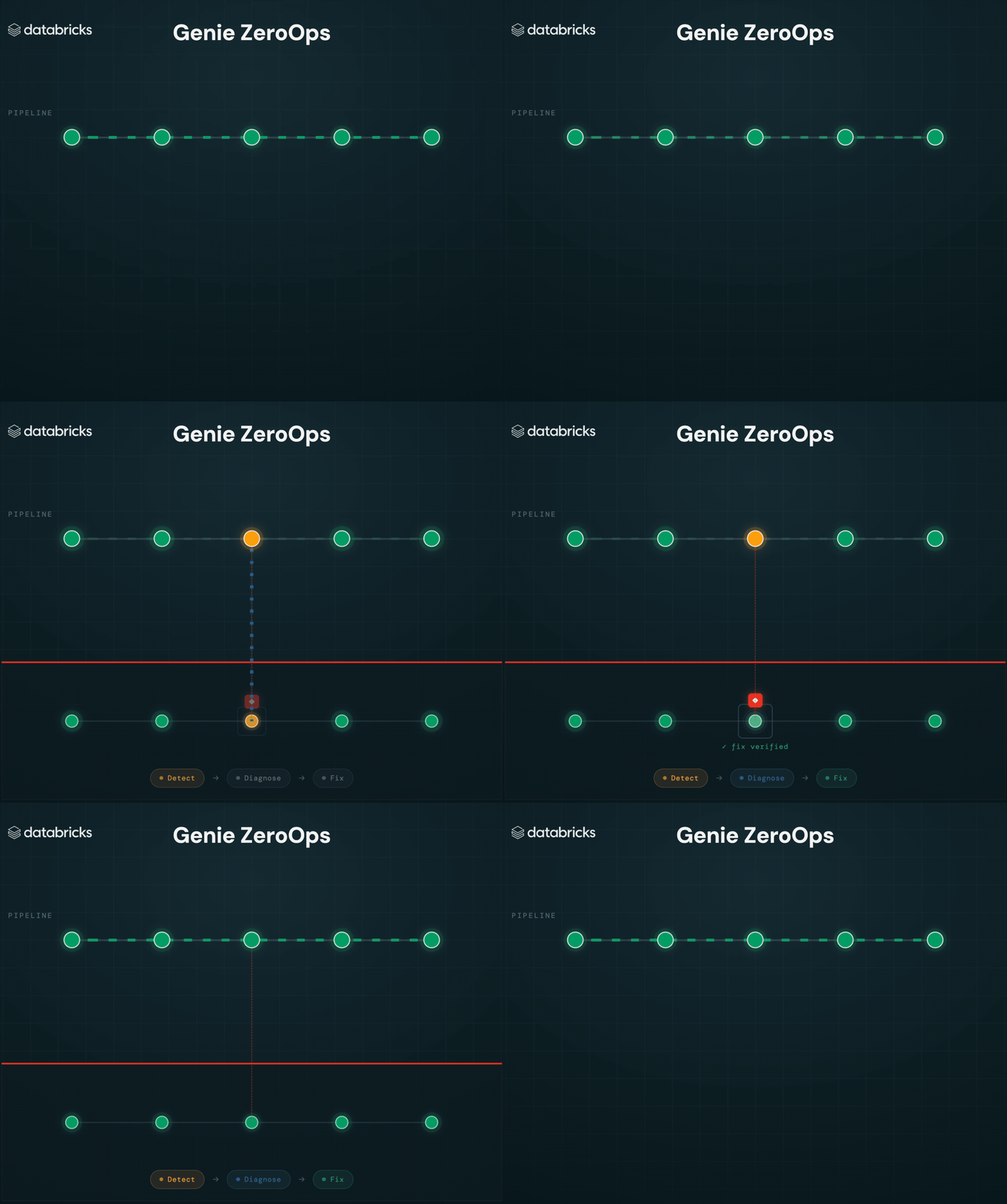
Genie ZeroOps is the agent on the other end. It continuously monitors in the background, investigates issues as they emerge, and proposes fixes for an engineer to review. So maintenance becomes something the platform handles with your team, not something your team handles alone at 3am.
Why this matters to startups
Large companies often have dedicated platform teams with several engineers on a support rotation. At a startup, maintenance duty usually lands on the same engineer who is supposed to ship a critical feature this week, and being on-call around the clock burns out the people you can least afford to lose. Most startups run production pipelines long before they can justify a platform team, so every hour of maintenance comes straight out of the building budget.
The stakes for a startup are higher than maintenance costs alone: a broken dataset or dashboard isn’t just an internal inconvenience, it’s often the product a customer is paying for.
The usual answer is to invest in more observability: custom dashboards, alert rules, runbooks, a dedicated on-call rotation, and often a separate monitoring vendor to evaluate, integrate, and pay for. Each of those is a project, and a startup has no spare projects. Worse, the need grows with every pipeline you add, while the team typically doesn’t.
If your pipelines already run on Databricks, this changes the math, because the health signal and the maintenance agent live in the platform you’re already using. For a small team, that means:
- Nothing new to adopt. No vendor evaluation, no integration project, no agent to deploy and babysit. Health and ZeroOps show up in the same workspace where your jobs already run, governed by the permissions you’ve already set.
- No observability stack to build. Health rolls up the signals that matter per job, in the UI the team already uses. Nobody maintains a dashboard of dashboards.
- A quieter on-call. ZeroOps watches continuously, investigates in its own sandbox, and has a proposed fix waiting for review instead of a page waiting for a human.
- Maintenance that doesn’t scale with headcount. Ten pipelines or a hundred, the watching and the first pass at diagnosis are the platform’s job, not a growing slice of every engineer’s week.
- No black box in production. Fixes arrive as reviewable changes through the team’s normal review flow, so adopting the agent doesn’t mean handing it the keys.
How it works
The two pieces work together. Lakeflow Jobs health rolls multiple signals into a single per-job status, surfaced in the workspace Job UI. Genie ZeroOps is the autonomous agent that acts on it: it monitors that status alongside other signals, including direct events such as previous job failures and data-quality anomalies, as well as upstream changes that quietly degrade pipelines over time.
They also draw on orchestration, compute, and governance metadata that already live in one platform, rather than being assembled from external monitors, custom alert rules, and glue code that a team has to build and maintain.
Understanding the full picture
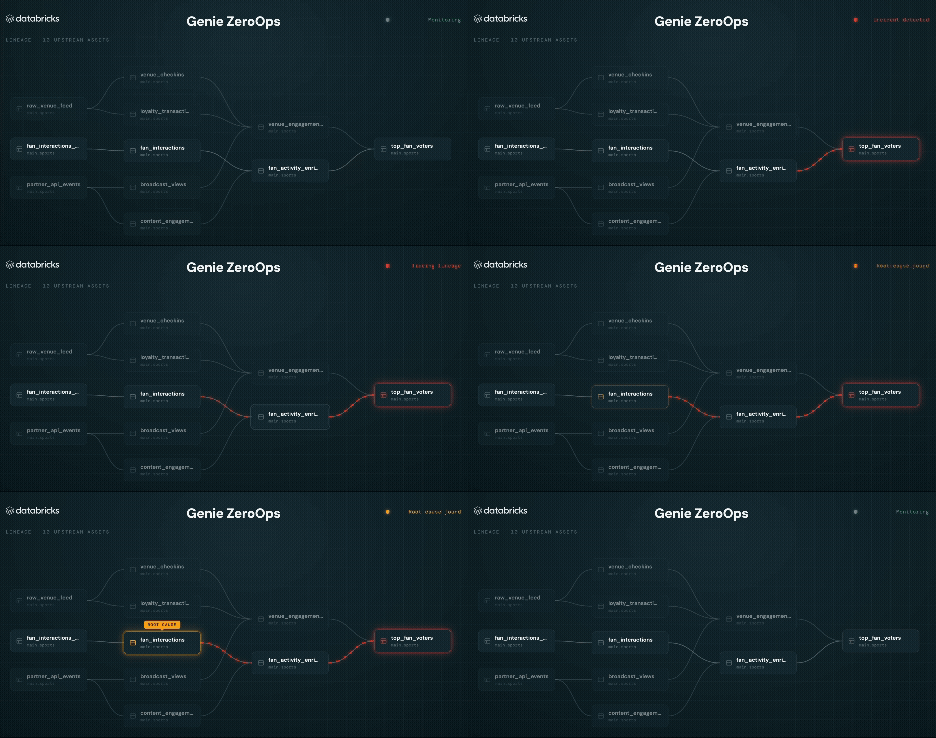
Because every asset’s dependencies are already mapped in Unity Catalog, the agent can walk the dependency graph to separate the task that actually broke from the downstream tasks that merely inherited the failure.
That same graph lets it classify why a job failed or is at risk of failing, rather than firing off a separate alert for every symptom. The root cause could be:
- A code bug
- An upstream schema change
- Bad data arriving from another pipeline
The aim is to act on early signals, such as a slowdown, late-arriving data, or a runtime nearing end-of-support, rather than waiting for the failure they predict. Some of those signals are silent. A job can succeed while the data it produces quietly degrades, showing up in data quality metrics long before anything throws an error.
An agent watching continuously can pick up patterns that no engineer scanning a dashboard has time to catch.
The agent works in its own sandbox
The obvious fear with an agent touching your pipelines is that it touches the wrong thing or makes a breaking change to a production table. Genie ZeroOps protects against this in a few ways:
- It has governed read access to what it needs to diagnose a problem and write access only to its own sandbox environment, so it can’t read or touch anything outside of its boundaries.
- Production data and catalogs are not directly mutated by an investigating agent.
To validate a fix against realistic data, ZeroOps shallow-clones the data it needs into that sandbox. A shallow clone references the underlying data without copying it, so the agent gets production-realistic data to test against with no duplicated storage and no risk to the real tables.
Humans stay in the loop
Speed to remediation is critical, but you don’t want changes to production pipelines to go untracked or lack proper CI/CD controls. In order to make this capability truly production-ready, the agent follows a consistent lifecycle:
- Continuously monitor in the background
- Detect the issue
- Assess the root cause through lineage
- Generate a fix, using the team’s existing workflow (GitHub PRs, Jira tickets) as context, so the change aligns with the conventions the codebase already follows.
- Verify it in the sandbox before proposing anything
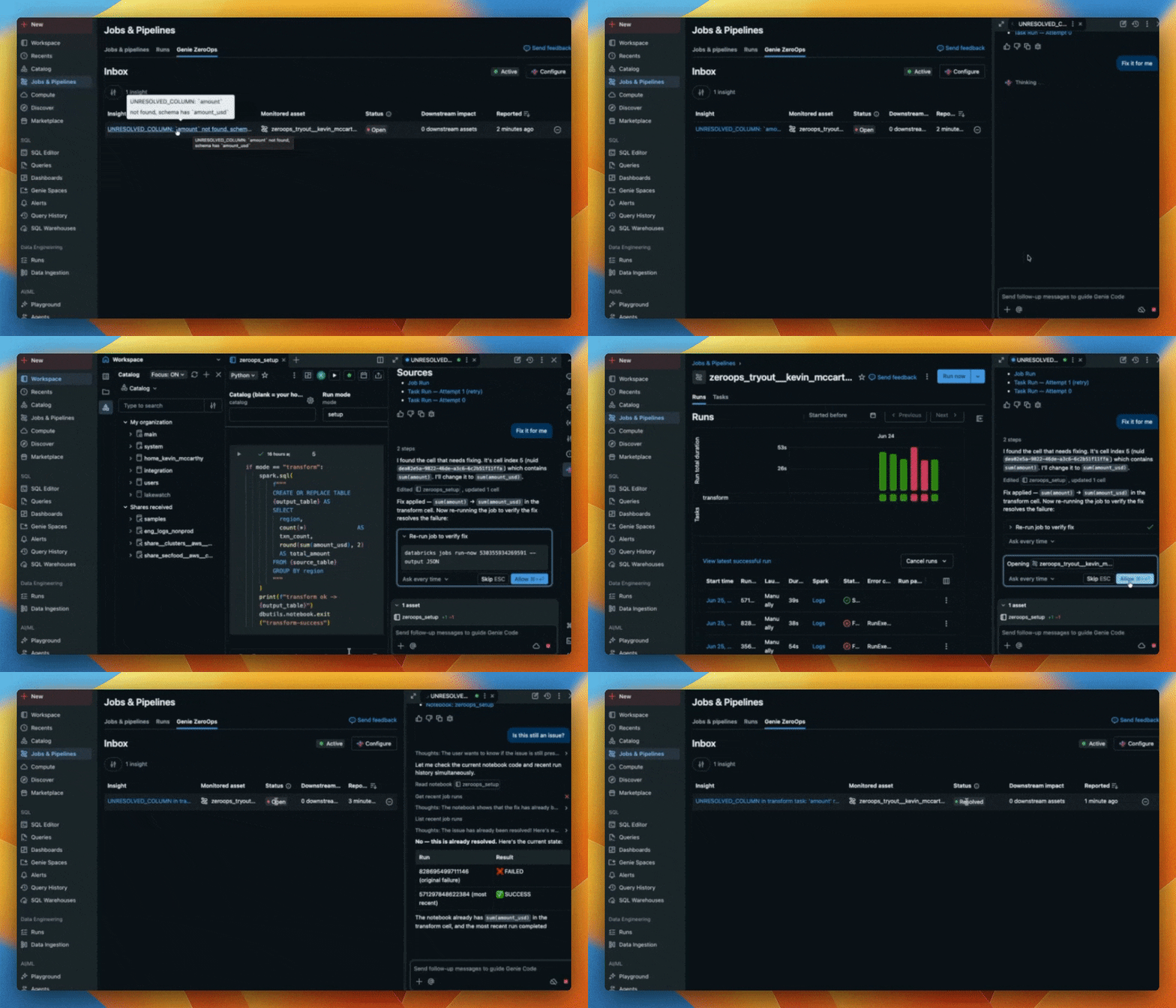
What lands in front of an engineer is an inbox-style queue, prioritized by severity, where each item includes its root cause analysis and a proposed fix.
Recommended changes are published for review and released to production through the same review and CI/CD practices that a team already trusts. Nothing is applied to production without approval. Autonomy applies to the investigation, not to unattended changes in production.
Where to start
Your pipelines already generate the signals that matter; what has been missing is a consolidated way to read them and an agent ready to act on them.
Lakeflow Jobs health is in private preview, and Genie ZeroOps is entering private preview soon. If you’re interested in trying it in your workspace, your Databricks account team would love to hear from you. Check out the announcement demo from DAIS 2026, the official announcement blog post, the blog post on agentic data engineering, and documentation for Genie and data engineering on Databricks.
The next time a job starts to slip, you won’t need to wake up at 3am and investigate scattered logs to see what went wrong. ZeroOps already flagged it, investigated it, and had a fix ready for review. Your team sleeps soundly, and the workday goes toward building rather than firefighting.
The Databricks for Startups Field Engineering team works closely with founders and engineers working on ambitious ideas. We love connecting on scalable architecture, data platforms, and the real challenges of bringing data and AI systems into production.
Working on something interesting? We’d be happy to compare notes and see where we can help. Email us at ask_startups@databricks.com or reach out on LinkedIn.
메타데이터
- post_id
- e76ec0a2e673
- slug
- the-signals-before-the-failure-proactive-pipeline-maintenance-with-genie-zeroops-e76ec0a2e673
- url
- https://blog.databricksforstartups.com/the-signals-before-the-failure-proactive-pipeline-maintenance-with-genie-zeroops-e76ec0a2e673
- canonical_url
- https://blog.databricksforstartups.com/the-signals-before-the-failure-proactive-pipeline-maintenance-with-genie-zeroops-e76ec0a2e673
- author_url
- https://medium.com/@kevin.mccarthy-databricks
- status
- ok
- fetched_at
- 2026-08-18 03:56:49