Modern marketing leaders (CMO or otherwise) must think like ‘revenue builders’ — because marketing…
I’ve stopped thinking of marketing as a team that “runs campaigns.” I think of it as the system that creates, shapes, and accelerates…
Modern marketing leaders (CMO or otherwise) must think like ‘revenue builders’ — because marketing is no longer “a function”, it’s an operating system
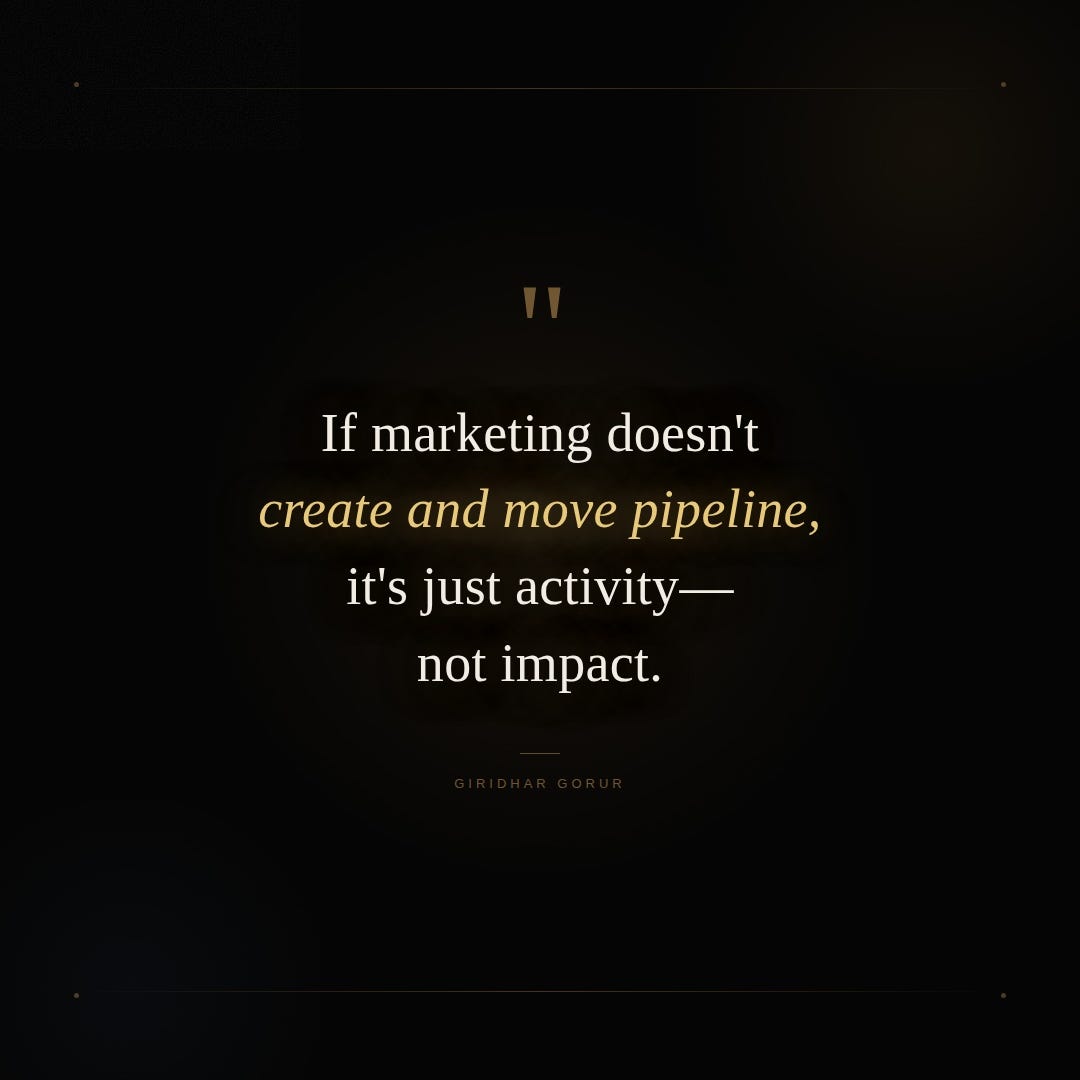
I’ve stopped thinking of marketing as a team that “runs campaigns.” I think of it as the system that creates, shapes, and accelerates revenue — or it becomes expensive activity dressed up as progress.
In B2B — especially industrial — growth rarely fails because the brand story is weak. It fails because the revenue engine is leaky: the wrong accounts, the wrong handoffs, the wrong cadences, the wrong incentives, and dashboards that celebrate motion instead of outcomes.
So, when I say marketing leaders need to think like revenue builders, I mean something very practical:
1) Builders don’t “launch.” They run adoption, velocity, and conversion.
A campaign going live is not an outcome. An event being executed is not an outcome. A whitepaper being published is not an outcome.
The outcome is whether it moved a real account to the next stage — whether it created a Sales Accepted Lead, an opportunity, or accelerated an in-flight deal.
That’s why I like to structure marketing around pipeline acceleration and conversion-ABM, funnel optimization, and rigorous qualification — not top-of-funnel noise.
2) Builders don’t report “influence.” They accept ownership.
The comfort zone for marketing is “pipeline influenced.” The operator stance is pipeline created, pipeline progressed, pipeline won.
In our own planning, we’ve already spoken about making the shift tangible — which is, building visibility for Opportunity Pipeline generated by Marketing and separating what’s “out of market” vs. what’s “in market.”
That distinction matters because it forces a hard question:
Are we funding awareness… or are we funding revenue?
And then it gets even sharper when you put stakes on it, like tracking MQL → SAL → Opportunity, and even setting a baseline like “% of SALs converted to opportunity pipeline.”
3) Builders obsess over handoffs — because that’s where revenue dies.
Most B2B teams don’t have a marketing problem. They have a handoff problem.
You can feel it in the day-to-day: leads come in, requirements vary wildly, and the system breaks now the buyer becomes “sales owned.” That’s exactly why I spend time in weekly cadences with SDR motions — reviewing lead patterns, refining outreach cadence, identifying why some conversations convert and others don’t.
That’s operator behaviour:
- diagnose friction,
- tighten the loop,
- remove blockers,
- and iterate fast.
4) Builders run marketing with constraints, not fantasies.
One of the most operator-like things a marketing leader can do is treat spend like capital allocation — not like an annual entitlement.
When we review budgets, we’re not just asking “what do we want to do?” We’re asking: what have we done by region, what is planned, what is spending, what is the likely overrun, and what do we cut or stop.
That’s not “marketing admin.” That’s running the business.
5) Builders design repeatable systems, not one-off heroics.
In IMEA, we’ve been explicit about the mechanisms that make marketing operational:
- ABM targeted to priority verticals,
- shared KPIs and pipeline review sessions with sales,
- and funnel optimization with clear conversion accountability.
And when we look ahead, the priorities remain operator-shaped: accelerating revenue marketing through CPL / SEM / BANT-led motions, not just brand activity.
The uncomfortable truth: Marketing is judged like an operating function now.
Not by how good the work looks. But by whether it produces predictable growth.
So my own internal test has become simple:
- If I removed three campaigns, would pipeline change?
- If I removed two events, would pipeline change?
- If I can’t answer those, I don’t have a marketing plan — I have a calendar.
메타데이터
- post_id
- e792efa5ba2f
- slug
- modern-marketing-leaders-cmo-or-otherwise-must-think-like-revenue-builders-because-marketing-e792efa5ba2f
- url
- https://medium.com/@raisom/modern-marketing-leaders-cmo-or-otherwise-must-think-like-revenue-builders-because-marketing-e792efa5ba2f
- canonical_url
- https://medium.com/@raisom/modern-marketing-leaders-cmo-or-otherwise-must-think-like-revenue-builders-because-marketing-e792efa5ba2f
- author_url
- https://medium.com/@raisom
- status
- ok
- fetched_at
- 2026-06-10 08:17:25



