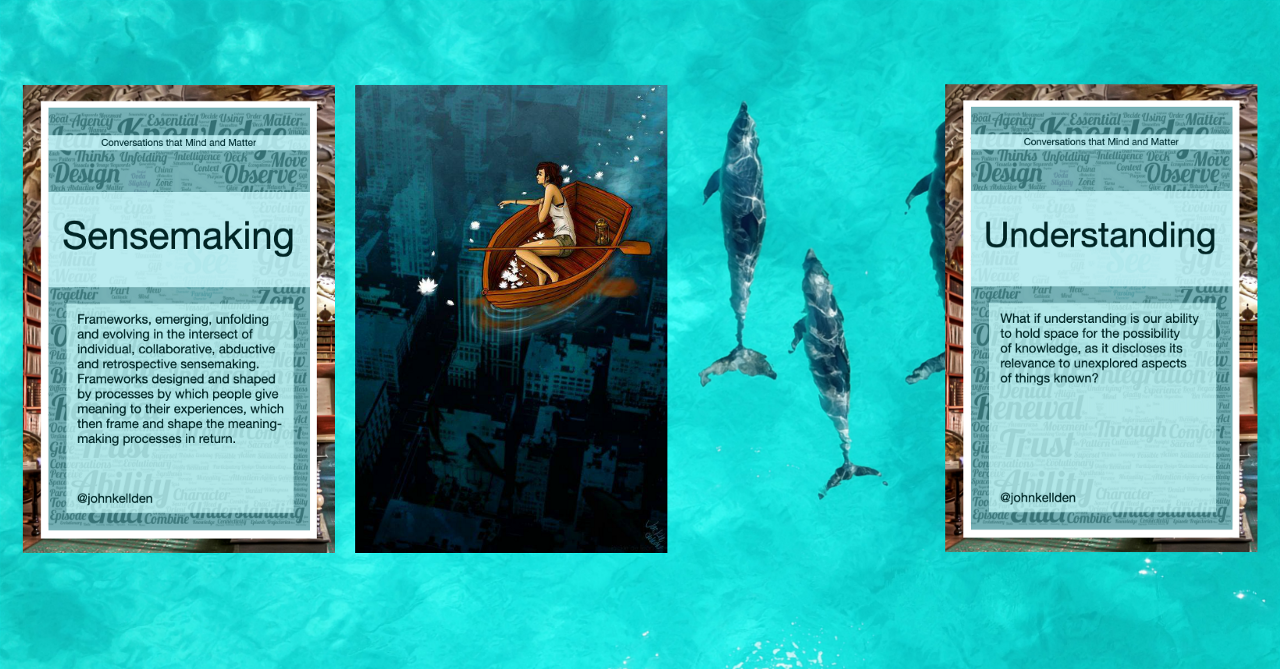
Playⁿ: Surfacing Understanding
From Tacit Knowing to Shared Understanding, and from What We Learn to Recursion Capital
Playⁿ: Surfacing Understanding
From Tacit Knowing to Shared Understanding,
and from What We Learn to Recursion Capital
In one paragraph
Surfacing makes what matters available to shared attention; Understanding creates room for it to become important; and intelligent return allows what proves worthwhile to unfold, evolve and compound into understanding, shared understanding, meaningful agency and Recursion Capital.
Playⁿ in a few sentences
Playⁿ does not promise to solve a wicked problem. It cultivates conditions in which a problem can become a worthwhile dilemma, and a worthwhile dilemma can become a Generative Center Question around which people inquire together.
Cards, cards-in-play, perspectives, conversation, human–AI metalogue, notes, shards and small different moves help participants surface what matters, cultivate shared understanding and discover what might be worth doing next.
small different moves; surface what matters
What proves valuable need not disappear when the session ends: it can be retained, returned, related differently and brought back into play. Over time, that recursive play and movement can turn conversations into learning, learning into patterned intelligence and understanding into increased capacity for what happens next.
Golden Thread
Before we can understand something together, something has to become available to us together. What proves worth understanding can become worth returning to; and what returns into a changed, playable field can enter new relations, revisit and deepen shared understanding and increase what becomes possible next.
Throughline
As a generative sequence:
surface → understand → retain → return → relate → pattern → act → learn → resurface ↺
Small different moves through a changing field as one of the ways understanding becomes agency, memory becomes playable, and return becomes Recursion Capital.
Playⁿ: Simplicity Beyond Complexity
In a world filled with endless data and messy challenges, we often get lost in details. Organizations build massive databases to record every meeting note, yet they still struggle to find real wisdom.
“The only simplicity to be trusted is the simplicity to be found on the far side of complexity” — Alfred North Whitehead
Neither trust, nor true clarity comes from gathering more facts. Instead, it comes from a deeper kind of order that Alfred North Whitehead called simplicity beyond complexity. This simplicity is not basic or shallow. It is a hard-won clarity achieved after we look deeply into complexity and rediscover its center, its beating heart.
The rest of this post is complex, challenging, demanding. This is both deliberate and by design. If I were to change the concision of the introduction, or remove all the modular essayistic postscripts, I would rob you of a worthwhile dilemma:
Reading in order to understand.
The practice of Playⁿ helps individuals and groups build trust through small different moves and re-discover a newfound clarity through a mix of cards, questions, generative play, meaningful structures, and deep loops of learning.
Generative play is the act of exploring open-ended possibilities without rushing to final judgments. When people face complex dilemmas, they often try to solve them too quickly, forcing artificial order onto a wild, messy, yet also meaningful and worthwhile problem.
Reading is a complex, worthwhile dilemma.
Playⁿ uses a deck of cards to slow things down. Each card serves as a simple visual invitation, an interactive anchor that simplifies reality without losing its meaning. By gathering around questions playing these cards, participants engage in a meaning-making, meaningful process akin to semiotic exploration.
The cards display half-formed ideas, small signs, and quiet patterns, turning vast abstractions into tangible items that people can move, discuss, and rearrange on a table. This shared focus allows hidden insights to surface naturally, creating an open space where insight can emerge and understanding can grow.
in a network, the best place to store knowledge is in other people
This process shifts into recursive systemic play when these insights loop back into our work over time. Knowledge should never be stored away in a stagnant archive like an old checklist. Instead, system loops must allow our past experiences to return and meet our current realities.
When we loop back to an old observation, it meets a changed environment. We bring new eyes, fresh insights, other participants, new questions and different constraints to the table. This continuous circulation prevents repetition, ensuring that old lessons evolve into fresh capacities.
cards-in-play as recursion capital affordances
The group learns from its own historical movements, transforming basic information into a living form of wealth known as recursion capital.

Recursion Capital, one of the 504 cards in the Playⁿ Source Deck.
Card: Recursion Capital Recursion Capital is what is worth returning to without becoming fixed: generativity turned accumulated capacity kept coherent enough to guide renewed inquiry and open enough to be transformed by the next encounter.
It begins very small. Someone notices something, a card helps it surface and another participant sees it differently. Through cards-in-play, the group finds language for what has appeared, and one idea, thought, observation, insight or sentence seems worth keeping. A note is made. Later, someone returns to it, and it becomes a shard.
The shard enters another card session, another conversation around another worthwhile dilemma. Something previously tacit, hidden or latent becomes visible. It acquires context, another relation, then another, until a pattern appears.
This fluid approach aligns closely with Karen Barad’s philosophy of meeting ourselves, others, the world, and the universe halfway.
Knowledge is not an object that a detached mind captures and locks away. Knowing is an active relationship. We do not sit outside the system looking in; we are tangled up within it. When a group gathers together around a dilemma, they participate in an ongoing dialogue with their environment, tools, and shared histories. Every small choice and every small different movechanges the field of play. By embracing this entanglement, we discover that our ideas help shape and provide meaning to the very reality we are trying to understand.
every small choice and every small different move changes the field of play
At the end of this journey, we capture insights, create seed stories and bring back other meaningful lessons from the shared card sessions.
This post, Playⁿ: Surfacing Understanding shows that the deeper unit of Playⁿ is not the card, the note, the shard, the repository, or even the insight. It is the playable memory: something surfaced, understood enough, kept with clear purpose, responsive to small different moves and later returned to a changed field where people can use it to build what they could not see before, what they could not understand alone.
When we treat our experiences as fluid threads to be re-woven rather than efforts and performances to be stored, we uncover and unlock sustainable forms of intelligence, connection and wealth. We free our attention from the churn of platforms and social media soundbite , focusing instead on what is worth returning to. Through cycles of discovery, play, insight,return, and change, we step past information overwhelm and attention scarcity and welcome a profound, actionable simplicity.
Beneath the Main Text
The postscripts follow the deeper movement underneath this simple sequence: cards as finite invitations; Surfacing and Understanding as a recursive pair; Notes becoming Shards; knowledge becoming playable memory; bounded forms entering open relations; conversation becoming inquiry; intelligence becoming ability and response-ability; patterns becoming revisable rather than canonical; and the notions of RSSSSP, MPOE, the Currencies and the CKR forming an ecology through which previous learning can return without merely repeating.
What compounds is not certainty, but the field’s capacity to bring together, notice, relate, reconsider, act, let go and understand.
A Glimpse of a Card Session
Four participants gather around a worthwhile dilemma:
How do we keep what we learn from becoming something we merely store?

Surfacing, one of the 504 cards in the Playⁿ Source Deck.
Card: Surfacing Surfacing is our ability to bring tacit impressions, half-formed ideas and weak signals into shared attention without forcing them prematurely into explanation or agreement.
A Surfacing card prompts one person to mention a recurring frustration she has never quite named: the group produces excellent insights, but too many disappear into meeting notes.
Understanding changes the conversation; another participant suggests that perhaps the problem is not capture but the lack of space for previous knowledge to encounter new circumstances.
Recursion Capital lands beside the first two cards, and a third participant says,
“Then the asset isn’t the note. It’s whether the note can become useful again.”
Someone else connects this with Structural, Process, Knowledge and Innovation Capital and wonders whether each becomes more valuable when it can combine and participate in the others.
Before the session closes, the group chooses one small different move: select a few notes from today, turn them into a shard and a seed story, and choose to bring them into their next inquiry beside a different card.
They leave without a final answer, but with a new understanding of what questions, cards and cards-in-play can be used for.
Surfacing Understanding
There is a simple idea underneath much of Playⁿ:
Before we can understand something together, something has to become available to us together, available in ways to help us resurface our thoughts.
Much of what people know is not immediately available in language. We sense things before we can name them. We notice that something in a conversation matters before knowing why. We recognize patterns before we can explain them. We carry thoughts, experiences, assumptions, metaphors, doubts, unspoken questions, unexpected associations and half-formed possibilities that influence what we do, without yet having entered shared attention or become part of meaningful, meaning-making interaction, conversation and participation.
A group almost always knows more than it can immediately say. At the same time, a group can say far more than it actually knows.
Surfacing matters in the space between those two conditions.
Surfacing, one of the 504 cards in the Playⁿ Source Deck.
Card: Surfacing Surfacing is our ability to bring tacit impressions, half-formed ideas and weak signals into shared attention without forcing them prematurely into explanation or agreement.
It is not merely disclosure, and it is not synonymous with brainstorming, extraction or the production of more information. Surfacing is the practice of making something sufficiently present that it can participate in inquiry. What surfaces does not have to arrive as a polished statement.
It may appear as a: question, contradiction, analogy, insight, phrase, image, generative listening, silence, weak signal, suspension of suspicion as primary mindset, trust, new sense of direction, analogy or one reflection that someone believes needs to be shared for the common good.
The first task is rarely to establish whether any of the above is true, it is much more to do with letting it appear. Precisely at this moment, this occasion, is where understanding begins its work.
The Understanding card moves understanding away from the image of a mind successfully acquiring an object called knowledge.

Understanding, one of the 504 cards in the Playⁿ Source Deck.
Card: Understanding Understanding is our ability to create and cultivate space for knowledge as it emerges, unfolds, directs, and reshapes our perspectives on the known, the adjacent possible and the unknown.
Understanding, in this sense, does not describe possession. It describes capacity: the ability to create, enact and cultivate conditions in which knowledge can emerge, evolve, respond to difference and reshape what participants are capable of perceiving.
Something surfaces. We make room for it. Another perspective alters it. Language gives it provisional form. Practice exposes it to consequence. Information introduces another difference. Knowledge provides context. An option becomes visible. Someone makes a small different move. The insights, small different moves and paths surface and unfold. Understanding changes.
Then the recursive play and movement can begin again. This makes Surfacing and Understanding a recursive pair.
Surfacing without Understanding can become exposure, extraction or information overload. Understanding without Surfacing can remain constrained by what the field already knows how to articulate.
Together, they allow the latent to become available and the available to become relational. Once something has become both meaningful and meaning-making, another question appears:
What is worth carrying forward?
From Understanding to Return
A useful, meaningful, convivial and purposeful conversation produces more than a transcript. Someone notices a distinction. Another person finds language for it. A previously hidden assumption becomes visible. A question improves. A practice becomes questionable. A possibility appears. A small different move seems worth trying.
A diagram becomes a Generativity Engine
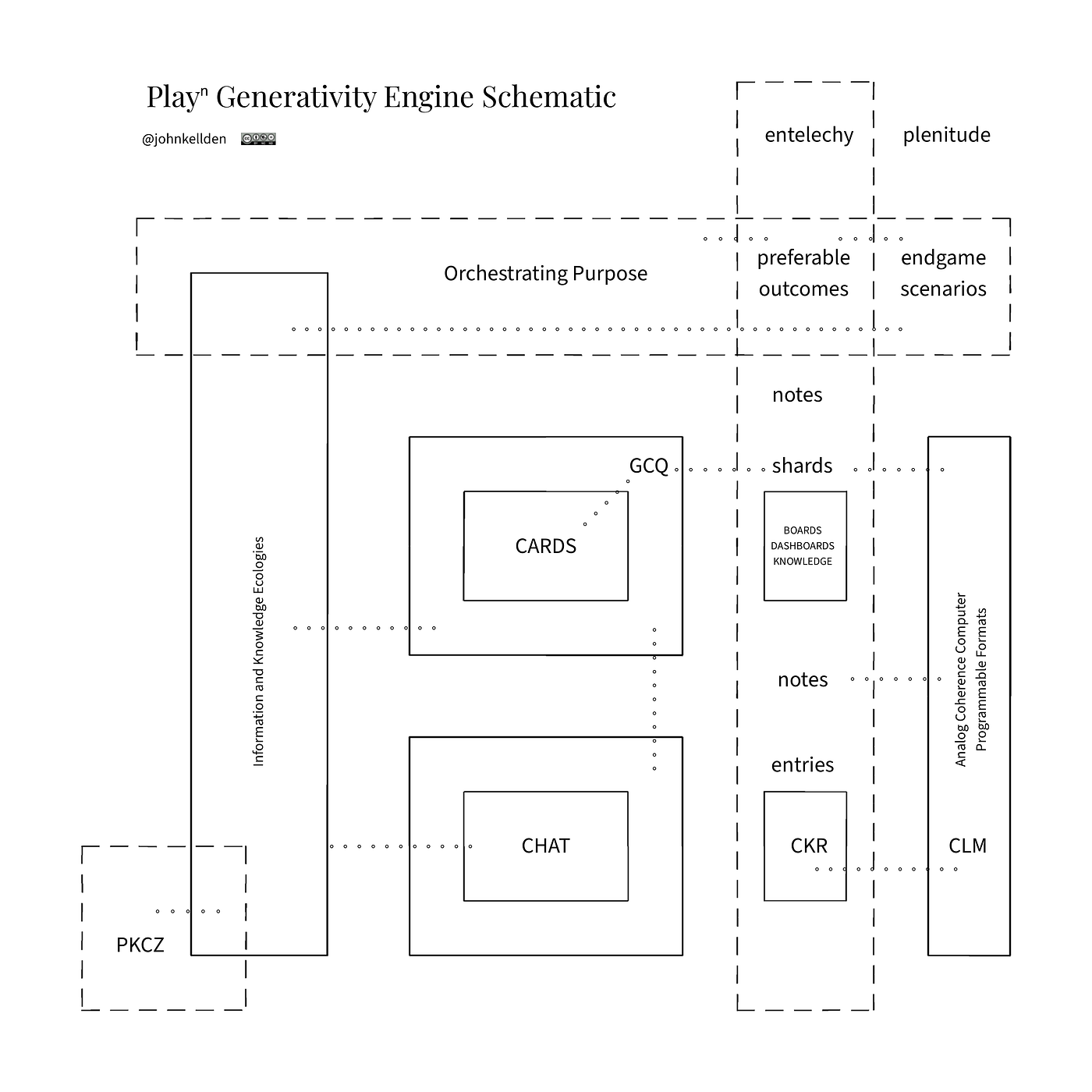
The Generativity Engine: one of the Playⁿ diagrams
Surfacing → Understanding → Retain → Return → Renewed Surfacing ↺
Surfacing makes differences, thoughts and possibilities available to the field. Cards, conversation and GCQs bring what surfaces into relation; Notes, Shards and the CKR retain what proves worth returning to. When retained learning is distributed through chat as signal fields and then re-enters and re-weaves lines of inquiry, it meets a changed field, so return becomes renewed surfacing rather than repetition.
Not everything needs to be captured.
That qualification matters more as the production and storage of information become easier.
Information can become abundant while attention becomes scarce. Notes can multiply while memory becomes less navigable. An organization can retain almost everything said to it and still become less capable of recognizing what matters.
Playⁿ introduces a modest counter-move:
Capture what is worth returning to.
A note can mark that something happened. A shard makes a stronger claim: something happened here that may deserve another turn.
The distinction is not principally one of file type, interface, protocol or platform. It is an act of discernment. A sentence becomes a shard because someone recognizes further generative potential in it. It may preserve an unresolved tension, name an important pattern, carry an unusually useful distinction, point toward a leverage point, hold the seed of a practice or simply avoid premature closure.
A card can catalyze cards-in-play, what then through a shard or seed story, becomes a small unit of generative return.
Let’s explore this through a quote and as a generative sequence:
“Intelligence is quickness to apprehend as distinct from ability, which is capacity to act wisely on the thing apprehended.” ― Alfred North Whitehead
- churn and cope
- intelligence and muddling through
- contextual and conversational intelligence (using language in meaningful, meaning- making ways, including chat)
- ability, reflecting a good enough assemblage of the previous three stages
- ability to wisely wield what has been intelligently apprehended
- response-ability
- ability to cultivate generative return
Alfred North Whitehead’s insight is a shard that has over time gained enough cultural currency to become “a quote”.
When something returns, it need not return unchanged. When encountering and then embracing an occasion, we can choose to meet ourselves, others, the world and the universe — halfway.
“Meeting the universe halfway.”
- — Karen Barad*
Finding ourselves at a different place, we can place the same note beside another worthwhile dilemma, another card, another participant or another moment and something latent can then become visible. Someone else may recognize a relation the original author could not see. A second note turned shard can become more significant and meaningful. Repeated moves, insights and cards-in-play can disclose, refine and evolve a pattern. The pattern can inform a practice, that then changes how we enact and act. Enaction and action evolves with purposes, goals and goal achievement. Achievement can yield preferable outcome, and provide new experience.
The movement has evolved, beyond: conversation → storage
To: conversation → note → shard → return → relation → pattern → shared understanding → action → experience → renewed surfacing ↺
Leading us to a possibility of compounding return. Feedback leading to something preferable, something worthwhile.
Recursion Capital
Recursion Capital names something present and implied in Playⁿ.
Recursion Capital, one of the 504 cards in the Playⁿ Source Deck.
Card: Recursion Capital Recursion Capital is what is worth returning to without becoming fixed: generativity turned accumulated capacity kept coherent enough to guide renewed inquiry and open enough to be transformed by the next encounter.
It begins very small. Someone notices something, a card helps it surface and another participant sees it differently. Through cards-in-play, the group finds language for what has appeared, and one idea, thought, observation, insight or sentence seems worth keeping. A note is made. Later, someone returns to it, and it becomes a shard.
The shard enters another card session, another conversation around another worthwhile dilemma. Something previously tacit, hidden or latent becomes visible. It acquires context, another relation, then another, until a pattern appears.
That pattern allows someone to recognize a situation earlier.
A practice changes. A small different move becomes possible. Its consequences return as experience, and the group comes to understand something it could not have understood when the original note was written.
Nothing magical has happened. Something has compounded. The important point is that what compounds goes beyond certainty.
Capacity, Intelligence, Ability and Generative Return
What compounds is capacity. Capacity to notice and distinguish. Capacity to rehearse, remember, forget and wisely wield. Capacity to relate, question, reconsider, participate and act. Capacity to make better use of what has already been learned, while recognizing when earlier knowledge no longer applies. Capacity, finally, to understand and to understand together.
Over time and across card sessions, intelligence can become ability, ability can deepen into response-ability, and response-ability can increase our capacity to become more intelligent, able, proactive and responsive to what experience is teaching us.
This gives capital an unusual meaning. The unit of Recursion Capital is not information, and not even knowledge. It is generative return: the capacity of something previously learned to return at a meaningful moment, enter a new level, situation or relation, and participate in creating what could not have been known before.
One way of tracing that development is through a seven-fold generative sequence:
1. churn and cope
2. intelligence and muddling through
3. contextual and conversational intelligence using language in meaningful and meaning-making ways, including chat
4. ability a good-enough assemblage of what the previous three movements have made possible
5. ability to wisely wield what has been intelligently apprehended
6. response-ability
7. ability to cultivate generative return
The sequence is not a ladder that leaves its earlier stages behind. Churn, cope, and muddling through are not immature conditions to eliminate; they remain part of the requisite repertoire. The other levels, conversation, judgment, ability and response-ability remain available to and within later forms of capability. What advances is the range, fluency, discernment and recombinability of capacities available to the participant or group.
What changes is the repertoire: participants become increasingly able to discern which capacities a situation calls for, how they might be applied and combined, and what from previous experience can be reused.
A note or shard is therefore not valuable only because it survived or became widely distributed. A knowledge graph is not valuable only because it grew. Nor is a system intelligent because it has been built, functions reliably and provides an impressive set of capabilities. The deeper questions around intelligence always revolve around what those structures, processes, flows and systems allow people, groups, networks and societies to notice, participate, share, learn, understand, distribute and do. In a word: culture:
Culture as the generative review of what is valuable.
Capacity and How Things Advance
Intelligence advances through ability, response-ability and, eventually, the ability to cultivate generative return.
Individual participants advance by extending the repertoire of sensemaking, meaningful and meaning-making heuristics, practices and moves through which they can enact and act with increasing fluency and generative judgment.
Groups advance by cultivating and extending designs, shared affordances, heuristics, Patterns of Playⁿ and small different moves in light of, and in service to, small group genius.
Whitehead’s observation is relevant here:
“Civilization advances by extending the number of important operations which we can perform without thinking of them.” — Alfred North Whitehead
The point is not to make thought unnecessary. It is to allow previously hard-won learning to become available as capacity, freeing attention for what remains unfamiliar, uncertain or newly consequential.
The generative review resides in the evolving combinations of thinks, things and gatherings that allow people to gather, notice, play, participate, understand, enact, act and do — and, through recursive return, to become capable of doing differently when the field changes.
To sum up — in light of individual and collective advances — the range, fluency, discernment and recombinability of capacities available to the participant or group, including the ability to respond to this:
What from this moment is worth returning to?
Recursion Capital and Intellectual Capital
Select parts of the above becomes meaningful to apply, as Recursion Capital is placed beside the discipline and field of Intellectual Capital.
For Playⁿ purposes, we can distinguish four mutually entangled forms:
Structural Capital includes the relatively durable forms through which collective capability becomes available: tools, platforms, cards, diagrams, repositories, language, architectures, protocols and other enabling structures.
Process Capital resides in ways of moving: inquiry, conversation, collaboration, card-play, surfacing, curation, experimentation, feedback, reflection, return and the repeatable practices through which work becomes possible.
Knowledge Capital includes distinctions, perspectives, expertise, patterns, questions, practices, remembered experience and shared understandings that have acquired usable significance.
Innovation Capital concerns the capacity to create adjacent possibilities: new combinations, experiments, interpretations, relationships, offerings, practices and small different moves that can alter what becomes possible next.
Recursion Capital is useful precisely because it need not be confined to becoming a fifth notion alongside these four. It can be understood instead as a recursive capacity moving among them.
Structural Capital compounds when structures make previous learning easier to reactivate rather than merely easier to store.
Process Capital compounds when previous process experience changes the way future processes are designed and enacted.
Knowledge Capital compounds when knowledge can be reframed, re-purposed, recontextualized, recombined, challenged and applied rather than being something accumulated only.
Innovation Capital compounds when previous learning encounters new situations and participates in producing possibilities that neither the old learning nor the new situation could have generated alone.
The relation between them is therefore less like four containers and more like a living ecology.
Generativity Engine — Recursion Capital & Recursive Capital
The Generativity Engine: one of the Playⁿ diagrams
Recursion Capital Recursion Capital compounds when what has been learned can return and increase what the field is capable of noticing, understanding and doing.
Structural Capital provides enabling forms and infrastructures; Process Capital provides movements and practices; Knowledge Capital carries distinctions, Notes, Shards, patterns and memory; Innovation Capital opens new combinations, possibilities and preferable outcomes.
The generativity engine schematic with its dotted lines of meaningful connectivity and transformation, combined with the particular flows and currencies — the Recursive Capital is the circulation among them — the capacity of each schematic, each dotted line, each form of capital to reactivate, reshape and increase the generative value of the others.
Structure makes processes possible. Processes generate and transform knowledge. Knowledge informs innovation. Innovation alters structures and processes. Experience returns. The cycle continues.
Recursion Capital names some of the capacity that accumulates because the movement can learn from its own previous movement.
Dotted Lines, Recursive Capital and Currencies
An engine is not only its visible components. There’s also its dotted lines, as an illustration of how it runs, and its “hum”.

Dotted Lines, one of the Playⁿ tables
Dotted Lines — Recursive Capital The dotted lines show where capital can become recursive. Value does not travel linearly from one component to another: structures shape processes, processes generate knowledge, knowledge enables innovation, innovation reshapes structures, and experience returns through the whole information and knowledge ecology. When those entanglements, patterns and crossings add context, relation, learning or agency, Recursive Capital is in motion; Recursion Capital is what can compound through repeated, intelligent return.
Recursive Capital = the capacity to circulate, return and recombine. Recursion Capital = the capacity that compounds because we can.
In Playⁿ, one way of sensing the hum, the particular recursive capital flowing through which dotted lines, is through a requisite variety of currencies:
Attention → Relevance → Trust → Time → Participation → Agency → Return → Knowledge → Coherence → Contribution → Generativity
These should not be mistaken for a compulsory funnel. They name different forms of value circulating through a living, evolving field.
Attention is not yet relevance. Relevance may earn time. Time can make deeper participation possible. Participation can increase agency. Agency enables meaningful return. Return allows learning to compound. Knowledge can strengthen coherence. Coherence can support contribution. Contribution can generate new conditions for generativity.
The movement can also stall, reverse and recur. A useful question:
Which currency needs to move next for our central uncertainty to decrease?
A group may possess excellent Structural Capital yet lack trust. It may possess extensive Knowledge Capital but insufficient return. It may possess Innovation Capital in the form of abundant ideas but lack the agency required to try anything. It may have mature processes that no longer generate relevance. It may have captured everything while creating little coherence.
The dotted lines and the currencies provide a different way to discern whether intellectual resources are alive inside a field.
Recursion Capital grows not because every currency increases simultaneously, but because participants become better able to notice which movement matters now and in the near future.
The Main Card Session
The four participants return a week later with a more demanding worthwhile dilemma at the center of the table:
How might our Intellectual Capital become more capable of generating what we need next, rather than merely preserving what we already know?
They begin with four cards representing the distinctions they have been using informally: Structure, Process, Knowledge and Innovation. A fifth card, Surfacing, is placed in the center.
At first the conversation behaves in a predictable manner. One participant sees Structural Capital as the foundation: without places to store material, ways to retrieve it, shared language and durable tools, too much collective intelligence disappears. Another pushes back. Their organization already has data and information software, platforms, repositorie and taxonomies. The problem, she says, is not structural scarcity but structural abundance.
“We have somewhere to put almost everything. We don’t have a good enough way to know what deserves another encounter.”
That sentence slows the participants. Someone writes it down.
The Process card moves closer to Surfacing.
A third participant notices that their most successful project reviews have always involved people returning to previous decisions and asking what they can now see that they could not see at the time. The practice was never formally designed, but it repeatedly generated insight. He says:
“So, maybe that is Process Capital. Not the checklist. The capacity to repeat a meaningful movement while still allowing each repetition to change.”
Understanding is drawn. The discussion shifts again.
One participant had assumed Knowledge Capital referreed to what the organization knows. Now she wonders whether it is better described as what can be brought into a sufficiently useful relation with the present situation.
The group distinguishes: having knowledge
from: having access to the relevance of knowledge.
They place Return beside Knowledge. The next card is Recursion Capital. For a few moments, nobody speaks.
Then one participant returns to the sentence captured earlier:
We have somewhere to put almost everything. We don’t have a good enough way to know what deserves another encounter.
He and the others notice the phrase now seems different. Ten minutes earlier it sounded like a criticism of their repository, now it sounds like a design principle.
The group begins exploring Recursion Capital not as another stock of intellectual property, but as the ability of Structural, Process, Knowledge and Innovation Capital to enter productive relation.
Structural Capital gives something somewhere to persist. Process Capital gives it ways to move. Knowledge Capital gives it contextual significance. Innovation Capital gives it opportunities to become otherwise.
Recursion Capital allows previous value to re-enter this circulation.
They place the Currencies beside the emerging arrangement. The question becomes less abstract:
Which currency is currently preventing their Intellectual Capital from becoming recursively useful?
One person says: Attention: people cannot notice what is hidden, avoided or buried.
Another adds: Relevance: search already works reasonably well, but retrieval rarely tells someone why this might matter now.
A third suggests: Trust: people often hesitate to expose incomplete ideas because the culture mostly rewards finished answers.
The fourth shares only one word: Return.
That one stays on the table. They realize that their system has been designed around capture and retrieval, whereas a recurring human practice of deliberate return has not yet been tried or cultivated.
The distinction creates a different possibility:
What if every important knowledge artifact does not need better indexing?
Perhaps some artifacts need return invitations?
A note capturing a significant insight and the turned into a shard could carry not only what was learned but a question such as:
Under what circumstances would this become worthwhile again?
A practice might carry: What would tell us that this pattern no longer holds?
A decision might retain: What did we not know when we made this choice?
A project closure might ask: What available to us here and now, could increase another group’s capacity rather than simply inform them?
Innovation Capital now enters the conversation differently. Instead of of treating innovation as the production of novel ideas, the participants begin to see some innovation as the result of older knowledge returning into sufficiently and significantly different relations.
A forgotten observation beside a new constraint. A previous failure beside a new technology. A shard from one team beside a dilemma in another. An old question beside someone not present when it was first asked.
What returns is not merely reused. It can be recomposed. Someone moves the Innovation card beside Perspectives. Another places Trust beside Surfacing.
Surfacing Different Conditions The group notices that new possibilities depend on what people are willing to make available before those possibilities are obvious. Innovation Capital therefore relies partly on conditions that allow weak signals, unfinished thoughts and uncertain interpretations to surface without being prematurely evaluated. Surfacing.
The field is changing. What began as a conversation about assets and intellectual capital has become an inquiry into intellectual circulation.
The participants understanding of capital itself has shifted. They no longer see the four forms primarily as inventories. They see them as capacities that can enable one another:
- structure supporting process;
- process activating knowledge;
- knowledge opening innovation;
- knowledge flow augmenting innovation;
- innovation modifying structure;
- experience returning through all four.
flow = structure x process
“x” = patterned intelligence applied to surfacing different conditions
Recursion Capital appearing increasingly less like an additional resource and more like a quality of the relations among resources across time.
The group moves toward Generative Closure. They do not try to settle the concept completely. Instead, they surface three things worth carrying forward.
The first is a provisional shared understanding:
Intellectual Capital becomes more generative when what has been learned can return, in context, into new relations that increase the field’s capacity to notice, understand and act.
The second is a small different move. For the next month, every major session will conclude by creating at most one shard carrying two questions:
Why might this be worth returning to?
Under what changed circumstances should we meet it again?
The third is an unresolved question:
Can we design for generative return without turning return into another compulsory workflow?
Nobody wants to answer that yet, which makes it all the more worth preserving.
Card Session: Generative Closure The group has surfaced something, understood enough to act, captured what deserves return and deliberately left room for the next encounter to change what they think they know. A generative closure. And also their first session and deliberate act of cultivating Recursion Capital.
Generative Closure
Surfacing begins with a small change of mindset, a small different move sourced from curiosity and confusion transformed into an act of creativity toward what is not yet fully formed. Something is noticed and allowed to appear; another perspective alters it, language gives it provisional form, and Understanding creates enough relational space for what has surfaced to embrace perspectives and creatively encounter difference without the need for premature explanation, control, agreement or closure.
Some of what is explored will prove transient and can be released. Some of the insights emerging in a session deserves a note. A smaller part can become a shard: not simply something retained, but something carrying enough generative potential to justify another encounter. This is where discernment becomes part of the practice.
Not everything needs to be captured, and not everything captured needs to be kept forever.
Remembering matters, and so does forgetting wisely.
Then time passes and circumstances change.
When a shard returns, it does not return to the field from which it came. It encounters people who have learned something since, questions that may have shifted, new cards, changed conditions, different purposes and perhaps another worthwhile dilemma altogether. What used to appear as an insight may now function as something different: a sign, a pattern, a warning, a question, a leverage point or the seed of a small different move.
This is a feature, not a bug. These differences need not be seen as obstacles or inconveniences to recursion. They are where much of its value resides.
Return, in this sense, is goes beyond repetition. It is an opportunity for recontextualization. A previous pattern may become questionable; a forgotten possibility may become timely; language that once clarified may now obscure; a practice may reveal itself as a leverage point, while another may need to be released. An old question can become better than the answer it once produced.
This is why Recursion Capital cannot mean accumulating more and more unquestioned knowledge. Its deeper value lies in cultivating generative return, returnable, revisable capacity: the ability of previous learning to re-enter different circumstances, enact new situations and participate in creating what could not have been known when it was first retained.
That recursive capacity can move through a great many of the different forms of Intellectual Capital. Structural Capital becomes more alive when structures support reactivation rather than storage alone. Process Capital compounds when practices can learn from their own previous enactment.
Knowledge Capital deepens when what is known remains available to reconsideration, recombination and renewed use. Innovation Capital strengthens when earlier learning encounters sufficiently different conditions to help create possibilities that neither the old knowledge nor the new situation could have generated alone.
Recursion Capital is more than a fifth compartment. It can connect them and move through them as a quality of their relations across time.
The CKR and knowledge graph acquire their deeper significance here as well. Their value is not simply that they remember. Their value lies in becoming playable memory: enabling an earlier question, insight, distinction, shard, pattern or move to become newly available when present circumstances make it meaningful again.
And because every field has finite attention, time and capacity, the question should not be confined inside: What else should we know?
Sometimes a more meaningful question is which kind of recursive, generative movement is needed now.
More relevance? More trust? More time? Deeper participation? Greater agency? Return? Coherence? Contribution?
The Currencies offer one way to listen for that changing hum.
Surfacing and Understanding remain the recursive pair underneath all of this. Surfacing makes the latent available; Understanding makes the available relational. What becomes understood changes what the field can subsequently notice. What subsequently surfaces can change and build further on what was previously understood. A move shifts the paths, the situation, the context and the conditions, provisional outcomes return as experience, and the changed field becomes capable of perceiving something that the earlier field could not.
In this way, knowledge begins to participate recursively in its own further formation. The practical questions remain simple:
What does what we have retained allow us to notice, understand and do now?
And: What from this moment is worth returning to?
A third question can be added right next to them: What should we allow to change, or let go, before it returns?
These are not questions for preserving the past intact. They are questions for increasing the field’s capacity to participate wisely in what happens next.
Surface what matters.
Create room to understand it.
Capture what deserves return.
Let go of what no longer serves.
Return without merely repeating.
Let difference create relation.
Let relations reveal patterns.
Let patterns remain revisable.
Let understanding increase agency.
Let agency make small different moves possible.
Let action change the field.
And let the changed field surface what none of us could have seen before. Repeated intelligently, this becomes patterned intelligence. Shared across time, it becomes playable memory and a living knowledge graph.
Recursively cultivated, it becomes Recursion Capital.
And wisely wielded — with enough discernment to know what to retain, what to reconsider, what to release and which currency needs to move next — it may become one of the conditions through which cards-in-play, understanding and shared understanding grows into response-ability, and response-ability into sociological wisdom.
Postscript I: Five Ways of Surfacing
The relationship between Surfacing and Understanding can be unfolded through a small family of cards. They do not describe five compulsory stages, nor do they need to be played sequentially. Their value lies in making several distinct movements available to a group depending on what the participants, the field, the inquiry and the moment require.
Card: Surfacing Surfacing is our ability to bring tacit impressions, half-formed ideas and weak signals into shared attention without forcing them prematurely into explanation or agreement.
This first card concerns emergence into shared attention. Something previously tacit becomes sufficiently present to participate in inquiry, without being required to arrive already explained or resolved.
A second Surfacing card shifts attention from emergence to relation:
Card: Surfacing Surfacing is our ability to make relations among observations, perspectives, language and practices visible enough to be noticed, questioned and connected across fields.
Here, what matters is no longer only that something has appeared, but that relations among what has appeared can themselves become available. An observation may connect with a perspective; language may reveal something about a practice; a distinction made in one field may unexpectedly illuminate another.
A third card introduces pattern:
Card: Surfacing Surfacing is our ability to anneal what becomes visible into provisional patterns that improve knowledge flow, reveal insight and strengthen our capacity to notice what will matter next.
Patterns remain provisional rather than final. Their purpose is not to close inquiry, but to increase the field’s capacity to recognize recurring relations, make distinctions earlier and notice what might otherwise remain latent.
A fourth Surfacing card makes return part of the practice:
Card: Surfacing Surfacing is our ability to return emerging patterns to the field as prompts, shards, options and small different moves, in light of preferable outcomes and in service to sociological wisdom.
What has surfaced and acquired enough significance need not remain behind in the session where it first appeared. It can return as a prompt, shard, option or possible move, entering another situation and another relation.
The fifth card introduces discernment:
Card: Surfacing Surfacing is our ability to discern what appeared from what is worth carrying forward, allowing attention, memory and discernment to curate what then becomes part of shared understanding.
Together, the cards suggest a generative movement:
bring forth → relate → pattern → return → retain
Yet this remains a grammar for Playⁿ rather than a procedural pipeline. One group may begin by asking what deserves retaining. Another may discover that something apparently settled needs to be surfaced again. A third may realize that what has appeared has not yet acquired enough connection, reflection or context to become understandable.
Surfacing is therefore not only the beginning of inquiry. It is a recursive capacity available throughout it.
Postscript II: A Calibrated Constellation
Surfacing and Understanding become more useful when surrounded by a constellation of cards that differentiate the field without pretending to represent the whole of it. Each introduces a finite distinction, while cards-in-play allow those distinctions to become relational.
Field names the relational space in which attention, perspectives, language, practices and possibilities meet. Meaningful agency emerges not from any one element in isolation, but through what participants notice, connect, try and sustain together.
Perspectives remind us that differently situated ways of seeing reveal some things while concealing others. Gathering perspectives therefore need not mean averaging them into agreement. Their differences can increase the requisite variety of inquiry and make the field more adequate to what it is encountering.
Language gives provisional form to experience. It makes something nameable, shareable, questionable and revisable, while simultaneously shaping what participants may become capable of noticing next.
Practices turn attention and intention into repeatable situated action. Tools and technologies can extend those practices, but judgment remains necessary in deciding how, when and toward what ends they should be used.
Options become visible when differences, constraints, capacities and consequences are sufficiently available for participants to imagine more than one possible way forward.
Path Unfoldment allows purposeful direction to emerge through small different moves rather than requiring the entire path to be known in advance. Acting, noticing, learning and adjusting become part of discovering the path.
Systems Intelligence Leverage Points direct attention toward places where a small, well-situated intervention can alter a relationship, pattern or flow without requiring impossible control of the system as a whole.
Intelligence becomes practically significant when apprehension becomes judgment, ability and response-ability.
Behavior gives visible form to the meeting of habits, conditions, interpretations, constraints and intentions.
Agency names our capacity to participate meaningfully in what happens next.
Information is difference made available to attention, while Knowledge is information that has acquired context, relation and usable significance while remaining open to revision.
Generativity concerns the cultivation of the adjacent possible: creating conditions in which relations can further thinking, dialogue, practice and possibility.
Generative Sequence describes an unfolding of small, different and mutually supporting moves in which each step can strengthen what matters while creating improved conditions for what may follow.
Generative Closure, finally, names a provisional moment when enough shared understanding has formed to capture what matters, choose a next move and continue without pretending that inquiry itself is finished.
Underneath the entire constellation is RSSSSP: the recursive movement through which these finite distinctions become relational as cards-in-play.
Postscript III: Information Is Not Yet Knowledge
The distinction between Information and Knowledge becomes more meaningful under conditions of platformed, frictionless information production. A card surfaces something; someone creates a note; an AI generates a summary; a meeting produces a transcript; an online service stores the resulting material. None of these, by themselves, guarantee knowledge.
A meaningful shorthand is:
Information becomes available. Knowledge becomes situated. Understanding becomes relationally meaningful, contextually generative and situationally responsive.
Information provides difference. Knowledge places that difference in context, relating it to experience, interpretation, purpose and possible action. Understanding creates enough room for knowledge to encounter uncertainty, perspective and possibility and, through it all, to change what participants become capable of perceiving.
This is why the statement not everything needs to be captured is more than an aesthetic preference. A healthy knowledge practice is selective. Discernment is part of cognition, and forgetting can be functional.
At individual scale, indiscriminate note-taking can create archives that are rarely revisited. At organizational scale, the same tendency results in repositories whose abundance can make relevant knowledge harder rather than easier to find. At larger scale, indiscriminate capture entails computation, storage, energy and infrastructures partly devoted to retaining things nobody has yet judged worth remembering.
Playⁿ therefore introduces a modest but significant counter-move:
capture what is worth returning to.
Postscript IV: Notes, Shards and Generative Return
A note says, in effect: Something happened here.
A shard makes a a different claim: Something happened here that may deserve another encounter.
The distinction is not principally one of file format, interface, database status or platform behavior. It is an act of valuation. Something becomes shard-like because someone, or eventually some group, recognizes further generative potential in it.
A shard may name a pattern, preserve an unresolved tension, give new form and useful language to something difficult to articulate, expose an assumption, point toward a leverage point or protect a worthwhile question from premature closure. Its significance is not exhausted at the moment of capture.
Generative Return Indeed, its value can change through use. Returned beside a new dilemma, a shard may reveal something more. Encountered by another participant, it may disclose something its original author could not see. Joined with another shard, it may reveal a relation; repeated relations may disclose a pattern; and a pattern, in turn, may become a practice.
This is why generative return differs from mere persistence. The important questions gradually shift from: What did we record?
toward: What have we found worth returning to?
and eventually: What has become more valuable because we returned to it?
Questions that lead toward Recursion Capital.
Postscript V: Cards as Finite Invitations
A Playⁿ card is not an answer. It is a finite invitation into attention, situational awareness and contextual, conversational intelligence.
Its boundedness is part of its usefulness because a card does not attempt to represent the whole situation. Instead, it introduces a temporary center around which perception, conversation and possible action can reorganize.
Surfacing asks what is becoming visible. Perspectives ask who can see what from where. Language asks which words are shaping what can be thought. Practices ask what we repeatedly do. Options ask what else might happen. Path Unfoldment asks which small move might teach us something worth knowing.
Placed alone, each card remains finite. Placed beside another card, a worthwhile dilemma, a participant, a different line of inquiry, an image, a diagram or an unfolding conversation, its meaning becomes relational.
Meaning happens partly between: between card and question, one card and another, one participant and another; between what was said and what remained tacit; between thought, sign and present circumstance; between one session and the next; between understanding and action; and between a note when an insight is first captured and the different thing it may become when returned later as a shard.
Cards-in-play can therefore become future affordances: relational instruments for organizing attention without determining in advance where attention must go or what participation must eventually produce.
Postscript VI: Bounded Forms, Open Meaning
The boundedness of the 504-card Source Deck can be understood as generative rather than merely formal. Each card is finite, and the deck itself is finite, yet cards-in-play continually encounter worthwhile dilemmas, situations, participants, questions, moves, diagrams, notes, shards, previous sessions and changing contexts.
The combinatorial possibility therefore exceeds both card design and deck mathematics. The same pair of cards can become newly meaningful when encountered by a different participant, in a different system state, beside a different diagram, around a different question or after a different path has already begun to unfold.
The bounded form provides enough continuity for recognition, while changing relations provide enough difference for emergence.
That relationship is central to the idea of bounded infinity. Finite symbolic forms can create conditions for unbounded generative, relational and recursive play, precisely because their meaning is neither entirely fixed inside them nor arbitrarily free from them.
Postscript VII: Conversation as the Medium
Card sessions are not principally exercises in interpreting cards. They are cards-in-play conversations.
The cards perturb; participants respond. Differences surface, sign use evolves, language forms and perspectives encounter one another. Patterns appear. Assumptions become available for examination. Options multiply or narrow. Someone recognizes a leverage point, while someone else proposes a small different move.
Sometimes an insight deserves capture in a note. Sometimes a sentence becomes worth keeping as a shard. Later, that note or shard can return beside another card, another participant or another worthwhile dilemma, and the combination changes what it means.
At that point, the participants, the card session, the field and the network have begun to learn.
No single conversation has to do everything. One session can surface, another can differentiate, and another can test. Some sessions can remember and reconnect; others may reveal that an earlier insight or understanding no longer holds. A later gathering may retrieve an overlooked insight or reflection whose relevance could not have been recognized until the circumstances changed.
A recursive knowledge practice does not require every session to reach completeness. It gives worthwhile incompleteness somewhere to return.
Postscript VIII: Behavior, Agency, Paths and Leverage
Behavior can occur with little reflection, while agency requires some capacity to participate in what happens next. Someone reacts. Then someone notices the reaction, recognizes a pattern, perceives another possibility and makes a small different move. Agency has increased.
Agency is not merely an individual property. It can be enabled, expanded or constrained by language, interfaces, cultural technologies, perspectives, practices, tools, other people and the quality of the questions available to a group. A timely Generative Center Question can increase it. So can an insight, a remembered shard, an enabling constraint, a shift from confusion toward curiosity, a different mindset or a newly visible adjacent possibility.
Several transformations become related:
Behavior → Agency
Information → Knowledge
Intelligence → Ability → Response-ability
In each case, something merely available or occurring becomes something participants can wield more purposefully.
This is where Playⁿ becomes intensely practical. Understanding and shared understanding eventually encounter a family of questions:
What might we do? What could we do? What should we do?
Options can precede paths, and paths can precede certainty. Path Unfoldment offers an alternative to both paralysis and premature action: make a small different move that matters enough to teach us something, notice the consequences, update understanding and continue.
Systems Intelligence introduces another distinction. Not all moves intervene at the same depth. Some change an event; others alter a relationship, information flow, incentive, possibility of participation or even the language through which the situation itself is interpreted.
This is also one place where the Playⁿ equation becomes useful:
flow = structure × process
with:
“×” = patterned intelligence
A leverage point can begin as a meaningful moment of recognition. Encountered repeatedly and across different situations, it can develop into a pattern and eventually become part of patterned intelligence.
Postscript IX: Generativity, Sequence and Closure
Generativity is not equivalent to producing endless novelty. It concerns the cultivation of conditions from which worthwhile novelty can emerge.
The adjacent possible often cannot be designed completely in advance. It has to become possible through a better question, a clearer distinction, a new relationship, a useful tool, a small act of trust, a surfaced idea, an unexpected agreement or disagreement, a card, a boundary or a change in the conditions through which people can participate.
The notion of Generative Sequence gives form to that movement. The individual moves are not merely meaningful in isolation; they prepare conditions for one another.
We can reflect on the contrast between: destroy → replace
and: notice → strengthen → differentiate → connect → try → learn → return → continue
Without return, sequence can remain largely linear. With return, sequence becomes capable of learning from itself.
Generative Closure then introduces an apparent paradox. How can a generative practice close? By distinguishing closure from finality.
Generative Closure does not say: We now know.
It says something closer to: We understand enough, together, to recognize what is worth carrying forward.
That may be an insight, a small different move, a question, a changed perspective, an idea, an option, a practice, a move, a leverage point, a purposeful path, a preferable outcome or a seed story whose significance has not yet fully unfolded.
Shared understanding need not mean that everyone thinks the same thing. It means enough relational coherence has formed for, among and between the participants to recognize what they have learned together and what they have become capable of doing that they could not do before.
Closure becomes memory. Memory becomes material for renewed play. What appeared as the end, becomes a possible beginning.
Postscript X: RSSSSP — The Engine Underneath
Card: RSSSSP Recursive Systemic Semiotic Sympoietic Symbolic Play. The engine of the Source Deck: the continuous looping of symbolic play and interaction that braids questions, cards-in-play conversations and complex patterns into a system of shared understanding.
RSSSSP is not merely another card among 504. The card names something the deck itself performs.
The recursive dimension means that what emerges can return and participate again. The systemic dimension means relations and patterns matter at least as much as isolated elements. The semiotic dimension means images, diagrams, metaphors, signs, sign-use, language and interpretation participate actively in what becomes possible. The sympoietic dimension means that understanding is made-with rather than produced by an isolated component. The symbolic dimension means finite forms can carry, provoke and reorganize meaning beyond themselves.
And play preserves variation, possibility and provisionality.
RSSSSP therefore names both an engine and a pattern of participation. A card combination can meet a different question, worthwhile dilemma, participant, group, moment, shard, system state or path already taken. The same bounded symbolic forms can thereby become meaningful and meaning-making without becoming arbitrary.
There is continuity enough for recognition, difference enough for emergence and generative return enough for evolution.
Postscript XI: The MPOE Understory
Beneath this recursive engine lies a philosophical and operational understory: a Modular Process Onto-Epistemology.
The phrase may sound abstract, yet its practical intuition is relatively simple: what things are, how we know them and what they may become cannot always be separated cleanly from the relations and processes through which they emerge.
A card is one thing alone and something else as a card-in-play. A note or shard can mean one thing when first captured and something more, less or different when returned later. A participant enters a conversation with one perspective, while participation introduces other perspectives and can change the one with which that participant arrived.
The field itself is modified by what participants notice and do.
Knowledge is therefore not simply transferred into an unchanged container. Knowing changes the knower; the knower changes the field; and the changed field alters what can subsequently become knowable.
The architecture benefits from modularity for the same reason. Cards can recombine. Questions can change. Notes can become shards. Shards can form patterns. Patterns can enter a CKR. Different spheroid, spiraling lines of inquiry can trace different pathways through a knowledge graph and activate different possibilities for meaning-making.
No single monolithic representation has to carry the whole.
This also offers one way of reading the dotted lines in Playⁿ diagrams. They need not signify uncertainty alone. They can indicate potential relation, permeability, latent pathways, unfinished transitions and connections that have not yet hardened into predetermined chains.
The Playⁿ engine has a hum, a generative hum inside a coherent field.
Postscript XII: The Hum and the Currencies
The Currencies provide one way of sensing the operating state of the field:
Attention → Relevance → Trust → Time → Participation → Agency → Return → Knowledge → Coherence → Contribution → Generativity
They should not be understood as a single compulsory progression. They describe different forms of value that can move, stall, recur and interact.
Sometimes the needed movement is more information. Sometimes it is trust. A group may need better language, another perspective or enough time for participation to deepen. It may already possess substantial knowledge yet lack agency, or have agency without sufficient coherence. It may have achieved coherence without contribution. Sometimes what matters most is simply return.
The guiding question remains:
Which currency needs to move next for the central uncertainty to decrease?
That question prevents the reflexive assumption that every difficulty is solved by adding more knowledge. The field may instead require greater relevance, stronger participation, more trust, another practice, a different structure or one carefully chosen small different move.
The currencies help us listen for the hum.
Postscript XIII: The CKR as Playable Memory
The CKR — the Curated Knowledge Repository — acquires a more specific meaning when viewed through Recursion Capital. It is not simply the destination of knowledge creation. It becomes part of the recursive apparatus through which knowledge can return to play.
A static repository asks: What did we save?
A playable CKR asks: What here might matter now?
A knowledge graph asks: What relation have we not yet noticed?
And a recursive inquiry graph can ask: What becomes possible when this previous insight, this present dilemma and this new perspective meet?
The CKR can therefore become a form of collective and longitudinal memory that retains more than conclusions. It can preserve traces of inquiry: questions, notes, shards, patterns, moves, consequences, alternative paths, meaningful distinctions, perspectives, leverage points and previous generative closures.
Its deeper value lies in both curation and reactivation.
A knowledge network can carry not only information, but previously cultivated capacity. What was once learned can become available for participation in a different inquiry.
That is one of the ways a CKR can contribute to Recursion Capital.
Postscript XIV: Compound Value Without Premature Canon
Anything called a knowledge repository can gradually become a canon. Anything called capital can invite indiscriminate accumulation. Anything called patterned intelligence can solidify into received wisdom.
A genuinely recursive system therefore needs a counter-movement.
What returns should not automatically be affirmed simply because it survived. An old shard can be contradicted. A pattern can lose relevance. A cherished practice can become maladaptive. A leverage point can move. A language distinction can begin obscuring what it once illuminated. A previous Generative Closure can reopen.
Recursion Capital is therefore not the accumulation of unquestioned correctness.
It is the cultivation of generative return, returnable, revisable capacity.
Compound value can arise because what has been retained remains both accessible and available to be recontextualized, recombined, challenged, tested, transformed, renewed — or forgotten. The quality of the capital rests as much upon what the field can release and what its participants can rehearse, as upon what it can retain.
This brings us back to two complementary principles: Not everything needs to be captured.
And: Not everything captured needs to be kept forever.
As a core generative seed of recursion: remembering, participating, wielding, moving and forgetting wisely.
Postscript XV: Surfacing and Understanding as a Recursive Pair
The deeper significance of Surfacing may reside in its relationship with Understanding. Surfacing makes the latent available. Understanding makes the available relational. Knowledge changes perspective, and changed perspective makes further surfacing possible. Further surfacing changes understanding again.
A possibility appears and a move is made. Its consequences enter the field. Something from the encounter becomes worth noting; a note may become a shard because it deserves return. The shard enters another inquiry and acquires another meaning. A relation appears, a pattern begins to form and the pattern influences action. Action changes the field, and the changed field can surface something that had previously remained invisible.
At that point, we are no longer describing knowledge flow alone.
We are describing knowledge becoming capable of recursively participating in its own further formation.
This is why Surfacing and Understanding are better understood as a recursive pair than as successive steps. Each changes the conditions under which the other can occur.
Postscript XVI: The Larger Playⁿ Movement
One way of understanding Playⁿ is to begin with a deceptively simple claim: the cards are not designed to solve a worthwhile dilemma. They are designed to make it more playable.
They gather attention, slow premature certainty and give insights and differences somewhere to appear. They help participants surface and name what matters, enable perspectives to encounter one another, allow information to acquire context, help intelligence become ability and create conditions in which behavior can become agency.
An insight can become a note. A note can become a shard: something worth returning to. Small different moves can trace lines of inquiry through which patterns become visible. Patterns can enter shared navigable memory, and that memory can return to inquiry.
Over time, the knowledge graph becomes less like a database of previous conversation and more like a living landscape of perspectives, language, practices, options, paths, leverage points, questions, memories, patterns, capabilities and moves available for renewed play.
dotted lines table
Playⁿ: Generative forces and recursive play building blocks RSSSSP keeps the landscape moving. MPOE provides part of its understory. Cards provide bounded symbolic forms. Dotted lines preserve relational openness. The generative engine supplies scaffolding. Currencies reveal the hum. Notes capture. Shards select and invite return. The CKR provides curation, knowledge and repository. The inquiry graph connects, traces and reconnects. The knowledge graph compounds.
And human participants continue playing and participating, enacting, determining and guiding what any of it is for.
Postscript XVII: Coda — Recursion Capital
Recursion Capital begins with someone noticing something. A card helps it surface, another person sees it differently, and the group discovers language for what has appeared. One sentence seems worth keeping, so a note is made. Later, someone returns to it, and it becomes a shard.
The shard encounters another card, another worthwhile dilemma and different people. Something previously latent in it becomes visible. It acquires another relation, then another, until a pattern begins to appear. The pattern helps someone recognize a situation earlier, a practice changes and a small different move becomes possible. Its consequences return as experience, and the group eventually understands something it could not have understood when the original sentence was written.
Nothing magical has happened.
Something has compounded.
RSSSSP names the recursive engine through which such compounding becomes possible. The 504-card Source Deck provides a bounded symbolic ecology, while the living relations among cards, participants, questions, sessions, circumstances and memories extend its possibility far beyond the deck itself. Beneath it lies a Modular Process Onto-Epistemology in which knowing, acting, relating and becoming remain entangled; around it are dotted lines and generative-engine schematics that scaffold potential relation rather than predetermined causality; and through it move currencies of attention, relevance, trust, time, participation, agency, return, knowledge, coherence, contribution and generativity.
Yet capital emerges especially through the movement between Notes and Shards, and between Shards and Notes. The reversal matters. A note can become a shard, while a returning shard can generate another note. One shard can illuminate another; a conversation can reorganize a pattern; and a pattern can reshape the question from which the next conversation emerges.
The movement traces a generative sequence:
conversation → note → shard → return → renewed conversation → relation → pattern → shared understanding → action → experience → renewed surfacing ↺
The CKR matters here not as a warehouse but as playable artifact. The inquiry graph remembers what was asked. The knowledge graph traces and remembers what remains worth knowing. The playable graph asks what the memories might become.
Their value need not remain only additive. A useful distinction discovered once may save time later. A shard repeatedly returned to can become a reliable pattern. A pattern encountered across groups can reveal a leverage point. A leverage point can become practice. Practice can increase agency. Greater agency can enable better moves. Better moves can produce better information. Information can reshape knowledge, and knowledge can deepen understanding.
Understanding, in turn, may reveal something entirely new that needs Surfacing. The capital has returned to the beginning, but this return is no longer the same. The field has changed, disclosing a central paradox of Recursion Capital:
What compounds is not certainty. What compounds is capacity.
Its deepest unit is therefore not information and not even knowledge. It is generative return: the capacity of something previously learned to return at a meaningful moment, enter a new relation and participate in creating what could not have been known before.
Two generative questions: What does what we have retained allow us to notice, understand and do now?
What from this moment is worth returning to?
Those two generative and recursive questions remain close to the heart of Playⁿ.
Playⁿ: A Beginning Practice Surface what matters. Create room to understand it. Capture what deserves return, then return beyond repeating. Let relations reveal patterns, patterns inform meaningful agency and action reshape the field. Then allow the changed, playable field to surface what none of us could see before.
Repeated intelligently, it becomes patterned intelligence. Shared over time, it becomes a living knowledge graph. Recursively cultivated, it becomes Recursion Capital. And wisely wielded as generativity and generative play, two conditions for sociological wisdom.
Postscript XVIII: John Kellden
Participate well. Sing out for yourself. Hold still for three seconds, long enough for the noospheric transception to land, while also remaining perfectly yourself if it does not, and let the rest unfold.
I am less interested in being right than in remaining responsive to what feels generative, meaningful and true, building further on what is already there while occasionally adding something new.
Card: Bounded Infinity The bounded infinity of the 504-card Source Deck is a finite symbolic grammar providing unbounded generative possibility.
Through the Modular Process Onto-Epistemology (MPOE), these finite symbolic elements (the cards) become vessels of recursive systemic semiotic sympoietic and symbolic play.
My work, centered on cards, large finite sets and bounded infinity, explores conscious evolution, cultural sensemaking and human–AI metalogue as practices of becoming rather than systems of certainty. I do not assume that understanding will be immediate or universal. I assume only that play, careful attention, small different moves and shared inquiry can make a difference over time.
If there is a personal throughline, it is this:
to participate, as best I can, in the ongoing experiment of human becoming.
Participation is also one of the 504 cards in the Playⁿ Source Deck:

Participation, one of the 504 cards in the Playⁿ Source Deck.
Card: Participation Participation is presence becoming consequential contribution. A participant affects what the field can notice and do, remains open to being affected, and shares responsibility for the conditions through which later participation becomes possible.
What remains will remain. The work is simply to participate well: living into our own questions, remaining responsive to what becomes possible and leaving concerns about lasting meaning and purpose to those who follow.
In the end, we add our own unique touch to a much larger canvas, meeting ourselves, others, the world and the universe halfway.
We made it? What happened? We happened.
John Kellden is a Swedish facilitator, storyteller and creator of Playⁿ, a card-based practice for navigating complexity through playful and structured inquiry. For more than two decades, he has developed and field-tested a 504-card Source Deck designed to catalyze perspective shifts, generative dialogue and new patterns of understanding in individuals and small groups.
At the core of the work is a simple practice: pick a card, make a move, notice what shifts, sing out for yourself, listen for what becomes possible and follow where the inquiry leads.
He continues to explore how play, storytelling and new practices can support conscious evolution and meaningful cultural change.
메타데이터
- post_id
- e7993bcd209f
- slug
- playⁿ-surfacing-understanding-e7993bcd209f
- url
- https://medium.com/@johnkellden/play%E2%81%BF-surfacing-understanding-e7993bcd209f
- canonical_url
- https://medium.com/@johnkellden/play%E2%81%BF-surfacing-understanding-e7993bcd209f
- author_url
- https://medium.com/@johnkellden
- status
- ok
- fetched_at
- 2026-08-25 12:43:18