Lokma to Dolma: From Home to Another Land
After Blessing With Lokma: Tasty Traditions in Izmir, I felt guilty for not writing more about lokma. I should also have talked about its…
Lokma to Dolma: From Home to Another Land
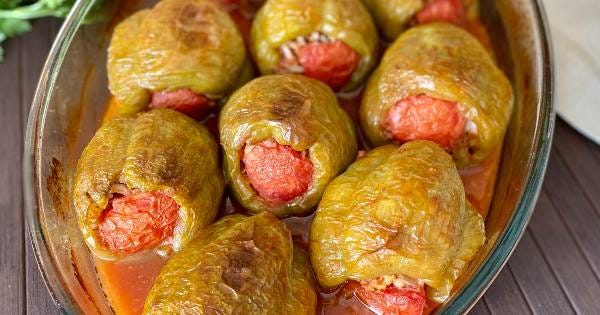
Yummy (I prefer stuffed peppers with olive oil, vegetarian version in oven)
After **Blessing With Lokma: Tasty Traditions in Izmir, **I felt guilty for not writing more about lokma. I should also have talked about its origin, its challenges, similarities to other treats, and perhaps shared a few memories involving other foods.
We can call it ‘morsel’, ‘bite’… It is smaller than a doughnut. Lokma really lives up to its name. Ideally we should consume it fresh and hot as soon as we see the lokma truck on the corner. We shouldn’t wait to eat it later. Otherwise, the crunchy exterior and sweet syrup simply won’t be the same.
When it comes the origin, there are discussions between Greece and Türkiye. But everything I’ve learned points to an Arabic origin. The earliest records date back to the 13th century in Arabic cookbooks as luqmat al-qādi, or “judge’s morsels,” from the Abbasid era. It later spread through the Ottoman Empire into our region and into Greece and Cyprus.
Since we are the neighbors and share so much — foods, culture, history — it’s only natural that lokma exists in both Turkish and Greek culinary traditions, even though its roots are Arabic. This kind of sharing isn’t unique to lokma; many of our foods have traveled and transformed across borders.
I found a ***charming video*** that captures this cultural exchange beautifully. You can’t hear the word “lokma” or “loukoumades,” but the joy of sharing these sweet bites is clear — proof that our past was intertwined in dishes, memories, and both good and bad times.
Then I remember the dolma / staffed vegetable that I ate in Armenia. The experience deeply moved me. Though the dish both had similarities and differencies. I am deeply sorry to not to find these images in my archive and I cannot even remember the small and quiet village’s name.
That encounter marked a pivotal moment in my journey. It was the first time I truly expanded my perspective, realizing that despite my belief in having a broad outlook, there was so much more to learn and appreciate. This opportunity arose through a short-term Eurodesk project around 2013, which unknowingly served as preparation for my future self in 2015.
In 2015, while in Greece, I had the opportunity to prepare Turkish dishes during my turn in the kitchen. This experience not only allowed me to share familiar flavors but also highlighted the remarkable similarities between Turkish and Greek cuisines.
Moreover, this exploration extended beyond Greece and Türkiye. I observed parallels with Spanish and Italian cuisines, the Mediterranean culinary tradition encompassing these diverse yet interconnected cuisines, reflects a rich tapestry of shared history and flavors. This journey underscored the beauty of culinary exchange and the unifying power of food, deepening my appreciation for the interconnectedness of cultures through their gastronomy.
For instance, I occasionally add cinnamon to my dolma, a personal touch that enhances its flavor. There are other variations I choose not to share in this post — just to ensure I don’t inadvertently inspire any culinary experiments that might not suit everyone’s palate. Of course, that’s all in jest. Ultimately, the choice of ingredients reflects our individual tastes, habits, and perspectives on life. When it comes to dolma fillings, it’s entirely up to us to decide: do we adhere to traditional stereotypes, or do we infuse our own style and joy into the dish?
Before concluding this post, I feel compelled to acknowledge that some dishes resist being confined to a single identity — such is their nature. Food exists to be shared, transcending borders and uniting us in experience. However, I also respect historical contexts and the origins of dishes.
I recall a moment during my time volunteering at a festival in Greece, where I met a teenage girl who had just turned 18 and had never traveled abroad. In a global volunteer group, she firmly stated that moussakka / musakka is exclusively Greek. She was, in many ways, my past self before my experiences in Armenia. Fortunately, I refrained from telling the nene / grandma that dolma is solely Turkish and questioning the grandma’s right to prepare it in her kitchen with ingredients from her modest garden in Armenia.
Such encounters remind me that our perceptions are often shaped by limited experiences. Yet, as we broaden our horizons, we come to understand that food, like culture, is a shared heritage, constantly evolving through exchange and adaptation.
I hope this post offers a moment of calmness, inviting you to reflect on your own self-journey through the lens of taste. Indeed, food serves as a profound medium for introspection and cultural exploration.
For me, revisiting these delicious memories in my heart and mind after a series of business visits in July has been a comforting reminder of the shared culinary heritage that unites us. It’s a testament to how food, beyond its nutritional value, nourishes the soul and bridges cultural divides.
For me, dolma is more than just a dish; it’s a window into a world of shared histories and cultural narratives, allowing me to see beyond the surface and appreciate the deeper connections that bind us.
What about you? Is there a dish that opens your eyes to new perspectives, one that transcends the plate and connects you to a broader world?
Love From Jade
메타데이터
- post_id
- e7c5457ce5d3
- slug
- lokma-to-dolma-from-home-to-another-land-e7c5457ce5d3
- url
- https://medium.com/@jadegram/lokma-to-dolma-from-home-to-another-land-e7c5457ce5d3
- canonical_url
- https://medium.com/@jadegram/lokma-to-dolma-from-home-to-another-land-e7c5457ce5d3
- author_url
- https://medium.com/@jadegram
- status
- ok
- fetched_at
- 2026-07-18 18:12:35