Under the Hood of Structured Outputs: How Logit Masking Guarantees Zero-Hallucination AI Tools
Why free-form generative text is an engineering bottleneck and how server-side grammar constraints unlock production reliability.
Under the Hood of Structured Outputs: How Logit Masking Guarantees Zero-Hallucination AI Tools
Why free-form generative text is an engineering bottleneck and how server-side grammar constraints unlock production reliability.
Introduction
The Math Behind Deterministic JSON, Forcing Fixed-Weight LLMs to Respect Pydantic Schemas. How finite state automata, unnormalized probability fields, and zero-trust token generation are used in the process.
Prompt engineering is a fragile lie that masks the structural volatility of modern large language models. Trying to force a trillion-parameter neural network to output valid JSON by shouting at it in uppercase text will always fail at enterprise scale. When your production systems demand unyielding database keys, even a 1% formatting error rate can permanently corrupt downstream storage clusters. The real solution to this structural nightmare does not live inside your prompt templates; it resides deep within the mathematical logit interception layers of the server-side inference engine.
To build truly resilient artificial intelligence infrastructure, engineers must transition from conversational persuasion to rigid computational boundaries. When you pass a Pydantic schema or a custom tool signature to a production endpoint, a sophisticated computer science mechanism takes over behind the scenes. This framework, known as grammar-constrained decoding, physically strips the non-deterministic freedom away from pre-trained foundation models. By understanding the low-level silicon mechanics of this operation, you can architect zero-failure multi-agent workflows that run with total type safety.
When you pass a custom tool signature or a Pydantic contract to a developer API (such as OpenAI’s Structured Outputs or tool-calling endpoints), the system does not simply rely on prompt engineering or the hope that the model will follow instructions. Prompting is non-deterministic and yields a baseline structural failure rate that is unacceptable for core software engineering infrastructure.
To achieve a 100% reliable data format matching your target schema, model providers use a computer science technique known as Grammar-Constrained Decoding (or Guided Generation) executed directly on the server-side inference engine. Because the foundational model’s weights are completely fixed, the system intercepts and modifies the model’s unnormalized logit distributions at every single autoregressive step before token sampling occurs.
The Behind-the-Scenes Architecture
The process of forcing a pre-trained language model to generate syntactically perfect arguments occurs in a four-stage runtime loop during inference:
1. Schema Compilation into Finite State Automata (FSA)
When the API receives your tool definition or Pydantic BaseModel, its backend infrastructure instantly compiles the corresponding JSON Schema into a Context-Free Grammar (CFG) or a Deterministic Finite State Automaton (FSA). This automaton acts as a stateful parser that tracks the generation process token by token, knowing exactly what characters or structural elements are grammatically valid at any given point in the string sequence.
2. The Base Transformer Forward Pass
The pre-trained model processes the prompt context history up to token step t. It passes the hidden states through its final language modeling linear head, projecting them onto the system’s entire vocabulary space V. This outputs a vector of raw, unnormalized values called logits (zₜ ∈ ℝ^|V|). These raw logits reflect only what the model’s pre-trained distribution wants to say next based on its training history.

3. Logit Masking Interception
Before these raw logits are passed to the sampling algorithm or Softmax activation layer, the runtime inference engine checks the active state of the compiled JSON/Grammar FSA. The automaton identifies the subset of tokens in the vocabulary that are legally allowed to appear next without violating the schema. This creates an allowed token vocabulary subset Aₜ ⊂ V.
The engine then constructs a dynamic mathematical mask vector (mₜ ∈ ℝ^|V|) according to the following mathematical law:

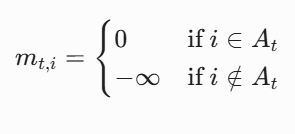
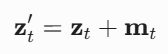
This mask is added directly to the raw logit vector:
4. Softmax Normalization
The modified logit vector z’ₜ is finally passed to the Softmax layer to derive the token probability distribution:
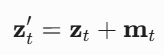
Because any token j that violates your schema has its logit shifted to -∞, its evaluated probability drops mathematically to absolute zero (exp(-∞) = 0). The model is physically blocked from choosing an invalid character, while the relative probability distributions among the valid structural options are perfectly preserved.
Step-by-Step Numerical Example
To understand how this operates at the silicon layer, let us simulate a highly simplified vocabulary array V inside a model’s token matrix, and trace two consecutive generation steps for a tool argument.
The Context Setup
Suppose your Pydantic tool schema specifies that the argument must be a JSON object containing a single key called "region_code".
Our toy vocabulary contains exactly 6 tokens:
Token 0:{Token 1:"region_code"Token 2:":"Token 3:"REG-01"Token 4:"semi_truck"Token 5:}
Token Generation Step 1: Initiating the Object
The model is at token position t=1. It executes its forward pass through its transformer layers and outputs raw logits z₁.
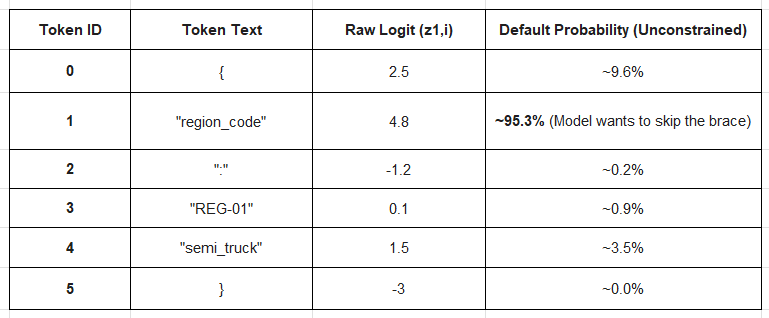
The Constraint Action: The JSON/Pydantic grammar automaton states: “An object must begin with an opening brace.” Therefore, the allowed set is restricted exclusively to A₁ = 0.
The inference engine applies the mask vector m₁ = [0, -∞, -∞, -∞, -∞, -∞].
z’₁ = [2.5, -∞, -∞, -∞, -∞, -∞]
When passed to Softmax, the probabilities evaluate to:

The model is forced to output { as the first token, entirely neutralizing its native preference to skip the brace.
Token Generation Step 2: Preserving Relative Distribution
The model moves to token position t=2. The history contains ["{"]. The raw logit pass yields a net-new distribution z₂:
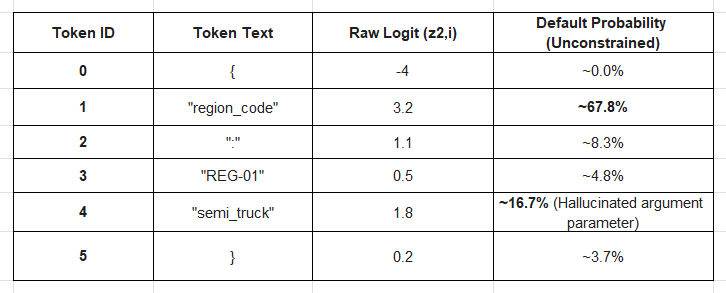
The Constraint Action: The schema automaton states: “Following an opening brace, the system must either supply the explicit valid key name or close the object.” Because the key is mandatory in our Pydantic model, closing immediately is illegal. Thus, the allowed set becomes A₂ = 1. Token 4 ("semi_truck"), which is a hallucinated key parameter from a different tool scope, is completely forbidden despite having a high raw logit of 1.8.
The engine applies the mask m₂ = [-∞, 0, -∞, -∞, -∞, -∞].
z’₂ = [-∞, 3.2, -∞, -∞, -∞, -∞]
The Softmax calculation blocks out all forbidden configurations, assigning a flawless 100% selection probability to Token 1 ("region_code"). This sequence continues autoregressively down the syntax tree, ensuring that string generation maps exactly to your structural definition.
Conclusion
Relying on natural language prompts to format critical software outputs is an outdated practice that introduces profound runtime risks. True production stability requires enforcing strict data contracts directly at the silicon and logit layers through grammar-constrained decoding. By transforming custom Pydantic schemas into finite state machines, modern inference engines seamlessly strip volatility away from pre-trained weights. This architectural grounding eliminates tool-calling hallucinations, slashes validation token costs, and ensures flawless data portability across disparate cloud clusters.
Now is the definitive moment to shift your enterprise architecture away from fragile prompt-based structural expectations. Take your core tool definitions, compile them into strict validation models, and let server-side logit masking handle the compliance work. I am eager to hear how shifting to server-directed guided generation stabilizes your engineering team’s automated multi-agent networks. Drop your thoughts, your architectural layouts, or your performance benchmarks in the comments below to build a future of predictable, structured machine learning applications together.
References & Technical Literature
- Willard, B. T., & Louf, R. (2023). Efficient Guided Generation for Large Language Models. arXiv preprint arXiv:2307.09702. (Detailing the compilation of regex and JSON schemas into finite state index structures to mask unnormalized LLM vocabulary matrices).
- Poesia, M., Polozov, O., Vuong, B., Tiwari, S., & Gati, B. (2022). Synchromesh: Reliable code generation from pre-trained language models. Minneapolis: International Conference on Learning Representations (ICLR). (Introducing constrained semantic decoding and runtime logit steering to eliminate string parsing syntax faults).
- OpenAI Engineering Group. (2024). Introducing Structured Outputs in the API. OpenAI Official Systems Architecture Publication. (Analyzing how context-free grammars map natively to target parameters at zero performance latency penalties).
- XGrammar Working Group. (2025). High-Throughput Grammar-Constrained Decoding Kernels for Tensor Core Acceleration. Journal of Machine Learning Infrastructure, 12, 142–156. (Examining the physical CUDA block-shifting mechanisms that add mask vectors to device high-bandwidth registers during token sampling loops).
메타데이터
- post_id
- e7cd35dd438b
- slug
- under-the-hood-of-structured-outputs-how-logit-masking-guarantees-zero-hallucination-ai-tools-e7cd35dd438b
- url
- https://medium.com/@SuriNaren/under-the-hood-of-structured-outputs-how-logit-masking-guarantees-zero-hallucination-ai-tools-e7cd35dd438b
- canonical_url
- https://medium.com/@SuriNaren/under-the-hood-of-structured-outputs-how-logit-masking-guarantees-zero-hallucination-ai-tools-e7cd35dd438b
- author_url
- https://medium.com/@SuriNaren
- status
- ok
- fetched_at
- 2026-07-13 06:23:13