The Robots Aren’t Coming. They’re Already Clocked In
A humanoid robot moved over 100,000 totes at a Georgia warehouse last year. Another one helped build more than 30,000 BMW X3s on a real…
The Robots Aren’t Coming. They’re Already Clocked In
A humanoid robot moved over 100,000 totes at a Georgia warehouse last year. Another one helped build more than 30,000 BMW X3s on a real production line. This isn’t a CES demo reel. This is a Tuesday shift.
If you work in logistics, manufacturing, or you’re just the person who reads robotics news with one eyebrow raised, you’ve probably seen the same viral clip a hundred times: a shiny bipedal robot walks smoothly across a stage, does a little wave, and everyone claps. Then nothing. For years, that was the whole story.
2026 broke that pattern. Boston Dynamics shipped its all-electric Atlas into an actual factory. Agility Robotics went public on the strength of real customer contracts, not just cool videos. Figure AI signed a commercial deal with BMW priced by the hour, like renting a forklift. This article maps out exactly where these robots are working right now, what they’re actually doing task by task, and what’s still years away — with real numbers, real commands, and a project you can build yourself to evaluate whether any of this applies to your warehouse.
The Shift Nobody Marketed Correctly
Most coverage of humanoid robots falls into two buckets: breathless corporate press releases, or “robots are taking your job” panic pieces. Neither one tells you what’s actually happening on a warehouse floor this week.
Here’s the boring, useful truth. As of mid-2026, there are a handful of named companies running named robots at named facilities, generating real operating hours. That’s a different category than “in development” or “unveiled at CES.”
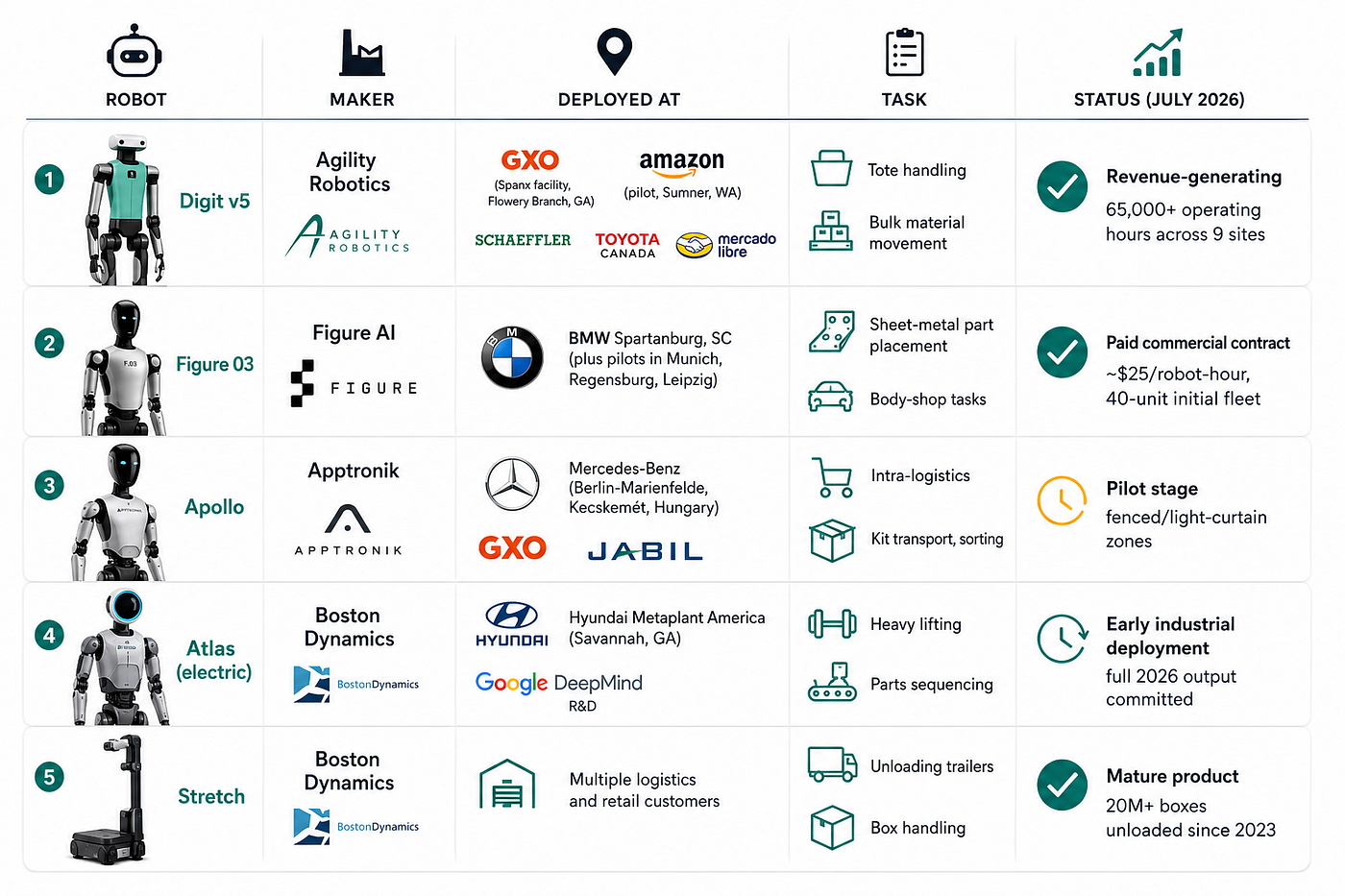
Notice what’s missing from that list: nobody is doing general “walk around and do whatever a person would do.” Every single deployment above is narrow, repetitive, and structured. That’s not a limitation hidden by PR — that’s the actual current shape of the technology, and it matters for what comes next.
Where They’re Actually Working, Site by Site
Amazon and Agility: the tote-recycling grind
Amazon’s relationship with Agility Robotics started small and stayed small on purpose. The first job Digit got wasn’t glamorous — it was tote recycling, picking up empty totes after inventory gets pulled out and stacking them for reuse. It’s the kind of task nobody wants to do 2,000 times a shift, which is exactly why it went to a robot first.
The bigger proof point isn’t Amazon, though. It’s GXO, the third-party logistics giant that runs warehouse operations for Spanx. GXO signed a multi-year Robots-as-a-Service deal with Agility, and by late 2025 Digit had moved over 100,000 totes at that single facility. That’s the number that matters more than any keynote demo: a real client paying real money because the math worked out. You can read Agility’s own numbers in their SEC filing announcing the public listing.
BMW and Figure: the $25-an-hour robot
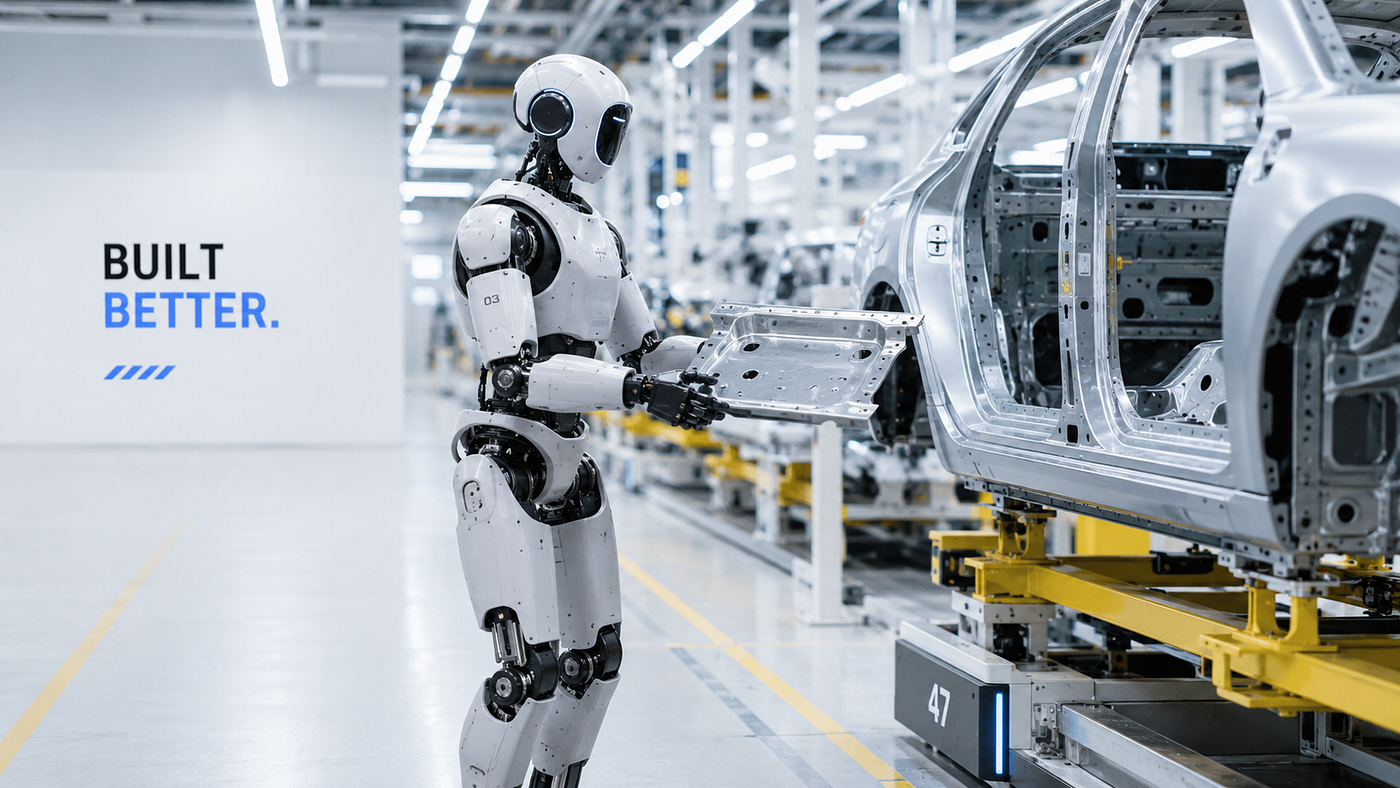
Figure’s deal with BMW Spartanburg is the cleanest commercial case study in the whole industry right now. Figure 02 ran a 10-month pilot, clocked more than 1,250 runtime hours, and touched more than 30,000 completed vehicles. BMW didn’t call it a research project afterward — they signed a commercial contract for 40 units of the newer Figure 03, priced at roughly $25 per robot-operating-hour.
That pricing structure is the detail engineers should pay attention to. It means a plant manager can put “humanoid robot hours” into a spreadsheet next to “temp labor hours” and “overtime hours” and actually compare them. That’s the moment automation stops being a science project and starts being a budget line.
Mercedes and Apptronik: logistics, not the assembly line
Apptronik’s Apollo took a different path than Figure. Instead of body-shop or final assembly, Mercedes-Benz put Apollo to work on intra-logistics — moving kits and components between stations at its Berlin-Marienfelde Digital Factory Campus and its Kecskemét plant in Hungary. Apptronik also has parallel pilots running with GXO and manufacturing partner Jabil, according to their own funding announcement covering the $520M raise.
Every Apollo unit currently operates inside a defined zone marked by light curtains — invisible laser boundaries that pause the robot the instant a person crosses them. That’s not a technical limitation dressed up as a feature. It’s the actual current safety model for almost every humanoid deployed near people today.
Hyundai and Atlas: the heavy-lift, long-game bet
Boston Dynamics’ electric Atlas is the highest-profile robot in the category, and also the one furthest from “help everyone with everything.” Atlas is currently doing heavy lifting and autonomous parts sequencing at Hyundai’s Metaplant in Savannah, Georgia, handling components up to 30 kg sustained and 50 kg in short bursts.
Hyundai’s ambitions are enormous on paper — more than 25,000 Atlas units committed to its own factories by 2028. But it’s worth knowing that this rollout hit a real speed bump: the Korean Metal Workers’ Union publicly blocked Atlas from entering Hyundai factory floors without a formal labor-management agreement first. That’s a preview of a fight most companies deploying humanoids are going to have, whether they’ve planned for it or not.
What’s Real Today vs. What’s Still Years Out
This is the table that most coverage skips, and it’s the one that actually answers “should I be worried about my job.”
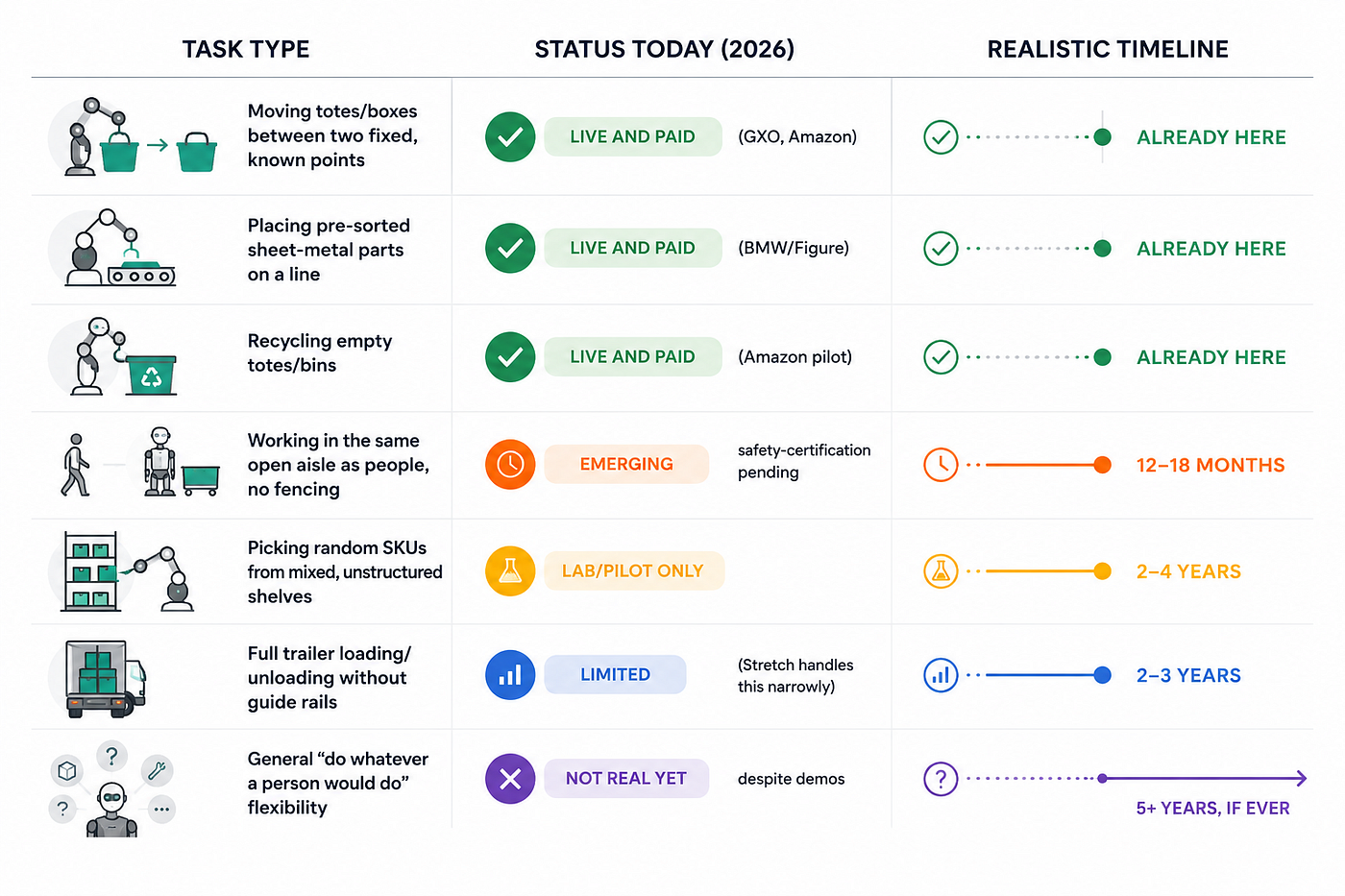
The pattern is simple: robots today are great at structured, repetitive, predictable tasks between known points. They’re bad at improvising. If your job involves judgment calls, weird edge cases, or handling something that isn’t where it’s supposed to be, you have more runway than the headlines suggest.
The Technical Reality: How These Deployments Actually Work
Here’s the part most articles skip entirely, because most writers covering this beat have never touched a robot’s fleet dashboard. If you’re the engineer who gets paged when a $250,000 robot stops moving mid-shift, this is what your job actually looks like.
Fleet management is the real product, not the robot
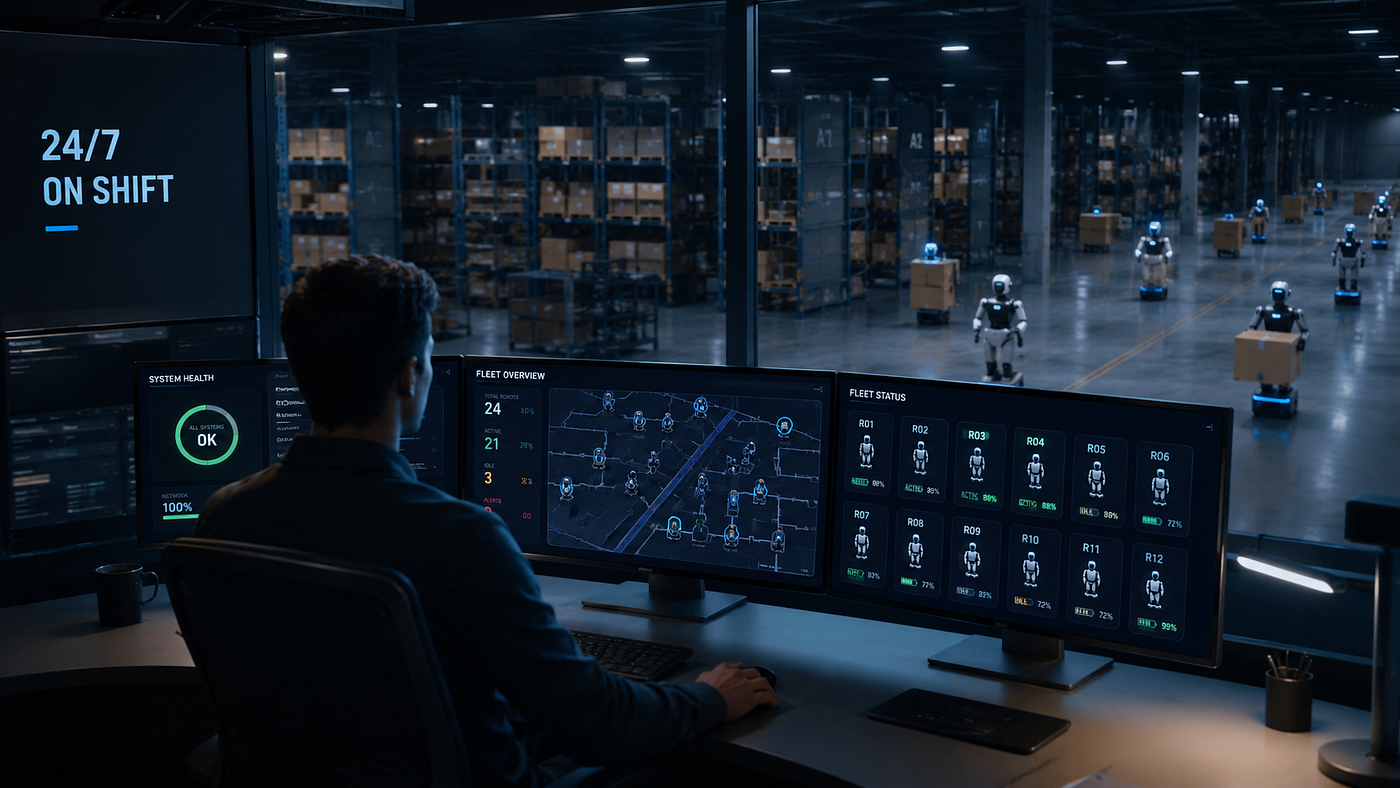
Agility’s commercial platform is called Arc. Boston Dynamics has its own fleet orchestration layer for Atlas and Stretch. Apptronik and Figure both run centralized dashboards. None of these companies sell “a robot” — they sell a robot plus a fleet operations layer, because a warehouse doesn’t want one robot, it wants forty robots that don’t collide, don’t idle, and report their own health.
Under the hood, most of these platforms still lean on familiar robotics tooling for low-level debugging, even if the production fleet software is proprietary. If you’re troubleshooting a robot’s perception stack or motion controller during an integration project, these are the actual commands you’ll run day to day.
# List every active node on the robot's onboard compute
ros2 node list
# See what topics a specific perception node is publishing
ros2 node info /perception_stack
# Watch battery state in real time while the robot is on shift
ros2 topic echo /battery_state
# Check current joint torque readings for a leg or arm actuator
ros2 topic echo /joint_states --field effort
# Confirm the robot's localization confidence inside the warehouse map
ros2 topic echo /amcl_pose
# Pull the last 200 lines of the safety-monitor log after an e-stop event
ros2 topic echo /safety_status --once
Safety zones are configured, not assumed
The light-curtain and geofencing setup that Apptronik uses with Mercedes isn’t a black box — it’s a configuration file, the same way a firewall rule is a configuration file. A simplified version of what a safety-zone definition looks like in practice:
# safety_zones.yaml - defines where the robot must slow or stop
zone_id: aisle_7_pick_station
zone_type: collaborative
max_speed_mps: 0.3
trigger_sensors:
  - light_curtain_north
  - lidar_ring_front
on_human_detected: slow_to_crawl
on_human_within_1m: full_stop
on_human_within_0.3m: emergency_stop
resume_condition: manual_confirm_or_60s_clear
logging: mandatory
That resume_condition line is the one that actually determines how disruptive a robot is to a real shift. If resuming requires a human to walk over and press a button every time someone crosses the line, you've just built a bottleneck, not a helper. This is the exact kind of integration detail that separates a pilot that gets renewed from one that gets quietly cancelled after six months.
A basic robot health-check you can run against any fleet API
Most commercial fleet platforms expose a REST API for status polling, since operations teams want this data in their own dashboards, not locked inside a vendor’s UI. Here’s a realistic pattern for a lightweight health check you’d run on a cron job:
# fleet_healthcheck.sh - poll each robot's status endpoint every 5 minutes
for robot_id in digit-01 digit-02 digit-03 digit-04
do
curl -s -H "Authorization: Bearer $FLEET_API_TOKEN" \
"https://fleet.internal.example.com/api/v1/robots/$robot_id/status" \
| jq '.battery_pct, .task_state, .last_estop_reason' \
>> /var/log/robot_fleet/$robot_id.log
done
# Alert if any robot has been idle longer than 15 minutes during a shift
grep -l '"task_state":"idle"' /var/log/robot_fleet/*.log | \
xargs -I{} echo "ALERT: check {}"
Real-World Practical Project: Build Your Own Deployment ROI Calculator
You don’t need to buy a robot to figure out whether one makes sense. Build this instead. It’s a Python script that takes your real warehouse numbers and tells you where a humanoid robot would actually pay off, using the $25/robot-hour figure BMW is publicly paying as a baseline.
# robot_roi.py - decide if a humanoid robot pencils out for a task
def robot_roi(human_hourly_wage, human_injury_cost_per_year,
              turnover_cost_per_hire, hires_per_year,
              robot_hourly_cost=25, robot_uptime_hours_per_day=20,
              days_per_year=300):
    human_annual_cost = human_hourly_wage * 8 * days_per_year
    robot_annual_cost = robot_hourly_cost * robot_uptime_hours_per_day * days_per_year
    turnover_annual_cost = turnover_cost_per_hire * hires_per_year
    avoided_human_costs = human_annual_cost + human_injury_cost_per_year + turnover_annual_cost
    savings = avoided_human_costs - robot_annual_cost
    payback_days = None
    if savings > 0:
        payback_days = round(365 * robot_annual_cost / avoided_human_costs)
    return {
        "robot_annual_cost": round(robot_annual_cost),
        "avoided_human_costs": round(avoided_human_costs),
        "net_annual_savings": round(savings),
        "estimated_payback_days": payback_days
    }
# Example run using rough industry averages for a single tote-handling task
result = robot_roi(
    human_hourly_wage=19.50,
    human_injury_cost_per_year=8500,
    turnover_cost_per_hire=4700,
    hires_per_year=2.1
)
print(result)
Run it with your own numbers before you sit through a single sales pitch. If net_annual_savings comes back negative, the vendor's demo doesn't matter — the math already told you no. If it's strongly positive, you now know exactly what question to ask the vendor: can their robot actually hit 20 hours of uptime a day, because that assumption is doing most of the work in this calculation.
A quick task-suitability scorer
Before you even run the ROI numbers, screen the task itself. This scoring script mirrors the logic Agility and Figure use internally when picking a pilot task — structured, repetitive, and bounded beats “complex and varied” every time.
# task_score.py - rough screen for humanoid-robot readiness
def score_task(is_repetitive, is_structured_layout, payload_under_35lb,
               fixed_start_end_points, low_variability_of_items):
    weights = {
        "repetitive": 25,
        "structured": 25,
        "payload": 15,
        "fixed_points": 20,
        "low_variability": 15
    }
    total = 0
    total += weights["repetitive"] if is_repetitive else 0
    total += weights["structured"] if is_structured_layout else 0
    total += weights["payload"] if payload_under_35lb else 0
    total += weights["fixed_points"] if fixed_start_end_points else 0
    total += weights["low_variability"] if low_variability_of_items else 0
    if total >= 80:
        verdict = "Strong pilot candidate"
    elif total >= 50:
        verdict = "Possible, needs process redesign first"
    else:
        verdict = "Not ready for a humanoid robot yet"
    return total, verdict
# Example: tote recycling task, similar to Amazon's first Digit deployment
print(score_task(True, True, True, True, True))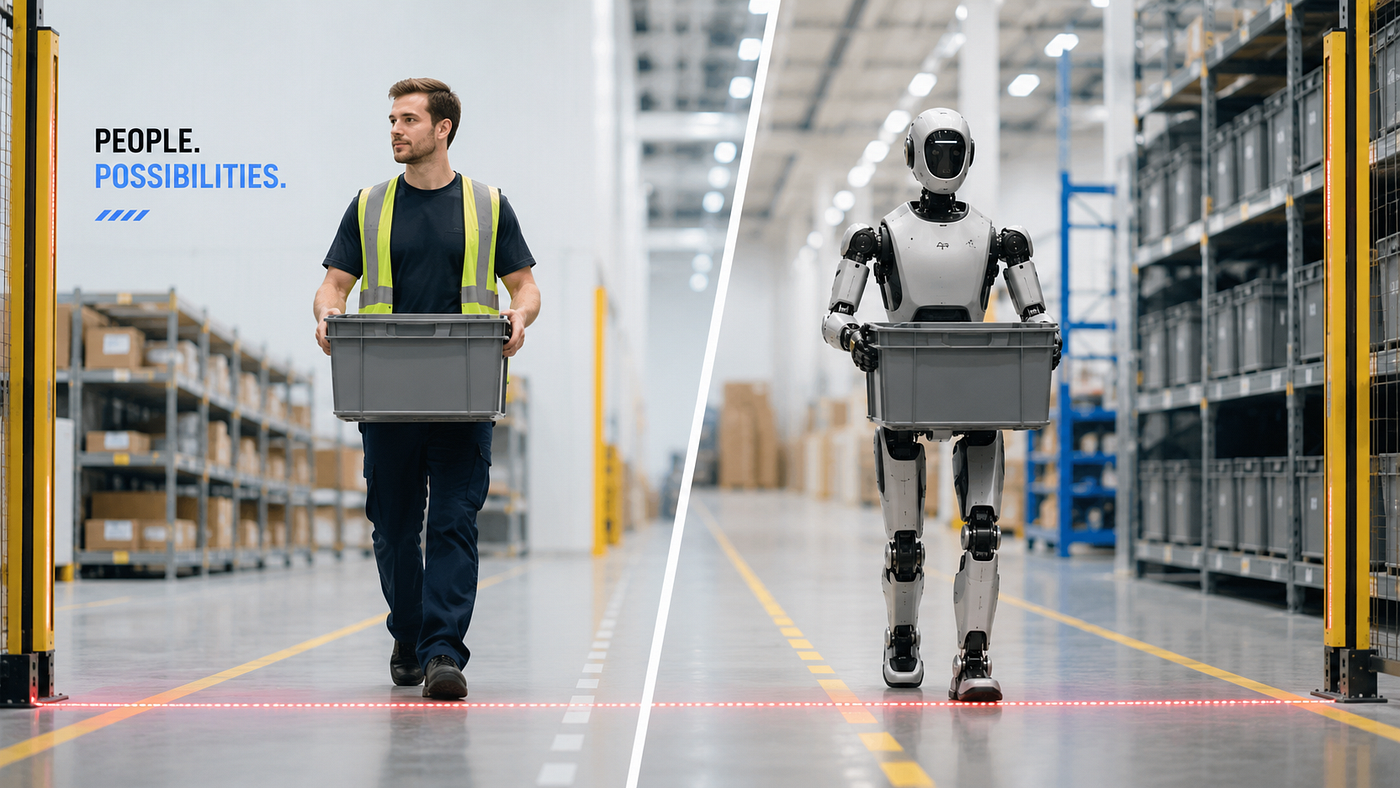
The Jobs Nobody’s Talking About Yet
Every one of these deployments created new roles that didn’t exist two years ago, and none of them are “robot repair technician” the way people expect.
Agility Robotics, GXO, and Mercedes all now employ people whose actual title translates to fleet operations coordinator — someone who watches uptime dashboards, reassigns tasks when a robot flags low battery, and escalates hardware issues before they become full outages. It’s closer to being a network operations center analyst than a mechanic.
There’s also a growing “robot choreographer” function at sites like BMW Spartanburg — someone who redesigns the physical workflow around a station so a robot’s fixed range of motion actually works with the existing conveyor and rack layout. That’s industrial engineering with a robotics-specific skill layer on top, and it’s currently a hard role to hire for because almost nobody has done it before.
Real Problems Companies Hit — and How They Actually Fixed Them
This is the part corporate press releases never publish.
Problem: robots idling because of ambiguous task handoffs. Early Digit pilots ran into cases where a robot would finish one tote and just… wait, because the warehouse management system hadn’t been updated to talk to the robot’s task queue in real time. GXO’s fix wasn’t more AI — it was an integration project that piped live WMS data directly into Agility’s Arc platform so task assignment happened automatically instead of through a human dispatcher.
Problem: safety-zone resets slowing down the whole line. In early Apollo pilots, every time a worker briefly crossed into a collaborative zone, the robot required manual confirmation to resume. That created a bottleneck worse than not having the robot at all. The fix was tuning the resume_condition logic (shown in the config above) to auto-resume after a timed clear period for low-risk zones, while keeping manual confirmation only for high-payload zones.
Problem: labor pushback and trust. Hyundai’s union block on Atlas wasn’t a technical failure, it was a relationship failure — robots got announced before workers got a seat at the table. Companies that avoided this friction, including several GXO sites, brought floor workers into the pilot-selection process from day one, letting them choose which task got automated first. Worker-nominated tasks had dramatically less resistance than management-imposed ones.
Problem: battery life killing a full shift. Digit v5’s four-hour battery life doesn’t cover a 20-hour operating window on its own. Sites running near-continuous coverage solved this with staggered hot-swap battery stations and a small buffer fleet — running five robots to guarantee four are always working, instead of trying to squeeze more runtime out of one unit.
Practical Tips If This Is Relevant to Your Work
If you’re evaluating a pilot, start with the single most repetitive, most injury-prone task in your building, not the flashiest one. Tote recycling and part-feeding got picked first for a reason — nobody misses doing those tasks, and the ROI math is the cleanest.
If you’re a warehouse worker wondering about job security, look at the task-suitability table above and be honest about where your daily work actually falls. Highly structured, repetitive, single-item tasks are the ones under real pressure over the next 18 months. Judgment-heavy, exception-handling work is not, at least not yet.
If you’re the engineer being asked to own an integration, insist on API access and log visibility from day one. Every vendor above supports it, and a pilot you can’t monitor with your own tooling is a pilot you can’t actually evaluate. For deeper background on the safety data driving a lot of these deployment decisions, the Warehouse Worker Resource Center’s injury reports are worth reading before you sign anything.
FAQ
Are humanoid robots actually replacing warehouse workers in 2026? In specific, narrow tasks, yes — tote recycling, part placement, and totes-between-two-points movement are being done by robots at paying customer sites right now. Full job replacement isn’t happening; task replacement within a job is.
How much does it cost to run a humanoid robot per hour? BMW’s public contract with Figure AI is priced around $25 per robot-operating-hour. That’s the closest thing to a public benchmark right now, though pricing varies by task complexity and contract structure.
Which company has the most robots actually deployed, not just announced? Agility Robotics currently has the widest verified commercial footprint — nine customer facilities and over 65,000 cumulative operating hours as of mid-2026, according to their own SEC filings.
Can I buy a humanoid robot for my own warehouse? Not directly yet in most cases. Nearly every deployment above is a pilot partnership or enterprise contract, not an off-the-shelf purchase. Expect quote-based sales conversations, not a checkout page.
What’s the difference between these humanoid robots and the wheeled robots warehouses already use? Wheeled AMRs (autonomous mobile robots) are cheaper and faster for moving goods across open floor space but can’t navigate stairs, ladders, or human-designed workstations built for two legs and two arms. Humanoids are being deployed specifically where the environment wasn’t redesigned for robots — which is most existing warehouses.
How do these robots avoid hurting people on the floor? Current deployments rely on light curtains, lidar-based proximity sensors, and geofenced zones that force the robot to slow or stop when a person gets close. True unrestricted human-robot collaboration is still pending formal safety certification at most companies.
Is this actually different from the “robots are coming” hype of the last decade? Yes, mainly because of what’s now measurable: paid hourly contracts, public operating-hour totals, and completed vehicle counts. Previous hype cycles didn’t have GXO signing multi-year commercial agreements or a robotics company going public on the back of real customer revenue.
Where This Actually Leaves Us
The honest read on mid-2026: humanoid robots are real employees in a small, specific set of warehouses and factories, doing a small, specific set of tasks extremely well. They are nowhere close to “general purpose,” no matter what the demo footage suggests.
If your job is structured and repetitive, that task is genuinely at risk over the next year or two, and it’s worth planning around now instead of later. If your job requires constant judgment calls on a messy, unpredictable floor, you have more time than the headlines are telling you — but “more time” isn’t the same as “no timeline,” so it’s worth watching the Boston Dynamics deployment updates and similar company blogs directly rather than relying on secondhand coverage.
메타데이터
- post_id
- e7e1e4700b1b
- slug
- the-robots-arent-coming-they-re-already-clocked-in-e7e1e4700b1b
- url
- https://medium.com/@austinblake001/the-robots-arent-coming-they-re-already-clocked-in-e7e1e4700b1b
- canonical_url
- https://medium.com/@austinblake001/the-robots-arent-coming-they-re-already-clocked-in-e7e1e4700b1b
- author_url
- https://medium.com/@austinblake001
- status
- ok
- fetched_at
- 2026-08-07 05:35:12
