🚨 SIEM Alone Is Not Enough: Automating Malware Detection with Real-Time Threat Intelligence
Security Information and Event Management (SIEM) platforms play a critical role in modern Security Operations Centers (SOCs). They…
🚨 SIEM Alone Is Not Enough: Automating Malware Detection with Real-Time Threat Intelligence
Security Information and Event Management (SIEM) platforms play a critical role in modern Security Operations Centers (SOCs). They centralize logs, correlate events, and generate alerts across complex infrastructures.
Yet many organizations encounter a persistent challenge:
Despite deploying a SIEM, sophisticated malware and advanced threats still evade detection — while analysts struggle with overwhelming alert volumes.
The root cause is often not visibility, but lack of real-time contextual intelligence and automated response capabilities.
This challenge motivated our research into enhancing Wazuh SIEM through live threat feed integration and automated mitigation mechanisms.
🧠 The Problem: Detection Without Context
Traditional SIEM deployments typically rely on:
- Static correlation rules
- Predefined detection signatures
- Manual IOC validation
- Human-driven response workflows
While effective for known threats, these approaches struggle against:
❌ Rapidly evolving malware ❌ Previously unseen indicators ❌ High-volume event streams ❌ Analyst fatigue and delayed response
In many SOC environments, alerts lack enrichment from external threat intelligence, forcing analysts to manually verify suspicious artifacts.
🔗 Our Approach: Real-Time Threat Intelligence Integration
To address these limitations, we designed a modular automation framework that augments Wazuh SIEM by:
✔️ Querying live Indicators of Compromise (IOCs) ✔️ Enriching log events in real time ✔️ Applying dynamic correlation logic ✔️ Triggering automated response actions
Instead of post-event enrichment, IOC validation occurs within the detection pipeline.
⚙️ System Architecture Overview
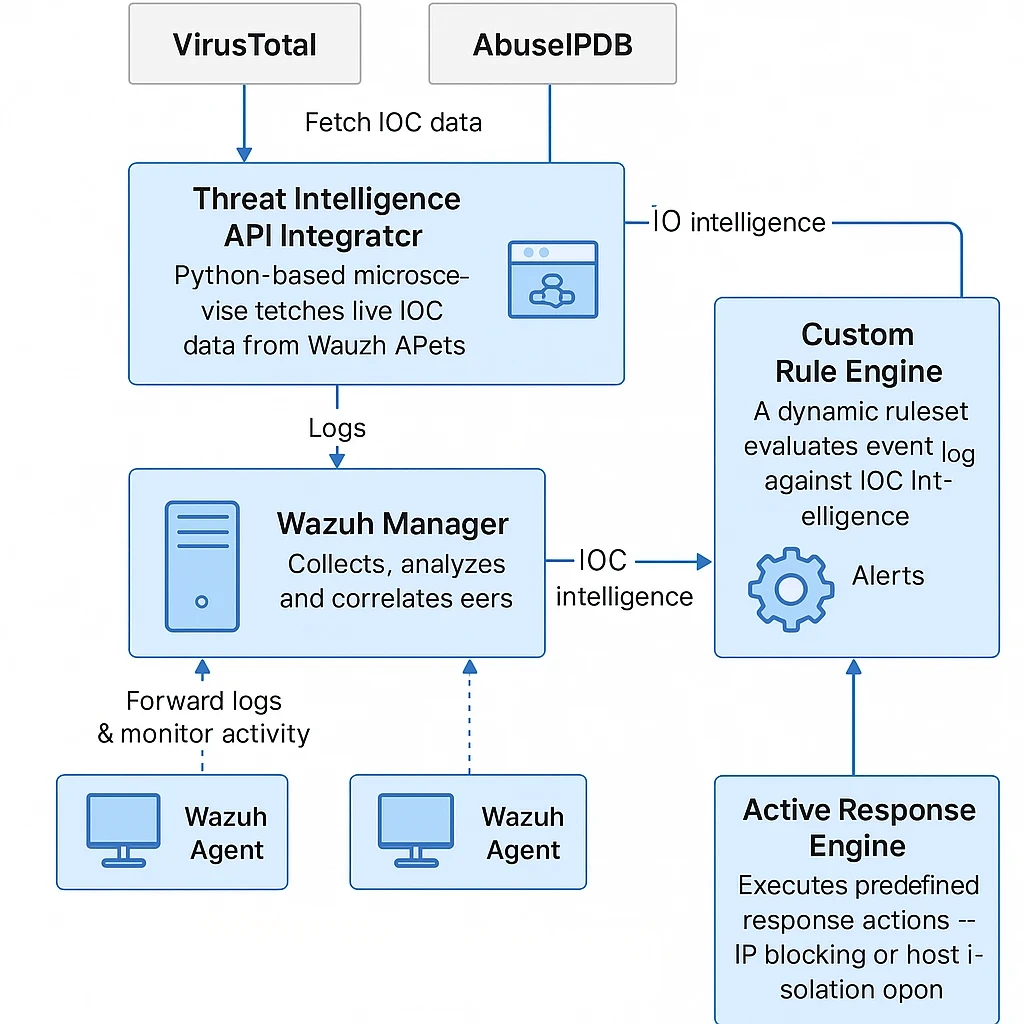
The framework integrates the following components:
- Wazuh Agents → Collect endpoint and system logs
- Wazuh Manager → Central analysis and correlation
- Threat Intelligence API Integrator → Python-based microservice querying VirusTotal and AbuseIPDB
- Custom Rule Engine → Context-aware detection logic
- Active Response Engine → Automated mitigation actions
This modular design ensures scalability, flexibility, and compatibility with additional threat feeds.
⚡ Real-Time IOC Enrichment
Incoming log events are parsed to extract potential indicators such as:
- File hashes
- IP addresses
- URLs
These indicators are dynamically validated against:
✔️ VirusTotal → Malware detection consensus ✔️ AbuseIPDB → Reputation confidence scoring
Threat intelligence results are evaluated using configurable thresholds, enabling adaptive detection decisions.
🔍 Dynamic Correlation and Alerting
Unlike purely static SIEM rules, enriched events are processed using:
- IOC confidence scores
- Contextual metadata
- Threshold-based correlation logic
This approach significantly improves:
✔️ Alert precision ✔️ Detection reliability ✔️ Noise reduction
🤖 Automated Active Response
Upon verified threat detection, the system automatically executes mitigation actions:
✅ Malicious IP blocking ✅ File quarantine ✅ Process termination
This transforms security operations from:
Passive Alerting → Near Real-Time Mitigation
📊 Experimental Evaluation
The framework was evaluated in a controlled enterprise-grade environment containing a balanced mix of benign and malicious activities.
Key performance metrics:
🎯 Threat Detection Rate: 95.0% 🎯 Alert Precision: 94.2% ⚡ Enrichment Latency: 1.4 seconds ⚡ Mitigation Delay: 2.8 seconds 📉 False Positive Rate: 4.0%
These results demonstrate that real-time threat intelligence enrichment can significantly enhance SIEM effectiveness without introducing prohibitive latency.
🖼️ System Workflow
The figure below illustrates the architecture of the proposed framework, highlighting how Wazuh logs are enriched via live threat intelligence feeds, evaluated by the custom rule engine, and processed by the automated response engine.
🔐 Security and Privacy Considerations
Real-time threat feed integration introduces important operational considerations:
- Secure API key management
- Protection of sensitive metadata
- Input validation and sanitization
- Controlled outbound connectivity
Mitigation strategies include caching mechanisms, selective enrichment policies, and secure credential storage.
🚀 Why This Matters for SOCs
Modern cyber defense requires:
✅ Faster detection ✅ Higher confidence alerts ✅ Reduced analyst workload ✅ Automated containment
By combining:
SIEM + Threat Intelligence + Automation
Organizations can significantly improve:
✔️ Malware detection capability ✔️ Incident response speed ✔️ Operational efficiency
🎯 Final Thoughts
Open-source SIEM platforms such as Wazuh offer exceptional flexibility, but must be enhanced with intelligent automation and contextual enrichment to address modern threat dynamics.
Our research demonstrates that:
Integrating real-time threat intelligence and automated response mechanisms can substantially improve detection accuracy and reduce response time — without relying on costly proprietary solutions.
📚 Research Publication
This work is formally published in:
IEEE Xplore 🔗 https://ieeexplore.ieee.org/document/11381876
메타데이터
- post_id
- e7f53271f172
- slug
- siem-alone-is-not-enough-automating-malware-detection-with-real-time-threat-intelligence-e7f53271f172
- url
- https://medium.com/@aasiam.cs/siem-alone-is-not-enough-automating-malware-detection-with-real-time-threat-intelligence-e7f53271f172
- canonical_url
- https://medium.com/@aasiam.cs/siem-alone-is-not-enough-automating-malware-detection-with-real-time-threat-intelligence-e7f53271f172
- author_url
- https://medium.com/@aasiam.cs
- status
- ok
- fetched_at
- 2026-07-13 20:52:00