The Surface You Don’t Know | Fiive Eyes
Core Intelligence Platform Threat Surface
The Surface You Don’t Know | Fiive Eyes
Core Intelligence Platform Threat Surface
Every serious breach of the last decade shares one quiet detail in the post-mortem: the entry point was something the organisation didn’t know it had. You cannot defend an asset you don’t know exists — and most organisations know less of their own surface than they assume.
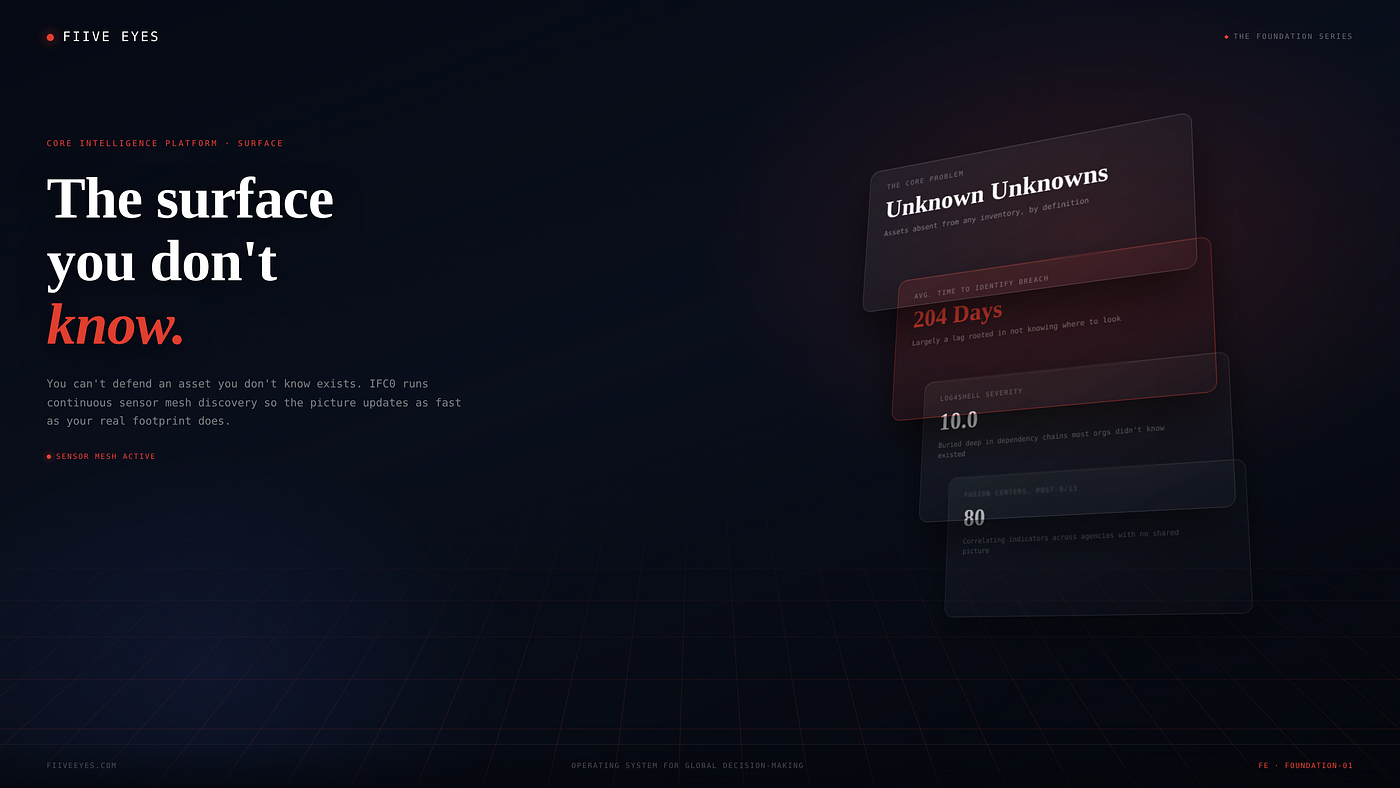
204 Days Average time organisations take to identify a breach, per IBM’s long-running Cost of a Data Breach research — a lag rooted largely in not knowing where to look
10.0 CVSS severity score assigned to Log4Shell (December 2021) — a flaw buried so deep in software dependency chains that most organisations didn’t know they were exposed
80 State and Major Urban Area Fusion Centers operating in the U.S., established after 9/11 specifically to correlate indicators across agencies with no shared picture
Unknown Unknowns The practitioner term for assets, dependencies, and exposures absent from any inventory — because nobody knew to look for them in the first place
The foundation every other discipline sits on
This series begins here for a reason. Every module examined elsewhere in this architecture — financial intelligence, cognitive warfare detection, strategic warning, human source validation — assumes a baseline capability underneath it: knowing what you actually have to defend, monitor, or watch in the first place. That baseline is not glamorous, and it rarely gets the attention the more advanced disciplines do. It is also where the overwhelming majority of real-world failures actually originate, because an organisation cannot correlate a threat against an asset it does not know it owns, cannot flag an indicator of compromise on a system it has never inventoried, and cannot task a sensor against a gap in its own perimeter that nobody has mapped.
The threat surface is not a fixed inventory. It is a constantly shifting, largely self-inflicted expansion — every new cloud service an employee signs up for without informing security, every open-source software dependency quietly pulled in by a dependency of a dependency, every forgotten subdomain still pointed at a decommissioned server, every physical sensor or access point added to a facility without being logged centrally. None of this is exotic tradecraft. It is ordinary organisational entropy, and it is the single most consistent precondition behind the breaches that make headlines.
The case that proved the point at global scale
In December 2021, a vulnerability was disclosed in Log4j, an open-source Java logging library so deeply embedded in enterprise software that a significant share of the organisations affected did not know they were running it at all — not because they used Log4j directly, but because some vendor, framework, or internal tool three or four dependencies removed from their own code did. The flaw, later named Log4Shell, received the maximum possible severity score under the industry’s standard scoring system, and within days of disclosure, security researchers were tracking millions of exploitation attempts worldwide. The technical vulnerability was, in the end, patchable. The genuinely hard problem — the one that took most large organisations weeks rather than hours to resolve — was simply determining where, across every system, vendor product, and internal application, the vulnerable component actually existed. Many organisations discovered mid-incident that their own asset inventory, built and maintained in good faith for years, was substantially incomplete.
Log4Shell was not primarily a story about a software flaw. It was a story about how few organisations, when a genuinely urgent question arrived — “are we exposed, right now, anywhere” — could actually answer it with confidence.
Why “we’ll audit it periodically” no longer works
The traditional response to this problem has been the periodic security audit or asset inventory review — a snapshot taken quarterly, or annually, of what an organisation believes it owns and operates. This was always an imperfect solution, and it has become a substantially worse one as the pace of legitimate organisational change has accelerated. Cloud infrastructure can be provisioned and decommissioned in minutes, not months. A new software dependency can be pulled into a build pipeline automatically, without a human ever reviewing the decision. A single misconfigured storage bucket, spun up for a two-week project and forgotten, can sit exposed for years. A surface that changes continuously cannot be meaningfully secured by a process that checks in once a quarter — by the time the audit runs, the surface it is describing has already moved on.
This same underlying lesson — that a fragmented picture assembled after the fact is structurally inferior to a continuously correlated one — is precisely why physical, post-9/11 intelligence architecture converged on the same solution the cybersecurity industry would later reinvent independently. The eighty-odd State and Major Urban Area Fusion Centers established across the United States after September 11, 2001 exist for exactly this reason: to correlate indicators, alerts, and threat actor information across agencies that previously held fragments of the same picture with no mechanism to assemble them. The fusion cell concept and the attack surface management concept are, at bottom, the same architectural insight applied to physical and digital domains respectively — a threat is only actionable once disparate signals are correlated against a complete, current picture of what exists to be threatened.
Why this is the entry point, not an afterthought
Every module in this architecture — financial, narrative, human, cognitive, strategic — ultimately produces an indicator that has to be matched against something real: an asset, an entity, a position, a person. A sensor mesh and a continuously maintained inventory of indicators of compromise, threat actors, and alerts is the substrate every other discipline in this series correlates against. Get this layer wrong, and every more sophisticated capability built on top of it is reasoning about a picture that was already incomplete before the analysis began.
The architecture required
A genuine threat surface capability requires continuous, automated discovery rather than periodic review — treating asset inventory as a live feed that updates as the organisation’s actual footprint changes, not a document refreshed on a calendar. It requires structured indicator-of-compromise tracking, correlated in real time against a maintained threat actor database, so that a new signal is checked automatically against everything already known rather than triaged in isolation by whoever happens to see it first. And it requires genuine fusion-cell architecture — a mechanism, whether physical or digital, that assembles fragmented signals from disconnected sensors and teams into one coherent, current operating picture, because the alternative, as Log4Shell demonstrated at planetary scale, is discovering the true size of your own exposure only once someone else has already found it first.
IFC0 Intelligence Module — Threat Surface (SURFACE)
IFC0’s Threat Surface module provides continuous sensor mesh coverage, structured indicator-of-compromise tracking, threat actor correlation, and fusion cell architecture as the foundational layer every other IFC0 capability builds on. Available across all tiers, because every organisation, sovereign or commercial, first needs an accurate, continuously updated picture of what it actually has to defend before any more advanced intelligence discipline can be meaningfully applied on top of it.
Every sophisticated intelligence discipline in this series assumes this layer already works. Most organisations have never verified that it does. The surface you can’t see is not a smaller problem than the ones this architecture examines elsewhere — it is the one all of them are quietly standing on.
Fiive Eyes · IFC0 — Threat Surface & Sensor Fusion Module From sky to soil. IFC0 sees the entire battlefield. www.fiiveeyes.com
메타데이터
- post_id
- e7fb9cd48208
- slug
- the-surface-you-dont-know-fiive-eyes-e7fb9cd48208
- url
- https://medium.com/@fiiveeyes/the-surface-you-dont-know-fiive-eyes-e7fb9cd48208
- canonical_url
- https://medium.com/@fiiveeyes/the-surface-you-dont-know-fiive-eyes-e7fb9cd48208
- author_url
- https://medium.com/@fiiveeyes
- status
- ok
- fetched_at
- 2026-08-03 04:45:28