Inside Matter: Rutherford and the Atomic Revolution
Nobody has ever seen the inside of an atom, and nobody ever will. Everything we claim to know about it was established by throwing…
Inside Matter: Rutherford and the Atomic Revolution
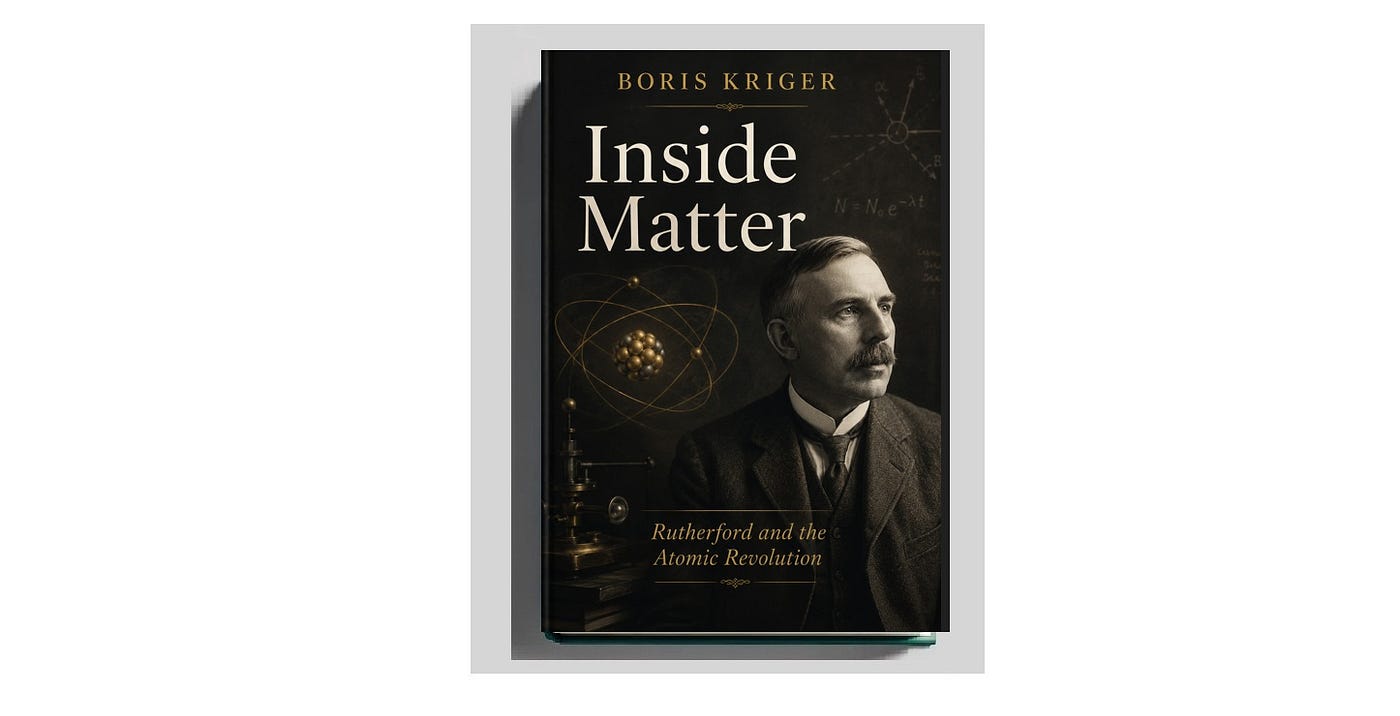
Nobody has ever seen the inside of an atom, and nobody ever will. Everything we claim to know about it was established by throwing something at it and watching what came back.
Ernest Rutherford, the son of a New Zealand flax farmer, turned that awkward fact into the most productive method in the history of science. He named the alpha and the beta ray, wrote the first physical law that says nothing at all about any individual event, transmuted one element into another, found the nucleus in a deflection that should not have happened, predicted the neutron twelve years before anyone found it, and built two laboratories that between them produced a dozen Nobel laureates and most of twentieth-century physics.
He also published an atom that could not exist, and said so in print. He calculated that his own model gave the electron less than a billionth of a second before it spiralled into the core, declared the question outside the scope of the evidence, and left it open for someone else. Two years later Niels Bohr closed it by simply asserting what the evidence could not supply. This book argues that the pair of them, taken together, show something about how physics actually works that neither shows alone.
And in 1933 Rutherford said that anyone expecting a source of power from the transformation of the atom was talking moonshine. He was right about everything he had measured and blind to everything he had not, which is the characteristic failure of a mind disciplined enough to refuse to guess.
Inside Matter follows the experiment rather than the man. It runs from a wooden box in Manchester through Chadwick, Cockcroft and Walton, the Stanford accelerator that found hard points inside the proton, and on to the one object the method cannot dislodge: the quark that will not come out. There the book asks a question Rutherford would have recognised, since he asked its ancestor in 1911 and refused to answer it — what do you say about the inside of something when the only tool you have has finally run out?
The answer offered here is the author’s own, and is marked as such: that confinement is not a prohibition but a structural condition, that the stability of the proton is a topological fact rather than a lucky accident, and that the chart of the nuclides can be read as a catalogue of shape. The alpha particle Rutherford fired at the foil turns out, on this reading, to be a brick from the wall he was firing at. The projectile was made of the target. That is where the book ends, and it is where it was always going.
KEYWORDS Rutherford, nucleus, scattering, radioactivity, transmutation, confinement, isotopology
[embed]
Contents
Chapter One — The Last Man to Have Done This. 15
Chapter Two — Something Comes Back. 23
Chapter Three — The Instrument He Walked Away From.. 29
Chapter Four — Two Kinds of Ray. 34
Chapter Five — The Law That Says Nothing About Any Atom.. 40
Chapter Six — Transmutation. 46
Chapter Seven — The Probe Is the Object 52
Chapter Nine — One in Eight Thousand. 66
Chapter Ten — What the Recoil Forces. 72
Chapter Eleven — The Atom That Cannot Exist 79
Chapter Twelve — Bohr Declares. 85
Chapter Thirteen — Moseley. 91
Chapter Fourteen — Nitrogen into Oxygen. 98
Chapter Fifteen — Naming the Proton. 104
Chapter Sixteen — String and Sealing Wax. 110
Chapter Seventeen — Chadwick, 1932. 118
Chapter Eighteen — The First Machine. 123
Chapter Nineteen — Kapitsa. 128
Chapter Twenty — Moonshine. 135
Chapter Twenty-One — Southampton Row.. 141
Chapter Twenty-Two — Westminster Abbey, 1937. 146
Chapter Twenty-Three — The Method Does Not Age. 152
Chapter Twenty-Four — Hofstadter 158
Chapter Twenty-Five — SLAC, 1968. 163
Chapter Twenty-Six — The Thing That Will Not Come Out 170
Chapter Twenty-Seven — What Confinement Is Usually Said To Be. 175
Chapter Twenty-Eight — A Different Reading. 181
Chapter Twenty-Nine — Winding, Not Luck. 187
Chapter Thirty — Isotopology. 192
Chapter Thirty-One — The Brick and the Bullet 197
Chapter Thirty-Two — The Largest Nucleus. 202
Chapter Thirty-Three — Inside Matter 207
Case Study One — Counting Flashes: The Human Being as Instrument 220
Case Study Two — The Vienna Dispute, 1927. 224
Case Study Three — Where the Radium Came From.. 227
Case Study Four — Naming the Isotope: A Physician at Dinner 230
Case Study Five — The Age of the Earth, and Lord Kelvin Asleep. 233
Case Study Six — The Cloud Chamber and the Weather on Ben Nevis. 236
Case Study Seven — Blackett’s Twenty-Three Thousand Photographs. 239
Case Study Eight — From Tedium to Electronics. 242
Case Study Nine — Aston’s Whole Numbers. 245
Case Study Ten — Gamow and the Barrier That Need Not Be Cleared. 248
Case Study Eleven — Twelve Years of Waiting: Chadwick and the Beryllium Radiation. 251
Case Study Twelve — The Voltage Multiplier 254
Case Study Thirteen — The Kapitza Club and the Crocodile. 257
Case Study Fourteen — Rutherford’s Letters to Bohr 260
Case Study Fifteen — String and Sealing Wax versus Berkeley. 263
Case Study Sixteen — Oliphant, 1934: Fusion in Rutherford’s Laboratory. 266
Case Study Seventeen — Moonshine and the Manhattan Alumni 269
Case Study Eighteen — The Transfermium Wars. 272
Case Study Nineteen — The Night Super-Kamiokande Destroyed Itself 275
Case Study Twenty — Where the Gold Foil Came From.. 278
Biographies of Rutherford and His Circle. 317
The Discovery of the Nucleus and the Early Experiments. 319
Instruments and Experimental Technique. 321
Quantum Theory and the Atom.. 323
The Strong Interaction, Quarks, and Confinement 325
Neutron Stars and Dense Matter 327
Proton Decay, Neutrinos, and Large Detectors. 329
Methodology, Measurement, and the Structure of Evidence. 330
Consequences, Applications, and Aftermath. 332
Preface
There is a class of object about which we are in a peculiar position. We are certain it exists, we can list its properties to many decimal places, we have built an industrial civilisation on the strength of what we know about it, and we cannot look at it. Not merely have not looked, in the way that nobody had looked at the far side of the moon before 1959, but cannot, in a sense that no improvement in instruments will repair. Light will not resolve an atom, because the wavelength of light is thousands of times larger than the thing to be resolved. Nothing that could resolve it can be focused into an image by any lens that can be built. The interior of matter is not hidden the way a locked room is hidden. It is hidden the way a sound is hidden from the eye.
This is the problem that organises the present book, and the reason it is a book about a method rather than a book about a man. Ernest Rutherford was born in 1871 in Brightwater, in the north of the South Island of New Zealand, the fourth of twelve children of a flax miller, and he died in 1937 as Baron Rutherford of Nelson, with his ashes placed in Westminster Abbey a few paces from Newton. That arc is a good story and it will be told, because the circumstances of a life do shape the work that comes out of it, and because his particular circumstances — provincial, practical, chronically short of equipment, self-taught in the habit of making do — turn out to be tightly connected to the kind of physics he did. But the life is not the argument. The argument is that Rutherford solved the problem of the invisible interior in a way so general that it has never been superseded, only scaled up, and that following the method forward from his hands to the present day is the only way to see both what it can do and where it finally stops.
The method is easy to state and inexhaustible in application. If you cannot look inside a thing, throw something at it and study what comes back. Everything follows from that: the choice of projectile, the choice of what to count, the arithmetic that converts a pattern of deflections into a statement about structure, and — crucially — the discipline required to say only as much as the deflections license and not one word more. It is worth pausing on how strange this is as a route to knowledge. A geologist can split a rock. A surgeon can open a body. An engineer can take the back off the machine. Rutherford could do none of these things and yet arrived at a picture of the atom’s interior more reliable than most of what was then believed about the interior of the earth. He did it by counting flashes of light on a screen in a darkened room, in the dark himself for half an hour beforehand so that his eyes would be sensitive enough, with an assistant calling out numbers, for hours at a stretch, over a period of years.
Three things about the method deserve announcing in advance, because they recur in every chapter and because they are the reasons this story is worth retelling when it has been told before.
The first is that structure lives in the rare event. When Hans Geiger and Ernest Marsden fired alpha particles at a sheet of gold leaf, the overwhelming majority went straight through with a deflection too small to notice. Those particles carried almost no information. The particles that mattered were the ones that came back — roughly one in eight thousand, a fraction so small that any sensible experimental programme would have treated it as contamination, apparatus error, or the sort of thing you clean up before publishing. The whole of nuclear physics is contained in that one-in-eight-thousand. This is not a quirk of the gold foil experiment. It is the general shape of the situation. An average tells you about the bulk; the bulk is empty; the structure is a small hard thing that hardly anything hits. If you smooth your data you destroy your result. A remarkable number of the discoveries in this book were made by somebody deciding to take seriously a small effect that everybody else had a reason to ignore.
The second is that the method is silent about anything it did not hit. This sounds obvious and is constantly forgotten. Rutherford’s 1911 paper establishes that the positive charge and nearly all the mass of an atom occupy a volume tinier than anyone had imagined, because that is what the recoils require and there is no other way to produce them. It establishes nothing whatever about how the electrons outside that core manage to stay there. Rutherford knew this. He knew, moreover, that on any classical account they could not stay there: an orbiting electron radiates, and the arithmetic gives it a lifetime measured in fractions of a nanosecond before it spirals into the centre. He published the model anyway, with an explicit remark that the question of stability lay outside the scope of what he was arguing. It is difficult to overstate how unusual this is. He had a result that was quantitatively forced, and a gap next to it that was not, and he declined to fill the gap with something plausible. Two years later Niels Bohr filled it with something that was not plausible at all — a flat assertion that certain orbits simply do not radiate — and was right. The two men together, the one who would not declare and the one who did, form the methodological centre of this book, and the reader should be warned now that neither of them is the hero of it. Both moves were necessary. Knowing which move a given situation calls for is the whole of the difficulty.
The third is that a method with a boundary will eventually reach it, and that reaching it is not a defeat. Rutherford’s own most famous mistake is the natural bridge here. In 1933 he said in public that anyone who looked to the transformation of atoms for a source of power was talking moonshine, and the remark has been quoted ever since as a warning about the blindness of experts. Read carefully, it is nothing of the kind. Every quantitative statement he made about it was correct. Bombarding nuclei with alpha particles, which was the only technique he had, is hopelessly inefficient; the great majority of projectiles miss; the energy recovered from the rare hits is a vanishing fraction of the energy spent. Within the regime he had measured, his conclusion was not a guess but a calculation. What he could not do was see across the edge of that regime to a mechanism that did not yet exist, in which the projectile carries no charge, is therefore not repelled, and is produced by the reaction it initiates. The neutron had been found in his own laboratory, by his own student, a year before he made the remark. The failure was not ignorance and not arrogance. It was the specific and unavoidable blindness of a correctly bounded extrapolation, which is the only honest kind, and which is blind precisely at the point where the regime changes. Anyone who has ever forecast anything should find this more disturbing than a simple error would be.
The book divides, without announcing it in the table of contents, into three movements. The first follows Rutherford himself, from Montreal to Manchester to the Cavendish, through the naming of the rays, the law of radioactive decay, the transmutation of one element into another, the discovery of the nucleus, the first artificial nuclear reaction, the prediction of the neutron, and the construction of two laboratories that produced an implausible share of twentieth-century physics. The second follows the method after his death, as it grows from a wooden box and a microscope into machines the size of towns: Chadwick and the neutron, Cockcroft and Walton and the first accelerator-driven disintegration, Robert Hofstadter establishing that the proton has a size, and the Stanford experiment of 1968 in which electrons fired at protons came back too often and too hard, exactly as alpha particles had come back from gold leaf fifty-seven years earlier, and revealed hard points inside. The third movement is where the method runs out.
It runs out on the quark. Every scattering experiment ever performed says the proton contains three of them, plus a great deal else; no scattering experiment has ever knocked one loose, and the theory says none ever will. Hit the proton hard enough to separate a quark and the energy you supply manufactures new particles which arrive to keep it company, so that what emerges from the collision is always a jet of ordinary composite matter and never the constituent itself. This is called confinement, and the standard account of it is a good deal less explanatory than its confident tone suggests. The book gives that account fairly and at length before saying anything else, because a reader is owed the consensus before being offered an alternative to it.
And then it offers one, marked plainly as the author’s own position and not as settled physics. The suggestion is that a free quark is not forbidden by an energy barrier but is structurally undefined — that on a spatially closed manifold certain configurations simply have no isolated form to be liberated into, in something like the way a half of a Möbius strip is not a smaller Möbius strip. On the same reading, the stability of the proton stops being a fortunate accident awaiting explanation and becomes a counting fact: a winding number cannot change continuously, and there is nothing for it to decay into that preserves it. And the chart of the nuclides, that great ugly staircase of isotopes which every physics building has on a wall, begins to look less like a table of empirical facts and more like a catalogue of which shapes close and which do not. The technical development of these claims lives elsewhere, in a multi-volume monograph series to which the closing chapters give the references; what appears here is the argument in words, with the mathematics left out and the status of each claim stated as it is made.
There is a closing symmetry that the author did not arrange and cannot resist. The projectile Rutherford used was the alpha particle, the nucleus of helium-4, which he identified as such in 1908 by collecting it in a glass tube and passing a spark through it until the spectrum of helium appeared. On the structural reading offered in the last chapters, the alpha particle is not merely a convenient bullet but one of the elementary closed configurations from which larger nuclei are assembled — a brick, in fact, from the wall he was firing at. The projectile was made of the target. If that is right, then the whole history in this book is a case of matter being used to interrogate itself, which is either a deep fact about the structure of the world or an accident of what happens to be available on a laboratory bench, and the difference between those two descriptions is more or less what physics is for.
A few practical notes. There is no mathematics in what follows; where a number matters it is given in words and the reader is told what it is a number of. Quotations that are traditional but poorly sourced — and Rutherford, being quotable, attracts them — are marked as attributed rather than presented as documented. Nothing in the biographical narrative is invented: where the record is thin, it is described as thin. Where the author’s own physics enters, in the last handful of chapters, it is announced in the first sentence of the chapter and referenced at the end of it, so that a reader who wants the history without the argument can close the book two chapters early and lose nothing that has been established.
The rest is a story about the only way anyone has ever found to see inside anything: throw something at it, be patient, count what comes back, and say no more than the recoil allows.
Chapter One — The Last Man to Have Done This
The story that Rutherford himself liked to tell about his origins begins in a potato field. He was digging, on the family land near Pungarehu on the west coast of the North Island, when the telegram arrived announcing that a scholarship he had failed to win had fallen to him after all, the first candidate having withdrawn to be married. He is supposed to have thrown down the spade and said that this was the last potato he would ever dig. Whether the words were exactly those is beyond recovering; the scholarship was real, the near miss was real, and the detail that his career turned on another man’s wedding is one of those facts that the historian has to accept without being permitted to invent it.
The setting is worth taking seriously rather than treating as picturesque. New Zealand in 1871 had been a British colony for thirty-one years. The European population was small, scattered, and occupied with the practical business of turning forest and swamp into farms. James Rutherford, the father, was a wheelwright and later a flax miller, which meant machinery: water wheels, drive belts, cutters, the constant improvisation of a workshop far from any supplier. Martha Thompson, the mother, had been a schoolteacher, and there were twelve children, of whom Ernest was the fourth. The household ran on the assumption that things were repaired rather than replaced and that a boy who could not make himself useful with his hands was a boy of limited prospects.
This is not folklore about the value of a rustic upbringing. It has a specific and traceable consequence in the physics. Rutherford’s laboratory style for the whole of his life was to build the cheapest apparatus that would settle the question, and to distrust an instrument he could not take apart and understand in an afternoon. When he ran the Cavendish in the 1920s and 1930s, and the money was there for something better, he still preferred glass, wax, wire and brass, and his students inherited the preference. The phrase associated with that laboratory — sealing wax and string — is usually quoted with affection, as if it described a charming eccentricity. It described a policy. An instrument you have built yourself is an instrument whose failure modes you know. An instrument bought from a catalogue can lie to you in ways you have no means of detecting, and the history of physics contains an unedifying number of results that were properties of somebody’s equipment.
There is a further consequence of the colonial setting that is easy to miss because it looks like a disadvantage. There was, in the New Zealand of Rutherford’s youth, no scientific establishment to speak of: no research tradition, no senior figures with programmes to be joined, no orthodoxy about what the important problems were. A young man of ability in Cambridge or Berlin in the 1890s inherited a set of questions along with his training, and the questions came ranked. A young man in Christchurch inherited the journals, which arrived by sea some months late, and had to decide for himself which of the things in them mattered. That is a harder position and in one respect a better one. It produces people who are unimpressed by consensus for the simple reason that they have never been in a room with it. Rutherford’s later willingness to publish a model of the atom that he knew to be classically impossible, and to say plainly in print that the impossibility was somebody else’s problem, is of a piece with an intellectual formation in which nobody senior was standing nearby to be offended.
He was academically formidable from early on, in the way of a boy in a small system where formidable is quickly noticed. Nelson College, then Canterbury College in Christchurch, where he took a degree, then a master’s with a double first in mathematics and physical science, then a further year of research because there was nothing else obvious to do and no professional physics to be had in the colony. That research is the first sign of the temperament. The question of the day, following Hertz’s demonstration in 1887 that electromagnetic waves existed, was what could be done with them. Rutherford, working with almost nothing, built a detector: a magnetised steel needle whose magnetisation was altered by the high-frequency current induced when a wave arrived, so that the arrival of a wave could be registered as a small mechanical deflection. He got it to work across the length of a building and then across a distance of several hundred metres, through walls.
This was 1894, and it deserves to be dwelt on, because it means that a young man in New Zealand had in his hands, before Marconi filed anything, a working means of detecting radio signals at a distance. What he did with it is the first genuinely characteristic decision of his life, and it is the subject of the third chapter of this book. For the moment it is enough to record that the scholarship telegram arrived in 1895, that the scholarship in question was one of a small number funded by the profits of the Great Exhibition of 1851 and intended to bring colonial talent to British laboratories, and that Rutherford sailed for England with the detector, the beginnings of a reputation, and an understanding with Mary Newton, whose mother kept the boarding house in Christchurch where he had lodged, and to whom he would be engaged for five years before he could afford to marry her.
He arrived at the Cavendish Laboratory in Cambridge at a moment of institutional novelty. The laboratory had been founded in 1874 under James Clerk Maxwell, and had been directed since 1884 by J. J. Thomson, who was thirty-three years old at his appointment and had never run anything. Under a regulation that had come into force only in 1895 — the year Rutherford arrived — graduates of other universities could for the first time come to Cambridge to do research and take a Cambridge degree. Rutherford was among the first to arrive under the new rule, and he was resented for it by some of the resident men, who regarded the arrangement as a dilution. He was a colonial with an accent, a loud laugh audible through several rooms, and a habit of arriving at conclusions faster than his manners allowed him to conceal.
The friction was not merely social. The 1895 regulation had been pushed through by Thomson against opposition precisely because he could see that the Cavendish needed a supply of research students and that Cambridge alone could not produce enough of the right kind. What he got, in the first intake, was Rutherford from New Zealand and John Townsend from Dublin, and within a decade the policy had visibly justified itself several times over. This is a small administrative fact with an outsized consequence, and it belongs in a book about method because it is the earliest instance of something that recurs at Manchester and again at the Cavendish under Rutherford himself: the productivity of a laboratory is set less by its instruments than by the rules governing who is allowed to walk in. Thomson changed a rule and got the nucleus, twenty-two years later, in another city, from a man the rule had admitted.
What happened next in that building has been described many times and does not need retelling in detail here, but its timing needs stating, because the accident of arriving in Cambridge in 1895 rather than in 1893 or 1898 shaped everything. In November 1895 Wilhelm Röntgen in Würzburg noticed that a screen coated with barium platinocyanide glowed when a covered discharge tube was running nearby, and announced X-rays within eight weeks. In early 1896 Henri Becquerel in Paris, chasing the reasonable but wrong idea that X-rays might be connected with phosphorescence, wrapped a photographic plate against a uranium salt, put it in a drawer during a spell of cloudy weather, developed it out of impatience rather than expectation, and found the plate blackened by something the uranium was emitting without any stimulus at all. In 1897 Thomson, measuring the deflection of cathode rays in electric and magnetic fields, established that they consisted of particles with a mass something like a two-thousandth that of a hydrogen atom, and drew the conclusion that the atom, the supposedly indivisible unit, had parts.
Rutherford was in the room for the third of these and put to work almost immediately on the consequences of the first two. His first Cambridge assignment was the study of how X-rays ionised gases — how, in other words, radiation stripped charge from the air it passed through, turning an insulator into a weak conductor. It was competent work. It also handed him a technique that would carry him through the next twenty years, because a gas that conducts when irradiated is a gas that can be used to measure radiation. Put the gas between two charged plates, apply a voltage, and the current that flows is proportional to how much ionisation is taking place, and therefore to how much radiation is arriving. The invisible has been converted into a needle on a scale. Almost everything Rutherford did afterwards rests on some version of that conversion, and the habit of insisting on it — that a phenomenon is not properly in hand until it produces a number — separates him from a good deal of the speculative physics of the period.
It is worth being explicit about what this conversion buys, since the whole later book depends on it. A photographic plate, which was Becquerel’s detector, answers the question “was there radiation here?” with a yes or a no and a vague sense of more or less. An ionisation chamber answers the question “how much, compared with what?” and it does so on a scale that can be reproduced in another laboratory by someone building his own chamber to the same description. The moment a phenomenon acquires a reproducible number, it acquires the possibility of a law, because a law is a relation between numbers. Everything Rutherford established in the following decade — that the radiation comes in two kinds with different penetrating power, that its intensity falls off in a fixed proportion in a fixed time, that the proportion is a property of the substance and not of its temperature or chemical state — is a relation between numbers that a plate could never have supplied. He was, in a precise sense, the man who put a scale on radioactivity, and the rest followed because the scale existed.
He turned the ionisation method on Becquerel’s uranium radiation almost as soon as he had it, and the result was the paper that made his name and is the subject of the fourth chapter. Then, in 1898, at twenty-seven, he was offered the chair of physics at McGill University in Montreal, endowed by a tobacco millionaire named William Macdonald who disapproved of smoking and had made his fortune from it anyway. It was a long way from the centre of things and the equipment was better than anything in Cambridge, Macdonald having spent freely on a building he did not understand. Thomson recommended him. Rutherford took it, married Mary Newton in 1900 on the strength of the salary, and spent the next nine years in Canada producing the work that would win him a Nobel Prize.
A remark on the shape of the career is worth making here because it recurs. Rutherford was never at the geographical centre of physics until he was already famous. Christchurch, Montreal, Manchester: three provincial appointments in succession, the last of which he held while doing the single most consequential experiment of the century. The centre came to him. This is not a moral about talent finding its level; plenty of talent does not. It is a structural observation about what a laboratory needs, which is a question this book returns to when it reaches Manchester, and the short version is that the requirements are a clear question, a technique adequate to it, and enough distance from fashion that the awkward result does not get smoothed away. Equipment matters less than any of these. Rutherford spent his life proving it.
Chapter Two — Something Comes Back
Consider the problem in its bare form, stripped of the history. There is an object. You wish to know how its interior is arranged. You may not open it, cut it, dissolve it, or look at it. What can you do?
There is exactly one general answer, and every technique in this book is a version of it. Throw something at the object. Watch what emerges. From the pattern of what emerges, infer the arrangement inside. This is not a clever trick; it is the residue left when everything else has been ruled out. And it is worth appreciating that it is a genuine method, which delivers real knowledge, and not a desperate expedient, because a great deal of ordinary human competence turns out to be this method operating below the level of conscious attention.
A person tapping a wall to find the stud is doing it. The knuckle is the projectile, the returning sound is the signal, and the inference — solid here, hollow there — is a structural claim about an interior that has not been seen. A doctor percussing a chest is doing it with more training and a better model of what the returns mean. Sonar and echo-location are doing it with sound in water and air. Seismology is doing it on the largest available scale: the earth’s interior is known from the way earthquake waves arrive at stations on the far side, and the existence of a liquid outer core was established because one class of wave, which cannot travel through liquid, casts a shadow across a predictable region of the surface. Nobody has been to the core. The shadow is the evidence, and it is sufficient.
What all of these have in common is that the information is carried by the deviation. A wave that passes through unchanged tells you nothing except that there was nothing in the way. The signal is in the reflection, the delay, the bending, the absence. This has a consequence which is uncomfortable and which sits at the centre of the Rutherford story: the more transparent the object, the rarer the informative event, and the more strongly the experimenter is tempted to discard exactly the data that matter.
Suppose the interior you are probing is mostly empty. Then almost every projectile passes through without incident. The fraction that interacts is small, and the fraction that interacts dramatically is smaller still. Now consider the position of the experimenter. He has fired a great many projectiles and recorded a great many null results, which cluster beautifully around a small average deflection and produce a clean distribution. He also has a handful of events that do not belong to that distribution at all — huge deflections, wildly improbable on any smooth account. Every instinct of good practice tells him these are contamination. The apparatus has a leak, or the source is not what it should be, or a stray particle came from somewhere else, or the observer’s eye played a trick in the dark. Discarding outliers is not laziness; it is very often correct, and the literature of every experimental field is littered with signals that turned out to be equipment. But when the object under study is mostly empty and structured, the outliers are the structure, and the beautiful central distribution is a measurement of the emptiness.
This is the general form of the finding that gives this book its spine, and it should be stated flatly before the history begins to illustrate it. In a scattering experiment, the average carries the bulk and the tail carries the architecture. Smooth the data and the result is destroyed. Trust the tail without checking and you will publish an artefact. There is no rule that resolves this. What resolves it, in practice, is doing the experiment again with the deliberate intention of making the rare event either grow or vanish — changing the thickness of the target, the material, the energy of the projectile — and seeing whether the anomaly behaves like a property of the object or a property of the room. That procedure, unglamorous and slow, is what separates the nucleus from the long list of effects that were real in one laboratory and nowhere else.
A second feature of the method needs establishing at the same time, because it governs the whole later argument. The method tells you about what the projectile interacted with, and about nothing else. This sounds too obvious to write down, and yet the entire difficulty of the last third of this book comes from forgetting it. If your projectile carries electric charge, you learn about charge; you are blind to anything neutral in your path. If your projectile is large compared with a feature, that feature is invisible to it, in the way that a hand feeling a wall learns nothing about the crystal structure of the plaster. The resolution of the method is set by the wavelength of what you throw, which is set by its momentum, which is why the history of this subject is a history of throwing things harder, and why the machines grew from a tabletop to a ring twenty-seven kilometres round. Every step in that growth bought a smaller feature size and nothing else. It bought no new kind of knowledge. It made the same measurement finer.
It is worth making the seismological case concrete, because it is the clearest available demonstration that this way of knowing produces knowledge of the ordinary reliable kind and not a set of plausible guesses. Earthquakes generate two families of wave that travel through the body of the earth. One is a compression, like sound, and passes through solids and liquids alike. The other is a shear, a sideways displacement, and a liquid cannot sustain it: a fluid has nothing to shear against. In 1906 Richard Dixon Oldham noticed that the shear waves from a large earthquake fail to arrive at stations beyond a certain angular distance, and that the compression waves arrive there late and bent. There is a shadow, and it has a sharp edge at a predictable place. From the geometry of that edge — nothing else, no sample, no borehole — the depth of a liquid boundary within the earth can be computed. It sits a little under three thousand kilometres down. Everything anyone knows about the earth’s core rests on inferences of this type, and the number has held up for more than a century. No one has been within a hundredth of that depth, and no one ever will be.
There is one further property of the method which is easy to state and turns out to be the hinge on which the last chapters swing. The method assumes that the object has parts which could in principle be separated, and that these parts, once liberated, would be things of the same general kind as the projectile — objects with a position, a momentum, a definite existence outside the whole. That assumption is so deeply built into the practice that it is not usually noticed as an assumption. It is correct for the atom, whose electrons can be stripped off and studied at leisure. It is correct for the nucleus, whose protons and neutrons can be knocked out and caught. It is, so far as anybody has ever managed to demonstrate, false for the quark, which cannot be got out at all, and the resulting situation — a constituent whose presence is established by scattering and whose isolated existence is denied by the same theory that establishes it — is the strangest thing in this book. When we reach it, the question will not be how to hit harder. Harder does not help; harder makes more particles. The question will be what the word “inside” is doing in a case where the parts have no separate form to be liberated into.
One piece of vocabulary should be introduced here and then used without further apology, because the whole subject speaks in it. When physicists report the outcome of a scattering experiment they do not usually report a count of events, which depends on how long they ran and how many targets they had. They report a cross-section: the effective area that each target presents to the incoming projectile for a given kind of outcome. It has the units of an area and it can be pictured as one, provided the picture is not taken too literally. A large cross-section means the target is, for that particular process, a big thing to hit; a small one means it is a small thing to hit. The nucleus has a large cross-section for deflecting alpha particles gently and a very small one for turning them round. What makes the concept indispensable is that it is a property of the target and the process, and not of the apparatus, so that a measurement made in Manchester in 1911 with a microscope and a zinc sulphide screen can be compared directly with a measurement made in California in 1968 with a two-mile accelerator. The continuity of this book is, in a quite literal sense, the continuity of a single quantity being measured with steadily improving tools.
That is a long way ahead. What is needed now is the historical beginning of the method, and it begins not with the gold foil but with radioactivity, because before you can throw something at an atom you need something to throw. Nature supplied it, in the form of a heavy element that spits out fast massive charged particles for free, forever, without being asked. That the projectile was available before anybody knew what to do with it, and that identifying the projectile turned out to be as hard a problem as using it, is where the story properly starts.
Chapter Three — The Instrument He Walked Away From
In 1895 and 1896 Rutherford held, in the form of his magnetic detector, one of the two or three most commercially valuable pieces of apparatus in the world, and he put it down.
The facts are these. His New Zealand work had produced a device for detecting Hertzian waves at a distance, and on arriving in Cambridge he continued to develop it, extending the range to something over a kilometre and demonstrating reception through the fabric of buildings. The Cavendish took an interest. There was talk of using it for ship-to-shore signalling. Thomson, who understood perfectly well what was in front of him, encouraged the work. Then in 1896 Röntgen’s X-rays and Becquerel’s uranium radiation arrived in quick succession, Thomson set Rutherford to work on the ionisation of gases, and the wave detector was abandoned. Within a few years Guglielmo Marconi, working with a coherer rather than a magnetic detector and with a far better instinct for what the invention was for, had built the wireless telegraph into an industry, taken out the patents, and become one of the most famous men alive.
Rutherford’s own account of the decision, offered later, was that the new radiations were more interesting. That is probably the whole truth and it is worth taking seriously rather than reading as modesty or as the retrospective good fortune of a man who chose correctly. There is a real principle underneath it, and the principle recurs so often in this story that it should be stated in general terms: given a choice between a phenomenon that is understood and can be exploited, and a phenomenon that is not understood at all, the second is the better investment for anyone whose business is knowledge rather than product.
Consider what the two options actually offered. The wave detector worked, and its working was explained. Hertz had produced the waves; Maxwell’s equations, twenty years old by then, described them completely; the physics of the detector was straightforward induction. Everything remaining was engineering — difficult, lucrative, historically enormous engineering, but engineering, in which the questions have known kinds of answer. The uranium radiation, by contrast, was a scandal. A lump of a heavy metal, sitting on a bench, doing nothing, apparently unchanging, emitted something continuously that could darken a plate through paper and metal foil and discharge an electroscope across a room. It did this without being illuminated, heated, struck, or in any other way supplied with energy. It did it in the dark, in the cold, in a drawer. It had, so far as anyone could establish, been doing it since the mineral formed. Every part of that description contradicted the conservation of energy as it was then understood, and nobody had the faintest idea what was going on.
One of these two situations contains a discovery and the other contains a business. It is a general fact about research that the phenomena worth chasing are the ones that make no sense, and a general fact about human incentive that these are the hardest to fund, because a proposal to investigate something nobody understands cannot promise a result. Rutherford was in the fortunate position of being paid a small stipend to do as he liked, in the one building in the world where the choice was obvious, at the one moment when it was available. He took the incomprehensible one. Marconi took the other and did extremely well out of it, and there is no criticism of Marconi implied here; the wireless telegraph saved a great many lives and Marconi built it, which Rutherford would not have done.
There is a second element to the decision which is less often noticed and which speaks to Rutherford’s specific gift. The wave detector was an instrument in search of a use. The uranium radiation was a phenomenon in search of an instrument. Rutherford, throughout his career, was drawn to the second kind of situation, and the reason is that he was constitutionally a measurer. What he wanted from a phenomenon was a number. The uranium radiation, in 1897, produced no numbers at all: it fogged plates, which is qualitative, and discharged electroscopes, which is qualitative unless somebody makes it otherwise. Rutherford had in his hands, from the X-ray work, precisely the technique that would make it otherwise — the ionisation chamber, with its current proportional to the radiation arriving. He could see a route from a mystery to a measurement. Nobody who has not felt the pull of that particular prospect will quite understand why a young man would put down a working radio.
The question of priority, which comes up whenever this episode is told, is worth settling briefly and then dropping. Rutherford did not invent radio and did not claim to. Hertz produced and detected the waves in 1887 and 1888. Several people built detectors in the following years, on several principles; the magnetic detector was one line among others, and a version of the magnetic principle was later patented and used by Marconi’s company for ship-borne reception, where it worked well for a decade. What Rutherford had was an early, sensitive instrument and a demonstrated range, at a moment when very few people had either. What he did not have, and never pretended to want, was the conviction that this was the beginning of a system of communication rather than an interesting laboratory effect. That conviction was Marconi’s, and it was the rarer commodity of the two.
It is worth adding that the abandonment was not total or instantaneous, and the tidy version of the story compresses it. He continued to publish on the detector into 1896 and there was a period in which both lines ran together. What is clear is that by 1897 the radiation work had taken over completely, and that when the opportunity arose to make the wave work into a career he did not take it. Later, when wireless had become an industry and he had become famous for something else, he was asked about it more than once and gave the same answer without visible regret.
The chapter has a coda that belongs to the argument rather than to the life. The decision Rutherford made in 1896 is one that the modern research system finds structurally difficult to make. A phenomenon that is understood and has an application can be described in a grant proposal in terms of deliverables, timelines and impact. A phenomenon that makes no sense cannot. The reader may draw whatever conclusion seems warranted about how many of the uranium radiations of the present are sitting unexamined for want of anyone able to write down, in the required form, what they expect to find. Rutherford’s answer, had the form existed, would have had to read: I do not know what this is, I do not know what it will turn out to be for, and I propose to spend several years finding out. He was given the money. Within two years he had separated the radiation into two kinds and named them, and within seven he and a young chemist in Montreal had shown that the atoms of one element were turning into the atoms of another, which no chemist of the nineteenth century would have accepted as a possibility and which no amount of work on wireless telegraphy would ever have revealed.
Chapter Four — Two Kinds of Ray
The experiment that separated radioactivity into its components is so simple that it can be described completely in a paragraph, and it is a useful corrective to any impression that the great results of this period required apparatus. Rutherford took a source of uranium radiation, placed it below an ionisation chamber so that the radiation passed into the chamber and produced a measurable current, and then began laying sheets of aluminium foil over the source, one at a time, recording the current after each.
What he expected, presumably, was a smooth decline: more absorber, less radiation, on some curve. What he got was a step. The first few sheets cut the current dramatically — the first sheet alone removed a large fraction of it. Then the decline abruptly stopped, and further sheets, many of them, had almost no effect at all, until eventually a much thicker barrier began to bite. This is not the signature of one thing being progressively absorbed. It is the signature of two things with wildly different penetrating power, one of which is stopped by almost nothing and the other of which is barely troubled by a hundred times as much material.
He named them in 1899, in a paper on the absorption of uranium radiation: the easily absorbed component alpha, the penetrating component beta. A third and far more penetrating kind was identified in France by Paul Villard in 1900 and acquired the name gamma by extension. The Greek letters have stuck for a hundred and twenty-five years and are now so familiar that it takes an effort to see what an act of intellectual courage the naming was.
Consider Rutherford’s position at the moment of naming. He did not know what either component was. He did not know whether they were particles or waves. He did not know their charge, their mass, their speed, or their origin. He knew exactly one thing about each: how far it goes before it stops. And on the strength of that single property he asserted that there were two of them, gave them names, and thereby committed the entire subject to treating them as distinct kinds of thing rather than as one thing under varying conditions.
This is a declaration in the strict sense. The absorption data force the conclusion that the radiation is not homogeneous; they do not force the conclusion that it consists of exactly two species, since it might in principle have consisted of a continuum with a peculiar distribution, or of five species of which three happened to be indistinguishable in his apparatus. The two-species reading was an act of judgment about what kind of world he was in, taken early, on thin evidence, and it turned out to be right. It is important to say that it turned out to be right rather than that it was right at the time, because the same move made in a different situation produces the phantom entities with which the history of science is amply supplied, and there was no way, in 1899, of telling from the inside which case this was.
What a name does, in a case like this, is create an obligation. Once you have said there are two things, the question “what is the alpha?” becomes askable, and its answer becomes a thing that can be right or wrong. Before the name there is only a curve of absorption, and a curve cannot be interrogated. Rutherford spent the following nine years discharging the obligation, and the answer to “what is the alpha?” cost him more effort than any other single question of his career, which is the subject of the seventh chapter.
The gamma radiation, which Villard found in 1900 by the same absorption technique carried further, took longer to place and is worth a paragraph because it illustrates the limits of the method. Gamma rays pass through centimetres of lead. They are not deflected by magnetic fields at all, at any strength. On the reasoning that worked for the other two, this leaves either an uncharged particle or something that is not a particle, and for twelve years nobody could decide which. The question was settled in 1914 when Rutherford and Edward Andrade reflected gamma rays from a crystal and obtained the same kind of interference pattern that had recently been obtained with X-rays, establishing a wavelength and therefore a wave. Gamma radiation is light, of a wavelength far shorter than anything then known, emitted by the nucleus as it settles after a rearrangement. The lesson for the method is unwelcome and permanent: a probe that responds only to charge is blind to everything neutral, and the blindness is not partial but total. This will matter enormously in 1932, when the most important particle in the story turns out to be one that no charged-particle detector can see at all.
One should also register what the three-way division did to the shape of the field. Before 1899 there was one phenomenon, radioactivity, and a growing list of substances that exhibited it. After 1900 there were three distinguishable radiations, each with a characteristic behaviour, and every new substance could be characterised by which of the three it emitted and in what proportion. This is the transition from a curiosity to a subject. A field becomes tractable at the moment its phenomena acquire a small number of named types, because from then on a new observation can be classified rather than merely recorded, and classification is the beginning of every science that has one. Rutherford performed that transition for radioactivity almost single-handed, in about eighteen months, using aluminium foil.
The beta was settled much faster and by other people. Becquerel and others established within a few years that the beta rays were deflected by a magnetic field in the direction appropriate to a negative charge, and that the ratio of their charge to their mass matched the value Thomson had measured for cathode rays. The beta ray was the electron, emitted at a substantial fraction of the speed of light. This was already odd — the atom was throwing out its own parts, unprovoked — but it was odd in an intelligible way, since electrons were known to exist and to be extractable from atoms by other means.
The alpha resisted. It was not deflected at all in the fields available to Rutherford in his first attempts, which suggested either no charge or a large mass, and the ionisation it produced was enormous, hundreds of times that of a beta particle over a much shorter track. A thing that ionises heavily and travels a short distance and cannot easily be bent is a heavy charged thing moving fast, and by 1903 Rutherford had built a strong enough field arrangement to bend it slightly and to establish that the charge was positive and the mass considerable. The identification of exactly which heavy positive thing it was took another five years.
There is a general observation to be drawn from the shape of this chapter, and it applies to a good deal of what follows. The order in which the properties of the alpha particle were established is almost exactly the reverse of the order in which they would be listed in a textbook. A textbook says: an alpha particle is a helium nucleus, consisting of two protons and two neutrons, bound together very tightly, emitted from heavy nuclei with an energy of a few million electron volts. Rutherford’s route began with none of this and with no possibility of any of it, since protons and neutrons had not been conceived. He began with a range in aluminium. From the range he got a name; from the name, a research programme; from the programme, over nine years, a charge, a mass, a velocity, and finally an identity. Knowledge in this subject is assembled from the outside inward, and every stage of it consists of measuring something crude about a thing whose nature is unknown, then using the crude measurement to design the next one.
One further point about the alpha deserves stating now because it governs the whole middle of this book. The alpha particle is emitted with a speed of roughly one-fifteenth that of light and a mass some seven thousand times that of the electron. This is, by the standards of anything then available, an extraordinarily energetic object, and nature produces it free of charge, in a steady stream, from a lump of material that requires no power supply and no maintenance. Every experiment in this book up to 1932 was performed with projectiles obtained in this way. It is worth appreciating the historical accident: had radium not existed, or had it been substantially rarer, the interior of the atom would have remained closed until the invention of the accelerator, which is to say for another thirty years. The nucleus was found when it was because the earth happens to contain a natural particle gun.
Chapter Five — The Law That Says Nothing About Any Atom
In 1900 Rutherford, working in Montreal, noticed that thorium compounds produced something he called an emanation — a substance which behaved like a gas, could be blown along a tube by a current of air, was itself radioactive, and lost its activity over the course of a few minutes. Because it could be moved and then measured somewhere else, its decline could be followed cleanly, without the confusion of a parent source sitting underneath. He measured the activity against time and found that it fell in a particular way: in each successive equal interval, the same fraction of what remained was lost. After about a minute, half was gone. After another minute, half of the remainder. And so on, indefinitely, on a curve that never quite reaches zero.
This behaviour is now so familiar that it has a name known to schoolchildren, and the familiarity conceals what a strange thing it was to find. In 1902 and 1903, in a series of papers written with the young chemist Frederick Soddy, Rutherford set out the general law: the activity of a radioactive substance decays exponentially, at a rate characteristic of that substance and unaffected by anything anyone could do to it. Heat it, cool it, dissolve it, combine it chemically, compress it: the rate does not move. Each substance has its own half-life, from fractions of a second to billions of years, and that number is as much a property of the substance as its atomic weight.
Now consider what this law asserts and, more importantly, what it does not. It says that if you have a very large number of atoms of a given kind, half of them will have decayed after a certain time. It says nothing whatsoever about any individual atom. It does not say which atoms will go first, or why one goes and its neighbour does not, or what distinguishes an atom that is about to decay from one that will sit unchanged for a further billion years. And this is not a gap awaiting the arrival of better instruments. The law itself, in the form Rutherford and Soddy wrote it, requires that there be no such distinction, because the moment atoms differ in their readiness to decay, the decay of a population stops being exponential. Exponential decay is precisely the signature of a process in which every surviving atom, regardless of how long it has already survived, has exactly the same chance of going in the next second as every other. An atom of uranium that has been sitting in a rock since before the earth cooled is, on this account, in no way closer to decaying than one manufactured yesterday. It does not age. Nothing accumulates. There is no clock inside it running down.
Nobody was ready to say what that meant, and to their credit Rutherford and Soddy did not pretend to. What they had was a law of the most respectable kind — quantitative, reproducible, universal across substances, and immediately useful — which was silent about mechanism in a way that no other law in physics was. Newton’s laws tell you what any individual body does. The gas laws are statistical, but the statistics are known to be an average over individual motions that obey ordinary mechanics, and Boltzmann had made this explicit. The radioactive decay law is statistical with nothing underneath. It is not an average over a hidden mechanism; it is a statement that the individual event has no determining cause available to inspection.
This was 1902. Quantum mechanics, in which the absence of a determining cause for the individual event becomes an official feature of the world rather than an embarrassment, arrives between 1925 and 1927. For roughly a quarter of a century, then, the most quantitatively secure law in the newest branch of physics was one whose form implied indeterminacy, and physics simply carried on. There was no crisis. There was no famous debate. Almost nobody wrote about it as a philosophical problem, and Rutherford, who had less patience with philosophy than almost anyone of comparable stature, certainly did not.
The claim that the rate cannot be altered was, in its day, a much harder sell than the mathematics, and it is worth recording how it was defended, since the defence is a model of its kind. The obvious objection is that nobody had tried hard enough. Rutherford and others accordingly tried: they heated sources to the temperature of a furnace and cooled them to that of liquid air, a range of something like a thousand degrees, across which every chemical rate in existence varies by orders of magnitude. Nothing moved. They compared the same element in different compounds, in solution and dry, as a metal and as a salt. Nothing moved. They subjected sources to the strongest available electric and magnetic fields and to pressure. Nothing moved. The negative results accumulated into a positive statement of unusual strength: whatever is going on is not happening in the part of the atom where chemistry, heat and pressure have any purchase. Long before there was a nucleus to name, its isolation from the outside world had been demonstrated by the failure of every attempt to interfere with it.
The spread of half-lives found in nature is itself a fact that takes some absorbing. Thorium’s principal isotope has a half-life of about fourteen billion years, longer than the present age of the universe; some of the intermediate members of the same decay chain last a fraction of a second. That is a range of more than twenty-seven orders of magnitude among substances that are, chemically, entirely ordinary and in some cases neighbours in the periodic table. Nothing else in the physics of the period exhibited a spread remotely like it. Gamow’s tunnelling account of 1928 explains it, and explains it beautifully, since the tunnelling probability depends exponentially on a quantity that varies only modestly from nucleus to nucleus, so that small differences in the barrier produce colossal differences in the lifetime. But in 1903 the spread was simply a brute fact, and it sat in the literature for a quarter of a century as an unexplained regularity of the most conspicuous kind.
It is worth asking why the scandal went unremarked, and the answer is instructive about how science actually operates. A law is unsettling only when someone attempts to reconcile it with something else. The decay law was not in conflict with anything anyone was trying to do. It was a tool: it let you identify substances by their half-lives, disentangle decay chains, and calculate quantities that could not be weighed. It worked. The question of what determines the moment of an individual decay was not blocking any research programme, and questions that block nothing do not get asked. It took the arrival of quantum mechanics from a completely different direction — spectra, black-body radiation, the photoelectric effect — before anybody had a framework in which the strangeness of 1902 could even be phrased. George Gamow gave the first quantum account of alpha decay in 1928, as a tunnelling process, and only then did the exponential law acquire an underneath.
There is a second consequence of the decay law which deserves a paragraph because it changed the age of the world. If a substance decays at a rate that nothing can alter, and it turns into something identifiable which accumulates, then the ratio of parent to daughter in a sample is a clock that has been running since the sample formed. Rutherford saw this almost immediately and said so in public in 1904, in a lecture at the Royal Institution at which Lord Kelvin was present and, by Rutherford’s own later account, asleep for the awkward part. Kelvin had spent decades insisting on a young earth, some tens of millions of years, on the grounds that a molten body cools in a calculable time and there is no source of heat to slow it. Radioactivity was the missing source of heat, and radioactive dating was the ruler that would eventually give the earth four and a half billion years. A law about the unpredictability of individual atoms turned out to be the instrument that fixed the age of the planet, which is a good illustration of how little the practical value of a result has to do with the tidiness of its foundations.
For the argument of this book, the decay law matters for a third reason. It is the first place where Rutherford states, in effect, the limits of what his data can support. The law describes populations. He did not extend it to individuals, did not propose a mechanism, and did not fill the gap with a plausible internal picture of an atom becoming gradually unstable, which would have been the natural thing to do and which would have been wrong. Nine years later he would do the same thing again, on a far more conspicuous stage, with the stability of the electron orbit. The refusal is the same refusal, and it is not modesty. It is a working rule about the difference between what a measurement establishes and what it merely permits.
Chapter Six — Transmutation
The word was disreputable. To a chemist in 1902 it meant the alchemists: base metal into gold, the centuries of failure, the fraud and the credulity and the long climb of the discipline out of that swamp into respectability. Chemistry had been built on the proposition that the elements are permanent. Lavoisier’s revolution consisted precisely in taking the elements as fixed and conserved, and everything since — Dalton’s atoms, the law of definite proportions, the periodic table itself — depended on it. An element could combine, dissolve, precipitate, be heated to incandescence, and would emerge as itself. That was what being an element meant.
And here were Rutherford and Soddy in Montreal, with thorium producing an emanation that was chemically inert like the newly discovered argon and helium, which in turn deposited an active substance on the walls of the vessel, which in turn decayed into something else. Soddy, whose training was chemical and whose instincts were therefore the ones being violated, is reported to have said, on realising what the data meant, that this was transmutation. Rutherford’s reported reply was that Soddy should for heaven’s sake not call it that, or they would have their heads off as alchemists. The exchange is well attested in the sense that Soddy told it repeatedly in later life; like most good laboratory anecdotes it should be read as substantially true in spirit and approximate in wording.
What is not approximate is the caution in the published papers. The 1902 and 1903 series speaks of the transformation of matter, of parent and daughter substances, of one radioactive substance being produced from another. The chemistry is laid out with care, the separations are described in detail, and the argument is built so that a hostile reader must accept the conclusion from the procedures rather than from the authors’ assurance. The word transmutation is used sparingly and with a clear sense of what it costs.
The evidence was of a kind that chemistry could not refuse, because it was chemistry. Soddy separated thorium X from thorium by ordinary chemical means — precipitation with ammonia — and found that the separated fraction carried away most of the activity. So far, so unremarkable. Then he watched both fractions over the following weeks. The separated thorium X lost its activity on a curve, halving every four days. The thorium from which it had been removed, and which should therefore have been inert, regained activity on precisely the complementary curve, climbing back to its original value at exactly the rate at which the other declined. The two curves, plotted together, cross and sum to a constant.
There is no way to read this except one. The thorium is manufacturing the thorium X. It does so continuously, at a fixed rate, from itself, without any chemical process being involved, and it does so whether or not anybody is watching or has removed the product. An element is producing a different element. The pair of complementary curves is one of the most economical pieces of evidence in the history of the subject: two lines on a graph, obtained with beakers and an electroscope, and the permanence of the elements is finished.
Rutherford and Soddy then did the thing that separates this from a mere anomaly. They generalised. Their theory of atomic disintegration proposed that radioactivity is not a property of matter in bulk but an event in a single atom; that the atom, on undergoing this event, expels a fragment and becomes an atom of a different element; that the resulting element may itself be radioactive, so that a heavy element sits at the head of a chain of successive transformations running down to something stable; and that the energy released is drawn from a store within the atom vastly larger than anything involved in chemical change. Every one of these propositions was correct, and every one of them was, at the time, an outrage.
The last is worth isolating. They calculated, roughly, that the energy released in the decay of a given mass of radium was on the order of a million times the energy released in any chemical reaction involving the same mass. This was not a speculation but an arithmetic consequence of measurements they had made. It also identified, three decades before anyone could exploit it, the fact that made the twentieth century what it became: there is a reservoir inside the atom, and it is enormous. Soddy grasped the implications quickly and in later life talked about them a great deal, in a register that grew steadily less scientific. Rutherford grasped them equally quickly and reached the opposite conclusion about their practical significance, for reasons that were sound at the time and are the subject of the twentieth chapter of this book.
The immediate consequence of the disintegration theory was a decade of extremely difficult bookkeeping, and it produced a second result of the first rank which is usually credited elsewhere and belongs partly here. If uranium decays into something, which decays into something else, and so on down a chain of a dozen or more members, then the chain will contain substances that are chemically indistinguishable from one another and from known elements while differing in their radioactive behaviour. By 1910 there were something like thirty of these, far more than the periodic table had room for. Soddy, by then in Glasgow, proposed the resolution in 1913: they are not separate elements at all but varieties of the same element, identical in chemical character and different in atomic weight. He called them isotopes, from the Greek for the same place, meaning the same place in the periodic table. The thirty embarrassing substances collapsed into a handful of elements with several weights each, and the periodic table survived intact. This is the direct descendant of the Montreal work: the disintegration theory generated the problem, and the same partnership, separated by an ocean, generated the solution.
Soddy also gave, with Kazimierz Fajans working independently, the rule that made the chains navigable: an alpha emission moves an element two places down the table, a beta emission one place up. Once that is in hand, a decay chain can be read off as a walk through the periodic table — down two, up one, up one, down two — and the whole tangle of uranium’s descendants resolves into an ordered sequence terminating in lead. It is one of the very few places in this subject where a complicated body of chemical fact reduces to a rule a child could apply, and it stands as evidence that the disintegration theory was not merely consistent with the data but organising it.
The prize, when it came in 1908, was for chemistry, which delighted and irritated him in roughly equal measure. He had spent his life insisting on the primacy of physics and had made, in his own view, a physicist’s discoveries; the Nobel committee took the view that establishing that one element becomes another is a chemical result, which is difficult to argue with. His remark at the ceremony — that he had dealt with many different transformations with various time periods, but the quickest he had met was his own transformation from a physicist into a chemist — is well documented and was delivered, by every account, with enjoyment.
There is a methodological point in this chapter which should not be lost among the good stories. The transmutation result was accepted quickly and with very little resistance, and the reason is that it was established by the opponents’ own methods. Had Rutherford and Soddy argued from the physics — from ionisation currents and absorption curves and inferred internal mechanisms — chemists would have had every reason to wait and see, since none of those techniques were theirs and none of the conclusions could be checked in a chemistry laboratory. Instead Soddy did the separation with reagents any chemist had on the shelf, and presented a result that any competent chemist could reproduce in a fortnight. A claim that overturns a discipline is best delivered in the discipline’s own instruments. This is not a rhetorical trick; it is a matter of what counts as checkable by the people whose assent is required, and it recurs later in this book at the point where a result about the interior of the proton has to be made credible to people who do not work on protons.
Chapter Seven — The Probe Is the Object
By 1907 the alpha particle was known to be positively charged, heavy, and fast. What it actually was remained open, and the leading suspicion — that it was a helium atom stripped of its electrons — rested on circumstantial evidence of a kind that Rutherford found unsatisfying. Helium was found in uranium minerals where it had no business being. Ramsay and Soddy had shown in 1903 that radium emanation, kept in a sealed tube, produced helium over a period of days. The charge-to-mass ratio, measured with the fields Rutherford could generate, was consistent with a doubly charged helium atom, and also, given the experimental uncertainty, with several other things.
The experiment he designed with Thomas Royds in 1908 to close the question is the most elegant in his career and possibly the most elegant of the period, and its elegance lies entirely in the mechanical arrangement rather than in any physical subtlety.
The difficulty is one of contamination, and it is severe. Helium is present in the atmosphere, in glass, adsorbed on every surface in a laboratory, and dissolved in the materials from which apparatus is made. Any experiment that simply collects gas near a radioactive source and finds helium in it has demonstrated nothing at all, because the helium may have come from anywhere. What was needed was an arrangement in which the alpha particles themselves, and nothing else, could enter the collecting vessel.
Rutherford and Royds took a glass tube with walls a hundredth of a millimetre thick — thin enough for an alpha particle to pass through, far too thin to leak a gas — and filled it with radon, then called radium emanation. This tube they sealed inside a second, thicker tube which had been evacuated. The alpha particles emitted by the radon inside the thin tube punched through its wall and were stopped in the space between the two. The radon itself, being a gas of ordinary atoms with no such penetrating power, stayed put. Whatever accumulated in the outer space, therefore, had arrived there as alpha particles and by no other route.
They left it for six days. Then mercury was raised to compress the accumulated gas into a small capillary at the top, electrodes were applied, and a discharge was struck. The spectrum of helium appeared: the yellow line, and then, as more gas accumulated over the following days, the full characteristic set. The alpha particle, on being brought to rest and given a pair of electrons to collect, is helium.
Two things about this result deserve more than the passing mention they usually receive. The first is the sheer directness of the logic. There is no chain of inference, no model-dependent step, no assumption about the mechanism of anything. Either alpha particles are helium nuclei or gas passed through a wall through which gas cannot pass. The experiment is constructed so that the only alternative to the conclusion is an impossibility, and that is the highest standard an experiment can reach.
The second is stranger and matters for the whole later argument of this book. Rutherford had spent nine years establishing the nature of his instrument. The alpha particle was, for him, first and foremost a tool — the thing you fire at other things. In 1908 he demonstrated that the tool is itself a piece of ordinary matter: not an exotic emanation, not a distinct species of radiation, but the nucleus of the second element in the periodic table, the same helium that fills a balloon.
This is a closure that ought to be dizzying and is generally passed over as a tidy conclusion. The instrument for looking inside matter is made of matter. The knife is made of the same stuff as the thing being cut, and it works only because that stuff comes in a form compact enough and stable enough to survive being fired. Every scattering experiment in this book, including the ones performed with machines the size of a town, has this circularity in it somewhere, because there is nothing else available to throw. Matter is investigated exclusively by means of matter, and the possibility of the investigation depends on the existence of pieces small and durable enough to serve. The last chapters of this book will argue that the durability of the alpha particle in particular is not an accident of nuclear binding but a structural fact about which configurations close, and if that is right then the closure here is deeper than it looks: the probe that revealed the nucleus is one of the elementary units from which nuclei are built.
There is a piece of context that sharpens the achievement, and it concerns William Ramsay, who had discovered the noble gases and was the most authoritative chemist in Britain on anything gaseous. Ramsay had in this period announced a series of transformations — that radium emanation could convert copper into lithium, and thorium into carbon, among others — which turned out to be entirely spurious, the products of contamination in exactly the way this experiment was designed to prevent. Ramsay was not a charlatan; he was a distinguished man working at the limit of his technique in a field where the quantities are minute and the sources of error are everywhere. The lesson Rutherford drew, and applied in the design with Royds, was that in this subject a positive identification is worthless unless the experiment forecloses every route by which the substance could have arrived other than the one claimed. The thin-walled tube is not a clever flourish. It is the whole content of the result, and it exists because the field had recently been embarrassed by the alternative.
The six days are worth a sentence too. The amount of helium produced by the radon in that tube over most of a week was of the order of a cubic millimetre at ordinary pressure, which is why the mercury and the capillary were necessary: the gas had to be compressed into a volume small enough that a discharge through it would produce a spectrum bright enough to see. The whole experiment therefore rests on the fact that spectroscopy identifies a substance from an almost unweighably small quantity of it. Nothing else available in 1908 could have done the job, and the coincidence that spectral analysis had reached that sensitivity a generation earlier is one of the several pieces of luck without which the interior of the atom would have waited.
For the moment the practical consequences are what matter. Once the alpha particle is known to be a helium nucleus, its charge is known exactly — two units — and its mass is known exactly, four times that of hydrogen. This converts every subsequent scattering calculation from an estimate into an arithmetic. When Rutherford came to work out, three years later, what kind of internal structure could produce the deflections Geiger and Marsden were seeing, he needed to know precisely what he was firing. The 1908 experiment supplied it. Without it, the 1911 analysis would have contained an unknown where it needed a number, and the nucleus would have been a qualitative suggestion rather than a quantitative result.
There is also a counting consequence which fed directly into everything that followed. In the same period Rutherford and Hans Geiger developed two independent ways of counting individual alpha particles: an electrical method, in which a single particle entering a chamber at high voltage triggers an avalanche of ionisation large enough to move a needle, and the visual method, in which a particle striking a screen coated with zinc sulphide produces a flash of light visible through a microscope in a darkened room. The two methods agreed. This agreement is worth pausing on: it established that a single alpha particle is a discrete individual event, countable one at a time, and not a statistical feature of a continuous stream. Combined with a measurement of the total charge carried by a known number of particles, it gave the charge on each, and confirmed it as two units. The electrical method, developed further by Geiger over the next decade and refined with Walther Müller in 1928, became the Geiger counter, which is the only piece of apparatus in this book that a member of the public could name.
Something should be said about how disagreeable the visual method was to use, because it bears on what a laboratory is. To count scintillations, an observer sits in a completely dark room for at least half an hour beforehand, so that his eyes reach full sensitivity. He then stares down a microscope at a small screen on which faint flashes appear at random intervals, and calls out each one to an assistant with a stopwatch. He can do this for about a minute at a stretch before his reliability collapses, and for perhaps an hour before he is useless for the day. The flashes are at the threshold of vision. Observers differ. Fatigue produces both missed events and imagined ones, and the imagined ones are the more dangerous.
The response to this in Manchester was not to find a better instrument, since none existed, but to treat the observer as an instrument requiring calibration. Geiger tested candidates and rejected those whose counts drifted. Sessions were kept short. Independent observers counted the same screen. The results that came out of that laboratory rest, at the bottom, on the disciplined use of human retinas, and they have all been confirmed since by electronic means. It is a reminder that the reliability of a measurement is not a property of the equipment but of the procedure surrounding it, and that a procedure can make a trustworthy instrument out of an untrustworthy component. This will be relevant again when the book reaches the point at which the interesting effects are one part in ten million and the detector is a building.
Chapter Eight — Manchester
Rutherford took the chair of physics at the University of Manchester in 1907, succeeding Arthur Schuster, who had made an unusual arrangement: he resigned early, at fifty-five and in good health, on condition that Rutherford be appointed. Schuster had built the laboratory, endowed a readership, and concluded that the best thing he could do for physics in Manchester was to leave it to somebody with more momentum. It is a rare act and it deserves recording, since the four years that followed produced the nucleus.
What Rutherford inherited was a well-equipped building and a supply of radium on loan from the Austrian Academy of Sciences, which controlled the world’s best source at Joachimsthal in Bohemia. He also inherited Hans Geiger, who had come as an assistant and would prove to be one of the most capable experimentalists of the century. Over the next few years he assembled around these a group that, in retrospect, looks less like a research team than like a list of the next generation: Ernest Marsden, an undergraduate; Henry Moseley, arriving from Oxford in 1910; Georg von Hevesy, later the founder of radioactive tracing in biology; Niels Bohr, who spent part of 1912 there; James Chadwick, who arrived as a student in 1911. Between them they collected four Nobel Prizes and would have collected a fifth had Moseley lived.
It is tempting to attribute this to luck or to the magnetism of a great man, and both played a part, but there are specific and transferable features of how the laboratory ran that are visible in the record and that account for a good deal more.
The first is that Rutherford handed out real problems. Marsden was an undergraduate when he was set the task of looking for large-angle scattering; Chadwick was given a serious piece of work in his first year; Moseley, within months of arriving, was working on his own line. There was no apprenticeship period of washing glassware and reproducing known results. The reasoning behind this is not sentimental. A student given a real question either produces a real result or fails visibly, and either outcome is informative within a year. A student given busywork produces nothing either way and the laboratory learns nothing about him.
The second is that Rutherford was physically present in the laboratory and talked constantly. He had no interest in administration and delegated it as far as he could get away with. He went round the benches daily, asked what had been found since yesterday, and was audibly delighted or audibly unimpressed. Several of his people recorded that they could hear him coming, and that his singing — he sang, badly, and usually the same hymn — was a reliable indicator of how the day was going. The value of this is not morale. It is that a result is discussed on the day it appears, before the person who obtained it has had time to construct a theory of it, and a great many bad ideas die within an hour of being born in a laboratory arranged this way.
The third is the cheapness, already mentioned, and it has a consequence beyond the obvious. Expensive apparatus creates a constituency for the questions the apparatus can answer. A laboratory that has spent a great deal of money on an instrument will find reasons to keep using it, and its research programme drifts towards whatever the instrument does well. A laboratory built on glass, wax and wire can rearrange itself in an afternoon and follow a question wherever it goes. The gold foil experiment cost almost nothing and could be modified between morning and afternoon, which is precisely why the crucial variations — different metals, different thicknesses, different angles — could be run in sequence over weeks rather than proposed, funded and built over years.
The fourth is the least comfortable and the most important. Rutherford was interested in what was wrong. The standing question in that laboratory was not “what does the theory predict?” but “what is not fitting?”, and the culture rewarded bringing him an anomaly. In most laboratories an anomaly is a nuisance, since it stands between the experimenter and the result he was hired to get, and the professional incentive is to make it go away. In Manchester an anomaly was the currency. Marsden’s backscattered alpha particles were exactly the kind of result that a well-run, target-driven laboratory would have quietly attributed to a contaminated source and moved past.
There is a fifth feature which is harder to name and is visible mainly in the negative. Rutherford had almost no interest in theory and made a point of saying so, sometimes offensively. He is supposed to have banned discussion of the universe in his department, and to have said that if a piece of physics could not be explained to a barmaid it was probably not very good physics; the first is attributed and the second widely quoted without a firm source, but both are consistent with everything documented about him. The consequence was that his laboratory did not develop a house theory to defend. There was no framework whose survival depended on results coming out a particular way. Bohr, who did have theoretical ambitions, found Manchester congenial precisely because nobody there minded what he thought as long as it could be checked.
This hostility to theory had costs as well, and honesty requires that they be stated. Rutherford underrated relativity and never really engaged with quantum mechanics, which by the 1920s meant that some of the most important developments in physics were happening in a language he had chosen not to learn. His response, characteristically, was to hire people who spoke it rather than to learn it himself, and the Cavendish under his direction employed several. The arrangement worked, but it left him increasingly a figure who set problems rather than one who could evaluate the answers on his own.
A word about the radium is in order, since it is the one respect in which Manchester was not cheap. The Austrian Academy owned, through the Joachimsthal mines, effectively the world’s supply of high-grade pitchblende, and it lent Rutherford several hundred milligrams of radium bromide — a quantity worth, at the prices of the day, a substantial fraction of the laboratory’s annual budget, and one that no British institution could have purchased outright. The loan was arranged partly through Stefan Meyer in Vienna, and it was made because the Viennese physicists wanted the material used well rather than because they expected anything in return. It was reclaimed after the war amid a good deal of awkwardness, and eventually settled by payment. The point is that the single genuinely expensive item in the Manchester story arrived as a gift from a foreign institution on the strength of a personal reputation, which is a mechanism no funding system has ever managed to replicate deliberately.
As for the manner: it is universally reported and worth taking as evidence rather than as colour. He shouted, he was impatient with slowness, he swore at apparatus, and he was capable of dismissing a piece of work in a sentence that its author remembered for fifty years. He was also, by the account of essentially everyone who worked for him, generous with credit, indifferent to precedence, and entirely without the habit of appending his own name to work he had not done. Marsden’s and Geiger’s papers carry their names and not his. Moseley’s great papers are Moseley’s alone, written after he had left Manchester for Oxford, and Rutherford supported the work throughout without any claim on it. Given how much of what came out of that laboratory could have been annexed by its director, the restraint is not a small thing, and it is the most straightforward explanation of why able people wanted to be there.
The laboratory dispersed in 1914, as every laboratory in Europe did. Geiger went home to Germany and served in the German artillery; Marsden served with the British; Moseley was killed at Gallipoli; Chadwick, who happened to be in Berlin working with Geiger when the war began, spent four years interned at Ruhleben, where with the help of parcels and the tolerance of his guards he continued to do small experiments in a stable block. That Geiger and Marsden, who together produced the observation that opened the nucleus, spent the following four years firing at one another’s armies is a fact about the twentieth century that requires no commentary.
The general point of this chapter can be put in a sentence, and it is one of the two or three theses of the book. What made Manchester productive was not equipment and not funding. It was a set of practices — real problems handed to junior people, daily contact, apparatus cheap enough to be abandoned, and an explicit appetite for the result that does not fit. All four are institutional choices rather than material conditions, and all four are available to anyone. That so few laboratories, then or now, are arranged this way is a fact about incentives rather than about knowledge.
Chapter Nine — One in Eight Thousand
Geiger and Marsden’s experiment is often described as though the observation came out of nowhere, a bolt from a clear sky. It did not. It came from a nuisance.
Geiger had been measuring the scattering of alpha particles by thin metal foils, mapping the small deflections they suffered in passing through. This was a routine and important measurement, because the amount of scattering constrains the distribution of charge inside the atom, and because the scattering was blurring the beams used for other work. The results were consistent with the picture then dominant, J. J. Thomson’s, in which an atom is a diffuse sphere of positive charge with the electrons distributed through it. On that picture the electric field inside an atom is gentle everywhere, since the charge is spread out, and an alpha particle passing through suffers many tiny deflections in random directions. The accumulation of many small random kicks gives a small net deflection, and the distribution of net deflections has a characteristic shape which the data broadly matched.
The word broadly is doing some work. There was a persistent tail: a few more large deflections than the model comfortably allowed. Geiger mentioned it. Rutherford, according to his own later account, suggested to Marsden that he look and see whether any alpha particles were being reflected — not merely deflected by a large angle but turned right round and sent back out of the same face of the foil they entered.
It is important to be clear that this was not a prediction. Rutherford said afterwards that he did not believe anything would be found, and that the suggestion was of the kind one gives a student to keep him occupied on something that can be checked. On the Thomson model the answer is unambiguous: backscattering is not merely rare but effectively impossible. To turn a fast heavy alpha particle round requires a single enormous force, and there is no such force anywhere inside a diffuse atom. Accumulating it from many small kicks is possible in the way that winning a lottery every week for a year is possible — not forbidden, but with a probability so small that no experiment could see it.
The arrangement Marsden built was as simple as the question. A source of alpha particles, a foil, and a zinc sulphide screen placed on the same side of the foil as the source, shielded by a lead plate so that no particle could reach it directly. Any flash on that screen must have come from a particle that entered the foil and came back out. Marsden, in the dark, watched. There were flashes.
The first were with platinum; gold, being more easily made into a very thin uniform leaf, became the standard target. The number was small — something like one incident particle in eight thousand — but it was unmistakably there, it grew when the foil was thicker, it grew with the atomic weight of the metal, and it did not vanish when every conceivable source of error was chased down. Rutherford’s reaction, in the form he gave it years later in a lecture, has become the best-known sentence in experimental physics: that it was about as credible as firing a fifteen-inch shell at a piece of tissue paper and having it come back and hit you. The remark is genuine, though it was made long after the event and represents a polished retelling rather than a contemporaneous exclamation.
Consider what the experimenters actually had. They had a very small effect, of a kind that everything they believed said should not exist, obtained by a young man staring at faint flashes in a dark room. Every ordinary instinct of experimental practice says this is an artefact. And there were candidate artefacts in abundance: the source might be contaminated with a substance emitting in another direction, the foil might have pinholes, the lead shielding might be inadequate, stray particles might be bouncing off the walls of the apparatus, the observer might be seeing what he had been asked to look for. The last is the serious one, and anyone who has counted anything at the limit of detection knows it.
What was done about it is the part of the story worth learning. They varied things. If the flashes are an artefact of the apparatus, they will not care what the foil is made of; if they are a property of the atoms in the foil, they will care a great deal. The effect turned out to depend strongly on the metal, rising sharply with atomic weight, which no artefact of the room would do. If they are an artefact, the count will not scale sensibly with foil thickness; it did, and in the manner appropriate to a process happening in a single encounter rather than by accumulation. If the observer is imagining them, a different observer will get a different number; different observers agreed. The systematic mapping of the effect against angle, thickness and material occupied Geiger and Marsden for the better part of two years, and it is that mapping, not the initial sighting, that constitutes the discovery.
This is the general procedure for turning an anomaly into a result, and it is worth stating abstractly because it is the only defence anyone has against being fooled. An artefact is a property of the apparatus; a result is a property of the object. Therefore change the object and hold the apparatus fixed. If the effect tracks the object, it is real. If it does not, it is yours. Every serious question of this kind in the following century — and there have been many, some of which went the other way — has been settled by some version of that manoeuvre.
The scale of the labour deserves a note, because the phrase “two years of mapping” passes over something considerable. Geiger and Marsden counted, by eye, in the dark, in one-minute stretches, well over a hundred thousand individual scintillations. At the largest angles the rate was a handful of flashes per minute and the sessions had to be repeated many times to accumulate a number with a usable uncertainty. The published tables of 1913, which give the count at each of a series of angles for silver and gold, represent something on the order of a year of two men’s evenings. Nothing about this was glamorous and none of it could be delegated to a machine. It is the least discussed and most necessary component of the discovery: a result of this kind is not obtained by having an idea but by sitting in a dark room for a very long time and being honest about what was seen.
The two years of mapping produced a body of numbers: how many particles come out at each angle, for each metal, at each thickness. Those numbers are what Rutherford took away and thought about, on and off, for something over a year. They are quantitative, they are extensive, and they are the reason that what emerged in 1911 was not a suggestion about atomic structure but a calculation with a formula attached that could be checked against every one of them.
It should also be recorded that a concentrated central charge had been proposed before, and by whom, since the history is often told as though the idea were unavailable until the data forced it. In 1903 the Japanese physicist Hantaro Nagaoka published a model in which the atom consists of a large central positive mass surrounded by a ring of electrons, on an analogy with Saturn and its rings; he had corresponded with Rutherford and visited Manchester. The model was criticised, correctly, on the ground that such a ring is mechanically unstable, and it was set aside. The instructive point is that having the right picture in advance was worth very little. What Nagaoka lacked was not imagination but a measurement that forced the choice, and no amount of arguing from analogy could supply it. Rutherford’s 1911 paper is not superior because the picture is better; it is superior because a formula in it can be tested against several hundred counted flashes, and Nagaoka’s could not.
One last observation belongs here. The Thomson model was not stupid, and the men who held it were not fools. It accounted for the known facts: atoms are neutral, they contain electrons, they have a size of roughly the observed magnitude, and they scatter alpha particles by small angles in about the observed amount. It was a reasonable model that fitted the available data, and it was destroyed by a measurement of an effect representing about one part in eight thousand of what was going on. The bulk of the data continued to fit the wrong model perfectly well after 1911, and fits it tolerably today. This is the sharpest available illustration of the thesis of the second chapter. What the bulk of the alpha particles reported was the emptiness. The architecture was in the tail.
Chapter Ten — What the Recoil Forces
Rutherford announced his conclusion to a meeting of the Manchester Literary and Philosophical Society in March 1911 and published it in the Philosophical Magazine in May. The paper is titled, with characteristic flatness, “The Scattering of α and β Particles by Matter and the Structure of the Atom”, and it is worth describing what kind of document it is, because its reputation as a moment of revelation obscures the fact that it is an exercise in arithmetic.
The argument runs as follows. Suppose that instead of being spread through the atom, the positive charge and essentially all the mass are concentrated in a region small compared with the atom itself. An alpha particle passing at a distance then feels a force that grows enormously as it comes closer, since electrical repulsion goes as the inverse square of the separation and the separation can now become very small indeed. A particle aimed almost exactly at the centre will be turned right round. A particle passing further out will be deflected less. The relationship between how close the particle would have passed and how far it is deflected can be worked out completely, because the mathematics of an inverse-square repulsion is the mathematics of an orbit and had been fully understood since Newton. The particle follows a hyperbola.
From that, one can calculate how many particles should emerge at each angle for a given foil, given source and given target material, and Rutherford did. The result is a formula whose content can be stated in words. The number scattered at a given angle falls off very steeply as the angle increases, in a particular way; it is proportional to the thickness of the foil, because a thicker foil offers more chances of a single close encounter; it is proportional to the square of the charge on the target nucleus, which is why heavy elements scatter so much more strongly than light ones; and it falls off as the fourth power of the velocity of the incoming particle, so that faster projectiles are harder to deflect.
Each of these dependences was a prediction that could be checked against the Geiger and Marsden data, and each of them was checked over the following two years. They held. The angular dependence held over a range in which the number of counts varied by a factor of about a quarter of a million, which for a measurement made by counting flashes by eye is a remarkable span. This is the reason the paper carried the field. Not the picture, which anyone could have drawn, and which Nagaoka had drawn eight years earlier, but a formula with four separate dependences all of which came out right.
There is a further quantitative payoff which is frequently overlooked and which mattered more at the time than the picture did. If the deflections are produced by a central charge, then their magnitude tells you how large that charge is. Rutherford could extract, from the scattering data, an estimate of the charge on the nucleus of gold, and it came out at something in the region of a hundred units, roughly half the atomic weight. Within the accuracy available this was consistent with the atomic number of gold, which is seventy-nine. Two years later Moseley’s X-ray work would make the identification exact and turn the atomic number from a position in a list into a physical quantity, and that story belongs elsewhere. What matters here is that the scattering measurement gave the first physical estimate of nuclear charge at all.
It also gave, almost incidentally, a size. If an alpha particle fired straight at a gold nucleus comes to rest and turns back, the point at which it stops is the point at which its kinetic energy has all been converted into electrical potential energy, and since both quantities are known the distance can be calculated. For the fastest alphas available the answer was around three ten-thousandths of an angstrom — that is, some ten thousand times smaller than the atom itself. The nucleus had to be smaller than that, and the atom was therefore established as, by volume, essentially entirely empty. If a nucleus were the size of a marble on the halfway line of a football pitch, the nearest electron would be somewhere in the stands. Almost all of the matter you are made of is, in the only sense the word can bear, nothing at all.
A word on what the formula does not contain, since its silences are as informative as its content. It contains no reference to the size of the nucleus, because a point charge and a small sphere produce identical deflections for any particle that does not actually reach the sphere. It contains no reference to whatever holds the nucleus together, because that force, whatever it may be, has no effect on a particle passing outside. And it contains no reference to the electrons, whose contribution to deflecting a heavy fast alpha particle is negligible, in the way that a swarm of gnats is negligible to a bus. The formula is a statement about one thing only — a concentrated charge — and this is why it could be right in 1911 and remain right after everything else in atomic physics had been rebuilt twice. A result that depends on very little survives a great deal.
The formula also carried, encoded in the point at which it eventually failed, the first indication of the next layer down, though nobody could read it for some years. Rutherford noted that for the lightest elements and the fastest particles the measured scattering began to depart from his prediction: too few particles came back at the largest angles. The interpretation is that the alpha particle, in these cases, is getting close enough to actually touch the nucleus, at which point something other than electrical repulsion takes over. This is the earliest experimental trace of the strong nuclear force, obtained as a deviation from a formula, by exactly the procedure this book keeps describing. The failure of the model marks the boundary of the model’s domain, and the boundary is itself a physical fact about a new thing.
Now the part that this book exists to draw attention to. The 1911 paper establishes a small massive charged centre. It does not establish anything about the electrons. Rutherford says so explicitly, and the sentences in which he says so are among the most instructive in the literature of physics. He notes that the question of the stability of the proposed atom need not be considered at this stage, since it will evidently depend on the detailed structure of the atom and on the motion of its constituent charged parts. He notes further that his scattering result is essentially unaffected by whether the central charge is positive or negative, since the mathematics of an attractive inverse-square force gives the same distribution of deflections as a repulsive one, and that he has assumed it positive for reasons outside the experiment.
That last admission is worth dwelling on, because it is the kind of thing an author under any pressure to present a finished picture would omit. He is saying, in the paper that founds nuclear physics, that his own experiment cannot determine the sign of the charge it has discovered. It is a genuine limitation of the method — scattering measures the strength of a force law and the closeness of approach, and a hyperbola is a hyperbola whether the particle is pushed away or swung around — and he states it rather than allowing the reader to assume more than the data give.
The whole paper is constructed on this principle. There is a claim, which is forced by numbers; there is a boundary; and beyond the boundary there are open questions which are named and left open. Nothing is filled in for the sake of completeness. No mechanism is proposed for the stability of the electrons because no measurement bears on it. No account is given of how the nucleus itself holds together, though on any electrical reckoning a concentration of positive charge that small should fly apart instantly, because again nothing in the experiment bears on it.
It is worth asking why this discipline is rare, since stated baldly it sounds like nothing more than ordinary honesty. The pressure against it is real and comes from several directions at once. A model with a hole in it is easy to attack and hard to teach; a complete picture is more persuasive, more memorable, and more likely to be adopted. There is also a genuine intellectual pull, which anyone who has worked on anything will recognise: when a structure is nearly finished, the missing piece suggests itself, and the suggestion arrives with a feeling of insight indistinguishable from the feeling that accompanies a real inference. The discipline consists in noticing that the feeling is the same in both cases and that only one of them has evidence behind it.
The reception was, by the standards one might expect, muted. There was no sensation in 1911. The paper was read, and the scattering formula was accepted by those working on scattering, and the picture of a nuclear atom was regarded with reserve for the excellent reason that everybody could see it was mechanically impossible. Thomson did not abandon his own model. The transformation of the nuclear atom from an interesting scattering result into the foundation of physics required two further things, one of which arrived in 1913 from Copenhagen by way of Manchester, and the other of which arrived in the same year from Oxford. The next chapter is about the first.
Chapter Eleven — The Atom That Cannot Exist
The objection to Rutherford’s atom is not subtle and was obvious to every physicist who read the paper. It can be set out in four steps, none of which was in dispute in 1911.
First, an electron in orbit around a central charge is accelerating. This is true even if its speed is constant, because acceleration in mechanics means a change in velocity, and velocity includes direction; a body going round a circle is changing direction continuously and is therefore accelerating continuously, towards the centre. Second, Maxwell’s electromagnetic theory, which by 1911 had been confirmed in every respect anyone had managed to test, says that an accelerating charge radiates energy in the form of electromagnetic waves. This is not a peripheral consequence of the theory but a central one; it is how a radio antenna works, and Hertz had demonstrated it in the 1880s. Third, an orbiting body that loses energy spirals inward, since a smaller orbit is a lower-energy orbit. Fourth, one can compute how fast.
The computation is not difficult and gives an answer of the order of ten picoseconds — a hundredth of a billionth of a second — for an electron to spiral from the observed size of an atom into a nucleus of the size Rutherford’s scattering implied. And as it spiralled, the frequency of its orbit would rise continuously, so that the light emitted would sweep smoothly upward through every frequency in a continuous smear, ending in a flash as the electron arrived.
So the nuclear atom, taken as a piece of classical mechanics and electromagnetism, predicts that all matter collapses in about ten picoseconds while emitting a continuous spectrum. Two things are wrong with this prediction. Matter does not collapse, and the light emitted by atoms is not a continuous smear but a set of sharp lines at particular frequencies, which had been catalogued in enormous detail by spectroscopists for half a century and which constituted the single largest body of precise unexplained data in physics.
This is not a small difficulty to be cleared up later. It is a flat contradiction between a new experimental result and two of the most thoroughly established theories in existence. And Rutherford published anyway.
The published sentence deserves its own paragraph. The question of the stability of the atom proposed, he wrote, need not be considered at this stage, for this will obviously depend on the minute structure of the atom and on the motion of the constituent charged parts. Read carelessly, it looks like an evasion. Read carefully, it is a precise statement of the logical situation, and it is correct in every particular. The scattering data constrain the distribution of mass and charge. They do not constrain the dynamics of the electrons. A conclusion drawn from the data can therefore be asserted; a conclusion about the dynamics cannot be, and the fact that classical dynamics gives an answer which is plainly false is a problem for classical dynamics and not for the scattering result.
There is a name for the alternative course, and it is instructive to imagine it. Rutherford could have proposed a mechanism. He was not incapable of speculation and had a good physical imagination. He might have suggested that the electrons are stationary, held in equilibrium by some arrangement of forces; that they orbit in a manner that happens not to radiate for reasons connected to their arrangement in rings; that the radiation from many electrons cancels by symmetry, which was in fact a live idea at the time and had been explored by Thomson and by others. Any of these would have made the 1911 paper more complete and more satisfying. All of them were wrong. And a wrong mechanism attached to a right result does not merely add an error; it invites the whole package to be rejected together, since a reader who demolishes the mechanism has every reason to think he has demolished the paper.
This is the practical case for the discipline, and it is stronger than the moral one. Keeping the established claim separate from the supplied one protects the established claim. When Bohr overturned the classical treatment of the electrons two years later, nothing in Rutherford’s paper had to be withdrawn, because Rutherford had asserted nothing about the electrons. The nucleus survived the arrival of quantum mechanics untouched, and survives it still, because it had been isolated from the beginning as a claim about scattering.
The general principle can be stated without any of the terminology that usually attends it. In any piece of work there are things the evidence forces and things the author supplies to make a coherent picture. Both are usually necessary; a paper consisting only of what the evidence forces is often unreadable and sometimes unpublishable. What is not necessary, and what does the damage, is presenting the two in the same voice, so that a reader cannot tell which parts would survive the failure of the others. Rutherford’s 1911 paper marks the boundary explicitly, in a sentence, and the marking cost him nothing and bought the result a permanence that very few papers of the period have.
One should be careful not to over-idealise this. Rutherford was not operating a philosophical programme; he had no theory of scientific method and would have been contemptuous of one. He left the stability question alone because he could not answer it, did not much care for the kind of thinking that would be required to answer it, and had a large amount of scattering work in hand that he could get on with instead. The discipline was temperamental rather than principled. That is arguably the more encouraging conclusion, since temperaments can be cultivated in a laboratory and principles, as the record shows, are widely professed and less widely followed.
It may help to see how unusual this is by contrast with the alternative that was on offer. Thomson’s model, whatever its faults, had no stability problem of this kind, since a diffuse positive charge supplies a restoring force that pulls an electron back towards the centre if it wanders, and an electron sitting at the centre of such a distribution feels no net force and does not accelerate and does not radiate. The plum-pudding atom is mechanically stable and classically respectable. Rutherford’s atom is neither. In strict terms, the model that everybody abandoned was internally consistent and the model that everybody adopted was not, and it was adopted because the scattering data left no choice. There are not many episodes in physics where the trade is that explicit: consistency was given up in exchange for a fit to counted events, and the discipline was right to make the trade.
The situation also produced one of the more curious silences in the literature. Between 1911 and 1913 the nuclear atom sat in the journals as a known impossibility, cited for its scattering formula and passed over as a picture. There was no crisis, no manifesto, no organised attempt to rescue it. Physicists simply used the part that worked and did not discuss the part that did not, which is what a field generally does when a contradiction is real, unresolved, and not blocking anyone’s immediate work. The same pattern appeared with the decay law’s indeterminacy a decade earlier and appears again, in the second half of this book, with the constituent that cannot be extracted. It is worth naming as a general phenomenon: a discipline can carry an acknowledged impossibility for years without distress, provided the impossibility is quarantined and the surrounding work continues to pay.
There is one more feature of the situation which deserves comment because it is genuinely rare. Rutherford knew that his model was impossible and said so, but he also knew something else: that the impossibility was of a specific and localised kind. It was not that the data were internally inconsistent, or that the model failed to account for what it was built to account for. It was that a different and independent body of theory, applied to the model, gave nonsense. That is a signal about the other theory. A result that is solid on its own terms and incompatible with an established framework is one of the two or three most valuable things that can occur in science, and the correct response to it is not to abandon the result but to mark the incompatibility and see who breaks first. Classical electrodynamics broke.
Chapter Twelve — Bohr Declares
Niels Bohr arrived in England in 1911, spent an unhappy few months in Cambridge where Thomson did not much attend to him, and moved to Manchester in the spring of 1912. He was twenty-six. He was a theorist in a laboratory that had no use for theory, and Rutherford, who had a well-attested contempt for what he called mathematicians, took to him anyway. Bohr spent about four months there and left with the problem.
What he produced, in three papers published in 1913, is the most consequential act of unsupported assertion in the history of physics, and it is important to be clear about how unsupported it was.
Bohr’s proposal has two parts. The first is that among all the orbits an electron might occupy, only certain ones are permitted, distinguished by the condition that the angular momentum of the electron takes a value that is a whole-number multiple of a particular constant. In these permitted orbits — he called them stationary states — the electron simply does not radiate, notwithstanding that it is accelerating and that Maxwell’s theory says it must. The second is that radiation is emitted not continuously but when an electron moves from one permitted orbit to another, and that the frequency of the light emitted is fixed by the energy difference between the two orbits divided by Planck’s constant.
Neither part follows from anything. The first is a flat contradiction of electromagnetic theory, offered without any account of why the theory should fail in this case, and Bohr did not pretend otherwise; he says in effect that the classical result cannot be right because atoms exist, and that the departure must therefore be accepted and its rules discovered. The second borrows Planck’s constant, which had been introduced in 1900 to make the theory of black-body radiation come out right and which was still widely regarded as a mathematical device of unclear standing, and gives it a role in the mechanics of a single atom that Planck himself found alarming.
This is a declaration in the purest form the history of physics affords. Rutherford saw it as such and said so. His letter to Bohr on receiving the draft raises exactly the right objection, and it is the objection of an experimentalist: if an electron jumps from one orbit to another and emits light of a frequency set by the energy difference, how does the electron know, at the moment it starts, where it is going to stop, since the frequency of the light depends on the destination? The question exposes the fact that the model contains no mechanism whatever for the transition. It is a rule about before and after with nothing in between. Bohr had no answer. Nobody had an answer for thirteen years, and the answer, when it came, was that the question as posed does not have one.
And Bohr was right. The model predicted, from the two assertions and nothing else, the exact wavelengths of the spectral lines of hydrogen — the Balmer series, known with high precision since 1885 and unexplained since. It predicted them not approximately but to the accuracy of the measurements, and it did so with a combination of constants that had never been assembled before. It went further and predicted a series in the ultraviolet and another in the infrared, both subsequently found. It also accounted for a set of lines that had been attributed to hydrogen in stellar spectra by showing that they belonged to ionised helium, and when a measurement appeared to contradict this Bohr corrected the calculation for the finite mass of the nucleus and the agreement improved rather than collapsed.
So we have, side by side, two of the most important papers of the era, produced by two men who worked in the same building. One asserts nothing beyond what the measurements force and explicitly declines to complete the picture. The other completes the picture by fiat, in defiance of established theory, with no mechanism and no justification except that it works. Both are right. Both were necessary. And there is no rule, then or now, that would have told either man in advance which move his situation called for.
What can be said is what distinguishes a productive declaration from an empty one, and the criterion is visible in this case. Bohr’s assertions were not a way of avoiding a hard question. They were sharp, specific, and immediately fatal if wrong: they gave numbers, in advance, for quantities that had already been measured to many decimal places by people with no interest in the outcome. A declaration that generates an exposed prediction is a scientific act whatever its provenance. A declaration that explains what is already known and predicts nothing new is a description in disguise, and the difference between the two is not in how they are arrived at but in what they can be checked against.
It is worth noticing that Bohr’s model was, considered as a picture of the atom, wrong — wrong in ways that were apparent within a decade. Electrons do not travel in orbits. The model fails for every atom with more than one electron. Its central assumption about angular momentum is not quite right even for hydrogen, as the full quantum treatment shows. By 1926 essentially nothing of the mechanism survived. What survived was the two things it had got right: that the energies of an atom form a discrete set, and that light is emitted in transitions between them. The declaration was correct in its structure and incorrect in its detail, and this is a common and underappreciated pattern.
The reception of the 1913 papers is itself instructive. The spectral prediction converted people almost immediately, because spectroscopy was a mature and unforgiving discipline with numbers accurate to six figures, and a theory that reproduces six figures from two assumptions is not something anybody can dismiss on grounds of taste. But the conversion was to the numbers, not to the picture. Otto Stern and Max von Laue are supposed to have agreed, on a walk, that if this nonsense of Bohr’s turned out to be right they would give up physics; the story is widely told and comes from Stern in later life, so it should be treated as an accurate reflection of the mood rather than a transcript. The mood is the point. A great many able people found the model intellectually intolerable and used it anyway, because it worked, and this is a more honest picture of how a theory is adopted than the one in which evidence produces belief.
One further consequence of Bohr’s model belongs to the argument of this book and is usually filed elsewhere. By fixing the energies of the electron states in terms of the nuclear charge, the model made the frequencies of the characteristic radiation of an element a direct function of a whole number. That is the theoretical setting in which Moseley’s X-ray measurements of 1913 and 1914 became decisive rather than merely regular: a straight line through a set of measured frequencies acquires an interpretation the moment there is a model in which the underlying quantity is a count of charges. Bohr supplied the interpretation and Moseley supplied the count, and the two together converted the nucleus from a scattering centre into an integer. The next chapter is about the man who did the counting and about what happened to him.
There is a final observation about the pairing of these two chapters. It is sometimes suggested that the lesson of Bohr is that boldness is rewarded and that scientific caution is a failure of nerve. That reading does not survive contact with the record. Bohr was bold about one thing — the discreteness of atomic states — and rigorously careful about everything else, deriving consequences meticulously and comparing them with spectroscopic data of the highest available precision. Rutherford was cautious about the electrons and had been extremely bold about the nucleus, which he asserted on the strength of an effect representing one part in eight thousand. Neither man was characteristically bold or characteristically cautious. Each was bold precisely where he had something that could be tested and cautious precisely where he did not, which is not a compromise between the two virtues but the thing that both virtues are approximations to.
Chapter Thirteen — Moseley
Henry Gwyn Jeffreys Moseley came to Manchester from Oxford in 1910, aged twenty-two, with a degree that had disappointed everyone including himself. His family produced scientists the way other families produce solicitors: his father a naturalist who had sailed with the Challenger expedition, both grandfathers Fellows of the Royal Society. He had gone to Eton, won the prize in chemistry, gone up to Oxford, and come away with a second, which in the Edwardian examination system meant a good deal less about his abilities than the system supposed.
Rutherford took him on as a demonstrator, which meant teaching, which Moseley disliked and did competently. Within two years he had negotiated his way out of the teaching and into full-time research, and by 1913 he was producing, largely alone, the measurements that would establish the atomic number as a physical quantity and fix the order of the periodic table for good. That achievement is examined in detail elsewhere and will not be recapitulated here. What belongs in this book is the manner of the work, the speed of it, and what happened afterwards.
The manner first. Moseley’s apparatus was a device of the kind that Manchester specialised in: cheap, ingenious, and built to answer one question with no possibility of ambiguity. He needed to measure the wavelengths of the X-rays emitted by many different elements, and the difficulty was that changing the target meant opening the vacuum, replacing it, and pumping down again, which took hours and introduced the possibility that the conditions had shifted between one element and the next. His solution was a small trolley inside the evacuated tube, carrying a row of different element targets, which could be drawn along from outside so that each in turn was presented to the electron beam without the vacuum ever being broken. The spectra were then photographed in sequence onto a single plate.
The resulting plate is one of the most quietly astonishing objects in the history of the subject, and it is worth describing what it looks like rather than what it means. It shows a series of pairs of dark lines, one pair for each element, marching down the plate in an even progression. There is no scatter, no ambiguity, no judgment required. An intelligent person with no physics at all can look at that plate and see that the elements form an ordered sequence with regular steps and that certain steps are double, indicating a missing element in between. The entire argument is present in the photograph. This is the rarest kind of experimental result: one where the data and the conclusion are the same object.
The speed is the second thing. Moseley began the X-ray work in late 1912 and had published the essential result by the end of 1913, having in that period also moved from Manchester to Oxford, where he worked in a borrowed laboratory with no assistant. He was twenty-six. The work identified the gaps that would be filled by technetium, promethium, hafnium and rhenium, ruled out several claimed elements that could not fit, and settled two order disputes in the periodic table that had resisted chemistry for forty years. Rutherford, who was not given to superlatives about other people’s work, described it in print afterwards as comparable in importance to the periodic law itself, and he was right.
There is one aspect of the Manchester method visible in Moseley’s work that should be drawn out, since it explains why the result came from that laboratory rather than from one of the several better-equipped places where the same measurement could have been made. The X-ray spectrometer had been invented by William and Lawrence Bragg in 1912 and 1913 and was available in principle to anyone. What Manchester supplied was not the instrument but the question. Antonius van den Broek, a Dutch lawyer with an amateur interest in the periodic table, had suggested in Nature in 1911 that the nuclear charge might equal the element’s ordinal position rather than half its atomic weight. It was a guess with essentially nothing behind it, and in most laboratories it would have remained a guess, since testing it required a substantial programme of tedious measurement in exchange for the confirmation of somebody else’s speculation. Moseley took it up because Manchester was a place where the standing question was which of the current suppositions could be settled by a measurement, and because his professor was known to be pleased by anybody who settled one.
The relationship between Moseley and Rutherford has a piece of documentary evidence more revealing than any anecdote. When Moseley moved to Oxford in late 1913, he continued the work in a laboratory where he had no formal position, no funding for it, and no assistant, and he wrote to Rutherford in Manchester about the results. Rutherford wrote back with comments, arranged for materials, and pressed him to publish quickly. There was nothing in this for Rutherford; the papers are Moseley’s alone and were published from Oxford. That a professor should continue to supervise, at a distance and without credit, work that had left his institution is not unheard of but it is not common either, and it belongs in the record alongside the shouting and the impatience.
Then the war. Moseley was in Australia at a meeting of the British Association when it began in August 1914. He came home and applied for a commission in the Royal Engineers, and after some difficulty — he had no military background and there was an initial reluctance to take him — was accepted as a signals officer. He was sent to Gallipoli in June 1915. On the tenth of August, at Suvla Bay, during a Turkish counter-attack on the position at Chunuk Bair, he was shot in the head while telephoning an order. He was twenty-seven.
It is customary at this point to observe that he would certainly have received the Nobel Prize, which is true and beside the point, since the prize is not awarded posthumously and the observation is a way of measuring the loss in a currency that does not apply. A more useful measure is this: the technique Moseley built was picked up and extended by others, and the periodic table he ordered stayed ordered, so the specific result was not lost. What was lost is everything he would have done between 1916 and, say, 1960, which on the evidence of what he did between 1912 and 1914 would have been considerable, and which cannot be estimated because the whole point of a first-rate researcher is that his output is not predictable from his previous output.
The consequence that matters institutionally is what Rutherford did about it. He wrote to the press, argued in committees, and pressed the case that scientists of this quality should not be employed as infantry or signals officers within range of small-arms fire. He was not alone in this and the policy that emerged was not his alone, but the change was real and it took hold within the war: from 1916 onwards British scientific personnel were, as a matter of increasing deliberate practice, directed into technical work — sound ranging, gas defence, aeronautics, submarine detection — rather than into the line. The Second World War was fought, on the Allied side, with the assumption that a physicist belongs in a laboratory, and that assumption is traceable in part to a hillside above Suvla Bay.
There is an uncomfortable observation to make about this, and this book is not in the business of avoiding uncomfortable observations. The policy is defensible on straightforwardly consequentialist grounds: a physicist working on sound ranging saves more lives than a physicist carrying a rifle. It is also, unavoidably, a policy that assigns differential value to human beings according to their measured usefulness, and it was implemented at the same time as the general conscription of men whose usefulness was not measured. Rutherford, who campaigned for it, would have regarded the objection as sentimental. Moseley, who had insisted on going, might not have. The record does not permit a resolution and the reader is entitled to whichever discomfort seems appropriate.
One further thing should be said, because it bears on how this book reads the whole period. Moseley’s result was, in the terms used throughout these chapters, a measurement of the purest kind: a directly observed regularity in a quantity nobody had thought to measure, requiring almost no theory to obtain and admitting almost no alternative interpretation. It arrived within months of Bohr’s model, which was a declaration of the purest kind. The two fitted together immediately, and the fit is what made the nuclear atom unarguable by 1914. Rutherford supplied the nucleus, Bohr supplied the rule that made it stable, and Moseley supplied the integer that made it countable. Three men, one of them dead within two years, in a period of thirty months, and the atom has an interior with an address system.
Chapter Fourteen — Nitrogen into Oxygen
During the war Rutherford served on the Board of Invention and Research, which was concerned principally with the detection of submarines, and he did serious work on it — tank experiments on the transmission of sound in water, tests of hydrophone designs, a good deal of travelling and committee-sitting. He was also, in the intervals, alone in a laboratory in Manchester doing something else, and he is reported to have excused a late arrival at one of the committees by saying that he had been engaged on experiments suggesting that the atom could be artificially disintegrated, and that if this were so it was of greater significance than the war. The remark is well attested in substance and appears in several accounts; the wording varies, and the reader should assume the sense is right and the phrasing polished.
What he was doing was firing alpha particles into gases and looking for scintillations at a distance greater than the alpha particles themselves could travel. The reasoning is simple. An alpha particle in air has a definite range, a few centimetres, after which it stops. If a screen is placed beyond that range and flashes are still seen, then something else is reaching the screen — something produced in the gas by the alpha particles, and lighter than they are, since only a lighter particle can be knocked forward far enough.
Marsden had noticed such long-range particles in hydrogen before the war, and their interpretation was straightforward: an alpha particle striking a hydrogen nucleus head-on knocks it forward, and a hydrogen nucleus, being a quarter the mass, travels considerably further than the alpha could. This is elastic billiards and involves no transformation of anything.
The surprise was that Rutherford found the same long-range particles when the gas was dry nitrogen, which contains no hydrogen at all. He chased contamination for months, since water vapour is everywhere and hydrogen is the commonest impurity in any gas handling system. He dried the nitrogen thoroughly, tried other gases, tried oxygen and carbon dioxide, which gave nothing. The effect was specific to nitrogen and it survived every attempt to explain it away.
The conclusion, published in 1919 in a series of four papers, is that an alpha particle striking a nitrogen nucleus is occasionally captured, and that the resulting composite immediately ejects a hydrogen nucleus. The nitrogen is not knocked about; it is changed. What remains after the ejection, as was established later by Patrick Blackett using a cloud chamber, is an isotope of oxygen. Nitrogen plus helium becomes oxygen plus hydrogen. An element has been deliberately transformed into another element by human action.
The distinction from the 1902 transmutation work is worth marking clearly, because they are often run together. In Montreal, Rutherford and Soddy had shown that elements transform themselves, spontaneously, at rates nobody can influence. In Manchester in 1919 Rutherford showed that a transformation can be caused. The first is a discovery about nature; the second is the beginning of a technology. Everything from radioisotope production for medicine to the reactor and the bomb descends from the 1919 result and not from the 1902 one, because the 1902 result offered no handle.
Blackett’s confirmation deserves its own note, since it illustrates how the field’s standards of evidence rose. Rutherford’s evidence was scintillations: counts of flashes, obtained by eye, at a rate of a few per minute, against which the objection of observer bias could always be raised and never quite dismissed. Blackett, in 1925, photographed the event. The cloud chamber, invented by C. T. R. Wilson, makes the track of a charged particle visible as a line of condensed droplets; Blackett took some twenty-three thousand photographs containing over four hundred thousand alpha tracks, and found eight in which an incoming track ends and two new tracks begin, in the configuration required by capture followed by ejection. The transformation is visible as a shape on a photographic plate. There is no counting, no observer in the dark, no possibility of imagination.
The fork in those eight photographs is worth dwelling on for a moment as an object. Everything else in this book is inferential: a number of flashes, a current, a spectral line, a distribution of angles, from which a structure is deduced. The cloud chamber photograph of a disintegration is the one case where the event itself has been recorded. It is as close as this subject has ever come to looking, and the reason it works is that it does not image the nucleus at all — it images the wake left in an ordinary gas by charged fragments a hundred thousand times larger than the thing that produced them. Even the exception is indirect.
It is worth recording what the 1919 papers actually claim, because the popular formula — Rutherford split the atom — is wrong in both of its nouns. Nothing was split: a nucleus absorbed a projectile and emitted a fragment, ending up heavier than it began, not divided. And it was not the atom but the nucleus, the atom having been split in the ordinary sense every time anybody ionised a gas since the 1890s. The phrase caught on because it is short and because the newspapers of the 1930s needed something to put over a photograph, and it has done a certain amount of damage, since it encourages the idea that the interesting event of 1919 was a demolition. The interesting event was a construction: two nuclei were briefly made into one, and the one that resulted was not the one either of them had been.
The choice of nitrogen was not inspired guesswork, and the way it was arrived at is a small model of how such work proceeds. Rutherford went through the light elements in turn, because the recoil of a heavy nucleus is too small to travel far and only light targets could produce a long-range particle at all. Hydrogen gave the expected elastic recoils. Oxygen and carbon dioxide gave nothing. Nitrogen gave something, and the something did not go away when the gas was dried. Later work established that boron, fluorine, sodium, aluminium and phosphorus behave similarly, so nitrogen was not unique, merely first — first because air is mostly nitrogen and air was what a man working alone in wartime had most conveniently to hand. A discovery is very often located where the materials were, and this is not a criticism of anybody.
The efficiency of the process was, and this becomes crucial in a later chapter, appalling. Of the many hundreds of thousands of alpha particles fired into the nitrogen, a handful produced a disintegration. The overwhelming majority passed through, lost their energy to the electrons of the gas in the ordinary way, and stopped, having achieved nothing. The reason is electrical: both the alpha particle and the nitrogen nucleus carry positive charge and repel each other, so that only a particle arriving with an unusually favourable aim and speed gets close enough to be captured. Every projectile Rutherford had was charged, and therefore every projectile he had faced the same barrier. This is the fact from which, fourteen years later, he drew a conclusion that was correct in its arithmetic and wrong in its scope.
It should also be said that Rutherford was in one respect misled by his own success. He interpreted the ejected hydrogen nucleus as having been knocked out of the nitrogen, which is to say that he read the reaction as a chipping rather than an absorption. The correct account — that the alpha is absorbed and a heavier compound nucleus forms and then decays — came later. The error is inconsequential for the result and is worth recording only as an instance of a general pattern: the discoverer of an effect is very often wrong about its mechanism, and the effect survives the correction because it was established by measurement and the mechanism was supplied.
In 1919 Rutherford left Manchester for Cambridge to succeed J. J. Thomson as Cavendish Professor. He arrived with the first artificial nuclear reaction in his pocket, a knighthood, a Nobel Prize eleven years old, and the intention of finding out what the nucleus was made of. The next chapter concerns the name he gave to the fragment that had come out of the nitrogen, and the particle he decided must exist without having the slightest evidence for it.
Chapter Fifteen — Naming the Proton
The hydrogen nucleus had been known as a distinct object for some years before it acquired a name. Rutherford proposed one in 1920, at a meeting of the British Association, on the reasonable ground that a thing which turns up as a constituent of other nuclei and which is the lightest positively charged unit deserves a term of its own. Proton was adopted, apparently deriving from the Greek for first, with a nod to Prout, whose hypothesis of a century earlier — that all elements are built from hydrogen — had been dismissed and was now partly vindicated.
In the same period, and in the Bakerian Lecture delivered to the Royal Society in June 1920, Rutherford said something considerably more interesting. He argued that there ought to exist a particle with a mass close to that of the proton and no electric charge at all.
The reasoning was structural rather than experimental, and it is worth setting out because it is one of the very few places where Rutherford argued from a discrepancy in bookkeeping to the existence of an unobserved thing. The atomic number of an element — its position in the table, established by Moseley as the charge on its nucleus — is roughly half its atomic weight, and for heavier elements rather less than half. Helium has charge two and weight four. Carbon has charge six and weight twelve. Gold has charge seventy-nine and weight about a hundred and ninety-seven. So a nucleus contains substantially more mass than can be accounted for by its protons. Something else is in there, and it has mass and no charge.
The available answer at the time was that the extra mass consisted of additional protons with electrons packed in alongside them to cancel their charge. This was the standard picture and it had the virtue of requiring no new particles, since protons and electrons were both known. Rutherford proposed instead that the proton and the electron might combine into a genuinely neutral entity, a close pairing that would behave as a single particle, and he sketched what its properties would be. Having no charge, it would not be repelled by nuclei and would therefore penetrate matter with extraordinary ease, passing through material that stops everything else. Having no charge, it would produce no ionisation along its path, and would therefore be nearly invisible to every detector then in use.
That last consequence is the reason the particle took twelve years to find. Every detection method available in 1920 — the scintillation screen, the ionisation chamber, the cloud chamber, and later the Geiger counter — works by registering the ionisation that a charged particle leaves behind it. A neutral particle leaves none. It can only be detected by what it hits, which means that its presence must be inferred from the recoil of something else, and the something else must be light enough to be knocked forward detectably. Rutherford had, in the Bakerian Lecture, described a particle and simultaneously explained why nobody would find it easily.
It should be noted that his conception was not correct in detail. He thought of the neutron as a bound proton-electron pair, a kind of collapsed hydrogen atom, and this is not what it is; the neutron is an elementary constituent in its own right, and the reasons why a proton and an electron cannot be confined together in a volume that small became clear only with quantum mechanics. So Rutherford was wrong about the composition and right about the existence, the mass, and the two properties — penetration and invisibility — that determined how the search for it had to be conducted. This is the same pattern as the 1919 misreading, and the same pattern as Bohr’s orbits: the structure right, the mechanism wrong, the prediction useful anyway.
The twelve-year search was conducted mainly at the Cavendish and mainly by James Chadwick, who had been Rutherford’s student at Manchester, had spent the war interned in Germany, and now had the neutron as a standing assignment. He tried repeatedly and in several different ways over the 1920s and found nothing, because he was looking for the particle directly rather than for its effects on something light. The failures are not recorded in any detail, which is normal and unfortunate; a full account of how a competent man spends a decade failing to find something that is there would be more instructive to a young researcher than almost anything in the published literature.
Chadwick’s eventual method, when it came in 1932, was exactly the one Rutherford’s 1920 argument implied, and the twelve-year delay is therefore not a failure of reasoning but a failure to see the reasoning’s consequence. If a neutral particle can only be detected through the recoil of what it strikes, then the detector should be a substance full of light nuclei — paraffin wax, which is largely hydrogen — and what one looks for is not the neutron but the protons it knocks forward. That is a two-stage inference of a kind that had been available since the Bakerian Lecture. It took a decade and a set of puzzling German results to force it into view, which is a reminder that the gap between having a principle and applying it is not a gap of intelligence.
One more remark about naming, since Rutherford did a great deal of it and the practice has consequences. He named the alpha and beta rays, the proton, and the half-life; he proposed the neutron and the term stuck. Naming is not a neutral act of bookkeeping. A name asserts that something is one thing rather than several, that it is the same thing on Tuesday as on Monday, and that it is worth having a word for. Each of those is a claim that can be wrong, and the history of physics contains a fair number of well-named entities that turned out not to exist. Rutherford’s naming record is unusually good, and the reason appears to be that he named only after he had a number attached — a range, a mass, a charge, a rate. He did not name the thing he suspected; he named the thing he had measured, with the single exception of the neutron, where he named a mass deficit and described what would have to be true of anything that filled it.
There is a general point about prediction which this episode illustrates and which deserves separating from the specific case. Rutherford predicted the neutron from a mass deficit — from the fact that a ledger did not balance. This is one of the two reliable routes to a genuine prediction of a new entity, the other being a symmetry or pattern with a hole in it, which is how Mendeleev predicted gallium and germanium. Both routes have the same character: something already measured fails to add up, and the missing quantity is specified before it is found. What makes such predictions worth making is that they are exposed. Rutherford named a mass, a charge, and two behaviours, and any of them could have come out wrong.
There is a contrast worth drawing here, and it will matter a great deal in the closing chapters. A particle proposed to balance a ledger is a very different object from a particle proposed to make a theory come out right. The first is constrained by numbers that exist independently of the proposal; the second can be given whatever properties the theory requires, and often is. Both are declarations. Only the first has anything holding it in place. When this book reaches the modern period, where several of the most important entities in physics are known only through their effects on other things, the question of which kind of declaration is in play becomes the whole of the difficulty, and the neutron is the best available example of the good case.
The book now leaves the sequence of discoveries for one chapter, to describe the laboratory Rutherford was running while all of this was going on, because the institution turns out to be part of the argument.
Chapter Sixteen — String and Sealing Wax
Rutherford took over the Cavendish Laboratory in 1919 and ran it until his death in 1937. In those eighteen years the laboratory produced the neutron, the first artificial disintegration by accelerated particles, the first evidence for the positron in Britain, the cloud-chamber technique in its mature form, the beginnings of radio astronomy in the persons of people trained there, and a body of low-temperature physics that was among the best in the world. Something like a dozen people who worked in that building under Rutherford received Nobel Prizes, several of them for work done there.
The physical plant was, by any modern standard and by many contemporary ones, poor. The building was Victorian and cramped. There was no workshop worth the name at first. The annual budget for apparatus in the early 1920s was of the order of a few hundred pounds, less than a single respectable instrument would have cost. Students were expected to build their own equipment out of what was available, and what was available was glass tubing, sealing wax, brass, wire, and whatever could be improvised. The phrase that attached itself to the place — string and sealing wax — was used at the time, often admiringly, occasionally as an insult by people with better-funded laboratories in Germany and the United States.
It is easy and slightly false to romanticise this. Poverty is not a research method, and Rutherford spent a good deal of effort raising money, accepting the Mond Laboratory when the Royal Society funded it, and taking large sums for the high-voltage work when they became available. He was not an ascetic. But he did hold, and act on, a specific view about the relation between apparatus and results, and the view is defensible and is not widely held today.
The view has three parts. First, an experimenter should understand his instrument completely, which in practice means having built it. An instrument bought from a manufacturer is a black box that can fail in ways its user has no means of anticipating, and a substantial fraction of spurious results in every era have been properties of somebody’s equipment. Second, cheap apparatus can be abandoned. The commonest failure of a well-funded laboratory is that it continues to ask the questions its expensive instrument can answer long after those questions have stopped being the interesting ones, because nobody can face writing off the investment. Third, the binding constraint on discovery is almost never sensitivity; it is knowing what to look at. A more sensitive instrument pointed at the wrong question yields nothing.
The third of these is the contentious one and the record supports it more than one might expect. The neutron was found in 1932 with apparatus that would have been intelligible to a physicist of 1910: a polonium source, a beryllium target, a slab of paraffin wax, and an ionisation chamber. Every component had been available for two decades. What was not available for two decades was the interpretation. Similarly the gold foil experiment used no technique that had not existed for years. The rate-limiting step in both cases was somebody realising which measurement would settle something.
Against this must be set the obvious counter-case, which arrived during Rutherford’s own tenure and which he handled better than his reputation suggests. From about 1930 it became clear that the natural alpha particle had been exhausted as a probe: its energy is fixed by nature at a few million electron volts, and everything that could be reached with that energy had been reached. Going further required machines, and machines required money on a different scale. Ernest Lawrence in Berkeley was building cyclotrons; the Cavendish, under Rutherford, built the Cockcroft-Walton accelerator and later a cyclotron of its own, and Rutherford went out and raised the funds for them. He grumbled, but he did it. The man who is remembered for sealing wax presided over the transition to machine physics and understood that it was necessary.
The transition was nonetheless the end of something, and the end can be dated with unusual precision. In 1932 the Cavendish produced the neutron and the first accelerator disintegration in the same year, using apparatus of the old and the new kind respectively. Within a decade the centre of the subject had moved to the United States, where the machines were larger and the money was continuous, and the mode of work had changed from a man alone with a screen to a team with an engineering department. There is no villain in this. Nuclei have a size, energies must exceed a threshold, and thresholds cost money.
What can be asked is whether the practices Rutherford relied on were tied to the cheap apparatus or merely coincided with it, and the answer appears to be that they were separable. Real problems given to junior people, daily contact between the director and the bench, an explicit appetite for the anomalous result, and freedom from a house theory: none of these requires a small budget. All of them require choices about how a laboratory is organised, and all of them are harder to sustain in a large team with an instrument that must be justified. Harder is not impossible, and the laboratories that manage it are recognisable.
A concrete illustration of the style is Rutherford’s handling of Peter Kapitsa, who arrived from Russia in 1921 and was given, over the following decade, quite extraordinary latitude: his own line of work on very high magnetic fields, then his own laboratory building, then his own funding stream. This was not the treatment of a favoured student but a bet on a particular kind of person, and the reasoning is recoverable from Rutherford’s letters supporting the funding. Kapitsa proposed to do something nobody else was doing, had a technique for doing it, and was likely to produce results nobody could predict. That is the whole of the case. It is a species of argument that no modern funding process is equipped to evaluate.
The Cavendish under Rutherford also had a policy, unwritten but consistent, of admitting outsiders. Kapitsa was Russian at a moment when that was politically awkward. Chadwick had spent four years in a German internment camp. Blackett was an ex-naval officer with no conventional academic path. Cockcroft was an engineer. The laboratory had, in other words, the same property that had brought Rutherford himself to Cambridge in 1895 under Thomson’s new regulation, and the property is not accidental. A laboratory that admits only the products of one training produces work of one kind.
One further practice deserves recording because it is unfashionable. Rutherford insisted that his people publish quickly and in plain language, and he read drafts and cut them. He disliked mathematical presentation where a physical argument would serve, sometimes to the point of obtuseness. The papers that came out of the Cavendish in this period are, as a body, unusually readable, and the readability is not a stylistic nicety: a paper that can be understood is a paper that can be checked, and a paper that can be checked is one whose errors surface within a year rather than a decade.
The tea ritual should be mentioned since every memoir mentions it. At four o’clock the laboratory stopped and everyone came to a common room and drank tea and talked, and Rutherford presided. Attendance was in practice compulsory. The function of this is obvious to anyone who has worked in a large group and is worth stating anyway: it guarantees that every person in the building hears, weekly at least, what every other person is doing, and it is in exactly such conversations that somebody with a problem meets somebody with an unrelated technique that happens to solve it. Chadwick heard about the German beryllium results at tea.
An objection to all of this should be faced, since it is the standard one. It may be said that the Cavendish succeeded because the physics of the 1920s and 1930s was in a state where cheap experiments could still settle large questions, and that the argument therefore does not transfer to a period in which the open questions require enormous instruments. There is something in this and it is not the whole story. It is true that nobody will find the next fundamental constituent with sealing wax. It is also true that a great deal of the most consequential work in any period is not at the energy frontier at all, and that the practices in question — giving real problems to junior people, being present, chasing the anomaly — apply with full force to a laboratory doing biology or condensed matter or anything else on a bench. The argument is not that instruments do not matter. It is that instruments are the part everybody already believes in.
There is a second and more interesting objection, which is that Rutherford’s appetite for anomalies is only safe in a field where anomalies are usually real. In a subject with a low prior rate of genuine effects and a high rate of experimental noise, a director who rewards the bringing of anomalies will fill his laboratory with artefacts and his literature with retractions, and several fields have discovered this at their own expense. The reply is that Rutherford did not reward anomalies; he rewarded anomalies that survived being attacked, and the attacking was the larger part of the work. Marsden’s flashes were interesting for a week and became a discovery only after two years of varying the target to see whether the effect belonged to the apparatus or to the gold. The appetite is not for the surprising result but for the labour of establishing whether it is one.
It is fair to note the costs. Rutherford’s laboratory was congenial to people who worked as he did and unwelcoming to others. It was a difficult place for theorists. Women were present — there were several, and some did substantial work — but the culture was masculine in a way that was ordinary for the time and is not therefore excusable. Rutherford also made at least one significant misjudgment about a research direction, dismissing the importance of the nuclear energy question in a way that shaped what the Cavendish did not do in the 1930s, and that is the subject of the twentieth chapter of this book.
The summary judgment is that Rutherford was probably the most effective laboratory director of the twentieth century, and that his effectiveness rested on a small number of practices which are cheap, well documented, and largely ignored. It is worth asking why they are ignored, and the answer is not mysterious. Each of them transfers risk from the junior person to the director, requires the director to be present in the building rather than in meetings, and produces a laboratory whose output cannot be forecast. These are all costs to the person in charge, and the benefits accrue to physics.
Chapter Seventeen — Chadwick, 1932
The neutron was found because of a chain of misinterpretations by three separate groups, each of whom had the effect in hand and did not know what it was, and it is one of the clearest cases in the record of the difference between having data and having a result.
In 1930 Walther Bothe and Herbert Becker in Germany bombarded beryllium with alpha particles and found that something came out which was extraordinarily penetrating — it passed through several centimetres of lead — and which produced no ionisation. They concluded, reasonably, that it must be gamma radiation of very high energy, since gamma rays were the only known thing with those properties.
In early 1932 Irène Curie and Frédéric Joliot in Paris took the Bothe-Becker radiation and passed it into paraffin wax, and found that protons came flying out of the wax with considerable energy. They reported this and interpreted it as the radiation knocking protons out of the hydrogen in the wax by a process analogous to the Compton effect, in which light knocks electrons about.
Chadwick read the Paris paper at the Cavendish in February 1932 and saw immediately that the interpretation could not stand. The objection is arithmetic. To knock a proton forward with the observed energy by a Compton-like process, the gamma ray would have to carry something like fifty million electron volts, which is far more energy than the beryllium reaction could possibly supply. Energy conservation forbids it. Something was badly wrong with the identification.
His alternative was Rutherford’s neutral particle, and the test followed directly from the mechanics of collision. If a neutral particle of about the mass of a proton strikes a proton, it transfers a large fraction of its energy, because equal masses exchange energy efficiently — the physics of a billiard ball striking another billiard ball squarely. If it strikes a heavier nucleus, it transfers less, and how much less depends in a precisely calculable way on the mass of the target. So: send the radiation into hydrogen and measure the recoil energy; send it into nitrogen and measure the recoil energy; and from the ratio of the two, compute the mass of the thing doing the striking. It is the same reasoning a snooker player uses without articulating it.
Chadwick did this in about a fortnight, working, by his own later account, extremely hard and sleeping very little. The mass came out close to that of the proton. He published a short note in Nature in February titled with characteristic Cavendish flatness — the possible existence of a neutron — and a full paper in the Proceedings of the Royal Society in May. The particle Rutherford had described in 1920 existed, had approximately the predicted mass, and had exactly the predicted properties of penetration and invisibility.
The reason the Paris group missed it is worth stating carefully, because the usual account, that they lacked imagination, is unjust and unhelpful. The Joliot-Curies were superb experimenters and their measurements were correct; it is their measurements that Chadwick used. What they lacked was Rutherford’s 1920 lecture. In Cambridge the neutron had been a standing hypothesis for twelve years, discussed at tea, searched for repeatedly and unsuccessfully by the man who now recognised it. In Paris it was not on the list of things that might exist. The data do not interpret themselves; they are read against a catalogue of what is possible, and the catalogue differs from building to building.
There is an unpleasant corollary. The Joliot-Curies also had, in the same period, data that contained the positron, and missed that too, and it was found by Carl Anderson in California. They were within a year the discoverers of artificial radioactivity, for which they received the Nobel Prize, so the story is not one of a mediocre laboratory. It is one of a first-rate laboratory whose catalogue of the possible had two specific gaps, and the cost of each gap was a discovery.
The consequences of the neutron were immediate and total. Within months the composition of the nucleus was settled: protons and neutrons, in numbers that account for the charge and the mass separately, with the electrons expelled from the nuclear interior where they had never fitted comfortably. Isotopes acquired an explanation — same protons, different neutrons — that had been descriptive since Soddy and was now structural. Werner Heisenberg produced the first proton-neutron model of the nucleus within the year.
And there was the other consequence, which nobody in Cambridge pursued and which mattered more than all of these. A neutron carries no charge. It is therefore not repelled by a nucleus. The electrical barrier that made Rutherford’s alpha-particle disintegrations so hopelessly inefficient — that made the overwhelming majority of projectiles miss — simply does not apply to it. A slow neutron can walk into a nucleus. And a reaction that produces neutrons and is initiated by neutrons can, in principle, sustain itself.
Every element of that argument was available in 1932, in Cambridge, to the people who had just found the particle. None of them drew it. Enrico Fermi in Rome began systematically bombarding elements with neutrons in 1934 and found, in the process, that slowing them down with paraffin made them far more effective, which is a result nobody predicted and which Fermi partly stumbled into. Leó Szilárd conceived the chain reaction in London in 1933 without doing any experiment at all. The Cavendish, which had the particle first, spent the following years on other things, and the reasons for this are the subject of the next chapters.
The mass measurement itself was not quite as clean as the summary suggests, and the untidiness is worth a sentence because it is typical. Chadwick’s first value for the neutron mass came out very slightly less than that of the proton, which raised the possibility that a neutron might be a bound proton-electron system after all, since a bound system weighs less than its separated parts. Better measurements over the following two years, principally of the energies in reactions where a neutron is absorbed or released, pushed the value up to slightly more than the proton, which settles the matter in the other direction: a free neutron has enough mass to decay into a proton and an electron, and it does, with a half-life of about a quarter of an hour. That last fact — that the neutron is unstable when free and stable when bound — is one of the strangest in the subject and will return in the closing chapters, since it is the point at which the question of what holds a proton together stops being rhetorical.
A word on Chadwick as a figure, since he is the most self-effacing person in this book. He was reticent to the point of severity, disliked publicity, and spent four years of the First World War interned in a stable at Ruhleben where he contracted the digestive illness that troubled him for the rest of his life. He would go on to lead the British effort within the Manhattan Project, sign the report that judged the bomb feasible, and spend the rest of his life declining to say very much about any of it. The interval between his Nobel Prize in 1935 and Hiroshima is ten years, and he was closely involved in every part of it.
Chapter Eighteen — The First Machine
John Cockcroft was an engineer by training who had worked at Metropolitan-Vickers before coming to the Cavendish; Ernest Walton was an Irish physicist who had arrived in 1927 wanting to build an accelerator and had spent several years failing to. In 1932 they succeeded, and the manner of the success is a good illustration of how a theoretical result can change what an engineer is asked to build.
The problem was straightforward and appeared insurmountable. To get a charged projectile into a nucleus you must push it through the electrical repulsion of that nucleus, and a calculation of the classical kind says how much energy is required. For even a light target the answer was in the region of many millions of volts, and generating and controlling such voltages in 1930 was beyond anything available. This is why nuclear physics had been stuck with the natural alpha particle: nature supplied a few million volts free, and no laboratory could better it.
George Gamow changed the arithmetic. In 1928 he had applied quantum mechanics to alpha decay and shown that a particle can pass through an energy barrier it does not have the energy to climb — the tunnelling effect, which arises because a quantum particle does not have a sharply defined position and there is a calculable probability of finding it on the far side of a barrier it never crossed. Gamow visited Cambridge, and Cockcroft, who was a good enough mathematician to follow the argument and enough of an engineer to see what it implied, worked out the consequence. If particles can tunnel, then a proton with far less energy than the classical barrier requires will occasionally get through. Not often — the probability is small — but a beam contains a very large number of protons, and a small probability multiplied by a large number is a usable rate.
The required voltage dropped from many millions to a few hundred thousand, which was difficult but possible. Cockcroft and Walton built a voltage multiplier from transformers, rectifiers and capacitors, filling a room with glass tubes and generating something over half a million volts, and used it to accelerate protons into a lithium target. In April 1932 Walton, sitting in a lead-lined observation hut at the bottom of the apparatus, saw scintillations on a zinc sulphide screen: alpha particles, produced by lithium absorbing a proton and immediately breaking into two helium nuclei.
The result was the first nuclear transformation produced entirely by artificial means, with a projectile made by human beings rather than borrowed from a radioactive source. It was also, and this is the part that mattered to theorists, the first direct experimental confirmation of Einstein’s mass-energy relation in a nuclear reaction. The masses of the lithium nucleus, the proton, and the two alpha particles were known to good precision, and they did not balance: the products weighed slightly less than the reactants. The missing mass, converted at the exchange rate given by the square of the speed of light, matched the measured energy of the two alphas. The equation had been written in 1905 and used as an accounting device for a quarter of a century; here it was checked, directly, on a laboratory bench, in a single reaction whose input and output could both be weighed.
There is an irony in the timing that should not be passed over. This experiment demonstrated, in April 1932, that a nuclear reaction releases energy in the quantity Einstein’s relation specifies, which is to say that it demonstrated the existence of the reservoir. It also demonstrated the reservoir’s inaccessibility, since the accelerator consumed vastly more energy than the reactions returned, the overwhelming majority of protons doing nothing at all. Both facts are visible in the same result. Which of the two a person took away from it determined what he thought about the future, and the next chapters are about people who took away different things.
The machine itself deserves a paragraph as an object. It was assembled in a room in the Cavendish from components that were, in engineering terms, ordinary: transformers of a kind used in the electrical supply industry, rectifier valves, capacitors, glass tubes sealed with wax and plasticine. It leaked and had to be pumped continuously. It was operated by two men. Photographs of it look like an installation rather than an instrument. And it is the direct ancestor of every particle accelerator since: the same principle of accelerating charged particles through a potential difference, scaled up by successive factors of ten for ninety years, until the potential differences are supplied by radio-frequency cavities and the ring is twenty-seven kilometres round.
Cockcroft-Walton generators, incidentally, are still made and still used, including as the first stage of larger accelerators and in a number of industrial applications, which is an unusual afterlife for a piece of apparatus from 1932. The design was simply good.
It is worth registering how compressed the year 1932 was. In February Chadwick announced the neutron. In April Cockcroft and Walton disintegrated lithium. In August Anderson, in California, photographed a positron track in a cloud chamber, confirming a particle Dirac had predicted from an equation. In December Harold Urey’s discovery of deuterium, from the previous year, was being confirmed and exploited. Within twelve months physics acquired a new constituent of matter, a new kind of projectile, a new class of particle nobody had suspected until an equation demanded it, and a heavy isotope of hydrogen that would become the standard target for everything. It is customary to call it the annus mirabilis of nuclear physics and the label is for once justified. It is also worth noticing that three of the four came out of small laboratories with modest budgets, in the last year in which that was going to be generally true.
For the argument of this book, the significance of 1932 is that it completes the toolkit and simultaneously exposes its limit. From this year onwards the experimenter has a choice of projectile: charged particles at whatever energy the machine can supply, and neutrons which pay no electrical entry fee at all. He has detectors that count, detectors that photograph, and detectors that will shortly become electronic. The method described in the second chapter of this book — throw something and watch what returns — is now fully industrialised, and everything that follows for the next thirty-five years consists of doing it harder.
And doing it harder works. It works for a very long time. Each increase in energy resolves a smaller feature, and the features keep being there: nuclei have structure, protons have size, protons have contents. The method does not begin to fail until the machines are the size of towns and the thing being looked for turns out to be of a kind that cannot be knocked loose. That is a long way off. What comes first is the year 1933, and a sentence spoken in public by a man who had every reason to know better and every reason to say what he said.
Chapter Nineteen — Kapitsa
Pyotr Kapitsa arrived in Cambridge in 1921 as a member of a Soviet scientific delegation and stayed for thirteen years. He was twenty-seven. In the preceding two years he had lost his father, his wife, his infant son and his newborn daughter to the epidemics and famine that accompanied the civil war, and he had been sent abroad partly on the argument of his teacher Abram Ioffe that a man in that condition should be got out of the country.
Rutherford did not want him. The laboratory was full, Kapitsa had no standing, and the political complications of admitting a Soviet citizen in 1921 were considerable. The story of how he was accepted is told in several versions and the core of it is that Kapitsa asked what accuracy Rutherford expected in his experiments, was told two or three per cent, and pointed out that with thirty students in the laboratory one more would fall within the experimental error. Rutherford let him in. Like all the best laboratory anecdotes this one may have been improved by repetition, but Kapitsa told it himself and the outcome is documented.
What followed was one of the more unusual working relationships in the history of the subject. Kapitsa was everything Rutherford was not: theatrical, politically shrewd, delighted by publicity, and an engineer of genius with a taste for building things larger and more powerful than anyone had built before. His research line was the production of very strong magnetic fields, which he achieved by a method that nobody else had the nerve to attempt — dumping an enormous current through a coil for a few thousandths of a second, accepting that the coil would destroy itself, and taking the measurement in the interval before it did. He then moved to low temperatures and built a helium liquefier of a new design.
Rutherford backed him without reservation. He supported Kapitsa’s election to the Royal Society in 1929, unusual for a foreign national of that age. He obtained funding from the Royal Society’s Mond bequest for a purpose-built laboratory, which opened in 1933 with Kapitsa as its director, at a cost that dwarfed anything else in the Cavendish. On the outer wall of that building, at Kapitsa’s request, Eric Gill carved a crocodile. The explanation Kapitsa gave was that in Russia the crocodile is the symbol of the father of the family and is regarded with awe and admiration, because it has a stiff neck and cannot turn back — it moves always forward with jaws open. He meant Rutherford, and the nickname was his private name for him. The carving is still there.
In the summer of 1934 Kapitsa went to the Soviet Union, as he had done nearly every year, to see his mother and to attend a conference. His exit visa was cancelled. He was informed that he would not be returning to Cambridge, that the state required his services, and that a laboratory would be built for him in Moscow. His wife and children were in England. He was thirty-nine.
What Rutherford did next is the reason this chapter exists. He worked, through diplomatic and political channels, for well over a year to have Kapitsa released, and failed. He then took the view that if his colleague could not come to the equipment, the equipment should go to him. The Mond Laboratory’s apparatus — the magnetic equipment, the helium liquefier, the specialised instruments built for a specific man’s specific programme — was sold to the Soviet government in 1935, for a sum in the region of thirty thousand pounds, and shipped to Moscow, where it furnished the Institute for Physical Problems that Kapitsa directed for most of the rest of his life.
It is worth being clear about what this involved. Rutherford had raised the money for that laboratory, built it around one person, and lost the person to a foreign state acting in a manner he found outrageous. He could have kept the apparatus, which was the property of his institution and represented years of effort and a great deal of somebody’s money, and given it to somebody else. Instead he negotiated its transfer to the country that had taken his colleague, on the argument that the work mattered more than the grievance. The correspondence in which he made this case is not the writing of a man who has forgiven anybody; it is the writing of a man who has decided that the productive course and the satisfying course are different and has chosen the first.
The episode also has a dimension that the memoirs handle with some embarrassment and that should not be omitted. Kapitsa had been, for years, a Soviet citizen working in a British laboratory on techniques of obvious industrial value, travelling home annually, and reporting to nobody in particular about anything. British opinion in 1934 was not uniformly sympathetic; there were people who thought the Cavendish had been careless and that the transfer of equipment amounted to subsidising a rival state. Rutherford’s position, argued in letters and in person, was that the equipment was useless to anyone but Kapitsa, that the work would otherwise stop, and that physics is not conducted by nations. It is a position that would be difficult to state publicly in most subsequent decades, and it is worth registering that it was contested at the time and that he won the argument.
There is also a question about how much Kapitsa knew in advance, which the record does not settle. He had been warned by friends in Moscow, more than once, that a return might be unwise. He went anyway, in successive years, apparently believing that his standing protected him, and in 1934 it did not. Whether this was confidence, or attachment to his mother and his country, or an inability to believe that a state would simply confiscate a man, is not recoverable. What is recoverable is that he never spoke of Rutherford afterwards with anything but affection, and that his correspondence in the year of the detention is that of a person in serious distress.
Kapitsa’s later career justified it. Working in Moscow with the transferred equipment and its successors, he discovered in 1937 that liquid helium below a certain temperature flows without any viscosity at all — superfluidity, the first macroscopic quantum phenomenon anyone had observed, a liquid that climbs the walls of its container and passes through channels too narrow to admit any ordinary fluid. He received the Nobel Prize for it in 1978, forty-one years later, which is among the longest intervals on record.
He also, in 1946, refused Stalin. Beria was directing the Soviet atomic project and Kapitsa was expected to work under him. Kapitsa wrote to Stalin objecting to Beria’s competence and conduct in terms that were, by the standards of the period, close to suicidal, and asked to be released from the project. He was dismissed from all his posts and spent eight years under house arrest at his dacha, where he built a small laboratory and continued to work on what he could. He was reinstated after Stalin’s death. That he survived at all is generally attributed to a combination of his international reputation and Stalin’s decision, for reasons nobody has established, not to have him killed.
The technical achievement of the Mond years should not be lost behind the politics, since it bears on why Rutherford valued him so highly. Kapitsa’s pulsed-field method produced magnetic fields several times stronger than anything previously available, and he used them to study how the electrical resistance of metals behaves in strong fields, finding a linear relation that carries his name. His helium liquefier of 1934 used an expansion engine rather than the pre-cooling with liquid hydrogen that everyone else required, which made liquid helium a routine laboratory commodity instead of a heroic undertaking, and the design principle is still in use. Both are cases of an engineer’s solution to a physicist’s problem, and both came from a man who had been admitted to the laboratory on a joke about experimental error.
There is a reading of this chapter which makes it a story about the vulnerability of science to politics, and that reading is available and true. There is a second reading which is more particular to the argument of this book. Rutherford’s treatment of Kapitsa — the initial admission of a man with no standing, the extraordinary latitude, the purpose-built laboratory, and finally the shipping of that laboratory to a hostile power — is of a piece with everything else recorded about how he ran a research group. The consistent principle is that the work is the object and the institution is the instrument, and that when the two come into conflict the institution loses. Very few directors of laboratories have behaved this way, and it is not obvious that any modern institution would permit it.
The two men corresponded until Rutherford’s death in 1937. Kapitsa wrote afterwards that he had lost the person who had taught him what a scientist was, and named his own laboratory’s style after the Cavendish, and kept a portrait. The crocodile on the wall in Cambridge outlasted both of them.
Chapter Twenty — Moonshine
On the eleventh of September 1933, addressing the British Association for the Advancement of Science at Leicester, Rutherford spoke about the transformation of atoms and said that anyone who looked for a source of power in this was talking moonshine. The Times reported it the following morning. It is the most quoted sentence he ever uttered and the one that has done the most damage to his reputation, and this chapter argues that the standard reading of it is wrong in a way that matters.
The standard reading is that a great scientist, grown old and complacent, failed to imagine what was coming, and that the lesson is a caution against expert pronouncements about the future. It is a satisfying story with a moral attached, and it appears in a very large number of books, usually alongside a similar remark by some Astronomer Royal about space travel.
Now consider what Rutherford actually knew, in September 1933, and what follows from it.
He knew, better than anyone alive, the efficiency of nuclear reactions produced by bombardment. He had been performing them for fourteen years. The number is brutal: for every projectile that produces a transformation, hundreds of thousands or millions do not. They lose their energy to the electrons of the material they pass through, heat it slightly, and stop. The reason is electrical repulsion — a charged projectile approaching a charged nucleus is pushed away, and only a very rare favourable encounter gets close enough to interact. The Cockcroft-Walton experiment of the previous year, which was performed in his own laboratory, exhibited the same arithmetic: each individual lithium disintegration releases far more energy than the proton that caused it, and the machine as a whole consumes vastly more energy than it liberates, because almost every proton misses.
From these facts a conclusion follows rigorously. Nuclear reactions initiated by accelerated charged particles cannot be a source of power. Not merely are they impractical at present; they are impractical in principle, because the loss mechanism is not a matter of engineering inefficiency but of the basic physics of charged particles moving through matter, and no improvement in the machine addresses it. On this Rutherford was not guessing. He was reporting a calculation, and the calculation was right, and it remains right today: no accelerator-driven scheme of this kind has ever produced net power, and none will.
So the failure was not one of arithmetic. It was a failure to see across the boundary of the regime the arithmetic described. Every projectile Rutherford had ever used carried electric charge, and every conclusion he had drawn about efficiency depended on that. The neutron does not carry charge. It is not repelled. It can walk into a nucleus at any energy, including energies so low that the particle is merely drifting. The entire loss mechanism that made his conclusion inescapable is absent for neutrons.
And the neutron had been discovered eighteen months earlier, in his own laboratory, by a man he had trained, on the strength of a prediction he had himself made in 1920. He knew everything required. The pieces were not merely available to him; they were his.
The second missing piece is subtler and is the one that Szilárd supplied. It is not enough that neutrons enter nuclei easily. For a self-sustaining process you need a reaction that is initiated by a neutron and produces more than one neutron, so that the output of one event supplies the input of several. This is not a statement about energy at all. It is a statement about the topology of a process — about whether the products of an event can serve as the causes of further events, and at what multiplicity. A chain reaction is possible or impossible depending on a number greater or less than one, and that number has nothing to do with how efficient any individual reaction is.
This is worth isolating because it identifies the exact shape of the error. Rutherford was reasoning about energy budgets: how much goes in, how much comes out, what fraction is wasted. Within that frame his conclusion is forced. The chain reaction is not a fact about energy budgets. It is a fact about whether a process feeds itself, and a process that feeds itself can extract a large amount of energy from a source with a poor per-event efficiency, because the events are free once the first one has been paid for. A single match lights a forest not because the match is efficient but because the fire is self-supplying. Rutherford, asked whether one could warm a house by striking matches, correctly calculated that one could not.
The general form of this failure deserves a name and does not have one, so let us describe it precisely. An expert extrapolates from a regime he has measured. His extrapolation is quantitatively sound, better than any layman could produce, and correct wherever the regime holds. It fails at exactly one place: the boundary at which some assumption he never had occasion to state — here, that projectiles carry charge — stops holding. He cannot see the boundary because unstated assumptions are invisible from the inside; they are not beliefs he holds but conditions of the world he has always worked in.
This is why the episode is more disturbing than a simple error would be. If Rutherford had been sloppy, the remedy would be rigour, and rigour is available. But he was rigorous, and rigour is what produced the mistake: the discipline that made him refuse to extrapolate beyond his measurements is the same discipline that made him certain within them. A more speculative man, a man who guessed freely and often wrongly, would have had a better chance of stumbling onto the chain reaction and a much worse record everywhere else.
There is no procedure that fixes this. What can be done is smaller and worth stating anyway. When a conclusion about the future is reached, the assumptions that make it hold can be written down explicitly — not the premises of the argument, which are usually stated, but the conditions of the world that were never in question. Rutherford’s hidden condition could have been written in a line: all available projectiles are charged. Written down, it invites the question of whether it might stop being true, and in this case the answer was sitting in the next room.
It is worth adding that Rutherford had said versions of this before and would have regarded the 1933 remark as unremarkable. He had been asked about atomic energy repeatedly since the Montreal days, when the enormous store of energy inside the atom had first been calculated, and he had consistently deflected the question, sometimes with a joke about a fool in a laboratory blowing up the planet by accident. His considered position was stable for thirty years and rested on the same arithmetic throughout. The 1933 sentence is not a late lapse; it is the settled view of a man who had thought about it since 1903 and had never had reason to revise the assumption underneath it.
One further observation belongs to the argument. The remark is often cited as evidence that experts should be discounted when they say a thing is impossible. That inference does not survive scrutiny either, because the sentence is not really a claim about the future at all — it is a report of a calculation about the present, delivered in the grammar of prophecy. The confusion is in the grammar. When someone with deep knowledge of a domain says that something cannot be done, he is almost always saying that it cannot be done by the means currently in view, and the question that ought to follow is not whether he is right but what the means currently in view have in common. That is a question anybody can ask, and it does not require expertise, and it is the question nobody asked Rutherford at Leicester.
One should add, in fairness, that Rutherford was not alone and that his position was the consensus. Einstein said something similar in the same period. Almost nobody in 1933 thought nuclear energy was a practical prospect, and the handful who did were regarded as enthusiasts. What distinguishes Rutherford is that he said it loudly, in a newspaper, on the day before a man in London read the report and thought about it while waiting to cross a road.
Chapter Twenty-One — Southampton Row
Leó Szilárd was thirty-five, Hungarian, Jewish, and living in London, having left Berlin in the spring of 1933 with two suitcases when it became clear what was happening in Germany. He had a doctorate in physics from Berlin, a patent with Einstein for a refrigerator with no moving parts, and no job. He lived in a hotel, kept his possessions packed, and had a habit — recorded by many people who knew him — of thinking in the bath and walking in the street.
On the morning of the twelfth of September 1933 he read The Times report of Rutherford’s speech. His own later account is that the word moonshine irritated him, on the general ground that no scientist should say a thing is impossible, and that the irritation set him thinking. Later that day, waiting at a traffic light on Southampton Row in Bloomsbury, he saw the answer. His account of the moment is precise and, given how many origin stories in physics are retrospective tidying, unusually credible in its detail: as the light changed and he stepped off the kerb, it occurred to him that if an element could be found which released two neutrons when it absorbed one, then a sufficient mass of that element could sustain a nuclear chain reaction.
That is the whole of it. There is no experiment, no apparatus, no calculation of any difficulty. The idea is a piece of combinatorial reasoning available to anyone who knew that neutrons exist and that neutrons enter nuclei without electrical hindrance, both of which had been public knowledge since 1932. It required, in addition, the habit of thinking about processes in terms of whether they feed themselves — a habit that comes more naturally to someone with a background in chemical kinetics or in engineering than to a nuclear physicist trained to think in terms of energy budgets.
Szilárd filed a patent in 1934 describing the chain reaction, and in 1936 assigned it to the British Admiralty specifically so that it would remain secret. He did not know which element would work; he spent several years testing candidates, and was wrong about most of them. Nobody knew the answer until Hahn and Strassmann in Berlin, in December 1938, found barium among the products of uranium bombarded with neutrons, and Lise Meitner and Otto Frisch, in exile in Sweden, worked out over Christmas that the uranium nucleus had split into two roughly equal parts and calculated the energy released. Fission produces two or three neutrons per event. Szilárd’s condition was met.
This book will not follow that story further, and the reason should be stated rather than left to inference. What happens between 1939 and 1945 is a different subject with a different shape: it is about states, secrecy, industrial mobilisation and moral catastrophe, and it deserves its own book rather than three chapters at the end of somebody else’s. The thread being followed here is the method of looking inside matter, and that thread runs from the gold foil not to Los Alamos but to Stanford. Fission is a branch, and an enormous one, and it is not this branch.
What belongs here is the comparison between the two men, because it is the most useful pair in this book. Rutherford had spent thirty-five years establishing, by measurement, what happens when you fire something at a nucleus. Szilárd had spent no time on this at all and had never performed a nuclear experiment. Rutherford was right about every quantity involved. Szilárd was right about the one thing that mattered and was wrong for six years about which element would do it. Neither man’s method was superior; they were answering different questions and neither could have answered the other’s.
The specific advantage Szilárd had is worth naming precisely, because it is not imagination and it is not open-mindedness, both of which are too vague to be useful. It is that he was asking a structural question about the process rather than a quantitative question about its yield. Does the output of this event include the input of the next? That is a question about connectivity, and it is answered by a count, not a measurement. Rutherford had all the measurements and had not asked the question, because in fourteen years of bombarding nuclei with alpha particles no reaction he studied had ever produced its own projectile, and so the possibility had never come up as a possibility.
There is a temptation to draw the moral that outsiders see what insiders cannot, and it is a bad moral. For every Szilárd there are a great many people outside a field who have an idea about it and are simply wrong, and their ratio is not favourable. What can be said, more narrowly, is that a question of a kind not native to a discipline is unlikely to be asked within it, and that this has nothing to do with the intelligence of the practitioners. Nuclear physics in 1933 had no tradition of asking about self-sustaining processes. Chemistry did — chain reactions in chemical kinetics had been described by Bodenstein and studied by Semenov and Hinshelwood, who shared a Nobel Prize for it. Szilárd was not smarter than Chadwick. He had a different set of questions in his head.
A word should be said about the patent, which is the strangest document in this story. Szilárd’s 1934 application describes, in general terms, a self-sustaining nuclear chain reaction and the conditions for it, four and a half years before anybody knew of a reaction that could satisfy them. It names the wrong elements. It is nonetheless, in its structural claim, correct, and it was written by a man with no laboratory. That he then assigned it to the Admiralty in order to keep it secret is the first act of deliberate scientific secrecy in this field, and it was taken by an individual with no institutional authority whatever, purely because he had worked out what would follow and did not want it published. Whatever one concludes about the rest of his career, the 1936 assignment is a decision of remarkable clarity taken years before anybody else saw the need for one.
Rutherford died in October 1937, fourteen months before fission was identified. He never learned that he had been wrong, and there is no way to know what he would have made of it. Szilárd spent the rest of his life trying to control what he had thought of at a traffic light — drafting the letter Einstein signed in 1939, pushing for the bomb to be built, then petitioning against its use on a city in 1945, then leaving physics for biology and spending his last years on arms control. Of the two men, it is not obvious which had the better relationship with his own work.
Chapter Twenty-Two — Westminster Abbey, 1937
Rutherford died on the nineteenth of October 1937, aged sixty-six, of complications following an operation for a strangulated hernia. The circumstances contain a small and bitter absurdity: as a peer of the realm he could not, by the convention of the time, be operated on by anyone but a titled surgeon, and the delay in finding one appears to have contributed to the outcome. He had been Baron Rutherford of Nelson for six years, having taken the name of the New Zealand province where he grew up. He was in good health until the week he died and had been working normally. His ashes were placed in the nave of Westminster Abbey, a short distance from Newton and Kelvin.
It is worth taking stock at this point of what the method had established in the four decades since a young man in Cambridge began laying aluminium foil over a uranium source.
In 1896 the situation was this. Atoms were believed to be indivisible and permanent. Their internal structure, if any, was unknown and there was no technique that could bear on it. The elements were fixed. The energy source of the sun was an open scandal, since no chemical process could sustain it for the time the geologists required, and the age of the earth was accordingly a matter of bitter dispute between physicists who calculated tens of millions of years and geologists who needed hundreds. Nothing was known of any force other than gravity and electromagnetism.
By October 1937 the following had been established, essentially all of it by scattering, counting, or the study of radioactive transformation. Atoms have parts. They consist of a nucleus containing nearly all the mass and all the positive charge, with electrons occupying a volume some ten thousand times larger in linear dimension. The nucleus consists of protons and neutrons in numbers that fix the element and the isotope respectively. The number of protons is the atomic number and determines the chemistry completely. Elements transform into one another, spontaneously in the case of the heavy radioactive series and artificially when bombarded. The energies involved in nuclear processes exceed chemical energies by a factor of about a million, which accounts for the sun and resolves the age of the earth. The energies of atomic electrons form a discrete set, and light is emitted in transitions between them. There exists at least one force other than gravity and electromagnetism, holding the nucleus together against the electrical repulsion that would otherwise disperse it instantly, and it is short-ranged and very strong. Radioactive decay is a random process at the level of the individual atom and exactly predictable in bulk, and it provides a clock that has dated the earth at billions of years.
That is a substantial fraction of everything a modern person believes about the composition of matter, and almost all of it was obtained by variations on the procedure of throwing something and watching what came back. It is a good moment to notice that the list contains no direct observation of any kind. Nobody had seen a nucleus, a proton, a neutron, or an electron. Every item on that list is an inference from a pattern of counts.
What the method had not established by 1937 is equally worth listing, since it defines the second half of this book. Nothing was known about what holds the nucleus together beyond the fact that something does. Nothing was known about whether protons and neutrons themselves have parts. The neutron’s instability when free was not yet established. The particle zoo that would appear in cosmic-ray studies and then in accelerators — the muon, discovered in the year Rutherford died, and the several hundred that followed — lay entirely in the future, and with it the problem of deciding which of these objects were elementary and which were composite, a problem that the method would eventually solve and that nothing else could have solved.
One item on the list deserves separating out because it is the one the rest of this book is about. By 1937 it was known that a force exists inside the nucleus which is not electrical, is enormously stronger than the electrical repulsion it overcomes, and reaches only across a distance of about the size of a nucleon. Everything about that description was obtained negatively — from the fact that nuclei do not fly apart, from the fact that alpha particles scattering off light nuclei at close range depart from the electrical formula, from the energies released in transformations. Nobody had any account of what the force was or where it came from. Hideki Yukawa proposed in 1935 that it might be carried by an exchanged particle of intermediate mass, which was the right shape of answer and led eventually to the pion; the deeper answer, that the force between nucleons is a residue of something happening at a smaller scale between constituents nobody had imagined, was thirty-five years away.
It is also worth registering how much of the 1937 picture was obtained without any theory of the nucleus at all. There was no equation for nuclear structure, no analogue of the Schrödinger equation for the interior, and the models in use — the liquid drop, and shortly the shell model — were frankly analogical, borrowed from the behaviour of ordinary matter and justified by the fact that they worked. This is a normal and underappreciated situation in the sciences: a domain can be mapped in considerable quantitative detail long before anybody knows the laws governing it, provided the mapping is done by measurement. The chart of the nuclides was largely filled in before there was any account of why it has the shape it has, and the last chapters of this book will argue that the shape is more informative than it is usually taken to be.
The obituaries were extensive and said what obituaries say. The most useful assessment of him as a physicist came, characteristically, from those who had worked under him, and the recurring theme in their accounts is not brilliance but a kind of physical intuition about apparatus and about what was worth doing — an ability to walk into a room, look at an experiment, and say what was wrong with it or what should be done next. This is not a transferable skill and it is not clear that it is teachable, which is inconvenient, since it seems to have been the largest part of what he had.
There is a summary judgment about his limits which should be recorded here rather than left implied. He did not understand quantum mechanics and made no serious attempt to. He was dismissive of relativity. He had a settled and mistaken view about the practical significance of nuclear energy which shaped what his laboratory did not do in its last years. He was capable of being harsh in a manner that damaged people, and there are several documented instances. He did not, on the whole, credit theoretical work at its value, and the Cavendish under him was a poor place for a theorist at exactly the moment when theory was becoming the leading edge of the subject.
Against these, a set of achievements which is difficult to parallel. He identified the two principal radiations and named them; established the law of radioactive decay; established with Soddy that elements transform; identified the alpha particle; discovered the nucleus; performed the first artificial nuclear transformation; named the proton; predicted the neutron; and directed two laboratories which between them account for a very large share of the experimental physics of the first third of the twentieth century. It is customary to describe him as the greatest experimentalist since Faraday, and while such rankings are largely decorative, it is difficult to nominate a competitor.
The remainder of this book is not about him. It is about what happened to the method after he stopped using it, and the reason for continuing is that the method did not stop. It scaled. Every subsequent layer of the interior of matter has been opened by the same procedure, and the procedure has never been improved upon in principle, only in energy. What follows is the account of where it went and where, finally, it arrived at something it cannot do.
Chapter Twenty-Three — The Method Does Not Age
It is worth setting out, at this halfway point, the general anatomy of a scattering experiment, because everything from here on is an instance of it and the vocabulary will otherwise obstruct the argument.
There is a beam of projectiles of known kind and known energy. There is a target. There is a set of detectors surrounding the target which record what emerges, at what angle, and with what energy. And there is the quantity extracted from all this: the cross-section, the effective area the target presents for each kind of outcome, which is a property of the target and the process and not of the apparatus. Everything the experiment knows is contained in how the cross-section varies with angle and with the energy of the beam.
Two distinctions organise the whole subject. The first is between elastic and inelastic scattering. In an elastic event the projectile bounces off and the target is left as it was; the only thing that changes is the direction of the projectile. In an inelastic event some of the projectile’s energy is deposited in the target, which is left excited, broken, or transformed. Elastic scattering tells you about the shape and size of the target as a whole. Inelastic scattering tells you about its internal degrees of freedom — what it can be made to do, and therefore what it is made of.
The second distinction is about resolution, and it is the one that dictated the entire subsequent history. A projectile behaves, for these purposes, as a wave, and its wavelength is set by its momentum: the faster and heavier the projectile, the shorter the wavelength. A wave cannot resolve a feature much smaller than its own wavelength. This is the same limitation that stops an optical microscope from imaging an atom, and it applies without exception. To see a smaller feature you must use a shorter wavelength, and to get a shorter wavelength you must go to higher momentum, and to get higher momentum you need a bigger machine.
That is the whole of the argument for building larger accelerators, and it should be understood as a modest one. A larger machine does not do a different kind of physics. It performs the same measurement with a finer probe. There is no threshold beyond which some new epistemology becomes available; there is only a smaller feature size. Rutherford’s alpha particles had a wavelength adequate to resolve the nucleus as a point-like centre of charge and quite inadequate to resolve anything about its interior, and that limitation, not any conceptual barrier, is why nuclear structure had to wait for machines.
There is a third notion which will be needed and which is worth introducing before it is required. If the target were a point, the way the cross-section falls off with angle would be given by a formula — Rutherford’s formula, in the classical case, and its quantum-mechanical successors. Real targets are not points, and the deviation from the point-like prediction encodes the spatial distribution of whatever the projectile is responding to. That deviation is expressed as a form factor: a function which is unity for a point and departs from unity in a manner determined by the size and shape of the target’s charge distribution. Measure the cross-section, divide by the point-like prediction, and what remains is a direct statement about how the charge is spread out.
This is a genuinely beautiful piece of experimental logic and it deserves to be appreciated. One does not image the target; imaging is impossible. One compares what is measured with what would have been measured if the target had no size, and the ratio is the size. The information about spatial extent has been converted into a deviation from an idealised prediction. Everything in the following chapters is obtained this way, and the reader who holds on to this one idea can follow the rest without difficulty.
The projectile must be chosen with care and the choice determines what can be seen. Alpha particles are heavy, doubly charged, and strongly interacting, which makes them excellent for probing nuclei as a whole and hopeless for probing the interior, since they interact so violently that the encounter cannot be analysed simply. Neutrons see the nuclear force and are blind to charge. Electrons are the cleanest probe available for charge structure, for a specific and important reason: the electron interacts only electromagnetically with the target, and electromagnetism is a theory that was completely understood by the 1940s. When an electron scatters, everything about the interaction is calculable, and therefore anything unexpected in the result is a statement about the target and not about the poorly-understood interaction.
That last point governs the second half of this book and is worth stating in general form. The ideal probe is one whose interaction with the target is fully understood, so that all the ignorance in the experiment is located in the thing being studied. Every ambiguity in the probe becomes an ambiguity in the conclusion. This is the reason the decisive experiments on the structure of the proton were done with electrons rather than with protons, despite protons being far easier to accelerate to high energy: a proton-proton collision is two unknown objects interacting by an imperfectly understood force, and disentangling the target from the projectile is nearly impossible. An electron is a point with no known internal structure, interacting by a known law. It is the closest thing physics has to a clean knife.
One more piece of vocabulary and the apparatus is complete. When a projectile scatters, the relevant measure of how hard it hit is not its energy but the momentum it transferred to the target. A large momentum transfer means a close, violent encounter and a short effective wavelength, and therefore fine resolution. A small momentum transfer means a glancing pass and a coarse view. Experimental results in this field are almost always presented as a function of momentum transfer, and the reason is now visible: momentum transfer is the magnification setting.
A practical remark about detectors belongs here, since the transition from Rutherford’s dark room to the modern arrangement is one of the few genuinely qualitative changes in the method. Rutherford counted flashes by eye at a rate of a few per minute. By the 1950s the counting was electronic and the rate could be thousands per second. By the 1970s the detector surrounded the target and recorded every emerging particle simultaneously rather than one angle at a time. By the present day the collision rate at the largest machines is such that the great majority of events must be discarded within microseconds by automated systems that decide, on the basis of criteria fixed in advance, which events are worth recording at all. That last development has an epistemological consequence that deserves more attention than it receives: an experiment which discards ninety-nine thousand events in every hundred thousand can only find things that somebody anticipated well enough to write into the selection rule. The rare event which carries the structure must first survive a filter designed by people who do not yet know what it is.
With this in hand the rest of the history can be told compactly. Turn up the momentum transfer on a nucleus and you resolve individual protons and neutrons. Turn it up further, on a single proton, and you first find that the proton has a size, then that it has structure inside, then that the structure consists of hard point-like objects. Turn it up further still and the point-like objects are still point-like, and remain so at every energy anyone has ever reached, and never come out. Each of those turns is a chapter.
Chapter Twenty-Four — Hofstadter
Robert Hofstadter began, at Stanford in the early 1950s, a programme of scattering high-energy electrons from nuclei, using a linear accelerator that was the ancestor of the much larger one built there a decade later. The technique was exactly the one described in the previous chapter: measure the cross-section as a function of angle, compare it with the prediction for a point charge, and read off the form factor.
Applied to nuclei, this gave the first accurate measurements of nuclear size and, more importantly, of nuclear shape — how the charge density varies from the centre outward. The picture that emerged is of a nucleus with a roughly constant density in the interior and a surface region a couple of femtometres thick over which the density falls to zero, like a drop of liquid with a slightly fuzzy edge. The radius scales as the cube root of the number of nucleons, which is exactly what one expects if nucleons are packed at a fixed density and simply occupy more volume when there are more of them. The nucleus is not a point and not a cloud; it is a small dense body of nearly incompressible stuff.
That result alone would have been a significant contribution. The one that mattered more came when the same technique was applied to hydrogen, whose nucleus is a single proton.
The proton had been assumed to be a point. There was no evidence that it was and no evidence that it was not; it was the lightest positively charged nucleus, it appeared to be elementary, and in the absence of any indication otherwise the simplest assumption was made. What Hofstadter and Robert McAllister found in 1955 was that the electron-proton cross-section departs from the point-like prediction, and departs in a manner that becomes more pronounced as the momentum transfer rises. The form factor is not unity. The proton has an extended charge distribution with a root-mean-square radius of something like eight tenths of a femtometre — that is, about a hundred-thousandth of the size of an atom, but not zero.
The proton, in other words, is not a point. It has a size, and therefore it has an inside, and therefore the question of what is in there becomes a question that can be asked. This is the exact structural repetition of 1911, one level down, and the parallel was noticed at the time. In 1911 the atom, previously a featureless unit, was found to have an interior with a hard centre. In 1955 the proton, previously a featureless unit, was found to have an interior.
It is worth pausing on how little theoretical machinery this required. Hofstadter did not need a model of the proton. He needed a beam of electrons of known energy, a detector that could measure their energy after scattering with sufficient precision, a hydrogen target, and the electromagnetic theory that tells you what a point would have done. The difference between the measurement and the point-like prediction is the result. It is the same logic as Rutherford’s, requires no assumptions about what is inside, and yields a number.
Hofstadter’s programme also produced a result about the neutron which is worth a paragraph, because it is a small classic of the genre. The neutron has no net charge, so a naive expectation is that it should not scatter electrons electromagnetically at all and should have no charge structure to measure. It does. By scattering electrons from deuterium — a nucleus containing one proton and one neutron — and subtracting the known proton contribution, one can extract the neutron’s form factor, and it is not zero. The interpretation is that the neutron contains charge that sums to zero while being distributed unevenly: positive nearer the centre, negative further out, or something of that character. A particle with no charge that nonetheless has a charge distribution is not a paradox but it is a strong hint, and it is one of the earliest pieces of evidence that a nucleon is a composite object with charged parts inside it rather than a neutral thing.
The measurement of the proton radius has a long afterlife which is worth a sentence because it illustrates the durability of these techniques and their capacity for embarrassment. In 2010 a measurement using muonic hydrogen — hydrogen in which the electron has been replaced by a muon, which orbits much closer to the proton and is therefore far more sensitive to its size — gave a radius about four per cent smaller than the electron-scattering value, with error bars far too small for the discrepancy to be dismissed. This was the proton radius puzzle, it took the better part of a decade to resolve, and the resolution appears to lie mostly in the difficulty of extracting a radius from scattering data at small momentum transfer. The episode is a reminder that a form factor is not read off but fitted, and that fitting involves choices.
What Hofstadter’s result did not do was reveal what the proton is made of. An extended charge distribution is consistent with many things: a small hard core with a diffuse cloud around it, a uniformly smeared blob, a swarm of constituents, or a genuinely continuous distribution of charge with no parts at all. Elastic scattering measures the overall shape and cannot distinguish these, for the same reason that feeling the outside of a sealed box tells you its dimensions and nothing about its contents.
The prevailing interpretation through the late 1950s and early 1960s leaned towards the smeared picture, and it was supported by a theoretical framework in which the proton was surrounded by a cloud of pions — particles discovered in 1947 and understood as the carriers of the nuclear force — continually emitted and reabsorbed. On this account the proton’s size is the size of its pion cloud, and there is no hard centre and no set of constituents. It was a reasonable picture, it accounted for the data, and it was widely held. It is the direct analogue of Thomson’s plum pudding: a diffuse account of an object which is in fact structured, held for good reasons, and destroyed by a measurement of rare violent events.
The destruction required a machine capable of much larger momentum transfer than Hofstadter had, and a different kind of measurement — inelastic rather than elastic, looking at events in which the proton is not merely deflected but broken up. That machine was built at Stanford between 1962 and 1966, two miles long, and the experiment was performed in 1967 and 1968. The next chapter is about the fact that when they turned it on, the electrons came back too often and too hard, which is a sentence that has been written once before in this book.
Chapter Twenty-Five — SLAC, 1968
The Stanford Linear Accelerator is two miles long, straight, and buried just deep enough that the visitor standing above it sees nothing but a very long low building crossing a very ordinary stretch of California. It was approved in 1961 over the objections of people who thought a linear machine was the wrong architecture, built between 1962 and 1966, and switched on with a beam of electrons at energies up to twenty billion electron volts. The scale is worth holding in mind alongside the apparatus of Chapter Nine. Geiger and Marsden had a lead box, a glass tube, a screen coated with zinc sulphide, and a microscope on a swivel. The Stanford machine required its own power substation, and the detectors at the far end were spectrometers the size of houses, mounted on rails and rotated into position by motors, because no human being was going to shove them around by hand.
What had not changed was the question. Fire something at a target, count what comes back, and at what angle. The whole enterprise of the previous fifty years had consisted of raising the energy of the projectile and improving the arithmetic, and the reason for raising the energy was always the same: a projectile probes structure on the scale of its own wavelength, and a shorter wavelength requires a faster particle. Rutherford’s alphas could resolve about ten femtometres, which is why he found the nucleus and nothing inside it. Hofstadter’s electrons resolved a fraction of a femtometre and found that the proton has a size. The Stanford beam could go finer still, and the people who built it did not particularly expect to find anything inside the proton, because the prevailing view was that there was nothing inside the proton to find.
The experiment that mattered was not designed as a search for constituents. It was designed as a survey. The MIT–SLAC collaboration — Jerome Friedman and Henry Kendall from Massachusetts, Richard Taylor from Stanford — set out to measure inelastic electron scattering across a range of energies and angles, that is, events in which the proton is not merely deflected but knocked apart, and the debris is ignored while the scattered electron is measured precisely. This is a less elegant experiment than the elastic one, because you are deliberately throwing away most of the information. It was regarded, by some of the people who had to approve the beam time, as a fishing expedition of secondary interest. There exists a certain kind of experiment which is proposed as a survey, funded as a survey, executed as a survey, and then turns out to have destroyed a picture of the world, and this is one of them.
The expectation was straightforward and it followed from Hofstadter. If the proton is a diffuse smear of charge — a pion cloud, a blob, something soft — then hitting it very hard should be very unlikely, and the harder you hit, the more unlikely it should become. A soft object absorbs a violent blow by deforming; it does not send the hammer back. Quantitatively, the elastic cross-section had already been observed to fall off steeply, roughly as the fourth power of the momentum transfer, which is exactly what a soft extended object should do. Nobody had strong reason to expect the inelastic case to behave differently.
It behaved differently. When the collaboration ran the numbers in 1968, the inelastic cross-section at large angles was not falling steeply. It was falling gently, in some regions barely at all once the trivial kinematic factors were divided out, and it was far larger than a diffuse proton had any business producing. Electrons were coming back at angles and energies which required them to have struck something small and hard. The alpha particle had bounced off the tissue paper again, in a different building, on a different continent, sixty years later, and the sentence that describes the result is very nearly the same sentence.
It is worth pausing on how unwelcome this was. In 1911 a small hard core inside the atom was surprising but conceptually harmless: nobody had a stake in the atom being soft. In 1968 the small hard things inside the proton had a name already, and the name was disreputable. Murray Gell-Mann and, independently, George Zweig had proposed in 1964 that the entire zoo of newly discovered particles could be organised if one assumed three underlying constituents with electric charges of two-thirds and minus one-third. Gell-Mann called them quarks, a word he took from a line in Joyce’s Finnegans Wake about three quarks for Muster Mark, thereby ensuring that the fundamental constituents of all ordinary matter are named after a pun in a book that almost nobody has finished. Zweig called them aces, which was tidier and lost.
The trouble was that fractional charges had never been observed. Millikan had established the quantum of charge in 1909 and every measurement since had come out an integer multiple of it. Searches for free quarks were mounted in seawater, in oyster shells, in moon rock, in cosmic ray showers, and in levitated superconducting spheres, and they all came back empty, and they still do. Faced with this, Gell-Mann took the defensible position that quarks might be a mathematical bookkeeping device — a way of organising the symmetry relations among particles without any commitment to little objects rattling about inside. This is a respectable move and it has a name in the vocabulary of this book. It is a refusal to declare more than the evidence forces, which is precisely what Rutherford did about the stability of his atom in 1911, and it looks like caution until the day the evidence arrives and the cautious man has to change his mind in public.
What made the Stanford result interpretable was a piece of theory that arrived at almost the same moment and from a completely different direction. James Bjorken, working at SLAC on sum rules derived from current algebra, had predicted that at high enough energies the structure functions describing the proton should stop depending on the two variables separately and depend only on a particular ratio between them. This property is called scaling, and it is the sort of prediction that is easy to state and hard to feel. Bjorken derived it by formal manipulation and was, by several accounts, not entirely sure what it meant physically.
Richard Feynman supplied the physical reading during a visit to Stanford in August 1968, and he supplied it in a form so simple that it has been taught to undergraduates ever since. Suppose the proton, viewed from a frame in which it is moving very fast, is a collection of independent constituents — he called them partons, carefully avoiding the contaminated word — each carrying some fraction of the total momentum. Then a violent collision does not interact with the proton at all. It interacts with one parton, which has no time to notice its neighbours during the moment of impact. And if the collision is with a single point-like object, the only thing the cross-section can depend on is what fraction of the momentum that object was carrying, which is one variable rather than two. Scaling is not a mysterious formal property. It is the signature of hitting one small thing at a time.
This is Rutherford’s 1911 argument, transposed. The observed pattern of rare violent recoils is compatible with one kind of internal arrangement and incompatible with the others, and the arithmetic does the discriminating. The additional step available in 1968 was that the angular distribution also encodes the spin of the thing struck. Curtis Callan and David Gross showed in 1969 that a specific relation between two of the structure functions holds if and only if the constituents have spin one-half, and fails if they have spin zero. The data satisfied the relation. The objects inside the proton were point-like, hard, and had the spin of an electron, which is to say they had precisely the properties Gell-Mann had declined to insist on.
The Nobel Prize followed in 1990, to Friedman, Kendall, and Taylor, and the citation was for their pioneering investigations concerning deep inelastic scattering, which is an admirably flat way of saying that they found the parts of the proton by throwing things at it. Bjorken did not receive it, and neither did Feynman, who had by then received one for something else and who in any case seems to have enjoyed the parton episode chiefly as a demonstration that a sufficiently naive picture is often the correct one.
So the method held. Fifty-seven years after the gold foil, at a hundred thousand times the energy, in a machine that cost more than the entire physical plant of the University of Manchester, the same procedure produced the same kind of answer: the target is not uniform, it has small hard components, and the evidence is a rare violent recoil. There is a real satisfaction in this. Very little in physics survives a factor of a hundred thousand unchanged.
But something new appeared in 1968 which had no analogue in 1911, and it is the reason the remaining chapters of this book exist. When Rutherford found the nucleus, the nucleus could be got hold of. He detached alpha particles from it, weighed it, hit it with other nuclei, and eventually transmuted it. When Chadwick predicted the neutron, the neutron was eventually caught in a chamber and its mass measured. Every object that the method had ever revealed could subsequently be obtained on its own and examined. The objects revealed at Stanford could not. They were unmistakably there, and they could not be brought out, not at twenty billion electron volts and not at any energy since. The method had, for the first time in its history, found something it could not deliver.
Chapter Twenty-Six — The Thing That Will Not Come Out
There is a particular kind of frustration available to an experimentalist which consists of being able to see a thing clearly and being unable to obtain a sample of it. It is not the frustration of a null result, which is honest and instructive and which Faraday published without embarrassment. It is the frustration of a positive result that refuses to be followed up. By the early 1970s the internal structure of the proton was not in serious doubt. Its constituents had spin one-half, fractional charge, and definite momentum distributions that had been measured. What nobody could do, then or now, was put one on a table.
The obvious response is to hit harder. This is the response the method has always recommended, it has never failed before, and the machines to do it were being built anyway. It fails here in an interesting way. If a proton is struck hard enough to knock a quark out of it, what emerges from the collision is not a quark. It is a narrow spray of ordinary particles — pions, kaons, protons — travelling in roughly the direction the quark was going, and containing, in aggregate, roughly the energy the quark was given. These sprays are called jets, they were first identified clearly at Stanford in 1975 by Gail Hanson and colleagues working at the SPEAR ring, and they are now such a familiar object that a modern collider event display looks like a firework and is read like a document.
The standard account of what happens is easy to state and worth stating carefully, because it contains the whole difficulty. As the struck quark separates from the rest of the proton, the energy stored in the field between them does not fall off with distance the way an electric field does. It grows, roughly in proportion to the separation, at a rate of about one billion electron volts for every femtometre of stretch. Pull for long enough and the stored energy exceeds the cost of making a new quark and antiquark out of the vacuum, whereupon that is exactly what happens: a pair appears, the connection breaks, and each broken end acquires a new partner. You have not obtained a quark. You have obtained two composite particles where there was one, and the accounting is such that this will happen every time, at any energy, in any experiment, for as long as anyone cares to try.
The usual analogy is the bar magnet, which cannot be cut into a north pole and a south pole because each cut produces two smaller complete magnets. The analogy is decent as far as it goes and it goes about two sentences. A magnet is a composite object made of dipoles, and the impossibility of isolating a pole is a fact about how it was assembled. The quark case is not like that. There is no assembly to appeal to. The impossibility is supposed to follow from the dynamics of the field itself.
The dynamics in question is quantum chromodynamics, and it acquired its decisive theoretical property in 1973, when David Gross and Frank Wilczek at Princeton, and independently David Politzer at Harvard, showed that the strength of the interaction between quarks decreases as they are brought closer together, approaching zero at very short distances. This is asymptotic freedom, it earned the Nobel Prize in 2004, and it is exactly backwards from the behaviour of electromagnetism, in which the effective charge grows as you approach and the far field is the weak one. It also explained, retroactively, why the Stanford result had been interpretable at all. Feynman’s partons behaved as independent objects during the collision because at the very short distances probed by a violent impact the force between them is genuinely feeble. The reason the proton looks like a bag of free particles under hard examination is the same reason its constituents can never be examined at leisure.
Asymptotic freedom is a theorem. What sits at the other end of the same theory — that the interaction becomes strong at large separation and produces a linearly rising potential — is not, or at least not in the sense that would satisfy a mathematician. It is a numerical fact. It is obtained by simulating the theory on a discretised lattice of spacetime points, a technique invented by Kenneth Wilson in 1974, and run on some of the largest computers that have ever existed. The simulations reproduce the observed masses of the light hadrons to a few per cent, which is a genuine triumph and not to be sniffed at. They also exhibit the linear potential. What no one has produced is an analytic demonstration, from the equations of the theory, that this must be so. The problem of proving that Yang–Mills theory has a mass gap was named in 2000 as one of the seven Millennium Prize Problems, with a million dollars attached, and the money remains unclaimed at the time of writing.
There is a temptation, which should be resisted, to read the temperature experiments as an escape. Heat nuclear matter sufficiently — as is done by collided lead or gold nuclei at Brookhaven and at CERN — and it undergoes a transition into a quark–gluon plasma, a state in which the constituents are no longer bound into individual hadrons but move through a common medium. This is real, it has been observed, and it is often described in popular accounts as liberating the quarks. It does not liberate anything in the sense relevant here. The plasma as a whole remains neutral in the relevant charge, it exists for something under a billionth of a billionth of a second, and when it cools every quark in it ends up inside a hadron again. Nobody has ever received a quark. The plasma is a crowded room, not an open door.
So the situation is this. The method that has organised every advance in this book requires, at its final step, that the thing revealed can be received. Rutherford received alpha particles by the million and put them in a tube. Chadwick received neutrons and weighed them by watching them knock protons about. Cockcroft and Walton received helium nuclei from broken lithium. The receiving is not incidental to the method; it is the step at which an inference about structure becomes an object in the hand, and it is the step that has always converted a clever argument into a settled fact.
At the level of quarks that step is unavailable, permanently, and not because the machines are not yet good enough. This is a novel situation and it deserves to be stated without the reassuring noises usually attached to it. Everything we assert about quarks is an inference from recoil patterns, supported by a theory whose short-distance behaviour is proved and whose long-distance behaviour is computed numerically and observed to work. That is a strong position. It is not the same kind of position as holding a sample.
The next chapter sets out, as fairly as I can manage, what the standard account says about why the thing will not come out. The chapter after that says what I think, which is a different matter, and I will mark the transition clearly so that nobody mistakes one for the other.
Chapter Twenty-Seven — What Confinement Is Usually Said To Be
The word confinement is doing a great deal of work in the literature, and the first thing to notice about it is that it is a name for a phenomenon rather than an account of one. This is a distinction the book has met before. In 1899 Rutherford named two kinds of radiation alpha and beta on the basis of how far they penetrated aluminium foil, and the names were an honest label for a difference in behaviour and made no claim about what the radiations were. Confinement is a label of the same kind. It records the fact that no isolated colour charge has ever been observed. Whether the label has since acquired an explanation is the question this chapter is about.
The theory in which the question is posed is quantum chromodynamics, and its central structural feature can be given in one sentence: the charge involved comes in three varieties rather than two, and the particles that carry the force between charges are themselves charged. In electromagnetism the photon is electrically neutral, which is why light beams pass through one another without interacting and why the field of a charge simply spreads and thins with distance. In chromodynamics there are eight gluons and every one of them carries colour. The field talks to itself. This single fact is the source of asymptotic freedom, of the difficulty of solving the theory, and of every proposed mechanism for confinement.
The most widely repeated mechanism is the flux tube, and it deserves to be repeated because it is a good picture and it is very likely capturing something true. Because the field lines between two colour charges attract one another rather than spreading, they are supposed to collapse into a narrow tube of roughly constant cross-section running from one charge to the other. A tube of constant cross-section and constant energy density contains energy in proportion to its length, which is the linear potential of the previous chapter arriving by a route one can visualise. Stretch the tube far enough and it snaps by producing a new pair at the break, which is the jet.
Why the field should organise itself into a tube is the point at which the accounts multiply. The most developed proposal is due to Yoichiro Nambu, Gerard ’t Hooft, and Stanley Mandelstam, working independently in the mid-1970s, and it is an inversion of a known phenomenon. In an ordinary superconductor, magnetic field lines are expelled from the bulk and, where they must pass through, are squeezed into thin quantised tubes, because the material is filled with a condensate of paired electrons. The proposal is that the vacuum of chromodynamics is a superconductor of the opposite type — a condensate not of electric charges but of magnetic monopoles — with the consequence that electric colour flux, rather than magnetic flux, is the thing squeezed into tubes. It is an elegant idea. The objects it invokes have not been observed, and their identification within the theory depends on choices of formulation that are not unique.
A related family of accounts attributes confinement to centre vortices, which are extended field configurations characterised by the discrete centre of the symmetry group, and there is respectable lattice evidence that removing them from simulated configurations destroys the linear potential. Others emphasise the condensation of other topological objects, or the behaviour of the propagators in particular gauges. The state of the field is that several mechanisms are supported by numerical evidence, that they are not obviously in competition, and that none has been derived from the theory rather than proposed for it and then tested against simulation.
The numerical evidence is genuinely impressive and should not be undersold by a book that is about to go elsewhere. The standard diagnostic is the behaviour of a quantity called the Wilson loop, and the criterion is that its value falls off with the area enclosed rather than with the perimeter — the area law, which is equivalent to a potential growing linearly with separation. Lattice simulations of the theory without dynamical quarks show the area law robustly. Simulations including dynamical quarks show the string breaking at the expected separation, because the vacuum can supply a pair, which means that strictly speaking the area law does not hold in the real world and the precise definition of confinement in the presence of light quarks is a subtler matter than the popular accounts allow. Lattice calculations also reproduce the hadron mass spectrum, including the mass of the proton, to a few per cent from first principles with only the quark masses and one overall scale supplied. That is a serious achievement by any standard.
Now the part that this book cares about. Consider what has and has not been established, using the distinction that has run through every chapter since the eleventh. It is measured that no free colour charge has been seen. It is computed, by simulation of the theory, that the potential between colour charges rises linearly, and computed with enough accuracy to reproduce the masses of things we can weigh. It is proposed — and here the verb changes — that the reason for the linear rise is monopole condensation, or centre vortices, or one of several other mechanisms, each of which introduces objects and structures that are chosen for the purpose and then found to be consistent with the numbers.
There is nothing improper in this. Physics proceeds by proposing structures and testing them, and a proposal that survives numerical testing has earned its keep. What is improper, and what happens routinely in exposition, is the compression of the three lines into one. A textbook or a documentary will say that quarks cannot escape because the energy required is infinite, and that the energy is infinite because the field forms a tube, and that the field forms a tube because the vacuum is a dual superconductor, in a single breath and a single tone of voice, as though the last clause had the same standing as the first. It does not. The first is an observation, the second is a numerical result about a model, and the third is a picture that has been fitted to it.
There is also a logical feature of the standard account that ought to be stated plainly, since it is what motivates the chapter after next. The account is energetic. It says that removing a colour charge to infinity would cost an unbounded amount of energy, and that this is why it never happens. An energetic prohibition is a statement about cost, and statements about cost are, in the ordinary way of physics, conditional. Things that cost too much at one energy become affordable at another; the whole history in this book consists of buying, at each new machine, phenomena that were unaffordable at the last. An account which forbids something on grounds of cost is therefore an account which, on its own terms, invites the question of what happens when the budget increases. The answer given is that the budget never increases enough, because the cost grows without limit. That is a coherent answer. It is also an answer that has to be imposed, since the growth without limit is precisely the thing that has never been derived.
The alternative to an energetic prohibition is a structural one. A structural prohibition does not say that a configuration is expensive; it says that the configuration is not a configuration — that the description of an isolated colour charge fails to specify anything in the space where the theory lives, in the way that a description of a triangle with two right angles fails to specify a figure in the plane. Prohibitions of that kind are not conditional on energy, they do not invite the question of a larger machine, and they are of a different logical type entirely. Whether the observed facts admit such a reading, and what would follow if they did, is the subject of the next chapter, which is my own and is labelled as such.
Chapter Twenty-Eight — A Different Reading
Everything up to this point has been an account of what other people found and what the community of physics currently holds. This chapter and the two that follow it are not that. They set out a position I have argued for at length elsewhere, it is not the consensus, and a reader who wants only the settled picture should treat these three chapters as an appendix by an interested party. The technical development, with the derivations, the numerical work, and the places where it fails, is in the fifth volume of a monograph series and can be checked by anyone inclined to check it (DOI 10.5281/zenodo.20370383). What follows here is the argument in words, which is a different and more dangerous thing, because words make everything sound easier than it is.
The starting point is the observation at the end of Chapter Twenty-Seven. The standard account of why a quark cannot be obtained is energetic: it would cost too much. My proposal is that the correct account is structural: there is nothing for it to cost. An isolated colour charge is not an expensive configuration of the world. It is not a configuration of the world at all.
To see why this is even a candidate, one has to be willing to take seriously a question that most working physics sets aside as unanswerable, which is what shape the universe is. Not what it looks like, which is a question about light, but what its spatial topology is — whether it is infinite in extent, or finite and closed on itself like the surface of a sphere but with one more dimension than a surface. The observational situation is that the universe is very nearly flat in its local geometry, that a large enough closed space is indistinguishable from a flat infinite one at any scale we can survey, and that the searches for the characteristic repetitions a small closed space would produce in the microwave background have not found them. The honest statement is that closure at large scale is not excluded and is not established.
The interesting move is that closure, if adopted, is not merely a cosmological detail. It is a constraint on what kinds of charge can exist anywhere at all, including inside a proton, and the reason has been known since the nineteenth century in a much simpler case. On a closed space the total electric charge must be zero. This is not a hypothesis, it is a consequence of Gauss’s law and the absence of a boundary: the flux from any charge has to go somewhere, and on a closed surface there is no elsewhere for it to go. Put a single electron in an otherwise empty closed universe and you have not described a universe with one electron in it; you have described nothing, because the field equations have no solution. The description is not expensive. It is void.
The proposal is that colour behaves the same way, with one crucial difference in the arithmetic. Electric charge on a closed space must sum to zero over the whole universe, which is a weak constraint locally, since a compensating charge may be arbitrarily far off. The colour case is stronger because the field carries the charge and therefore cannot spread thinly to a distant partner without carrying its own source along with it. The consequence, in the framework I have developed, is that the neutrality condition is not global but local: it must be satisfied within each closed cell of the structure, and the smallest object that satisfies it is what we call a hadron. On this reading the reason nobody has produced a free quark is not that the receipt would be costly. It is that a free quark is a description with no referent, in the same sense as a lone charge in a closed universe or a triangle with two right angles.
An immediate objection is that this cannot be right because the quarks inside a proton demonstrably behave as nearly free particles when struck hard, as the Stanford experiment showed. The objection dissolves on inspection, and its dissolution is the reason I find the picture attractive rather than merely cute. Asymptotic freedom is a statement about the behaviour of the interaction at short distance within a region that is already neutral. Nothing in the structural account forbids a constituent from moving freely inside its cell; what it forbids is the cell having a net charge. The two statements are not in tension, and the framework reproduces the short-distance behaviour by the same mechanism everyone else uses, because at short distance it is the same theory.
A second objection is more serious and I do not have a complete answer to it. The standard account, whatever its shortcomings as an explanation, delivers numbers. Lattice simulation produces the mass of the proton to a few per cent. A structural account which says that certain configurations do not exist is, on the face of it, a statement about permission rather than about magnitudes, and permission does not weigh anything. My response is that the framework does generate numbers elsewhere — a value for the cosmological constant from the sigma terms of nuclear physics, a Hubble constant, a set of predictions about nuclear stability — and that it should be judged on those, but I recognise that a reader is entitled to want the numbers in the same place as the claim.
What I would ask such a reader to notice is the shape of the disagreement rather than its content. The standard account and this one are not competing on whether quarks are confined; both say they are, and the observations are identical either way. They differ on what kind of statement the confinement is. One says it is a fact about cost within a space whose shape is not specified. The other says it is a fact about what can be defined within a space whose shape is specified and closed. The first is the sort of claim that gets tested by building a bigger machine. The second is the sort of claim that gets tested by looking at the sky, and by looking at what stays put.
It is also worth saying what would sink the picture, since a proposal that specifies no way of being wrong is not a proposal but a mood. If the microwave background were found to contain the matched circles that a small closed space produces — the same patch of sky appearing twice, as a room appears twice in facing mirrors — at a scale small enough to matter, the geometry would be settled and the framework would have to accommodate it or die. If it were established that the observable universe is a negligible fraction of a space so large that closure can never have any local consequence, the framework would survive formally and be useless, which is a worse fate. And if a single free colour charge were ever received in an apparatus, the structural account would be finished in an afternoon, along with everybody else’s.
I should add one remark about the sociology, since a reader may reasonably wonder why a position of this kind is not simply argued out in the usual venues and settled. It is argued out, at the length these things require, and the responses divide into three roughly equal parts: that the closure assumption is unmotivated, that the derivation is unconvincing at some specific step, and that the whole enterprise is unnecessary because the lattice already gets the proton mass right. The first is fair and is the point of the assumption. The second is what correspondence is for and has already improved the argument in several places. The third is the interesting one, because it is not an objection to the account but a statement that no account is wanted, and it is exactly the response Rutherford would have given, in a louder voice, to anyone who came into his laboratory asking what the nucleus was for.
There is a symmetry here that I did not construct and only noticed afterwards. Rutherford’s 1911 paper established the nucleus and declined to say why anything stayed in orbit around it, because his data did not force an answer and he refused to supply one. Bohr supplied one two years later by declaring a rule that nothing implied. What I am proposing is a similarly cheeky declaration: that the space is closed. It is not forced by the recoil data, it will not be forced by any recoil data, and it either buys enough to be worth its cost or it does not. On that question I have a strong opinion and no vote.
Chapter Twenty-Nine — Winding, Not Luck
There is an experiment running underneath a mountain in Japan which consists of fifty thousand tonnes of extremely pure water, watched continuously by around eleven thousand light detectors, in a chamber that took years to excavate and must be kept cleaner than most surgical theatres. It has been running in one form or another since 1983. Its principal purpose is to observe a proton falling apart. In four decades it has never seen one, and the people who run it will tell you, correctly and with some pride, that this is the single most valuable non-observation in physics.
The reason the experiment exists is a genuine gap in the standard picture, and the gap is not usually presented to general readers because it is embarrassing rather than dramatic. In the Standard Model, the quantity that would have to change for a proton to decay — the total number of quarks, counted with a sign — is conserved. But it is conserved by accident. There is no symmetry principle in the theory that protects it, in the way that electric charge is protected by a symmetry whose violation would wreck the entire structure of electromagnetism. Quark number simply happens to be conserved by every interaction the theory contains, given the particles that exist and the way they are coupled. Write down almost any extension of the theory — and grand unified theories, which merge the strong and electroweak interactions into a single structure, are the obvious extensions — and the accident stops holding. Protons decay, with a lifetime the theory predicts.
The earliest such predictions, in the late 1970s, gave lifetimes around ten to the thirtieth years, which sounds untestable and is not, because one does not wait for a proton, one watches an enormous number of them and waits for any of them. The tanks were built, the predictions were tested, and the predictions failed. Successive experiments have pushed the bound past ten to the thirty-fourth years for the most-watched decay channels, which has killed the simplest unified theories outright and forced the survivors into corners. The current situation is that a large and expensive branch of theoretical physics predicts an event that a large and expensive branch of experimental physics has spent forty years not seeing.
The framework of the previous chapter offers a different reading of the same non-event, and it is the cleanest illustration I know of what a structural claim buys you over an accidental one. If a proton is not a bag of three objects that happen never to rearrange themselves, but a closed configuration characterised by a whole number — a winding, in the sense in which a loop of string wrapped three times around a post is wrapped three times and not two-and-a-half — then its stability is not a matter of the rearrangement being unlikely or expensive. A winding number is an integer. It cannot change continuously, because there is no continuous path between three and two, and a process which cannot proceed continuously cannot proceed at all in a theory whose evolution is continuous. On this reading the proton does not have a very long lifetime. It has no decay mode, in the way that a closed loop has no way of becoming an open one without being cut.
It is worth being clear about the epistemic asymmetry this creates, because it is the sort of thing the rest of this book has been training the reader to notice. The mainstream position is that the proton is stable as far as anyone can tell and probably decays eventually; it predicts a positive event, has predicted several, and has been wrong about each of them so far. My position predicts that the tanks will report nothing for as long as they run, which is a prediction that cannot be confirmed and can only be killed. One flash of the right shape in one tank ends it, permanently and unambiguously, and there is no adjustment available. I would not describe this as a comfortable position. I would describe it as an unusually honest one, since it stakes everything on an experiment designed and funded by people who expect the opposite result and would very much like to get it.
There is a further difference which concerns adjustable quantities, and it is the kind of difference that decides arguments slowly and then all at once. When a grand unified theory predicts a proton lifetime and the tanks fail to see the decay, the theory is not usually abandoned; the mass scale at which unification occurs is raised, or the decay is routed into a channel the detectors are less sensitive to, and the prediction moves out beyond the current bound. This is not dishonest — the scale genuinely is not known independently — but it means the prediction has a dial on it, and a prediction with a dial can be kept alive for a very long time by a community that would like to keep it alive. The winding account has no dial. It does not predict a long lifetime that can be made longer. It predicts the absence of a process, and there is nothing to turn.
I want to note, because it seems to me a proper thing to note, what the people in the mountain are actually doing. They are maintaining a hall of water under a kilometre of rock, replacing detectors that implode, keeping the whole thing at a standard of purity that would shame a laboratory, and looking for something they have never seen, year after year, on the reasonable assumption that a bound is worth having even when it is only a bound. That is a form of patience which the discipline does not honour nearly enough, and it is precisely the same virtue as Marsden’s in the darkened room, counting flashes for hours in order to establish a rate. The difference is that Marsden had flashes to count.
The experiment has also, in the meantime, discovered that neutrinos have mass, by watching the ones produced in the atmosphere and noticing that fewer arrived from below than from above. That result won a Nobel Prize in 2015 and reshaped particle physics, and it was a by-product. There is a lesson in this about large patient instruments which I will not labour, except to say that an apparatus built to watch for one thing and kept running long enough will generally find another, and that this is the strongest practical argument for building them.
Chapter Thirty — Isotopology
Hanging on the wall of every nuclear physics department is a chart which does for nuclei what the periodic table does for elements, and which is far less famous, partly because it will not fit on a poster and partly because it is not as pretty. Protons run up one axis, neutrons along the other, and every combination that has ever been made or observed occupies a square. There are around three hundred stable or near-stable squares and about three thousand more that have been produced and observed to fall apart. The stable ones do not form a straight line and they do not form a smooth band. They form a ragged track with distinct bulges, and the bulges are the subject of this chapter.
The bulges occur at particular numbers of protons or neutrons: two, eight, twenty, twenty-eight, fifty, eighty-two, and one hundred and twenty-six. Nuclei with these counts are more tightly bound than their neighbours, more abundant in nature, harder to excite, and less inclined to absorb another particle. They were called magic numbers, originally as a mild joke by Eugene Wigner, and the name stuck because for about fifteen years nobody could explain them and the word was as good as any.
The explanation, when it came in 1949 from Maria Goeppert Mayer in Chicago and independently from Hans Jensen and colleagues in Heidelberg, was that nucleons occupy shells much as electrons do, and that the magic numbers are the points at which a shell closes. This required adding one ingredient by hand — a strong coupling between the spin of a nucleon and its orbital motion, of a size chosen to make the numbers come out right. With that term included, the sequence is reproduced exactly. Without it, the model gives two, eight, and twenty and then goes wrong. Goeppert Mayer shared the Nobel Prize in 1963, having spent much of her career in unpaid or nominally paid positions because institutions of the period declined to employ the wife of a professor, a fact which is usually mentioned in a sentence like this one and then dropped.
The shell model is enormously successful and it is worth being clear about what kind of success it is. It takes a coupling whose strength is fitted rather than derived, applies it to a potential whose shape is chosen, and reproduces a great deal. It is, in the vocabulary of this book, an excellent declared structure: something supplied to the description because the description needs it, which then earns its place by organising more than it costs. Bohr’s quantisation rule was the same kind of object in 1913 and it too was eventually derived from something deeper. Whether the spin-orbit term has been so derived is a matter on which practitioners differ, and the honest answer is that it can be motivated from nucleon-nucleon interactions but that the motivation is not a derivation of the magnitude.
What I have proposed, and what the word in this chapter’s title names, is a reading of the same chart in which the magic numbers are closure conditions of a packing rather than shell fillings in a potential. The bricks in this account are alpha particles — two protons and two neutrons — and the reason for choosing them as bricks is not aesthetic. The alpha particle is bound by twenty-eight million electron volts, which is enormous for a four-body object and out of all proportion to its neighbours; it is the reason alpha decay exists at all, since a nucleus can lower its energy by ejecting an object that is already so tightly assembled. Nuclear structure has known about this for a long time under the name of clustering, and the best-known instance is the second excited state of carbon-12, predicted by Fred Hoyle in 1954 on the grounds that without it the stars could not manufacture carbon and we would not be here to complain. It was found where he said it would be, and it behaves like three alpha particles in a loose arrangement rather than like twelve independent nucleons.
The proposal is that this is not a special case but the general one, and that the magic numbers are the counts at which a symmetric arrangement of such units closes on itself — the same kind of arithmetic that makes certain numbers of spheres pack into a complete shell and others leave a gap. If that is right, the chart of the nuclides is not a table of energies that happen to come out low at certain points. It is a catalogue of the arrangements that close, which is a statement of the same type as the one in Chapter Twenty-Eight about which configurations exist. I have set this out with the numbers in the volume already cited, along with a prediction about where the long-sought island of stability among the superheavy elements should sit, and the reader who wants to argue with it should argue with that rather than with this paragraph.
The far end of the chart is where the two readings can be told apart, and it is being explored at this moment in three laboratories. Beyond about element one hundred the nuclei are made one atom at a time, they exist for seconds or milliseconds, and their identification rests on watching a chain of decays and reading it backwards. The shell model predicts that binding should improve again somewhere near proton number one hundred and fourteen or one hundred and twenty-six, producing an island of relatively long-lived superheavy nuclei in an ocean of instantaneous ones, and the exact location depends on which version of the model and which fitted parameters one adopts. Predictions for the centre of the island have moved around by a dozen units over the decades, which is a polite way of saying that the model is being asked to extrapolate a long way past where it was fitted. A packing account gives a different and, importantly, a differently derived location, and it does not have the freedom to move. Whoever synthesises the relevant isotopes will settle it, and given the rate at which such elements are currently produced — a handful of atoms in a decade of beam time — this will be a slow settlement, conducted by people naming their products after other people, which is the one respect in which nuclear physics has never lost its manners.
I will end the chapter on the observation that made me take the whole line seriously, which has nothing to do with any framework and is simply a fact about the history in this book. The object Rutherford fired at the gold foil was an alpha particle. He did not choose it for its properties; he chose it because it was what radium gave him, and because it was massive enough to be undeflected by anything soft. He then spent 1908 proving it was a helium nucleus, and 1911 using it to discover that atoms have nuclei, and 1919 using it to break a nucleus open. Every result in the first half of his career was obtained with that one projectile.
And the alpha particle is not an incidental fragment. It is the most tightly bound small object in nuclear physics, the unit that clusters, the thing that comes out of heavy nuclei because it is already assembled inside them, and — on the reading I have been arguing — the brick from which the whole chart is built. Rutherford spent thirty years throwing the building block of nuclear matter at nuclear matter in order to find out what nuclear matter was made of. He never knew. It is the neatest accident in the history of the method, and it is where the last three chapters of this book begin.
Chapter Thirty-One — The Brick and the Bullet
The method described in this book has a hidden assumption which held for sixty years and then quietly stopped holding, and nobody announced the change because it happened by degrees. The assumption is that the probe and the target are different sorts of thing. You look at an object with something that is not that object: light on a leaf, a knuckle on a wall, an alpha particle on a sheet of gold. The asymmetry is what makes the exercise informative, because whatever comes back can be attributed to the target, the probe being known in advance and not itself under investigation.
Rutherford enjoyed that asymmetry for a while and then lost it, in the most literal way available. His projectile was an alpha particle, which he established in 1908 to be a helium nucleus. His target in 1919 was a nitrogen nucleus. The two objects belong to the same family, differ by a factor of three and a half in mass, and are made of the same components in different numbers. When he broke nitrogen open by hitting it with helium he was, strictly speaking, colliding a nucleus with a nucleus and interpreting the debris. The probe had joined the subject matter.
This became the normal condition rather than the exception. Neutron scattering, which is now the standard technique for determining the structure of crystals, proteins, and magnetic materials, uses neutrons produced by breaking up nuclei to examine matter composed of nuclei. Electron microscopy uses electrons to look at things containing electrons. And the Large Hadron Collider, which is the current end point of the entire tradition, fires protons at protons. There is no longer any external vantage point at all. The instrument, the projectile, and the object of study are made of the same stuff, and the experimenter is made of it too, which is a thought best not dwelt on during a night shift.
There is a genuine epistemic issue here and it is not merely a pretty observation. When probe and target are of a kind, the interpretation of a recoil requires knowing the structure of the probe as precisely as the structure of the target, and that knowledge has to come from somewhere. In practice it comes from previous experiments of the same type, which required their own probes, whose structure came from experiments before them. The chain does not terminate in an object known independently. It terminates in the earliest experiments, whose interpretation was simple because the questions were coarse. Everything since has been calibrated against everything before.
A useful way to feel the shift is to ask what is being held fixed. Geiger and Marsden held the projectile fixed: alpha particles from radium, always the same energy to within a few per cent, a known and boring quantity, so that any variation in the result belonged to the foil. That is the classical form of a controlled experiment and it is why the gold foil work is still set as a teaching example. In a modern collider nothing is held fixed. Both objects are composite, both are moving at essentially the speed of light, and the quantity of interest is extracted from a statistical ensemble of millions of events none of which is individually interpretable. The experiment has become a survey of a population rather than an interrogation of a specimen, and the shift happened without any single moment at which somebody decided to make it.
There is one respect in which the older arrangement survives, and it is worth flagging because it is the reason particle physics is not simply drowning in its own assumptions. The known behaviour of electrons remains, as far as anyone can determine, exactly that of a point with no internal structure, which makes an electron beam the closest thing to a clean probe that exists. This is why the deep inelastic experiments used electrons rather than protons, why the proposals for a future collider that would examine the recently found particle in detail favour electrons over protons despite the greater difficulty of accelerating them, and why the muon, being an electron with a heavier build, keeps turning up in precision measurements as an alternative witness. Physics has one instrument left that is not made of the thing it is looking at, and it uses it whenever it can afford to.
Practising physicists know this perfectly well and have a robust set of procedures for handling it, principally the practice of measuring the same quantity by routes that share as few assumptions as possible and comparing. This is why a discrepancy between two independent determinations of the same number is treated as an emergency rather than a curiosity, and it is why the proton radius puzzle of Chapter Twenty-Four caused such disproportionate excitement over four per cent. Consistency across routes is the only substitute available for an external vantage point, and it is a good one, but it is a substitute.
The collider case sharpens all of this to a point. When two protons meet at the LHC, what actually collides is one constituent from each, chosen at random from a distribution, carrying an unknown fraction of its parent’s momentum. The experimenter does not know the energy of the collision that produced the event under study. It has to be inferred from the products, using distributions measured in other experiments, which were themselves interpreted using an earlier generation of the same distributions. Add to this that most collisions produce nothing of interest, that the interesting ones must be identified and kept within a few millionths of a second by automatic systems that discard the rest forever, and that the surviving events are compared not against a formula but against a simulation of the entire apparatus, and the distance from Marsden with a microscope becomes vertiginous.
I want to be careful not to turn this into an insinuation, because it is regularly turned into one by people who would like the results to be untrue. The procedures work. The predicted particle turned up in 2012 within the mass range that had been narrowed by twenty years of indirect constraint, and it turned up in two independent detectors run by rival collaborations with a standing incentive to catch each other in error. That is about as good as evidence gets in this world. The point is not that the modern method is unreliable. The point is that it is reflexive, that its reliability rests on internal consistency across many routes rather than on any single comparison with something outside, and that this is a different logical situation from the one Rutherford was in, and worth noticing rather than glossing.
It also gives the alpha particle a second meaning beyond the accident noted at the end of the last chapter. If the framework of Chapter Twenty-Eight is right, the projectile was not merely of the same family as the target; it was the target’s structural unit. Rutherford threw the brick at the wall and read the bounce, and what he learned about the wall was learned with an instrument whose own properties were the thing he most needed to know and did not. That the answers came out right anyway is a fact about how coarse the early questions were, and a reminder that a method can work long before anyone understands why it works, which describes most of the useful things human beings have ever done.
Chapter Thirty-Two — The Largest Nucleus
A neutron star is what remains when a star of moderate mass runs out of fuel and its core collapses. It has roughly the mass of the Sun compressed into a sphere about twenty-five kilometres across, which gives it a density comparable to, and towards the centre substantially greater than, the density inside an atomic nucleus. It is held up not by heat or by nuclear burning but by the refusal of its constituents to occupy the same state, which is the same refusal that gives atoms their size and stops your hand passing through the table. It is, without much strain on the phrase, a single nucleus with the mass of a star and the diameter of a city, and it is the only place in the universe where nuclear matter exists in bulk.
This makes it the most interesting target in physics and the least accessible. Every method described in this book requires throwing something at the object and receiving what comes back. Nothing can be thrown at a neutron star. The nearest one is several hundred light years away, the surface gravity is such that anything arriving does so at a substantial fraction of the speed of light and is not heard from again, and the object cannot be brought into a laboratory for reasons that should not require elaboration. The tradition of Geiger and Marsden has run into a target it cannot address.
What is available instead is a change of role. If you cannot conduct the scattering experiment, you can wait for the universe to conduct one and read the instruments. This is not a metaphor. In August 2017 two neutron stars in a galaxy about a hundred and thirty million light years away spiralled together and merged, and the gravitational waves from the final minutes of that inspiral passed through the Earth and were recorded by three detectors. Telescopes across the spectrum found the afterglow within hours. The event is designated GW170817 and it is the single most informative measurement ever made about the interior of nuclear matter, obtained without anybody firing anything at anything.
The physics of the reading is elegant. As two neutron stars approach, each raises a tide on the other, and how much each deforms depends on how stiff its material is. A stiff star deforms less, a soft one more, and the deformation feeds back into the orbit and alters the frequency sweep of the waves in the last seconds before merger. The recorded waveform therefore contains a measurement of the stiffness of matter at a density no laboratory can reach. The result, as it happens, was that the material is less stiff than several popular models had assumed, which eliminated a range of theoretical accounts in a single afternoon and did so by an argument about the shape of a chirp.
It is worth recording how thoroughly nobody expected any of this. Neutron stars were proposed by Walter Baade and Fritz Zwicky in 1934, within two years of Chadwick’s discovery, on the reasoning that if a neutral heavy particle exists then a star could in principle be made entirely of them. This is a spectacular inference from a single new fact, and it was received with the enthusiasm usually reserved for a man announcing that the postman is a spy. Zwicky’s reputation for being right about unpopular things and insufferable about it did not help. The objects were not observed for thirty-three years, and when they were observed, in 1967, the discovery was made by a graduate student, Jocelyn Bell, who noticed an anomalous scruff on a chart recorder and did not throw it away — a piece of behaviour identical in kind to Marsden’s and, as it turned out, similarly rewarded, in that the Nobel Prize went to her supervisor.
The interior of such an object is, in the standard description, layered in a way that nothing else in nature is. An atmosphere perhaps a centimetre thick; a crust of ordinary nuclei arranged in a lattice, growing steadily more neutron-rich with depth; then a region in which the nuclei, squeezed out of shape, are believed to form extended structures with names — rods, sheets, tubes — that were borrowed wholesale from the study of soap films and are collectively and cheerfully known as nuclear pasta. Below that, a fluid of neutrons which is superfluid, flowing without friction, and threaded by vortices whose occasional unpinning is thought to produce the sudden small speed-ups observed in the rotation of certain pulsars. What lies below that is the open question, and it is the question this chapter is about.
The general question these measurements bear on is what happens to matter when it is compressed past the point at which nucleons stop being separate objects. At ordinary nuclear density, protons and neutrons are distinct and touching. At several times that density they must overlap, and it is not obvious in what sense there are still nucleons rather than a continuous medium of quarks with different organising principles. Whether a transition occurs, whether it is sharp or gradual, and at what density, are open questions on which the observed masses and radii of neutron stars bear directly.
Here I will again mark the boundary. The framework set out in the earlier chapters makes specific claims about this transition: that the relevant reorganisation occurs at around five times nuclear density, that it implies a definite maximum mass in the region of three and a half to four solar masses beyond which no such object can be supported, and that the resulting objects should carry a distinctive signature in the gravitational-wave record — a faint repetition following the main signal, produced by radiation that does not escape cleanly on the first attempt. These are my claims, they are set out with the derivations in the volume cited earlier, and they are not the consensus, which currently favours a maximum mass somewhat lower and does not predict the repetition at all.
The claims have the virtue of being cheap to kill. A confirmed compact object of four and a half solar masses that is not a black hole ends the mass prediction. A decade of merger events with no repetition in the data ends the other. Both experiments are running now, in the sense that the detectors are being upgraded and the event rate is climbing from a handful a year towards something like one a week, and the analysis of what may lie in the noise after a merger is an active argument in which several groups have staked positions. I expect to know within a few years whether I have been wasting my time, which is more than most theorists in most centuries have been able to say.
There is an irony in the arrangement that is worth stating in the plain form. The method of this book began with a man in Manchester who could arrange his own collisions, choose his own projectile, and repeat the experiment on a Tuesday if Monday’s result was unclear. It has ended, at the extreme of density, with physicists who can arrange nothing, choose nothing, and repeat nothing, waiting for two dead stars to hit each other somewhere in a galaxy nobody had previously bothered to name, and reading the result off a machine that measures a change in length smaller than a proton. Control has been given up completely, and in exchange the experiment has been done at an energy no apparatus could reach. Whether that is a triumph of the method or its retirement is a matter of taste, and I incline towards the first.
Chapter Thirty-Three — Inside Matter
The title of this book contains a preposition that has been quietly doing more work than it can bear, and the last chapter is the place to examine it. Inside, in ordinary speech, means within a boundary that could in principle be crossed. Inside the house, inside the box, inside the body: in each case there is a wall, and the wall can be opened, and if it is opened one sees what was concealed. The whole appeal of the phrase is the promise of eventual entry.
Nothing in this book has involved entry. Rutherford did not open the atom. He established the existence of a nucleus by an arithmetical argument about the frequency of rare large deflections, and no human being has ever seen a nucleus and no human being will. Chadwick did not observe a neutron; he observed protons moving in a way that required something neutral and heavy to have hit them. The Stanford experiment did not reveal quarks; it revealed a pattern of scattering that could not be produced by anything except small hard constituents. In each case the inside was reached by inference from the outside, and the confidence of the conclusion came not from the vividness of the picture but from the fact that the arithmetic excluded the alternatives.
This is a weaker relationship to the world than the word inside advertises, and also a stronger one. Weaker, because we never get to look and never will, and every statement in the field is a statement about what would produce the observed recoils. Stronger, because an argument that excludes alternatives is more secure than a glance. People misidentify what they are looking at constantly; a well-designed measurement that rules out every account but one is not subject to the same failure. Rutherford’s nucleus has survived a century of increasingly hostile examination, which is more than can be said for most things anyone has seen with their own eyes.
The final position of the tradition is that at the bottom of the sequence lies an object that cannot be extracted at all. That is not a defeat of the method so much as the method reporting its own boundary condition, and it should be received in the spirit in which Rutherford received the instability of his own atom in 1911: as a real result about what remains unsettled, to be stated plainly and left standing rather than papered over. He had a mechanically impossible atom and he published it, with a sentence noting that the question of stability did not affect the argument at hand. That sentence is the most admirable thing in this book. It is an author declining to supply, out of his own imagination, a piece of the world that his measurements did not deliver.
Everything since has been a series of tests of whether physics could keep that discipline, and the record is mixed in an instructive way. Bohr broke it deliberately in 1913 and was right. The pion cloud picture of the proton broke it inadvertently in the 1950s and was wrong. The current accounts of confinement break it politely, by presenting a fitted mechanism in the same tone of voice as a measured fact. I have broken it myself in the last few chapters, by assuming a shape for space that no observation compels, and I have tried to say so each time in a font the reader cannot miss. The distinction between what the recoil forces and what the author supplies does not tell you who is right. It tells you what kind of thing you are being offered, and that is a service worth performing even when — especially when — the person performing it is doing the supplying.
It is also worth setting down, since the book has spent thirty-two chapters on inference and hardly any on consequences, what the tradition has actually produced for people who will never read a scattering cross-section. The determination of crystal structures by diffraction, which is the same argument about deflected projectiles applied to a lattice, gave the structure of penicillin, of insulin, of haemoglobin, and of the double helix. Radiocarbon dating, which rests on the exponential decay law of Chapter Five, rewrote prehistory and continues to embarrass the occasional relic. Positron emission tomography puts a short-lived isotope into a patient and reconstructs an image from what emerges, which is Rutherford’s procedure conducted upon a living person for their own benefit. Smoke detectors in the ceiling contain a speck of americium emitting alpha particles across a small gap; the smoke absorbs them, the current drops, and the alarm sounds at three in the morning because of a piece of toast. The most reliable practical descendant of the discovery of the nucleus is a device that wakes you up unnecessarily, and there is no better summary of the relationship between fundamental physics and daily life.
As for the man himself, he would have found this chapter tiresome. Rutherford’s attitude to reflections on method was that they were what people did when the apparatus was not working, and there is a story, probably improved in the telling, about his suspicion of anyone in his laboratory found talking about the universe. He would have wanted to know what the next experiment was and whether the vacuum was holding. That impatience is not a failing to be excused; it is a substantial part of why he found what he found, and it is entirely consistent with the caution of the 1911 paper. He did not decline to speculate about stability because he had a philosophy of restraint. He declined because it was not the question in front of him, and the question in front of him was answerable.
The atom he described is a hundred and fifteen years old and has never needed correcting in its central claim: the mass is in a tiny central core, and nearly everything is empty. Every subsequent revision has been about what the core is made of and what the emptiness contains, and each revision has been obtained by the same manoeuvre, at higher energy, with larger equipment and more people. That is the whole content of the atomic revolution, and it began with a graduate student in a dark room, counting flashes, because his professor had asked him to look for something that ought not to be there.
Conclusion
A book about a man who spent his life throwing things at other things ought to end by asking what the throwing was for, and the answer turns out to be less obvious than it looks. It was not for the nucleus, which was a by-product of an investigation into how alpha particles are scattered. It was not for transmutation, which arrived while he was supposed to be working on submarine detection. It was not for the neutron, which he asked for in 1920 and did not get for twelve years, or for the bomb, which he denied was possible and which was built out of his students. Rutherford’s career is unusually poor in fulfilled intentions and unusually rich in things found while looking at something else, and this is not an accident of temperament. It is a property of the method.
The method, stated as plainly as it can be, is this. You cannot look inside anything. You can only send something in and examine what comes out, and the informative part of what comes out is almost never the bulk of it. The bulk is the eight thousand alphas that went straight through, the millions of collisions per second that the trigger system at a modern collider discards forever without a human being ever seeing them, the ninety-nine per cent of any measurement that is consistent with everything and therefore discriminates between nothing. The information lives in the rare event: the one in eight thousand that came back, the four per cent discrepancy in the proton radius, the scruff on Jocelyn Bell’s chart recorder, the electrons at Stanford that returned too hard and too often. A method that averages is a method that has thrown away its evidence.
This has a consequence for how research is organised which the discipline has never fully absorbed. Rare events are, by construction, indistinguishable from mistakes. A signal appearing in one run out of a thousand looks exactly like a fault in the apparatus, because faults in apparatus are also rare and also inconvenient, and the overwhelming statistical likelihood in any given case is that the anomaly is the equipment. Marsden’s flashes could have been light leaking into the room, or a contaminated screen, or eyestrain, and all three were checked. The judgement about which anomalies deserve months of checking and which deserve to be dismissed is not itself a scientific procedure. It is a matter of taste, exercised under uncertainty, and it is the single respect in which Rutherford was outstanding beyond any of his contemporaries. He could not calculate, by his own cheerful admission and everyone else’s, but he could smell which oddity was worth a year.
The second thread of the book is about the discipline of not saying more than the recoil permits, and here the record deserves a fair summary rather than a moral. Rutherford practised that discipline exactly once in a spectacular way — the 1911 paper, with its impossible atom and its refusal to fix the problem — and the discipline was not a doctrine he held but a consequence of his impatience with anything that could not be checked next week. Bohr abandoned the discipline two years later and was right. The pion cloud picture abandoned it in the 1950s and was wrong. The shell model abandoned it in 1949 by fitting a coupling to make the magic numbers come out, and was so useful that nobody now remembers it as an abandonment. The standard mechanisms of confinement abandon it today, gently, by describing a fitted picture in the same voice as a measured fact. And I have abandoned it in three chapters of this book by assuming a closed universe, which no observation requires of me.
The moral, if there is one, is not that declaring is bad. Nothing would ever have been built if physics had confined itself to what the data force, and a discipline that only ever reported cross-sections would be a very expensive form of stamp collecting. The moral is that the two operations are different, that the difference is easy to state, that keeping it visible costs nothing except a sentence, and that the sentence is omitted from almost every account written for the public and from a good many written for specialists. When the reader is told that quarks cannot escape because the vacuum is a dual superconductor, the reader is being handed a measurement, a computation, and a picture, in a single grammatical construction that flattens the differences between them. The remedy is not scepticism. The remedy is a habit of asking, of any confident sentence, which part of it came back off the foil.
The third thread is what happens when the method reaches something it cannot deliver, and this is where the book leaves the safety of history. For sixty years every object the method revealed was eventually obtained: alpha particles in a tube, neutrons knocking protons about in a chamber, positrons curving the wrong way in a cloud chamber photograph. The objects found at Stanford in 1968 were the first that could not be, and the situation has not changed since and, if the standard account is right, will not change at any energy. That is a genuinely new epistemic condition, and the honest description of our knowledge of quarks is that it is inferential all the way down, supported by a theory that is proved at short distance, computed numerically at long distance, and unproved in between.
What one makes of that is a matter on which reasonable people differ, and I have said what I make of it and marked it as mine. Briefly: I think an energetic prohibition, which forbids a thing on grounds of cost, is the wrong shape of explanation for something that never happens at any cost, and that the right shape is structural — that an isolated colour charge fails to be a possible configuration rather than an expensive one, in a space that closes on itself. I think the stability of the proton is a whole number rather than a run of luck, and I think the chart of the nuclides is a catalogue of arrangements that close rather than a table of accidental energy minima. Each of these can be killed by an observation, some of which are being attempted now, and if they are killed the framework goes with them. I would rather be wrong in a way that can be established than right in a way that cannot.
It should be said that this position is a minority one and that the majority position is not held out of stupidity or inertia. Lattice quantum chromodynamics computes the mass of the proton from first principles to a few per cent. That is not a small thing to have done and it is not something my framework has matched. A reader who finishes this book convinced that the standard account is incomplete and equally unconvinced by mine will have reached exactly the position the evidence supports, and I would count that as a successful outcome rather than a failure of persuasion.
A fourth thread has run under the other three without being named, and it concerns who does the work. The pattern is monotonous once one looks for it. The gold foil result was obtained by an undergraduate, Marsden, aged twenty, following an instruction he thought pointless. The X-ray spectra that fixed the ordering of the elements were obtained by Moseley, aged twenty-six, on apparatus he built himself, and he was dead at twenty-seven. The first pulsar was found by a graduate student who declined to dismiss a defect. The Stanford result was obtained by a collaboration whose beam time had been justified as a survey. In each case the senior figure supplied the question, the instrument, the funding, and the nerve to publish, and somebody young and unimportant supplied the observation. The distribution of credit has not always reflected this, and the distribution of prizes has reflected it less. It is a poor advertisement for hierarchy that the discipline’s greatest hierarch was also the one who most reliably handed his students something that mattered.
It should also be said, since the book has been generous to the method, where the method has been used badly. The same procedure of firing particles at matter and reading the products produced, within Rutherford’s own lifetime, a series of confident claims about the artificial transmutation of elements which turned out to be contamination, and, shortly after it, an entire literature on cold fusion built on measurements of heat that were not there. Deep inelastic scattering has been credited with discoveries that later evaporated, and the standard threshold for announcing a new particle was raised to its present severity precisely because the earlier threshold produced a graveyard. A method whose evidence is the rare event is a method structurally prone to reporting rare events that are not there, and the discipline’s honesty about this — the graveyard is documented and taught — is one of the better things about it.
There is one more thing the method has to say, and it concerns the man rather than the physics. Rutherford was not a subtle thinker and would have been insulted to be called one. He was loud, he sang badly and constantly in the laboratory, he broke equipment by handling it as though it were farm machinery, and he was so consistently unable to keep his opinions inside his head that his colleagues developed a system of coughing to warn visiting dignitaries. He was wrong in public about the most consequential technical question he ever addressed, and the man he was wrong in front of went away and conceived the chain reaction partly out of annoyance. His most famous student was detained by a foreign government and he responded by shipping the government his laboratory. He built the two most productive physics departments of the century by a method that consisted mainly of giving young people real problems and then leaving them alone, which is easy to describe and apparently impossible to institutionalise, since nobody has managed it since.
And the thing he actually did, once, in 1911, was to notice that a number was wrong. Thomson’s atom predicted that a fast alpha particle should be deflected by a fraction of a degree, and that the chance of a large deflection by the accumulation of many small ones was, when you worked it out, absurdly small — smaller than one in a number with many zeros. Marsden reported large deflections at a rate of about one in eight thousand. The gap between those two numbers is the whole of modern physics. Everything in this book followed from a man taking that gap seriously instead of assuming the apparatus was dirty.
It is not much of a lesson and it will not fit on a poster, but it is the only one the material supports. Find out what your account predicts should never happen. Then go and look, carefully, for a long time, at the place where it should never happen. If nothing is there, you have a bound, and bounds are worth having, and the people under the mountain in Japan have spent forty years proving it. If something is there, do not tidy it away. Count it.
Case Study One — Counting Flashes: The Human Being as Instrument
For roughly twenty years, from about 1908 to the late 1920s, the primary detector in experimental nuclear physics was a person. The technique was the scintillation method: a screen coated with zinc sulphide emits a faint flash when struck by an alpha particle, and an observer with a low-power microscope counts the flashes. Everything in this book that was established before the invention of electronic counting was established this way, including the nucleus itself.
The flashes are extremely faint. The observer must sit in a completely dark room for at least half an hour before beginning, so that the eye adapts, and Rutherford’s laboratory enforced this rigidly. Observers worked in shifts of no more than a minute or two at a time, because the counting rate of a tired eye drifts, and drifts in a direction that is not random. They alternated, they recounted each other’s fields, and they were forbidden to know what result was expected. Geiger, who was better at it than anybody, could count reliably up to about ninety flashes per minute; above that the eye merges events and the count silently saturates.
The physical basis was not understood at the time and is worth stating, because it explains why the method worked at all. A single alpha particle deposits several million electron volts in the crystal, which is converted with modest efficiency into a few thousand visible photons emitted over a period of microseconds from a spot a few micrometres across. Through a microscope this is at the threshold of vision. The human eye, dark-adapted, is one of the most sensitive light detectors that exists, capable in principle of registering a handful of photons, and for two decades it was also the cheapest.
What made the method scientifically respectable rather than anecdotal was the protocol. Rutherford’s group established, and published, the conditions under which counts were reproducible: the dark adaptation time, the maximum shift length, the maximum rate, the requirement of independent observers, the blind condition. This is a calibration procedure for an instrument that happens to be a person, and it was constructed with the same care one would apply to an electrometer. The instrument was known to have a zero drift, a saturation limit, and a systematic error under expectation, and it was operated within its specification.
The limitations were nonetheless severe, and they shaped which experiments could be done. A rate below a few flashes per minute is indistinguishable from the background of stray light and residual radioactivity, so any effect that occurred rarely was invisible. A rate above about a hundred per minute could not be resolved. The method therefore had a usable dynamic range of roughly a factor of thirty, which is pitiful by any modern standard, and every experiment in the classical period was designed to fall inside that window. When Geiger and Marsden wanted to measure scattering at large angles, where the rate is tiny, they had to increase the source strength and the exposure time and count for hours; when they wanted small angles, where the rate is enormous, they had to reduce the beam until it fell back into the countable range and then correct for the reduction.
There is a further point which is easy to miss and which mattered enormously in practice. The observer counts individual events. This is not the same as measuring an intensity, and it is the reason the whole field developed a statistical rather than a continuum mentality. An electrometer gives a current, which is an average over an enormous number of events and which conceals the discreteness of what is happening. A person at a microscope in a dark room sees one particle at a time, and the fluctuations in the count are visible and irreducible. The Poisson statistics of radioactive decay were established because the primary instrument had no choice but to display them.
The method was killed by the Geiger–Müller counter at the end of the 1920s, and nobody mourned it, least of all the people who had spent their twenties in dark rooms. Its epitaph is that it was abandoned not because it was inaccurate but because it did not scale. Every result it produced has survived. It remains the only period in the history of physics in which the sensitivity of the apparatus was limited by the biology of the person operating it, and in which the standard laboratory qualification included having good eyes and a tolerance for sitting still.
Case Study Two — The Vienna Dispute, 1927
By the mid-1920s the Institute for Radium Research in Vienna, under Hans Pettersson, was publishing results that contradicted the Cambridge group on a matter of substance. Rutherford’s laboratory had established that certain light elements could be disintegrated by alpha bombardment, producing protons, and had found that heavier elements could not. Vienna reported that almost everything could be disintegrated, at rates several times higher than Cambridge measured, including elements Cambridge had tested and found inert.
Both groups were using the scintillation method. Both were staffed by competent people. The disagreement was not about interpretation but about counts, which ought to have been the easiest kind of dispute to settle and was not, because there was no way to compare two sets of eyes across a continent. The exchange ran for several years in the journals, with increasing frostiness, and had the structure that such disputes usually have: each side suspected the other of an artefact and could not specify which one.
In December 1927 Rutherford sent Chadwick to Vienna to find out. This was a delicate thing to do and it was done with reasonable grace; Chadwick went as a visitor, was received hospitably, and was given access to the apparatus and the counting room. What he found was not fraud and not incompetence in any ordinary sense. The Vienna counts were performed by young assistants, several of them women employed for the purpose, who were told before each run what kind of result was anticipated. They were not rotated as rigorously as at Cambridge. And the counting rates they were asked to work at were, in some runs, well above the rate at which the eye can resolve separate events.
Chadwick arranged a decisive test with the cooperation of the Vienna staff. Runs were conducted in which the assistants were not told which condition was in force, and in some of which the alpha source was screened so that no particles could reach the screen at all. The counts under the blind condition fell to the Cambridge values. The counts with the source screened did not fall to zero. The observers were reporting flashes that could not have occurred, at a rate that correlated with what they had been led to expect.
The Vienna results were quietly withdrawn over the following years. Pettersson did not concede immediately or graciously, and the episode left a residue of bad feeling that outlasted the physics. Chadwick’s report to Rutherford was blunt in private and restrained in public, which was the correct handling and also the one that left the least documentary record, so that the affair is much less famous than it deserves to be.
The case is instructive for three reasons and they compound. First, the artefact was invisible from inside: every individual Vienna observer was doing their honest best, and none of them could have detected the effect by introspection, because expectation does not feel like expectation. Second, the fault was in the protocol rather than in the people, and the protocol had been published by Cambridge and simply not adopted with the same severity. Third, and most uncomfortable, the discipline had been operating for twenty years with a detector whose principal systematic error is sensitivity to what the operator believes, and had got away with it because Rutherford happened to insist on blind counting from the beginning, largely out of temperament rather than epistemology.
The modern descendant of the Vienna dispute is the blind analysis, now standard in particle physics and increasingly elsewhere, in which the final step of a measurement is deliberately concealed — by an unknown offset applied to the data, or by analysing a fake dataset — until the analysis procedure is frozen. The reason given is exactly the Vienna reason. People who know what answer they are hoping for will find it, without any dishonesty, at a rate that is small, consistent, and fatal.
It is worth adding that the story is often told as a morality tale about credulous assistants, which is unfair and misses the point. The assistants were doing what they were instructed to do by senior physicists who had not thought carefully enough about their own instrument. The failure was upstream, where failures usually are.
Case Study Three — Where the Radium Came From
Every experiment in the first half of this book required a source of alpha particles, and for practical purposes that meant radium or one of its decay products. Radium is not manufactured. It occurs in uranium ore in a fixed ratio of about one part in three million, which means that obtaining a usable quantity requires processing tonnes of rock, and in the period concerned essentially all of the world’s supply came from a single mine at Joachimsthal in Bohemia, then part of the Austro-Hungarian Empire.
The Austrian government controlled the ore and, from 1904, restricted its export. The Imperial Academy of Sciences in Vienna accordingly found itself in possession of the strategic reserve of the world’s most interesting substance, and behaved rather well about it, lending substantial quantities to foreign laboratories on terms that amounted to indefinite loan at no charge. Rutherford, first in Manchester and then at Cambridge, worked for decades with radium that belonged to Vienna.
This is a fact with consequences that historians of the period have traced in some detail. It meant that the experimental agenda of nuclear physics was set, in part, by an inventory decision taken in another country. It meant that a laboratory’s productivity depended on maintaining cordial relations with a foreign academy. And it meant that when relations became less cordial, the physics was affected. During the First World War the material was in Manchester and Vienna was an enemy capital; the loan was neither renewed nor returned, and the question of who owned the radium in Rutherford’s laboratory became genuinely awkward. It was eventually settled by purchase after the war, at a price arrived at through negotiation of a kind more familiar to art dealers than to physicists.
The scale of the quantities involved is worth stating because it is so much smaller than the drama suggests. Rutherford’s Manchester work was done with a source of a few hundred milligrams. The total quantity of purified radium in existence during the classical period of nuclear physics was measured in grams. Marie Curie’s standard, prepared for the international radium standard in 1911, was twenty-one milligrams. The entire experimental foundation of our knowledge of the nucleus was laid using an amount of active material that would fit comfortably in a thimble, most of it borrowed.
Price followed scarcity in the expected way. Radium reached something like a hundred thousand dollars a gram in the years around 1920, which made it, by weight, among the most valuable substances on Earth, and which produced the usual consequences: speculative mining ventures, a brisk trade in fraudulent radioactive patent medicines, and a genuine industrial demand for luminous paint that would shortly produce one of the worst occupational health disasters of the century. Physics was a minor customer in a market driven mostly by quackery and watch dials.
The dependence ended in two stages. Richer ores were found in the Belgian Congo in the 1920s, collapsing the Austrian monopoly and the price with it, and then the invention of the cyclotron and the neutron source made the whole question moot. After about 1935 a laboratory that wanted energetic particles built a machine rather than negotiating for ore. This is the moment at which experimental nuclear physics stopped being a science limited by a geological accident and became one limited by engineering and money, which is where it has remained.
It is a small corrective to the heroic account. The gold foil experiment is usually described as though the only inputs were ingenuity and patience. The other input was a few hundred milligrams of an element from a mine in Bohemia, lent by a government that would shortly be at war with the country holding it, without which the experiment could not have been performed at all.
Case Study Four — Naming the Isotope: A Physician at Dinner
By 1913 radiochemistry had a problem of nomenclature that was strangling it. The decay chains of uranium and thorium produced a proliferation of substances with names like radium B, thorium X, and actinium emanation, some three dozen in all, each identified by its half-life and its chemistry. The awkward finding, established chiefly by Frederick Soddy and independently by others, was that many of these were chemically inseparable from one another and from ordinary elements. Radium D could not be separated from lead by any chemical means whatever, and not for want of trying.
The implication was clear and unwelcome. Chemical identity, which had been the operational definition of an element since Lavoisier, did not correspond one-to-one with atomic weight. Two substances could be the same element by every chemical test and differ in mass, and therefore in radioactive behaviour. This threatened the periodic table, which was the most successful organising principle in chemistry, and it threatened it in the specific way that matters: not by contradicting it but by showing that its entries were not what everyone had assumed they were.
Soddy needed a word. The concept required a term that meant same place in the table, different mass, and the available vocabulary offered nothing. According to Soddy’s own account, the word was supplied at a dinner party at the Glasgow home of his father-in-law in 1913 by Margaret Todd, a Scottish physician and novelist who was present as a family friend. She proposed isotope, from the Greek for equal place. Soddy adopted it immediately and it entered the literature within months.
This is a charming anecdote and it is usually told for the charm. It is more interesting for what it reveals about the state of the field. Soddy had the concept, the evidence, and the priority; what he lacked was a name, and he lacked it badly enough that the absence was impeding the argument. A phenomenon without a word for it is difficult to reason about and nearly impossible to teach, and the radiochemical literature before 1913 is genuinely hard to read for exactly this reason — one watches competent people circling an idea they cannot say.
The naming had immediate consequences. Within two years the concept of the isotope had merged with Moseley’s determination that an element’s position in the table is fixed by nuclear charge rather than by weight, producing the modern picture in which an element is defined by its proton count and its isotopes differ in neutron count, although the neutron itself would not be identified for another seventeen years. The word arrived before the object it described was understood, and held the place open.
Soddy received the Nobel Prize in Chemistry in 1921 for this work. He then spent much of the remainder of his career on monetary reform and on increasingly bitter disputes about credit, and he is remembered as a difficult man, which is largely accurate and slightly unfair. He had been Rutherford’s collaborator on the transmutation work in Montreal, had co-authored the decay law of 1902, and watched the field he had helped create move to territory he could not follow. Margaret Todd, for her part, published novels under a pseudonym, wrote a biography of the first woman to qualify in medicine in Britain, and does not appear to have taken any further interest in radiochemistry.
There is a general observation available here about the productivity of outsiders, and it should be resisted. Todd did not solve a scientific problem. She solved a naming problem, at a dinner, for a man who described the requirement clearly to a room containing someone with good Greek. That is how most terminological problems have ever been solved, and the reason it is remembered is that the word turned out to be a good one.
Case Study Five — The Age of the Earth, and Lord Kelvin Asleep
In the second half of the nineteenth century William Thomson, later Lord Kelvin, calculated the age of the Earth from the rate at which a molten sphere of its size would cool. The answer, refined over several decades, came out between twenty and forty million years, and Kelvin defended it with the full authority of a man who had done more than anyone alive to establish thermodynamics as a science. It was a serious calculation, correctly executed, from stated assumptions.
It contradicted geology, which required hundreds of millions of years to lay down the observed sedimentary sequences, and it contradicted Darwin, whose mechanism required more time than Kelvin allowed. Darwin found the discrepancy deeply troubling and said so in later editions of the Origin. The geologists, on the whole, concluded that the physicist must be wrong somewhere and could not say where, which is an uncomfortable position and was regularly used against them.
The error was in an assumption so fundamental that it was invisible: that the Earth contains no internal source of heat. Kelvin’s calculation is a cooling problem, and a cooling problem assumes that the object is not being warmed from within. The discovery of radioactivity supplied precisely such a source. Radium and its relatives, distributed in trace quantities through the crust and mantle, generate heat continuously, and the quantity is easily sufficient to invalidate the calculation. The Earth is not a cooling ball; it is a ball with a fire inside it.
Rutherford presented this argument at the Royal Institution in 1904, and Kelvin was in the audience. Rutherford’s own account of the occasion, told repeatedly afterwards and no doubt polished in the telling, is that he saw Kelvin sitting in the front and realised he was about to demolish the great man’s life’s work in his presence; that Kelvin appeared to be asleep; that he woke as the crucial passage approached; and that Rutherford escaped by observing that Kelvin had himself allowed for the possibility of an unknown source of heat, which the discovery of radium had now supplied. Rutherford reported that Kelvin beamed at him.
The story should be handled with the usual caution applied to anecdotes told by their protagonists over thirty years, and there is no independent record of Kelvin beaming. What is documented is that Kelvin never publicly accepted the radioactive correction and continued to defend his figure until his death in 1907, and that the physics community accepted the correction within a few years anyway.
The constructive half of the story is more important than the diplomatic half. The same radioactivity that invalidated Kelvin’s calculation supplied a replacement. Bertram Boltwood, working in New Haven and corresponding closely with Rutherford, established that lead is the stable end product of uranium decay and proposed in 1907 that the ratio of lead to uranium in a mineral gives its age. His first determinations, using an approximate decay constant, gave ages up to two billion years. The modern figure for the age of the Earth, four and a half billion years, was established by the same method refined over the following half century, and rests on the exponential decay law of Chapter Five.
The episode is the cleanest example available of a general pattern. A calculation was correct, its author was the most authoritative person available, and the answer was wrong because of an assumption nobody had thought to question. The correction did not come from within geology or from a better version of Kelvin’s calculation. It came sideways, from a phenomenon discovered for entirely unrelated reasons, which happened to bear on the missing assumption. It is not possible to plan for this, and it is the strongest available argument for supporting work whose applications cannot be stated in advance.
Case Study Six — The Cloud Chamber and the Weather on Ben Nevis
In September 1894 a young Scottish physicist named Charles Thomson Rees Wilson spent a fortnight working at the meteorological observatory on the summit of Ben Nevis. The weather did what the weather does on Ben Nevis, and Wilson found himself watching optical effects produced when sunlight struck the cloud surrounding the summit — coronas, and the phenomenon in which an observer’s shadow is cast on cloud below and surrounded by a ring of light. He was so taken with these that he resolved to reproduce them in the laboratory, which required making clouds on demand.
This is one of the least promising research programmes in the history of physics and it produced one of the great instruments. Wilson built apparatus in which moist air could be expanded suddenly, cooling it and producing supersaturation, so that droplets would condense. The standard understanding was that condensation requires dust particles to serve as nuclei. Wilson found that if the air was filtered until no dust remained, and the expansion was made larger, a cloud formed anyway. Something else was serving as a nucleus.
He established over the following years that the nuclei were electrically charged particles, and that exposing the chamber to X-rays — newly available after 1895 — produced dramatically more of them. By 1911 he had refined the apparatus to the point where the condensation occurred along the path of a single ionising particle, producing a visible line of droplets that could be photographed. A charged particle crossing the chamber leaves a track in the way an aircraft leaves a contrail, and for the same reason.
The significance for the argument of this book is specific. Every measurement described in the early chapters was a count: how many particles arrived, at what angle, in what time. A cloud chamber photograph is not a count. It is a picture of an individual event, showing where the particle went, whether it changed direction, and whether anything came off it. For the first time the experimenter could see the history of a single particle rather than the statistics of many, and could see it in a form that could be shown to other people and argued over.
Placing the chamber in a magnetic field, as was done from the 1920s, added the sign and momentum of the charge, since a curved track reveals both. This is the configuration in which the positron was identified in 1932, from a photograph showing a track curving the wrong way for an electron and too gently for a proton. It is also the configuration that produced the first evidence for a whole generation of unstable particles in the 1940s and 1950s, and its descendants — bubble chambers, then wire chambers, then silicon trackers — are the reason a modern collider event can be displayed as a picture at all.
Wilson received the Nobel Prize in 1927, sharing it with Arthur Compton. He continued working on atmospheric electricity and thunderstorms for the rest of a long life, which is the subject he had been interested in from the start, and appears to have regarded the cloud chamber as a useful spin-off from the real work. He died in 1959 at the age of eighty-six, in the village where he was born.
The moral usually drawn is that curiosity-driven research pays off unpredictably, which is true and has been said often enough. The sharper point is about instruments. The scintillation screen answered the question how many, and every experiment built on it had to be framed as a counting question. The cloud chamber answered the question what happened, and immediately made askable a class of question that had previously had no experimental purchase. Instruments do not merely improve the answering of existing questions. They determine which questions are worth posing, and a field’s agenda can usually be predicted from its detectors.
Case Study Seven — Blackett’s Twenty-Three Thousand Photographs
In 1919 Rutherford reported that alpha particles passing through nitrogen produced long-range particles which he identified as hydrogen nuclei, and concluded that the nitrogen nucleus had been disintegrated. The evidence was a count of scintillations under various conditions, and it was persuasive to those inclined to be persuaded. It was not a picture, and the interpretation depended on a chain of subtraction arguments about what else might produce long-range protons.
Patrick Blackett, working at the Cavendish in the early 1920s, set out to see the process in a cloud chamber. The difficulty is arithmetical and severe. The disintegration is rare: something like one alpha in every fifty thousand passing through nitrogen produces the reaction. A cloud chamber can be expanded only occasionally, records whatever tracks happen to be crossing it at that moment, and must then be photographed, reset, and expanded again. To catch a handful of events one must therefore record a very large number of ordinary ones.
Blackett automated the process, which was the real innovation. He built a system in which the chamber expanded, the stereoscopic cameras fired, the film advanced, and the cycle repeated, without a human being present at each step. He then took twenty-three thousand photographs containing something over four hundred thousand alpha tracks, and examined them.
Eight showed the event. In those eight photographs, an alpha track ends and two tracks emerge from the end point: a long thin one, and a short thick one. The geometry, measured in three dimensions from the stereoscopic pair, allows the momenta to be reconstructed, and the reconstruction settles a question Rutherford’s counts could not.
What it settled was that Rutherford’s description of the reaction was wrong in an important respect. He had supposed that the alpha particle knocked a proton out of the nitrogen nucleus and continued on its way, in the manner of a billiard ball. The photographs show no outgoing alpha track. There are exactly two products, which means the alpha particle was absorbed: nitrogen plus helium gives oxygen-17 plus a proton. The nucleus was not chipped. It was transformed into a different element, and a heavier one.
This is a more radical result than the one Rutherford announced, and it arrived by a route his method could not have taken. A count tells you how many of something arrived. It cannot tell you that something failed to arrive, unless you knew in advance to look for it and had a way of distinguishing its absence from a detection inefficiency. The photograph shows the absence directly, because a track that is not there is not there.
Blackett published in 1925. He went on to work on cosmic rays, to identify the positron independently and nearly simultaneously with Anderson, to receive the Nobel Prize in 1948, to fall out substantially with the British defence establishment over the strategic bombing campaign, on which he was largely vindicated, and to become one of the more politically consequential scientists of the century. He was also, by every account, one of the very few people who could disagree with Rutherford in Rutherford’s own laboratory and be listened to.
The case study belongs in this book for the ratio. Eight useful photographs out of twenty-three thousand is an efficiency of one in three thousand, achieved by a man who built a machine to take the photographs while he was asleep. The information was in the rare event, as always, and the only way to obtain it was to record an enormous quantity of the unremarkable in order to find the few frames that mattered. Every trigger system in every collider now working is doing the same arithmetic, several million times a second, and discarding the rest.
Case Study Eight — From Tedium to Electronics
Hans Geiger spent the years from 1906 to 1912 in Manchester counting scintillations, and he was better at it than anyone else in the laboratory. The consequence of being better at a task of that kind is that one is given more of it. It is not surprising that the person who did the most counting by eye became the person who took the trouble to eliminate the eye.
His first instrument, developed with Rutherford around 1908, was a counter in which a wire held at high voltage inside a gas-filled tube produces a measurable current pulse when an ionising particle passes through. The principle is amplification by cascade: a single ion pair, accelerated in the strong field near the wire, produces further ionisation, which produces more, so that one particle yields a pulse large enough to move a needle or click a telephone earpiece. Early versions were unreliable, sensitive to the exact voltage, and prone to discharging continuously for no evident reason.
The mature form arrived in 1928, developed with Walther Müller at Kiel. The Geiger–Müller tube operates in a regime where every particle produces the same large pulse regardless of its energy, which makes the device useless for measuring how much energy arrived and superb for establishing that something did. It is cheap, robust, requires no dark adaptation, works all night, does not get tired, and does not care what result the operator is hoping for.
That last property is the one that mattered for the Vienna dispute, which was in progress at exactly this moment. An electronic counter cannot be persuaded. This is not a small thing: the discipline replaced an instrument whose principal systematic error was psychological with one whose principal systematic errors were electrical, and electrical errors can be diagnosed by someone other than the person making them.
The consequences for the pace of the field were dramatic and immediate. Coincidence circuits — arrangements in which two counters must fire within a short interval for an event to be recorded — became possible, and with them the ability to select particles travelling in a specific direction and to reject background. Walther Bothe developed the technique in the 1920s and received a Nobel Prize for it in 1954. Counting rates rose by orders of magnitude, experiments that would have required years of eyestrain became afternoon exercises, and the practical limit on an experiment shifted from human endurance to the stability of the electronics.
There is a longer arc here which is worth drawing, because it is the arc of the whole subject. The detector began as a person, became a gas tube with a wire in it, became an array of such tubes read by coincidence logic, became a photomultiplier watching a scintillator — the same zinc sulphide principle, with the eye replaced by an electron cascade — and became, in the modern instrument, several hundred million independent silicon channels read out simultaneously and reduced by automatic systems that discard all but one event in a hundred thousand before a physicist ever sees the data. At every stage the sensitivity improved and the human being retreated further from the point of contact.
What has not changed is the arithmetic being performed. A modern experiment counts events of a particular kind and compares the rate with what a hypothesis predicts. That was what Marsden was doing at a microscope in 1909, and it is what a trigger farm is doing now, and the reason the intervening century of instrumentation looks like progress rather than mere accumulation is that each new detector removed a specific limitation of the old one and thereby made a specific class of question askable. Geiger’s contribution was to remove the limitation he personally knew best, which was that after about ninety flashes a minute a human being begins, quietly and without noticing, to lie.
Case Study Nine — Aston’s Whole Numbers
Francis Aston built, at the Cavendish in 1919, an instrument that separated a beam of ionised atoms by mass and recorded the result on a photographic plate. The principle had been demonstrated by J. J. Thomson before the war; Aston’s contribution was to arrange the electric and magnetic fields so that ions of the same mass but slightly different velocity were brought to the same point on the plate, which improved the resolution by an order of magnitude and turned a demonstration into a measuring instrument.
The first result was that neon, whose chemical atomic weight is 20.2, consists of two components with masses very close to 20 and 22, in a ratio that accounts for the average. This confirmed for a stable element what Soddy had established for radioactive ones: an element is a mixture of isotopes, and the awkward non-integer atomic weights of chemistry are averages over a population rather than properties of individual atoms.
Aston then measured everything he could obtain, and by the mid-1920s had identified over two hundred naturally occurring isotopes. The general finding, which he called the whole-number rule, was that individual isotopic masses are very close to integers when expressed in units where oxygen is sixteen. This restored, at the level of individual atoms, the hypothesis that William Prout had advanced in 1815 and that chemistry had abandoned: that all atoms are built from a common unit.
The interesting part is the residual. The masses are close to integers and not exactly integers, and the deviations are far larger than the measurement error. Aston defined the packing fraction as the fractional deviation of a measured mass from the nearest whole number, plotted it against mass number, and obtained a curve that is one of the most consequential graphs ever drawn. It falls steeply from hydrogen, reaches a minimum in the region of iron, and rises slowly thereafter.
By 1920, when Aston presented this, its meaning was available. Mass and energy are equivalent, so a nucleus that weighs less than the sum of its parts is bound by the difference, and the packing fraction is a direct measurement of binding energy per particle. The curve therefore states, in a single line, that energy is released by combining light nuclei and by splitting heavy ones, and that the crossover is near iron. Everything about stellar energy generation, the abundance of the elements, fission, and fusion is contained in it.
Aston said so explicitly in his Nobel lecture in 1922, in remarks about the energy potentially available from hydrogen and about the hazards of releasing it. He was neither the first nor the last to make the observation, but he made it early, in public, and on the basis of his own measurements rather than speculation. Rutherford, eleven years later, dismissed the practical prospect in the remarks discussed in Chapter Twenty. Both men were reasoning from the same curve; they differed on the engineering, and the engineer who resolved the difference was not yet in the room.
The instrument itself has had the longest afterlife of anything in this book. Mass spectrometry determines the isotopic composition of rocks and thereby the age of the Earth, of meteorites, and of the Solar System; it identifies proteins by fragmenting them and weighing the pieces; it detects doping in athletes and explosives in luggage; it established the ratio of carbon isotopes that reveals whether a given carbon atom passed through a living organism, and therefore underlies both radiocarbon dating and the study of ancient diet. Aston built it to settle a question about neon and it is now in ten thousand laboratories, which is a better return on a photographic plate than anyone had a right to expect.
Case Study Ten — Gamow and the Barrier That Need Not Be Cleared
By the late 1920s there was a specific and embarrassing inconsistency in the treatment of alpha decay. A uranium nucleus emits alpha particles with energies of around four million electron volts. But an alpha particle approaching that same nucleus from outside is repelled electrically, and the height of the electrical barrier at the nuclear surface is around twenty-five million electron volts. The particle that comes out has nowhere near enough energy to have got over the wall it is supposed to have crossed. Rutherford knew this perfectly well and proposed various arrangements of neutralising charge to account for it, none satisfactory.
George Gamow, then twenty-four and working in Göttingen, resolved it in 1928 by applying the new quantum mechanics, and Ronald Gurney and Edward Condon obtained the same result independently at almost the same moment. In quantum mechanics a particle confined by a barrier has a wave function that does not stop at the barrier; it decays through it and continues on the far side with small amplitude. There is therefore a finite probability per unit time that a particle inside the nucleus will be found outside it, without ever having had the energy to cross. The particle does not go over the wall. It appears on the other side.
The calculation is straightforward and its result is spectacular. The probability depends exponentially on the barrier width and height, and the width depends on the energy of the emitted particle. A small change in energy therefore produces an enormous change in the decay rate, which is precisely what is observed: the empirical relation between alpha energy and half-life, established by Geiger and John Nuttall in 1911, spans some twenty-four orders of magnitude in lifetime for a factor of two in energy. Gamow’s formula reproduced it. An empirical curve that had sat unexplained for seventeen years fell out of two pages of quantum mechanics.
The practical consequence arrived within four years and is the reason the case study is here. If a particle can tunnel out, it can tunnel in. John Cockcroft, reading Gamow, worked out that protons accelerated to a few hundred thousand volts — an energy achievable with the electrical engineering of 1930 — would have a small but usable probability of penetrating a light nucleus, even though classically they would need several million. Without this argument the experiment of 1932 would not have been attempted, because everyone would have known that the available machines were an order of magnitude short.
Gamow himself is one of the more remarkable figures of the period. He fled the Soviet Union in 1933 after two failed attempts involving, on one occasion, a kayak in the Black Sea; he made foundational contributions to nuclear astrophysics and to the theory of the early universe, including the prediction of a relic radiation background; he was among the first to propose that the genetic code might be a combinatorial mapping problem, on the basis of no biology whatsoever; and he wrote a series of popular books about a bank clerk experiencing relativistic and quantum effects, which have taught more physics to more teenagers than most textbooks.
The point for the argument of this book is about the direction of the debt. The whole of Chapters Fifteen through Eighteen concerns experiments that were designed on the strength of a theoretical calculation which told the experimenters that something they believed impossible was merely improbable. The rare event, once again, was the thing worth chasing; the contribution of theory was to establish that it was rare rather than forbidden, which is the difference between an experiment and a waste of a year.
Case Study Eleven — Twelve Years of Waiting: Chadwick and the Beryllium Radiation
Rutherford proposed the neutron in his Bakerian Lecture of 1920, on structural grounds: the nucleus contains more mass than its charge accounts for, and a neutral particle of roughly protonic mass would resolve the discrepancy. James Chadwick began looking for it almost immediately and continued, on and off, for twelve years. The searches were unsuccessful in the specific way that is most demoralising, which is that a neutral particle leaves no track, produces no ionisation, and cannot be deflected, so that failing to find one is indistinguishable from its not being there.
The chain of results that ended the search began elsewhere. In 1930 Walther Bothe and Herbert Becker, in Germany, bombarded beryllium with alpha particles and found that it emitted a highly penetrating neutral radiation, which they took to be very energetic gamma rays, that being the only neutral radiation known. In January 1932 Irène Joliot-Curie and Frédéric Joliot, in Paris, passed this radiation through paraffin wax and observed that protons were ejected with considerable energy. They also interpreted the radiation as gamma rays, and concluded that gamma rays could knock protons out of matter.
Chadwick read the Paris paper and, by his own account, did not believe it. The reason is a piece of elementary mechanics. A photon can transfer momentum to a proton, but to give a proton the observed energy would require a gamma ray of implausible energy — far more than the beryllium reaction could supply. A billiard ball is not set moving that fast by a mosquito, however energetic the mosquito.
He then did the decisive experiment in about a fortnight, which is the part of the story that repays attention. He passed the beryllium radiation into different gases — hydrogen, nitrogen, and others — and measured the recoil energies of the nuclei it knocked out. This is a standard trick and its logic is exact: if an unknown particle collides elastically with targets of known and different masses, the ratio of the recoil velocities determines the mass of the unknown, with no need to know its energy. The answer came out very close to the mass of the proton. The radiation was not photons. It was a neutral particle of protonic mass, and Chadwick published in February 1932 under a title as flat as the physics was momentous.
Two features of the episode deserve emphasis. The first is that the Paris group had the phenomenon in hand and drew the wrong conclusion because they were reasoning within a framework that contained only two neutral things, photons and nothing. They were not careless; they were furnished with the wrong inventory. The second is that Chadwick was in a position to recognise the anomaly instantly because he had spent twelve years thinking about what a neutron would look like if it existed. Preparation of this specific kind — a long unsuccessful search that sensitises a person to a particular signature — does not appear on any grant application and is largely invisible in the record.
The neutron transformed the field within three years. It is uncharged, so it is not repelled by the nucleus and can be used as a projectile at any energy, however low. Enrico Fermi began systematic neutron bombardment of the elements in 1934 and discovered that slowing the neutrons down made them more effective, which is counter-intuitive and correct. That programme led directly to the identification of fission in 1938. Chadwick received the Nobel Prize in 1935, and by 1943 was head of the British mission to the Manhattan Project, a trajectory of eleven years from a fortnight of experiments in a Cambridge basement.
Rutherford, who had asked for the particle in 1920 and received it in 1932, was thus responsible for the request, the laboratory, and the man, and was as wrong as anyone about what the particle would be used for.
Case Study Twelve — The Voltage Multiplier
By 1930 it was clear that a machine capable of accelerating particles to high energy would be worth having, and equally clear that the necessary voltages were beyond the electrical engineering of the day. Estimates of the energy required to penetrate a nucleus classically ran into the millions of volts, and generating millions of volts in a laboratory in a controlled and repeatable way was, at that date, a fantasy involving lightning.
John Cockcroft’s insight, drawn from Gamow’s tunnelling calculation, was that the requirement was much lower than everyone assumed. If a proton has a finite probability of penetrating a nucleus at a few hundred thousand volts, and if one has a beam containing an enormous number of protons, then a rare penetration occurring in one particle in a billion is perfectly detectable. The design specification collapsed from several million volts to a few hundred thousand, which was hard but not fantastical.
Cockcroft and Ernest Walton then built a circuit that produces a high direct voltage from a modest alternating one, using a ladder of capacitors and rectifiers in which each stage adds the peak voltage of the supply. The arrangement had been described by Heinrich Greinacher a decade earlier and is now universally known by the names of the two men who used it to do physics. It is elegant, it requires no moving parts, and versions of it appear today in every device that needs a high voltage from a low one, including the microwave oven and the photocopier.
The apparatus was assembled in a room in the Cavendish with a ceiling that barely accommodated it, and the accelerating tube was made in sections of glass sealed with plasticine, which leaked. The experimenters observed the target — a lithium film — through a microscope trained on a zinc sulphide screen, from inside a wooden box, because the high voltage made it inadvisable to be anywhere else. On the fourteenth of April 1932, Walton sat in the box, ran the beam up, and saw scintillations of a size and abundance that could only be alpha particles.
The reaction is lithium plus a proton giving two helium nuclei. The mass of the products is measurably less than the mass of the inputs, and the difference appears as the kinetic energy of the two alphas, which was measured and found to agree with Einstein’s relation to within the accuracy of the experiment. This was the first quantitative confirmation of mass–energy equivalence in a nuclear reaction, and the first disintegration of a nucleus by artificially accelerated particles. Rutherford was fetched, was folded into the box with some difficulty, looked, and pronounced himself satisfied.
The Nobel Prize followed in 1951, with a delay that is unusual and unexplained. The more consequential outcome was structural: the experiment demonstrated that a machine could replace a radioactive source, and thereby ended the dependence described in Case Study Three. Within a decade the field belonged to whoever could build the largest machine, which was not Cambridge.
There is a final detail worth recording because it is so characteristic of the laboratory. The energy released in the lithium reaction is large per event and negligible in total, and Cockcroft and Walton were entirely clear about this. Their papers make no claim about energy production, and Rutherford’s dismissal of the prospect the following year was based directly on their numbers: it takes vastly more energy to run the accelerator than the reactions return. The calculation was correct. What it did not and could not anticipate was a reaction that supplies its own projectiles, which is what a chain reaction is, and which requires the neutron found in the same building four months earlier.
Case Study Thirteen — The Kapitza Club and the Crocodile
Pyotr Kapitza arrived in Cambridge in 1921 as a member of a Soviet trade delegation and stayed for thirteen years. He was twenty-seven, had lost his wife, his infant son, and his father to the influenza epidemic and the civil war, and he was, by every account, the only person in Rutherford’s laboratory permitted to be rude to Rutherford and enjoy it.
In 1922 he founded a seminar which became known as the Kapitza Club. It met weekly in college rooms, admitted only those invited, and operated on rules designed to prevent the vices of formal seminars. Speakers presented without notes. Attendance was capped. Criticism was expected to be immediate and unsparing, and the fact that the room contained one’s supervisor was not accepted as a reason to be polite. Over the following decade essentially every significant development in atomic and nuclear physics was discussed there, frequently before publication and frequently by the person responsible.
The scientific work was in high magnetic fields, which Kapitza pursued by a method of striking audacity: rather than build a magnet that could sustain an enormous field, he built one that could survive an enormous field for a few hundredths of a second, by short-circuiting a generator through it and accepting the consequences. The technique produced fields several times stronger than anything else available. Rutherford, who did not much care for expensive apparatus, secured funding for a purpose-built laboratory anyway, and the Royal Society Mond Laboratory opened in 1933 with Kapitza as its director.
On the wall of the new building, at Kapitza’s insistence, the sculptor and typographer Eric Gill carved a crocodile. The explanation generally given is that crocodile was Kapitza’s private name for Rutherford, and the reasons offered are various — that the animal cannot turn its head and therefore only moves forward, that it announces its approach by a loud noise, or simply that it was a Russian joke that does not translate. Gill also carved a relief portrait of Rutherford inside, which several people thought unflattering and which caused more institutional discomfort than the crocodile did.
In 1934 Kapitza travelled to the Soviet Union for a conference, as he had done most summers. This time his exit visa was refused. He was not imprisoned or charged; he was simply not permitted to leave, and after some months it became clear that he never would be. He was eventually given a new institute in Moscow and told to work.
Rutherford’s response is the part of the story that matters. After a period of diplomatic effort that failed, he arranged for the equipment of the Mond Laboratory — the generator, the magnets, the apparatus built for and by Kapitza — to be sold to the Soviet Union and shipped to Moscow, so that the work could continue. The negotiation was conducted through official channels, the price was modest, and Cockcroft supervised the packing. It is difficult to think of a comparable act by the head of a major laboratory before or since.
Kapitza went on to discover the superfluidity of liquid helium in 1937, to refuse to work on the Soviet atomic weapons programme, to be dismissed from his directorship and confined to his dacha for eight years as a consequence, to be restored after Stalin’s death, and to receive the Nobel Prize in 1978 at the age of eighty-four. The crocodile is still on the wall of the building on Free School Lane, which now houses a different department entirely, and most people who walk past it do not know what it is for.
Case Study Fourteen — Rutherford’s Letters to Bohr
Niels Bohr spent part of 1912 in Manchester and sent Rutherford the draft of his atomic theory in March 1913. The correspondence that followed is one of the few places where one can watch a great experimentalist and a great theorist disagree in private about what a theory is permitted to do.
Rutherford’s first response was practical and slightly weary: the paper was too long, and English readers would not tolerate the length. He proposed cuts. Bohr, who was twenty-seven and dealing with the most powerful man in the field, travelled to Manchester and argued for the length in person, apparently at such duration that Rutherford gave in from exhaustion. Bohr later said he had never met anyone with such patience, which in the circumstances is a diplomatic way of describing a man who wanted his evening back.
The substantive objection is the interesting one. In the theory, an electron drops from one allowed orbit to another and emits light of a frequency fixed by the energy difference. Rutherford put the difficulty in a form that has never been fully answered: at the moment the electron begins its transition, the frequency of the light it emits already depends on where it is going to end up. The electron appears to require advance knowledge of its own destination.
This is not a naive objection and it is not disposed of by the modern formalism so much as reframed by it. The quantum mechanics of 1925 onward does not describe a transit at all; it gives amplitudes for initial and final states and a rate for the transition between them, and declines to provide a trajectory. Rutherford was pointing at the absence of a mechanism, and the mature theory’s response is that there is no mechanism to supply and the demand is improper. Whether that constitutes an answer or a decision not to have one is a question that has occupied philosophers of physics for a century and is not settled.
There is a second objection in the correspondence which is less famous and more revealing of Rutherford’s instincts. He noted that Bohr’s system mixed classical and quantum ideas in a way that seemed arbitrary — electrons obey ordinary mechanics while in an orbit and something else while changing orbits — and asked, in effect, on what principle the boundary was drawn. The answer at the time was that it was drawn where it had to be to fit the spectrum of hydrogen. This is a fitted boundary, exactly the sort of declared structure that Chapters Twelve and Thirty discuss, and Rutherford identified it immediately as the weak joint even though the numbers it produced were spectacular.
What he did not do was oppose publication or withhold support, and this is the point of including the episode. He thought the theory contained an unresolved absurdity, said so in writing to its author, and then backed it publicly, recommended Bohr for positions, and defended the work to sceptics. The two remained close for the rest of Rutherford’s life; Bohr’s obituary notice for him is among the warmest things either man wrote.
The general lesson is one that institutions claim to have learned and mostly have not. A senior figure identified a genuine flaw in a junior figure’s work, was right about the flaw, and supported the work anyway, on the grounds that a theory which organises the hydrogen spectrum to five figures has earned its keep whatever is wrong with its foundations. Both halves of that judgement were correct, and holding both at once is harder than it sounds.
Case Study Fifteen — String and Sealing Wax versus Berkeley
The Cavendish under Rutherford was famous for the cheapness of its apparatus, and the phrase string and sealing wax attached to it early and stuck. The cheapness was partly a virtue and partly a constraint, and the two are hard to separate at this distance. Rutherford genuinely believed that an experiment which could be done simply should be, and that a graduate student who built their own equipment understood it in a way that a student issued with equipment did not. He also had very little money.
The numbers are worth stating. The Cavendish operated through the 1920s on an annual budget of a few thousand pounds. Research students paid fees to work there. Glassblowing, machining, and vacuum work were done in-house by a small permanent staff, and the workshop was a serious operation, but the scale was that of a well-equipped school rather than an industry. The experiments described in this book that were done at Cambridge were done with apparatus that would fit on two or three tables.
In Berkeley, Ernest Lawrence was building something else. The cyclotron, conceived in 1929, accelerates particles in a spiral by giving them repeated small pushes in a magnetic field, which sidesteps the need for a single enormous voltage. The first working model was four inches across. By 1932 there was a twenty-seven inch machine, by 1939 a sixty-inch, and the design of a machine of one hundred and eighty-four inches was under way. Lawrence raised money from foundations, from medical philanthropy on the strength of radioisotope therapy, and eventually from government, and he organised his laboratory around the machine rather than around individual investigators.
This was a different social form as well as a different scale. A Cavendish experiment had one or two authors and could be understood in full by both. A cyclotron laboratory has engineers, technicians, machine operators, and physicists, and no single person understands the whole apparatus. Lawrence’s real invention was arguably not the cyclotron but the laboratory built around it, which is the direct ancestor of every national laboratory now operating.
The handover of leadership can be dated with unusual precision. In 1932 Cambridge had the year of the neutron and the first artificial disintegration; it was, by any measure, the leading laboratory in the world. By 1935 the interesting new isotopes were being made at Berkeley, because making them required neutron fluxes that only a cyclotron could produce. Rutherford recognised the situation and did attempt to respond — Cambridge acquired a cyclotron, ordered in 1936, though it was not completed until after his death — but the response was late and half-hearted, and there is no evidence that he enjoyed it.
It is easy to read this as an old man failing to adapt, and there is something in that. It is fairer to note that the two models optimise for different things. The Cavendish model produced an extraordinary density of first-rate physicists per pound spent, because it forced everyone to build, and building teaches. The Berkeley model produced results the Cavendish model could not reach at any level of ingenuity, because some questions require a hundred tonnes of iron. Both statements are true, and the discipline has spent the ninety years since trying to have both and mostly having the second.
Rutherford’s last recorded opinion on the subject, given in the year of his death, was that the physics of the future would be done with modest apparatus by people with good ideas. He was wrong, and the laboratory that proved him wrong had been staffed at its founding by people he trained.
Case Study Sixteen — Oliphant, 1934: Fusion in Rutherford’s Laboratory
In 1934 Mark Oliphant, an Australian working under Rutherford at the Cavendish, was bombarding targets with deuterons — nuclei of heavy hydrogen, which had been identified only two years earlier — using a modest accelerator of the Cockcroft–Walton type. When the target itself contained deuterium, the results made no sense in terms of any known reaction, showing particles at energies that did not correspond to anything expected.
Oliphant, Paul Harteck, and Rutherford established what was happening: two deuterium nuclei were combining. The reaction proceeds by two channels of roughly equal probability, one producing helium-3 and a neutron, the other producing a nucleus of mass three consisting of one proton and two neutrons, plus a proton. The second product was new. They had discovered tritium, and simultaneously helium-3, and simultaneously the fusion of light nuclei, in a laboratory experiment, in 1934.
The energy release per event is enormous by nuclear standards, and the reaction is the one that powers the hydrogen bomb and that fusion reactor programmes have been pursuing for seventy years. It is therefore worth being precise about what was and was not demonstrated. Oliphant produced fusion events at a rate of perhaps a few per second, using a beam that consumed vastly more energy than the reactions returned. This is not a power source and nobody in the room thought it was. The energetics of beam-target fusion are hopeless for the same reason as the lithium experiment, and worse: the overwhelming majority of accelerated particles scatter and stop without reacting.
What is required for net energy is a plasma hot and dense enough that the nuclei fuse by their own thermal motion, confined long enough for the reactions to accumulate. That condition exists in the centre of the Sun, was achieved on Earth in 1952 by using a fission explosion to produce it, and has not yet been achieved in a controlled and sustained way, though the margin has narrowed considerably and one facility has now exceeded the break-even point for the energy delivered to the target.
The chronology is what makes this case study belong here. Rutherford dismissed the prospect of useful energy from nuclear transformation in September 1933. In 1934 the deuterium reaction that would eventually be pursued for exactly that purpose was discovered in his own laboratory, under his supervision, with his name on the paper. He did not change his stated opinion, and on the evidence available he had no reason to: the reaction he had just co-discovered released, in his apparatus, a quantity of energy too small to boil a thimble of water, at a cost in electricity that would have been noticed on the college bill.
Oliphant went on to build the accelerator programme at Birmingham, to be the one who insisted that the Frisch–Peierls memorandum on the feasibility of a uranium bomb be taken seriously by government, to fly to America in 1941 and browbeat the American physics establishment into believing it, and thereby to be as responsible as any individual for the Manhattan Project existing at all. He was afterwards a persistent opponent of nuclear weapons and served as governor of South Australia. He is the clearest single line from Rutherford’s bench to the events of 1945, and he is the least famous of the people in that line.
The lesson is not that Rutherford was foolish. It is that the distance between a phenomenon and its application is not a technical quantity that can be estimated by the person who discovers the phenomenon, and that the estimate is usually wrong in the same direction.
Case Study Seventeen — Moonshine and the Manhattan Alumni
Rutherford died in October 1937. The Manhattan Project began, in its recognisable form, in 1942. The interval is five years, and the intellectual and personnel continuity across it is startling once one lays it out.
James Chadwick, who found the neutron in Rutherford’s laboratory in 1932, became head of the British mission to Los Alamos and one of the few people with unrestricted access to the whole project. John Cockcroft, who split lithium in 1932, ran the Anglo-Canadian reactor programme at Montreal and Chalk River and afterwards founded Britain’s atomic energy establishment. Mark Oliphant, who fused deuterium in 1934, was the individual most responsible for persuading the American establishment to take the bomb seriously. Niels Bohr, who had argued about orbits in the Manchester letters, was smuggled out of occupied Denmark and spent the war attempting, with no success, to persuade Roosevelt and Churchill that the weapon should be internationalised before it existed. Patrick Blackett, of the twenty-three thousand photographs, was on the British committee that assessed feasibility and afterwards the most prominent scientific critic of nuclear strategy in Britain.
Set against this, the September 1933 remark about expecting power from atomic transformation being nonsense has a certain quality. It was made by a man who had, personally or through his students, produced every one of the ingredients: the nucleus, artificial disintegration, the neutron, the accelerator, and the fusion reaction. What he did not produce, and what nobody in his laboratory produced, was the idea of a reaction that supplies its own projectiles.
That idea belongs to Leo Szilard, and its structure is worth stating because it is not a physics result at all. Szilard’s insight is combinatorial: if there exists a reaction in which one neutron enters a nucleus and more than one neutron emerges, then the number of reactions grows geometrically and the energy release is limited only by the amount of material present. No new particle, force, or measurement is required. The whole content of the idea is a statement about the topology of a process — a loop with gain — and it could have been had by anyone with the neutron and a pencil, at any time after February 1932.
Why was it not had in Cambridge? The most plausible answer is that Rutherford’s laboratory thought in terms of beams and targets, because that is what its instruments were. A beam is supplied from outside, its intensity is set by the apparatus, and no reaction in a target can increase it. Within that frame the energy accounting is unambiguous and Rutherford’s dismissal is correct. Szilard was not an experimentalist and had no frame to be trapped in.
There is no comfort to be extracted from this, and I do not offer the case study as a moral about open-mindedness. Rutherford was right about his machines and wrong about the world, and the four people best placed to notice the gap were his own students, who noticed it within a decade and built the thing. He was spared the knowledge by five years and by the accident of an operation that went badly.
His widow lived until 1954 and saw all of it.
Case Study Eighteen — The Transfermium Wars
Elements beyond uranium do not occur in nature in any appreciable quantity and must be made, one nucleus at a time, by firing a beam of heavy ions at a heavy target and hoping for occasional fusion. The products live for seconds or less and are identified by the chain of decays they produce as they fall apart. By the 1960s two laboratories were doing this work at the frontier: the Lawrence Berkeley Laboratory in California and the Joint Institute for Nuclear Research at Dubna, north of Moscow.
Both claimed element 104. Dubna reported synthesis in 1964 and proposed the name kurchatovium, after the director of the Soviet atomic programme. Berkeley reported synthesis in 1969, disputed the Soviet data, and proposed rutherfordium. Both claimed element 105 as well, and the dispute extended upward through 106 and beyond as the two groups continued to produce results the other did not accept.
The technical basis of the disagreement was real and not merely political. Identifying an element from a handful of atoms requires reconstructing a decay chain, and a chain can be misassigned if a decay is missed, if the parent is misidentified, or if the products are contaminated by something else in the apparatus. Both laboratories made errors during the period, some of which they identified themselves, and the standards of evidence for a claim of this kind were being invented while the dispute was in progress. The Cold War context did not help, since neither group could easily visit the other, and neither could examine the other’s raw data.
The matter was eventually taken up by the international chemical and physical unions, who convened a working group in 1986 to assess priority. Its report in 1992 divided the credit, mostly by declaring that neither group’s early work met the standard and that later or joint work established the claims. The naming recommendations that followed were rejected by chemists in several countries with some heat — one proposal would have given the name rutherfordium to element 106 and a different name to 104, which annoyed nearly everyone — and it was not until 1997 that a final settlement was agreed.
Under that settlement element 104 is rutherfordium, 105 is dubnium, 106 is seaborgium, and so on up the chart. Rutherford therefore has an element, at atomic number 104, which is an appropriate place for him in the sense that it exists only because somebody built a machine to throw nuclei at other nuclei, and in the sense that its longest-lived isotope survives for about an hour and its commonest for a minute or so. Nothing named after him is stable.
The episode is worth a case study for two reasons. First, it is a demonstration that the method described in this book, run at its extreme, produces evidence so sparse that reasonable people can disagree about whether an event occurred at all: a claim resting on three atoms is a claim about a rare event with no possibility of a control run. Second, it shows the machinery science has developed for settling such disagreements, which is neither elegant nor fast — a committee, six years of deliberation, five more years of argument about the result — but which does terminate, and which produced a chart that everybody now uses without remembering the fight.
Seaborgium, incidentally, was named while Glenn Seaborg was still alive, which broke a convention and caused an entirely separate argument. He observed that he found it a greater honour than the Nobel Prize, which he had received forty years earlier and which does not appear on any wall chart in any school.
Case Study Nineteen — The Night Super-Kamiokande Destroyed Itself
The detector described in Chapter Twenty-Nine is a cylindrical tank a kilometre underground in a zinc mine in the Japanese Alps, holding fifty thousand tonnes of ultrapure water and lined with eleven thousand one hundred and forty-six photomultiplier tubes, each about half a metre across, each a glass bulb evacuated to a high vacuum. It was completed in 1996 and by 1998 had produced the evidence that neutrinos change type in flight and therefore have mass.
In November 2001 the tank had been drained for maintenance and was being refilled. Some hours into the refill, on the twelfth of November, one photomultiplier tube near the bottom imploded. A vacuum vessel under several atmospheres of water pressure does not break gently: the water rushes into the void and collides with itself, producing a shock wave. That shock wave reached the neighbouring tubes, which imploded, producing further shock waves.
The cascade propagated through the tank in a few seconds and destroyed six thousand seven hundred and seventy-seven of the eleven thousand tubes. The mechanism is a chain reaction in the strict sense — one event producing more than one event of the same kind — and the irony of this occurring inside an apparatus built to test the stability of matter has been noted by everybody who has ever described it, usually with more relish than the people who had to clean it up would consider decent.
The response was rapid and, by the standards of large scientific instruments, remarkable. The surviving tubes were redistributed to give partial coverage, and the detector was operating again within a year at about half its former sensitivity. Full replacement took until 2006. Every tube installed since is enclosed in a fibre-reinforced acrylic shell designed to contain the implosion of its own glass and to prevent the shock from propagating, a modification that would have been dismissed as an unnecessary expense had the accident not occurred.
No one was hurt, since the tank was unoccupied. The financial loss ran to several million dollars and the scientific loss was several years of sensitivity at a moment when the field was moving quickly.
The case study earns its place for what it says about the fragility of the arrangements underlying the confident statements in this book. The bound on the lifetime of the proton is quoted as a number with an exponent, in a tone suggesting something like a law of nature. It is in fact the output of a tank of water in a mine, maintained continuously for four decades by a few hundred people, subject to earthquakes, corrosion, funding cycles, and the possibility that one bulb near the bottom develops a flaw. The number is only as good as the institution, and institutions are made of glass more often than they look.
There is also a small technical lesson which has been applied elsewhere. Any array of identical fragile units in a shared medium can propagate a failure between them, and the failure will not appear in the reliability calculation for a single unit, because the calculation for a single unit does not include being hit by the neighbours. Designers of large detector arrays, of battery packs, and of data centres all now perform this analysis, and several of them cite the zinc mine.
Case Study Twenty — Where the Gold Foil Came From
The foil in the 1909 experiment was gold, chosen because gold is dense, has a high atomic number, and can be beaten thinner than any other metal — the leaf Geiger and Marsden used was a few hundred atoms thick, and gold leaf of that thinness had been an ordinary article of commerce since antiquity. It was purchased, almost certainly, from a supplier of gilding materials. Nobody in Manchester had any reason to wonder where the gold itself had come from, and no answer was available to them if they had.
The answer is that it did not come from the Earth in any meaningful sense; it arrived with the Earth, having been made elsewhere. Elements up to iron are produced in stars by fusion, because fusion releases energy up to iron and not beyond, as Aston’s packing fraction curve showed in 1920. Elements heavier than iron cannot be made that way. They require a process that adds neutrons to a nucleus faster than the nucleus can decay, which is called the rapid neutron capture process, and which requires a neutron density so extreme that for decades it was unclear where in the universe it could occur.
Two candidates were argued over for half a century: certain kinds of supernova, and the merger of two neutron stars. The theoretical case for mergers was strong — a neutron star is, by construction, the densest reservoir of neutrons available — but the events were expected to be rare and had never been observed.
On the seventeenth of August 2017 one was observed. The gravitational-wave signal described in Chapter Thirty-Two was followed, within hours, by the identification of the optical counterpart in a galaxy in Hydra, and the light from that afterglow was tracked across the spectrum for weeks. What it showed was a glow that faded and reddened over days in a manner characteristic of a large mass of freshly synthesised heavy elements decaying and heating the ejected material. The total quantity of heavy elements produced was estimated at several times the mass of the Earth, of which the gold alone amounted to something on the order of many Earth masses.
The chain therefore closes in a way that no one could have designed. The foil that revealed the nucleus was made of atoms assembled by the rapid capture of neutrons — the particle that the same laboratory would predict in 1920 and identify in 1932 — in the collision of two objects each of which is a single nucleus the size of a city, in an event whose signature was recorded by an instrument sensitive to a change in length smaller than the object Rutherford discovered.
I am aware that this is the sort of observation that decorates the end of documentaries, and I have tried throughout this book to avoid that register. So it is worth being clear about what the closure does and does not show. It does not show that the universe is elegant or that everything is connected. It shows that there is one physics, that the same small set of processes operates at every scale, and that a method developed to find out what is inside a sheet of metal turned out to work equally well on the object that made the metal. That is not poetry. It is the strongest available argument that the method has been doing what it claims.
The foil itself was thrown away. Nobody kept it, because it was a consumable, and because in 1909 it was the least interesting object in the room.
Glossary
Absorption — The stopping of radiation by matter. Rutherford’s first classification of radiation, in 1899, was based on nothing more than how much aluminium foil each kind could get through.
Accelerator — Any machine that gives charged particles energy by electric fields. It replaced the radioactive source and, with it, the dependence of physics on a Bohemian mine.
Actinide — The row of the periodic table beginning with actinium, containing uranium and everything heavier that occurs in nature. Its placement was argued over for years.
Activity — The number of decays per second occurring in a radioactive sample. It depends on how much material there is and on how unstable it is, and on nothing else — not on temperature, chemistry, or pressure.
Alchemy — The pre-modern pursuit of transmutation. It was wrong about method and about motive and right that elements are not permanent, which is an unusual scorecard.
Alpha decay — The emission of an alpha particle by a heavy nucleus. Explained in 1928 as quantum tunnelling: the particle does not climb over the barrier, it appears on the far side.
Alpha particle — A helium nucleus: two protons and two neutrons. Rutherford’s projectile of choice for thirty years, and the most tightly bound small object in nuclear physics.
Annihilation — The mutual destruction of a particle and its antiparticle, converting their mass entirely into energy. The most efficient energy release known and completely impractical.
Antiparticle — A particle with the same mass and opposite charge to another. The first found was the positron, identified in a cloud chamber photograph by a track that curved the wrong way.
Asymptotic freedom — The property of the strong interaction that it becomes weaker at short distances. It is the reason the inside of a proton looks like a bag of free particles when struck hard.
Atomic number — The number of protons in a nucleus, which fixes the element. Established as the true ordering principle of the periodic table by Moseley in 1913.
Atomic weight — The average mass of an element’s atoms, weighted by isotopic abundance. Its awkward non-integer values were a mystery until isotopes were understood.
Atomism — The doctrine that matter is made of indivisible units. It was right that matter has parts and wrong that the parts are indivisible, which took two thousand years to establish.
Background — Counts recorded by a detector that are not the signal being sought — cosmic rays, contamination, electronic noise. Half of experimental physics consists of knowing yours.
Bakerian Lecture — An annual lecture of the Royal Society. Rutherford used his, in 1920, to ask for a particle that did not turn up for twelve years.
Barn — A unit of cross-section, equal to a hundred-millionth of a millionth of a millionth of a square centimetre. Named because on nuclear scales it is as big as a barn door.
Baryon — A particle made of three quarks. The proton and the neutron are the only ones stable enough to build a world from.
Beam time — Access to an accelerator, allocated by committee. The scarcest resource in modern physics and the reason many good experiments are never performed.
Beta decay — The emission of an electron by a nucleus, converting a neutron into a proton. The electron is manufactured at the moment of emission; it was not sitting inside waiting.
Beta particle — An electron emitted by a nucleus. Named by Rutherford in 1899 on the basis of penetration, before anyone knew what it was.
Binding energy — The energy that would be needed to pull a nucleus apart into free nucleons. Equivalently, the mass the nucleus is missing relative to the sum of its parts.
Bjorken scaling — The observation that at high energies the scattering of electrons from a proton depends on one variable rather than two. The signature of hitting one small constituent at a time.
Blackbody — An idealised perfect absorber and emitter of radiation. The failure of classical physics to describe its spectrum began quantum theory in 1900.
Blind analysis — A procedure in which the answer is concealed from the analysts until the method is fixed. Adopted because the Vienna dispute of 1927 showed what happens when it is not.
Bohr model — The 1913 picture in which electrons occupy allowed orbits and jump between them. It was mechanically unjustified, spectacularly accurate, and superseded within fifteen years.
Bohr radius — The characteristic size of a hydrogen atom, about half an angstrom. It is roughly a hundred thousand times the radius of the nucleus it surrounds.
Bremsstrahlung — Radiation emitted by a charged particle when it is decelerated, typically by passing near a nucleus. The German is literally braking radiation, and nobody has improved on it.
Bremsstrahlung target — A piece of heavy metal used to convert an electron beam into X-rays. Moseley’s trolley of element targets was an early and elegant example.
Bubble chamber — A detector in which a charged particle leaves a track of bubbles in superheated liquid. The successor to the cloud chamber and the source of the great particle photographs of the 1960s.
Calibration — Establishing what an instrument’s readings correspond to, by exposing it to something already known. Every measurement in this book rests on a chain of these.
Cavendish Laboratory — The physics department of the University of Cambridge, founded 1874. Rutherford directed it from 1919; something close to thirty Nobel Prizes are attached to it.
Chain reaction — A process in which each event produces more than one event of the same kind. The idea belongs to Szilard in 1933 and requires no new physics, only a piece of arithmetic.
Chart of the nuclides — The two-dimensional table of all known isotopes, protons against neutrons. Far less famous than the periodic table and considerably more informative.
Chirality — Handedness — the property of a structure that is not identical to its mirror image. It matters in nuclear and particle physics in ways that surprised everyone in 1956.
Chirp — The rising frequency of a gravitational-wave signal from two objects spiralling together. Its exact shape encodes the stiffness of the matter involved.
Cloud chamber — A vessel of supersaturated vapour in which a charged particle leaves a visible trail of droplets. Invented by a man trying to reproduce the weather on a Scottish mountain.
Coincidence — A technique in which two or more detectors must fire together for an event to count. It suppresses background enormously and made electronic counting genuinely powerful.
Colour — The charge of the strong interaction, coming in three varieties. The name is a label chosen because three of something mixing to neutrality was a familiar picture; no optics is involved.
Compton scattering — The scattering of a photon by an electron, with a change of wavelength. It established that light carries momentum in discrete packets.
Confinement — The fact that no isolated colour charge has ever been observed. Note that this is the name of a phenomenon and not, by itself, an explanation of one.
Conservation law — A statement that some quantity is unchanged by any process. The ones that are enforced by a symmetry are far more secure than the ones that merely happen to hold.
Control run — An identical experiment with the effect deliberately removed, performed to see whether the signal persists. The Vienna assistants failed one badly in 1927.
Cosmic ray — An energetic particle arriving from space. Before accelerators it was the only source of very high energies, and it discovered several particles for free.
Coulomb barrier — The electrical repulsion a charged particle must overcome to reach a nucleus. Alpha particles emitted from uranium have nothing like enough energy to have crossed their own.
Counter — Any device that registers individual particles rather than an average intensity. Until about 1928 the standard counter was a person with a microscope in a dark room.
Cross-section — The effective target area an object presents for a given process, expressed as an area. It is the fundamental measured quantity of every scattering experiment ever performed.
Curie — A unit of radioactivity, defined by the activity of a gram of radium. The magnitude of the unit is a fair indication of how little radium anyone had.
Cyclotron — A machine that accelerates particles in a spiral by many small pushes rather than one large one. Lawrence’s real invention was arguably the laboratory built around it.
Dark adaptation — The half-hour of sitting in the dark required before the eye can see faint scintillations. It was a formal part of the experimental protocol at Manchester.
Decay constant — The probability per second that a given unstable nucleus will decay. The same for every nucleus of a kind, and indifferent to how long that nucleus has already existed.
Deep inelastic scattering — Firing electrons hard enough at a proton to break it up, and measuring the electron. The experiment that found the proton has parts.
Deuterium — Hydrogen with one neutron, discovered in 1932. Its availability made the 1934 fusion experiment possible almost immediately.
Deuteron — The nucleus of heavy hydrogen: one proton and one neutron. Fusing two of them in 1934 produced tritium, helium-3, and the reaction that fusion research still pursues.
Doublet — A pair of closely spaced spectral lines. Resolving them was for decades the standard test of whether a spectrograph was any good.
Effective complexity — A measure of how much structure, as opposed to randomness or uniformity, a system contains. Used in the author’s programme as a diagnostic across widely separated scales.
Elastic scattering — A collision in which the colliding objects survive and only their directions change. It measures the overall shape of a target and says nothing about its contents.
Electron — The light negatively charged constituent of atoms, identified in 1897. Still the closest thing to a point-like probe available, which is why precision experiments prefer it.
Electron volt — The energy an electron gains crossing a potential difference of one volt. Chemical bonds are a few of them; nuclear processes are millions.
Electroweak — The unified description of electromagnetism and the weak interaction. Its success is the main reason anyone expects the strong interaction to unify with them too.
Element — A substance whose atoms all have the same number of protons. The definition was chemical until 1913 and has been nuclear ever since.
Emanation — An early name for the radioactive gas produced in decay chains, now known as radon. The vocabulary of the period was full of such placeholders.
Emulsion — Photographic plates used directly as particle detectors. Carried up mountains and flown in balloons, they found several particles before accelerators existed.
Erratum — A published correction to a published paper. The frequency with which physicists issue them is one of the better indicators of the health of a field.
Event — A single interaction recorded by a detector. Modern experiments produce them at rates that make the classical period’s counting look like an afternoon’s fishing.
Exponential decay — The law by which a population of unstable nuclei diminishes. Its remarkable property is that it says nothing whatever about any individual nucleus.
Falsifiability — The property of a claim that some observation could refute it. A claim with an adjustable parameter for every awkward result has quietly given it up.
Fermi — A unit of length equal to a millionth of a billionth of a metre, roughly the size of a proton. Also called the femtometre by people with less sense of occasion.
Fission — The splitting of a heavy nucleus into two of roughly comparable size, with the release of energy and free neutrons. Identified in 1938, six years after the neutron.
Flavour — The property distinguishing the six kinds of quark from one another. The vocabulary of particle physics was largely invented by people amusing themselves.
Fluorescence — The prompt re-emission of absorbed light at a longer wavelength. Its investigation led directly to the discovery of radioactivity, entirely by accident.
Flux tube — The proposed narrow channel into which the field between two colour charges collapses. A good picture, well supported numerically, and not derived from the theory.
Form factor — A function describing how a target’s internal charge distribution modifies its scattering. Extracting a size from one involves fitting, and fitting involves choices.
Fusion — The combining of light nuclei into a heavier one, with release of energy. Achieved in a laboratory in 1934 at a rate of a few events per second and an energy cost that was absurd.
Gamma ray — High-energy electromagnetic radiation emitted by nuclei. Rutherford’s third classification, added when two letters proved insufficient.
Geiger counter — A gas-filled tube that produces an electrical pulse when a particle passes through. Invented by the man who had personally counted more scintillations than anyone alive.
Geiger–Nuttall relation — The empirical link between the energy of an emitted alpha particle and the half-life of its parent. Twenty-four orders of magnitude of lifetime across a factor of two in energy.
Gluon — The carrier of the strong interaction. Unlike the photon it carries the charge it mediates, which is the source of nearly every difficulty in the theory.
Grand unified theory — A theory merging the strong and electroweak interactions. Its characteristic prediction is proton decay, and the tanks have been reporting nothing for forty years.
Gravitational wave — A ripple in spacetime produced by accelerating masses. Detecting one requires measuring a change in length far smaller than a proton, which is now done routinely.
Hadron — Any particle made of quarks, including protons, neutrons, and pions. The smallest object that satisfies the neutrality requirement of the strong interaction.
Half-life — The time in which half of a sample decays. It is a property of the isotope and is unaffected by anything a chemist can do to the sample.
Heavy water — Water made with deuterium. Its production in quantity was a strategic objective during the Second World War and the subject of several raids.
Higgs boson — The particle associated with the field that gives elementary particles their masses. Found in 2012 within the range that indirect constraints had predicted.
Inelastic scattering — A collision in which the target is broken up or excited rather than merely deflected. Less elegant than elastic scattering and far more informative about contents.
Inverse square law — The rule that an influence falls off as the square of the distance. Testing whether it holds exactly, rather than nearly, has been unusually productive.
Ion — An atom with electrons added or removed, and therefore charged. Everything that can be accelerated or deflected in a laboratory is one.
Ionisation — The stripping of electrons from atoms by a passing charged particle. It is how nearly every detector in this book knows that something went by.
Isobar — Nuclei with the same total number of nucleons and different proton counts. They are typically related by beta decay.
Isotone — Nuclei with the same number of neutrons and different proton counts. A less-used category, kept mostly for symmetry with isotope and isobar.
Isotope — Atoms of the same element with different numbers of neutrons. The word was supplied at a dinner party in 1913 by a physician who had a better command of Greek than the physicists present.
Isotopology — The author’s reading of the chart of the nuclides as a catalogue of arrangements that close symmetrically, rather than as a table of accidental energy minima.
Jet — A narrow spray of ordinary particles produced when a quark is struck hard. It is what you get instead of a quark, every time, at every energy attempted so far.
Kilonova — The optical afterglow of a neutron-star merger, powered by the decay of freshly made heavy elements. One was observed in 2017 and settled where gold comes from.
Lattice QCD — Simulation of the strong interaction on a discretised grid of spacetime points. It reproduces the mass of the proton to a few per cent, which is a genuine triumph.
Luminosity — The rate at which a collider delivers collisions. Discovering a rare process is mostly a matter of having enough of it.
Magic number — A count of protons or neutrons at which a nucleus is unusually tightly bound. Named as a joke because for fifteen years nobody could explain the numbers.
Manhattan Project — The American programme that built the first nuclear weapons. Its British contingent was staffed substantially by Rutherford’s former students.
Mass defect — The difference between the mass of a nucleus and the sum of the masses of its parts. It is the binding energy, expressed as a weight.
Mass gap — The unproved property of the strong interaction that its excitations have a minimum mass. Establishing it carries a million-dollar prize, still unclaimed.
Mass spectrometry — Separating ions by mass and measuring the abundances. Built to settle a question about neon; now used for everything from dating rocks to catching dopers.
Meson — A particle made of a quark and an antiquark. The pion, the lightest of them, was for a while thought to constitute the whole of the proton’s surroundings.
Momentum transfer — How hard a collision was, expressed as the momentum handed over. The single most important variable in every scattering experiment; large values probe small distances.
Mond Laboratory — The Cambridge building constructed for Kapitza’s magnetic work in 1933. Its equipment was later sold to the Soviet Union and shipped after him.
Muon — A heavier relative of the electron, otherwise apparently identical. Used as a probe where its greater mass brings it closer to the nucleus and improves sensitivity.
Neutrino — An almost massless neutral particle produced in beta decay. Predicted because energy did not balance, undetected for twenty-six years, and now the subject of large industries.
Neutron — The neutral nucleon. Requested by Rutherford in 1920, delivered by Chadwick in 1932, and responsible for essentially everything that happened afterwards.
Neutron capture — The absorption of a neutron by a nucleus. Doing it rapidly enough, in a sufficiently extreme environment, produces every element heavier than iron.
Neutron star — The collapsed remnant of a massive star: roughly a solar mass in a sphere the size of a city, and the only bulk nuclear matter in the universe.
Nobel Prize — The annual award which, in the cases recounted here, went to the supervisor about as often as to the person who noticed the thing.
Nuclear pasta — The extended structures — rods, sheets, tubes — believed to form in the deep crust of a neutron star. The names were borrowed from the study of soap films and stuck.
Nucleon — A proton or a neutron, considered as the same object in two charge states. A useful abstraction that stops being useful at very high density.
Nucleus — The tiny massive charged core of the atom, containing essentially all its mass in about a hundred-thousandth of its diameter. Inferred in 1911 and never seen.
Nuclide — A specific nuclear species, defined by its proton and neutron counts. About three thousand of them have been made and observed.
Null result — A measurement that finds nothing. Faraday published his; the tanks in Japan have published forty years of them; both were right to.
Packing fraction — Aston’s measure of how far an isotope’s mass departs from a whole number. Plotted against mass, it contains the whole of fission, fusion, and stellar energy.
Parity — The behaviour of a process under mirror reflection. Its violation by the weak interaction in 1956 was the most disorienting result of the decade.
Parton — Feynman’s deliberately vague term for whatever is inside a proton. The vagueness was strategic: the word quark was contaminated by fractional charges nobody had seen.
Periodic table — Mendeleev’s arrangement of the elements. It was constructed on atomic weight, corrected to atomic number in 1913, and has survived both.
Phosphor — A material that emits light when struck by radiation. The zinc sulphide screen was one; so is every fluorescent tube and old television.
Photomultiplier — A vacuum tube that turns a few photons into a measurable electrical pulse. Eleven thousand of them line the tank described in the case studies, of which two thirds once imploded at once.
Photon — The quantum of electromagnetic radiation. Being uncharged, it does not interact with itself, which is why light beams pass through one another and gluons do not.
Pion — The lightest meson, and the carrier of the residual nuclear force between nucleons. The pion cloud picture of the proton was reasonable, widely held, and wrong.
Plum pudding — Thomson’s pre-1911 model in which electrons sit in a diffuse positive medium. It was a serious model, made a definite prediction, and was destroyed by it.
Poisson statistics — The mathematics of counting rare independent events. Every measurement in this book has error bars derived from it, because every one of them was a count.
Positron — The antiparticle of the electron. Identified in 1932 from a cloud chamber track that curved in the wrong direction and could not be explained away.
Precision measurement — An experiment aimed not at finding something new but at determining a known quantity to another decimal place. The sixth decimal place is where physics usually breaks.
Priority dispute — An argument about who did something first. Nuclear physics has had several, and the transfermium wars ran for thirty years.
Proton — The positively charged nucleon, and the nucleus of hydrogen. Named by Rutherford, who was as good at naming as he was at everything except arithmetic.
Proton decay — The hypothesised disintegration of a proton, predicted by unified theories and never observed. Forty years of not seeing it is the most valuable non-result in physics.
Quark — The constituent of hadrons, carrying fractional electric charge and colour. Named after a line in a novel that almost nobody has finished, and never obtained on its own.
Quark–gluon plasma — The state of matter produced when nuclear matter is heated past the point where hadrons keep their identity. It is a crowded room, not an open door.
Radioactivity — The spontaneous disintegration of unstable nuclei. Discovered in 1896 by accident and explained as transmutation in 1902 to considerable scandal.
Radiocarbon dating — Determining age from the decay of carbon-14. It rests entirely on the exponential law of 1902 and has rewritten prehistory more than once.
Radium — The intensely radioactive element that supplied nearly every alpha particle used before 1935. Essentially all of it came from one mine in Bohemia, on loan.
Range — The distance a charged particle travels in a material before stopping. Measuring it was the earliest way of identifying what a particle was.
Rare event — An occurrence that happens in a tiny fraction of trials. It carries the structural information, which is the thesis of this book in five words.
Recoil — The motion of a struck object after a collision. Measuring recoils of known targets is how Chadwick determined the mass of a particle he could not see.
Rutherford scattering — The deflection of a charged particle by a nucleus, and the formula describing its angular distribution. Still the standard against which everything is compared.
Scintillation — The faint flash produced when an alpha particle strikes a zinc sulphide screen. Counting these by eye was the primary experimental technique of nuclear physics for twenty years.
Shell model — The account in which nucleons occupy orbitals in a common potential, explaining the magic numbers. It requires a spin-orbit coupling supplied by hand to make the numbers come out.
Sigma term — A measured quantity describing how much of a nucleon’s mass comes from the light quark masses. It plays a central role in the author’s framework.
Spectroscopy — The measurement of light emitted or absorbed at particular wavelengths. It identified helium in the Sun before anyone found it on Earth.
Spin — An intrinsic angular momentum carried by particles, which does not correspond to anything rotating. That quarks have the same spin as an electron was established from an angular distribution.
Strong interaction — The force that binds quarks into hadrons and, residually, nucleons into nuclei. It gets stronger with distance, which is the reverse of everything else in physics.
Structure function — A measured function describing how a proton responds to being struck. Its behaviour at high energy revealed that the response comes from point-like constituents.
Superfluid — A fluid that flows without viscosity. The interior of a neutron star is believed to be one, on a scale of several kilometres.
Superheavy element — Any element beyond about atomic number one hundred and four, made one atom at a time. Their production rate is measured in atoms per week of beam time.
Systematic error — An error that biases every measurement in the same direction and does not shrink when you take more data. It is what actually limits nearly every experiment.
Tandem of measured and declared — The distinction, used throughout this book, between what an instrument records and what the theorist supplies. Neither is illegitimate; conflating them is.
Tracking detector — Any device that records the path of a particle rather than merely its arrival. Cloud chambers, bubble chambers, wire chambers, and silicon strips are successive answers to the same wish.
Transmutation — The conversion of one element into another. A word buried by chemistry as alchemical superstition and dug up by Rutherford and Soddy in 1902.
Trigger — The automatic system that decides, within microseconds, which collider events to keep. It discards the overwhelming majority forever, unexamined by any human being.
Tritium — Hydrogen with two neutrons. Discovered in Rutherford’s laboratory in 1934 as a by-product of the first laboratory fusion reaction.
Tunnelling — The quantum process by which a particle appears on the far side of a barrier it lacks the energy to cross. Explains alpha decay, and made the 1932 accelerator experiment worth attempting.
Uncertainty principle — The rule that certain pairs of quantities cannot both be sharply defined. It is why probing small distances requires large energies, and therefore why machines got big.
Vacuum — Space with the matter removed, which quantum theory says is not empty. What it contains, and whether it gravitates, is where the author’s programme begins.
Weak interaction — The force responsible for beta decay. It is feeble, short-ranged, and the only one that distinguishes left from right.
Wilson loop — A quantity whose behaviour in lattice simulations serves as the standard diagnostic for confinement. Its area law is equivalent to a potential that grows without limit.
Winding number — A whole number characterising how a configuration wraps. Because it is an integer it cannot change continuously, which is the basis of the author’s account of proton stability.
X-ray crystallography — Determining structure from the pattern of X-rays scattered by a lattice. The same argument as Rutherford’s, applied to a regular array, and responsible for the double helix.
Zeeman effect — The splitting of spectral lines in a magnetic field. It was one of the earliest indications that atoms have internal structure that responds to fields.
Zinc sulphide — The phosphor used in scintillation screens. The single most important material in experimental physics between 1908 and 1928, and now mostly found in glow-in-the-dark toys.
Timeline
c. 440 BCE — Leucippus and Democritus propose that matter is made of indivisible units separated by void. They are right that it has parts and wrong that the parts are indivisible, which takes two thousand years to establish.
c. 1250 — Alchemical transmutation is pursued systematically across the Islamic world and Latin Europe. The goal is correct and the method is not.
1661 — Robert Boyle defines an element as a substance that cannot be decomposed, replacing the classical four with an empirical criterion.
1789 — Antoine Lavoisier publishes a table of thirty-three elements and establishes conservation of mass in chemical reactions.
1803 — John Dalton proposes that each element consists of atoms of a characteristic weight, explaining the fixed proportions of chemical combination.
1815 — William Prout suggests that all atomic weights are whole multiples of hydrogen’s. Chemistry rejects it for a century, and Aston restores it in 1920.
1869 — Dmitri Mendeleev arranges the elements by atomic weight and leaves gaps for elements not yet found.
1871 — Ernest Rutherford is born on the thirtieth of August at Spring Grove, near Nelson, New Zealand, the fourth of twelve children.
1874 — The Cavendish Laboratory opens in Cambridge under James Clerk Maxwell.
1895 — Wilhelm Röntgen discovers X-rays. Within months they are being used to photograph bones and to ionise gases in laboratories everywhere.
1895 — Rutherford arrives in Cambridge as the first research student admitted to the Cavendish from outside, having reached the position by a scholarship he initially failed to win.
1896 — Henri Becquerel finds that uranium salts fog a photographic plate without any illumination.
1897 — J. J. Thomson identifies the electron and establishes that the atom has parts.
1898 — Marie and Pierre Curie isolate polonium and radium from uranium ore and coin the word radioactivity.
1899 — Rutherford distinguishes two kinds of radiation by how far they penetrate aluminium, and names them alpha and beta.
1900 — Max Planck introduces the quantum of action to account for the blackbody spectrum.
1900 — Paul Villard identifies a third, far more penetrating radiation, later named gamma.
1902 — Rutherford and Frederick Soddy, at McGill, publish the exponential law of radioactive decay and propose that radioactivity is the transmutation of one element into another.
1903 — The Curies and Becquerel share the Nobel Prize in Physics.
1904 — Rutherford lectures at the Royal Institution on radioactive heating and the age of the Earth, with Kelvin in the audience.
1905 — Albert Einstein publishes the equivalence of mass and energy, among four other things.
1907 — Bertram Boltwood proposes dating minerals by the ratio of lead to uranium, obtaining ages in the hundreds of millions of years.
1907 — Rutherford moves to Manchester.
1908 — Rutherford and Thomas Royds prove that the alpha particle is a helium nucleus by collecting it in a thin-walled tube and observing the helium spectrum.
1908 — Rutherford receives the Nobel Prize in Chemistry, a designation he found funnier than his chemist colleagues did.
1908 — Hans Geiger and Rutherford develop an early electrical counter for alpha particles.
1909 — Geiger and Ernest Marsden observe that about one alpha particle in eight thousand is deflected backwards by a thin gold foil.
1911 — Rutherford publishes the nuclear model of the atom, and notes explicitly that the question of its stability does not affect the argument.
1911 — Geiger and John Nuttall establish the empirical relation between alpha energy and half-life.
1911 — C. T. R. Wilson perfects the cloud chamber, making individual particle tracks visible and photographable.
1912 — Niels Bohr spends several months in Manchester.
1913 — Soddy introduces the term isotope, supplied at a dinner party by the physician Margaret Todd.
1913 — Bohr publishes the quantised atom. Rutherford objects in correspondence that the electron appears to need advance knowledge of its destination, and supports the work anyway.
1913 — Henry Moseley establishes that the ordering principle of the periodic table is nuclear charge rather than atomic weight.
1914 — Rutherford is knighted. The First World War begins in August.
1915 — Moseley is killed by a sniper at Gallipoli, aged twenty-seven. Rutherford afterwards campaigns against the deployment of scientists as infantry.
1917 — Rutherford works on submarine detection while pursuing, in the same laboratory, the disintegration of nitrogen.
1919 — Rutherford announces the first artificial nuclear transformation: alpha particles on nitrogen produce hydrogen nuclei.
1919 — Rutherford succeeds Thomson as director of the Cavendish Laboratory.
1919 — Francis Aston builds the mass spectrograph and shows that neon consists of two isotopes.
1920 — In his Bakerian Lecture, Rutherford names the proton and predicts a neutral particle of comparable mass.
1920 — Aston formulates the whole-number rule and introduces the packing fraction, whose curve contains fission, fusion, and stellar energy.
1921 — Soddy receives the Nobel Prize in Chemistry.
1922 — Pyotr Kapitza founds the Kapitza Club in Cambridge.
1922 — Aston receives the Nobel Prize in Chemistry.
1924 — Patrick Blackett begins automated cloud chamber photography of alpha-induced disintegrations.
1925 — Blackett publishes eight photographs, out of twenty-three thousand, showing that the alpha particle is absorbed rather than deflected, producing oxygen-17.
1925 — Werner Heisenberg formulates matrix mechanics; Erwin Schrödinger produces wave mechanics the following year.
1927 — Chadwick visits Vienna and demonstrates that the disputed scintillation counts were produced by expectation rather than by particles.
1928 — George Gamow, and independently Ronald Gurney and Edward Condon, explain alpha decay as quantum tunnelling.
1928 — Geiger and Walther Müller produce the mature form of the electronic counter, ending the era of counting by eye.
1929 — Ernest Lawrence conceives the cyclotron at Berkeley.
1930 — Walther Bothe and Herbert Becker observe a penetrating neutral radiation from beryllium bombarded by alpha particles.
1931 — Rutherford is created Baron Rutherford of Nelson.
1932 — In January, Irène and Frédéric Joliot-Curie report that the beryllium radiation ejects protons from paraffin, and interpret it as gamma rays.
1932 — In February, James Chadwick identifies the neutron by measuring recoil energies in gases of different mass.
1932 — In April, John Cockcroft and Ernest Walton split lithium with artificially accelerated protons and confirm mass–energy equivalence quantitatively.
1932 — Carl Anderson identifies the positron in a cloud chamber photograph.
1932 — Harold Urey identifies deuterium.
1933 — The Mond Laboratory opens in Cambridge with a crocodile carved on the wall by Eric Gill.
1933 — On the eleventh of September, Rutherford tells the British Association that expecting power from atomic transformation is nonsense. Leo Szilard conceives the chain reaction the following day.
1934 — Mark Oliphant, Paul Harteck, and Rutherford fuse deuterium nuclei, discovering tritium and helium-3.
1934 — Enrico Fermi begins systematic neutron bombardment of the elements and finds that slow neutrons are more effective.
1934 — Kapitza is prevented from leaving the Soviet Union. Rutherford subsequently arranges for the Mond Laboratory equipment to be sold and shipped to Moscow.
1934 — Walter Baade and Fritz Zwicky propose that a star could collapse into an object made of neutrons.
1935 — Chadwick receives the Nobel Prize in Physics.
1937 — Rutherford dies in Cambridge on the nineteenth of October, aged sixty-six, and is buried in Westminster Abbey near Newton and Kelvin.
1938 — Otto Hahn and Fritz Strassmann find barium among the products of neutron-irradiated uranium; Lise Meitner and Otto Frisch identify the process as fission.
1940 — The Frisch–Peierls memorandum establishes that a uranium weapon would require kilograms rather than tons, and would be feasible.
1941 — Oliphant travels to the United States and presses the American establishment to take the bomb seriously.
1942 — The first controlled chain reaction is achieved under a stand at the University of Chicago.
1945 — Nuclear weapons are used at Hiroshima and Nagasaki. Chadwick heads the British mission; Cockcroft directs the Anglo-Canadian programme.
1947 — The pion is identified in photographic emulsions exposed at high altitude.
1948 — Blackett receives the Nobel Prize in Physics.
1949 — Maria Goeppert Mayer and, independently, Hans Jensen explain the nuclear magic numbers by a shell model with a spin-orbit term supplied by hand.
1951 — Cockcroft and Walton receive the Nobel Prize in Physics, nineteen years after the experiment.
1952 — The first thermonuclear device is detonated, using the deuterium reaction discovered in Rutherford’s laboratory in 1934.
1954 — Fred Hoyle predicts an excited state of carbon-12 on the grounds that without it stars could not make carbon. It is found where he said.
1956 — Robert Hofstadter measures the charge distribution of the proton by electron scattering and shows that it has a size.
1956 — Parity violation is proposed by Lee and Yang and demonstrated by Wu, disorienting the entire field.
1961 — Construction of the Stanford Linear Accelerator is approved.
1963 — Goeppert Mayer shares the Nobel Prize in Physics.
1964 — Murray Gell-Mann and George Zweig independently propose fractionally charged constituents. Gell-Mann calls them quarks; Zweig calls them aces.
1964 — Dubna reports the synthesis of element 104 and proposes the name kurchatovium.
1966 — The Stanford machine is completed, two miles long.
1967 — Jocelyn Bell notices an anomalous signal on a chart recorder and does not discard it, leading to the identification of pulsars.
1968 — The MIT–SLAC collaboration finds that inelastic electron scattering from protons falls off far more slowly than a diffuse proton allows.
1968 — James Bjorken predicts scaling; Richard Feynman supplies the parton interpretation during a visit in August.
1969 — Curtis Callan and David Gross show that the observed relation between structure functions requires constituents of spin one-half.
1969 — Berkeley reports element 104 and proposes the name rutherfordium, beginning a dispute that runs for thirty years.
1973 — David Gross, Frank Wilczek, and David Politzer establish asymptotic freedom.
1974 — Kenneth Wilson formulates the theory on a lattice, making numerical computation possible.
1974 — Nambu, ‘t Hooft, and Mandelstam propose that the vacuum behaves as a superconductor of magnetic charge, producing flux tubes.
1975 — Gail Hanson and colleagues identify jets at the SPEAR ring, confirming that struck quarks produce sprays rather than free particles.
1978 — Kapitza receives the Nobel Prize in Physics at the age of eighty-four.
1979 — Three-jet events at PETRA provide direct evidence for the gluon.
1983 — The first large water detector begins operating in Japan, seeking proton decay.
1987 — A supernova in the Large Magellanic Cloud is detected in neutrinos, opening a second observational channel.
1990 — Friedman, Kendall, and Taylor receive the Nobel Prize for the deep inelastic experiments.
1992 — An international working group reports on the disputed claims to elements 104 and beyond.
1995 — The top quark is identified at Fermilab, completing the third generation.
1997 — The naming of the transfermium elements is settled: element 104 becomes rutherfordium.
1998 — Evidence that neutrinos change type in flight, and therefore have mass, is announced from the Japanese detector.
2000 — The Yang–Mills mass gap is named among the Clay Millennium Prize Problems, with a million dollars attached.
2000 — Evidence for the quark–gluon plasma is reported from heavy-ion collisions.
2001 — On the twelfth of November, one photomultiplier tube implodes in the Japanese detector and the resulting shock destroys nearly seven thousand of them.
2004 — Gross, Politzer, and Wilczek receive the Nobel Prize for asymptotic freedom.
2008 — The Large Hadron Collider is completed, colliding protons with protons.
2010 — A measurement using muonic hydrogen gives a proton radius four per cent smaller than the accepted value, opening a decade-long puzzle.
2012 — The Higgs boson is identified by two independent collaborations at the Large Hadron Collider.
2015 — The Nobel Prize is awarded for the discovery of neutrino oscillation.
2015 — Gravitational waves are detected directly for the first time, from two merging black holes.
2017 — On the seventeenth of August, gravitational waves from a neutron-star merger are recorded and the optical counterpart is found within hours, constraining the stiffness of nuclear matter and establishing where the heavy elements are made.
2019 — The proton radius puzzle is largely resolved in favour of the smaller value, with the discrepancy attributed to the extraction procedure.
2021 — Bounds on the proton lifetime pass ten to the thirty-fourth years in the most-watched channels, killing the simplest unified theories.
2022 — A fusion experiment reports, for the first time, more energy out of the target than was delivered to it.
2024 — Lattice calculations reproduce the light hadron spectrum, including the proton mass, to within a few per cent from first principles.
2025 — Gravitational-wave detectors continue upgrades toward an event rate approaching one merger per week, with post-merger signal analysis an open argument.
Literature
Biographies of Rutherford and His Circle
Andrade, E. N. da C. Rutherford and the Nature of the Atom. Doubleday. A short memoir by a former student and colleague. Valuable for the texture of the Manchester laboratory rather than for the physics, which is dated.
Badash, Lawrence. Rutherford and Boltwood: Letters on Radioactivity. Yale University Press. The correspondence that produced radiometric dating of the Earth. Shows how much of the science was conducted by post.
Brown, Andrew. The Neutron and the Bomb: A Biography of Sir James Chadwick. Oxford University Press. The standard life of Chadwick, and the best available account of the twelve-year search and the Vienna visit.
Campbell, John. Rutherford: Scientist Supreme. AAS Publications. A New Zealand perspective, strong on the early life and on separating the documented record from the anecdotes Rutherford told about himself.
Eve, A. S. Rutherford: Being the Life and Letters of the Rt Hon. Lord Rutherford, O.M. Cambridge University Press. The official life, published in 1939 by a friend. Uncritical, but it reproduces letters whose originals are otherwise hard to reach.
Heilbron, J. L. H. G. J. Moseley: The Life and Letters of an English Physicist. University of California Press. The definitive account of Moseley, including the apparatus, the results, and the circumstances of his death.
Hendry, John, ed. Cambridge Physics in the Thirties. Adam Hilger. Recollections by participants of the Cavendish in its final Rutherford years, including the transition of leadership to the machine laboratories.
Oliphant, Mark. Rutherford: Recollections of the Cambridge Days. Elsevier. A first-hand account by the man who fused deuterium in Rutherford’s laboratory and later pressed for the bomb.
Wilson, David. Rutherford: Simple Genius. MIT Press. The most readable full-length biography, with a good ear for the difference between what Rutherford said and what he was later reported to have said.
The Discovery of the Nucleus and the Early Experiments
Geiger, H., and E. Marsden. On a Diffuse Reflection of the Alpha-Particles. Proceedings of the Royal Society A, volume 82. The 1909 paper reporting large-angle scattering. Two pages, and worth reading for the flatness of the prose.
Heilbron, J. L. The Scattering of Alpha and Beta Particles and Rutherford’s Atom. Archive for History of Exact Sciences, volume 4. The standard scholarly reconstruction of what Rutherford actually knew and when.
Pais, Abraham. Inward Bound: Of Matter and Forces in the Physical World. Oxford University Press. The best single history of twentieth-century particle and nuclear physics, written by a physicist who knew most of the participants.
Rutherford, E. Collision of Alpha Particles with Light Atoms. Philosophical Magazine, series 6, volume 37. The 1919 announcement of artificial transmutation, in four parts, the last of which contains the claim.
Rutherford, E. The Scattering of Alpha and Beta Particles by Matter and the Structure of the Atom. Philosophical Magazine, series 6, volume 21. The 1911 paper. The passage setting aside the question of stability is the methodological centre of this book.
Rutherford, E., and F. Soddy. The Cause and Nature of Radioactivity. Philosophical Magazine, series 6, volume 4. The 1902 papers proposing transmutation and the exponential decay law.
Rutherford, E., and T. Royds. The Nature of the Alpha Particle from Radioactive Substances. Philosophical Magazine, series 6, volume 17. The 1908 spectral demonstration that the projectile is a helium nucleus.
Stuewer, Roger H. The Age of Innocence: Nuclear Physics between the First and Second World Wars. Oxford University Press. Excellent on the Vienna dispute, the Blackett photographs, and the transition to electronic counting.
Trenn, Thaddeus J. The Self-Splitting Atom: The History of the Rutherford-Soddy Collaboration. Taylor and Francis. A close study of the Montreal years and of the collaboration that produced the decay law.
Instruments and Experimental Technique
Aston, F. W. Mass Spectra and Isotopes. Edward Arnold. Aston’s own account of the instrument and the whole-number rule, including the packing fraction curve.
Blackett, P. M. S. The Ejection of Protons from Nitrogen Nuclei, Photographed by the Wilson Method. Proceedings of the Royal Society A, volume 107. The 1925 paper reporting eight useful photographs out of twenty-three thousand.
Galison, Peter. Image and Logic: A Material Culture of Microphysics. University of Chicago Press. The major study of how detector traditions — picture-making and counting — shaped what physics could ask.
Geiger, H., and W. Müller. Elektronenzählrohr zur Messung schwächster Aktivitäten. Naturwissenschaften, volume 16. The 1928 paper describing the mature counter.
Knoll, Glenn F. Radiation Detection and Measurement. Wiley. The standard technical reference. Useful for understanding exactly what each detector in this book could and could not do.
Rutherford, E., J. Chadwick, and C. D. Ellis. Radiations from Radioactive Substances. Cambridge University Press. The 1930 textbook that summarises the classical period from inside it, immediately before the neutron changed everything.
Wilson, C. T. R. On an Expansion Apparatus for Making Visible the Tracks of Ionising Particles in Gases. Proceedings of the Royal Society A, volume 87. The 1912 paper. The Ben Nevis origin is recounted in Wilson’s Nobel lecture.
Quantum Theory and the Atom
Bohr, N. On the Constitution of Atoms and Molecules. Philosophical Magazine, series 6, volume 26. The 1913 trilogy. Rutherford’s objections in correspondence concern the transition mechanism, which the paper does not supply.
Gamow, G. Zur Quantentheorie des Atomkernes. Zeitschrift für Physik, volume 51. The 1928 tunnelling account of alpha decay.
Gurney, R. W., and E. U. Condon. Wave Mechanics and Radioactive Disintegration. Nature, volume 122. The independent and nearly simultaneous version of the same result.
Heilbron, J. L., and T. S. Kuhn. The Genesis of the Bohr Atom. Historical Studies in the Physical Sciences, volume 1. Traces exactly what Bohr took from Manchester and what he supplied.
Jammer, Max. The Conceptual Development of Quantum Mechanics. McGraw-Hill. Dense and rewarding on the period between the Bohr atom and matrix mechanics.
Rosenfeld, L., ed. Niels Bohr: Collected Works. North-Holland. Contains the Rutherford correspondence in full, including the complaint about the length of the manuscript.
Nuclear Structure
Bohr, Aage, and Ben R. Mottelson. Nuclear Structure. Two volumes. Benjamin. The standard advanced treatment. Volume one covers single-particle motion and the shell model in detail.
Goeppert Mayer, M. On Closed Shells in Nuclei. Physical Review, volume 74 and volume 75. The 1948 and 1949 papers establishing the shell model with spin-orbit coupling.
Hodgson, P. E., E. Gadioli, and E. Gadioli Erba. Introductory Nuclear Physics. Oxford University Press. A clear undergraduate treatment of binding energy, magic numbers, and decay.
Hoyle, F. On Nuclear Reactions Occurring in Very Hot Stars. Astrophysical Journal Supplement, volume 1. The 1954 paper predicting the carbon-12 state required for stellar carbon production.
Jensen, J. H. D., et al. On the Magic Numbers in Nuclear Structure. Physical Review, volume 75. The independent Heidelberg version of the shell model.
Krane, Kenneth S. Introductory Nuclear Physics. Wiley. The standard textbook. Good on the chart of the nuclides and on why the stability track bends.
Wildermuth, K., and Y. C. Tang. A Unified Theory of the Nucleus. Vieweg. The systematic treatment of cluster structure in nuclei, which is the technical background to alpha clustering.
The Strong Interaction, Quarks, and Confinement
Bjorken, J. D. Asymptotic Sum Rules at Infinite Momentum. Physical Review, volume 179. The 1969 paper predicting scaling.
Bloom, E. D., et al. High-Energy Inelastic Electron-Proton Scattering at 6 and 10 Degrees. Physical Review Letters, volume 23. One of the two 1969 papers reporting the Stanford result.
Callan, C. G., and D. J. Gross. High-Energy Electroproduction and the Constitution of the Electric Current. Physical Review Letters, volume 22. The relation whose satisfaction established that the constituents have spin one-half.
Feynman, R. P. Very High-Energy Collisions of Hadrons. Physical Review Letters, volume 23. The parton model, stated with characteristic economy.
Friedman, J. I., and H. W. Kendall. Deep Inelastic Electron Scattering. Annual Review of Nuclear Science, volume 22. A review by two of the experimenters, written while the interpretation was still settling.
Gell-Mann, M. A Schematic Model of Baryons and Mesons. Physics Letters, volume 8. The 1964 proposal, including the hedging about whether the constituents are real.
Greensite, Jeff. An Introduction to the Confinement Problem. Springer. The best available survey of the competing mechanisms and of what the lattice does and does not establish.
Gross, D. J., and F. Wilczek. Ultraviolet Behavior of Non-Abelian Gauge Theories. Physical Review Letters, volume 30. Asymptotic freedom, one of the two simultaneous papers.
Hofstadter, R. Electron Scattering and Nuclear Structure. Reviews of Modern Physics, volume 28. The determination that the proton has a finite size and a measurable form factor.
Nambu, Y. Strings, Monopoles, and Gauge Fields. Physical Review D, volume 10. An early statement of the dual superconductor picture.
Politzer, H. D. Reliable Perturbative Results for Strong Interactions. Physical Review Letters, volume 30. The independent derivation of asymptotic freedom.
Wilson, K. G. Confinement of Quarks. Physical Review D, volume 10. The lattice formulation and the area law criterion.
Zweig, G. An SU(3) Model for Strong Interaction Symmetry and Its Breaking. CERN preprint. The version that called them aces and was never published in a journal.
Neutron Stars and Dense Matter
Abbott, B. P., et al. GW170817: Observation of Gravitational Waves from a Binary Neutron Star Inspiral. Physical Review Letters, volume 119. The detection paper, and the source of the tidal deformability constraint on nuclear matter.
Baade, W., and F. Zwicky. On Super-Novae. Proceedings of the National Academy of Sciences, volume 20. The 1934 proposal of neutron stars, made within two years of the neutron.
Haensel, P., A. Y. Potekhin, and D. G. Yakovlev. Neutron Stars 1: Equation of State and Structure. Springer. The standard technical reference on the interior, including the crust and the pasta phases.
Hewish, A., et al. Observation of a Rapidly Pulsating Radio Source. Nature, volume 217. The 1968 discovery paper for pulsars.
Lattimer, J. M., and M. Prakash. The Physics of Neutron Stars. Science, volume 304. A clear review of what the observed masses and radii imply about the equation of state.
Pian, E., et al. Spectroscopic Identification of r-Process Nucleosynthesis in a Double Neutron-Star Merger. Nature, volume 551. The observation establishing that the heavy elements are made in mergers.
Özel, F., and P. Freire. Masses, Radii, and the Equation of State of Neutron Stars. Annual Review of Astronomy and Astrophysics, volume 54. The observational constraints, assembled and assessed.
Proton Decay, Neutrinos, and Large Detectors
Fukuda, Y., et al. Evidence for Oscillation of Atmospheric Neutrinos. Physical Review Letters, volume 81. The 1998 result establishing neutrino mass, obtained as a by-product of a proton decay search.
Georgi, H., and S. L. Glashow. Unity of All Elementary-Particle Forces. Physical Review Letters, volume 32. The 1974 unified theory whose proton lifetime prediction was subsequently excluded.
Nishino, H., et al. Search for Proton Decay in Super-Kamiokande. Physical Review D, volume 85. A representative account of the search and the resulting bounds.
Super-Kamiokande Collaboration. The Super-Kamiokande Detector. Nuclear Instruments and Methods A, volume 501. The technical description of the tank, the tubes, and the reconstruction after the 2001 accident.
Methodology, Measurement, and the Structure of Evidence
Chang, Hasok. Inventing Temperature: Measurement and Scientific Progress. Oxford University Press. On how quantities become measurable when there is no prior standard to calibrate against. Directly relevant to the calibration chain problem.
Collins, Harry. Changing Order: Replication and Induction in Scientific Practice. Sage. On what happens when two laboratories cannot agree about a count, which is the Vienna problem in general form.
Franklin, Allan. The Neglect of Experiment. Cambridge University Press. On how experimenters decide that a result is real rather than an artefact, with several nuclear physics cases.
Galison, Peter. How Experiments End. University of Chicago Press. On the judgement, never fully formalisable, that a measurement is finished and can be published.
Hacking, Ian. Representing and Intervening. Cambridge University Press. The argument that entities are real when you can use them as tools, which is precisely the criterion quarks fail.
Klein, Ursula, and Wolfgang Lefèvre. Materials in Eighteenth-Century Science. MIT Press. Useful background on how the concept of an element became operational before it became nuclear.
Kriger, B. A Unified Structural Theory of Complex Systems. DOI 10.5281/zenodo.18637687. The author’s doctoral work, which supplies the systems framework underlying the measured and declared distinction used throughout this book.
Kriger, B. Information Substrate Theory. Volume VII of the monograph series. DOI 10.5281/zenodo.20483632. The framework in which the several measures of information are treated as projections of a single differentiated substrate.
Kriger, B. Structural Persistence and Coherence Analysis. Volume VI of the monograph series. DOI 10.5281/zenodo.20455316. Extends the diagnostic apparatus to structure formation and persistence.
Kriger, B. Topology of QCD and Isotopology. Volume V of the monograph series. DOI 10.5281/zenodo.20370383. The technical development of the positions stated in Chapters Twenty-Eight to Thirty-Two, including the derivations and the numerical work.
Mayo, Deborah G. Error and the Growth of Experimental Knowledge. University of Chicago Press. A rigorous treatment of severe testing, which is the formal version of the argument that a rare event carries the information.
Consequences, Applications, and Aftermath
Bernstein, Jeremy. Nuclear Weapons: What You Need to Know. Cambridge University Press. A clear technical account of what the chain reaction requires, by a physicist with no interest in drama.
Hoddeson, Lillian, et al. Critical Assembly: A Technical History of Los Alamos. Cambridge University Press. The definitive technical history, useful here chiefly for the role of Rutherford’s former students.
Kevles, Daniel J. The Physicists: The History of a Scientific Community in Modern America. Harvard University Press. On the transition from the Cavendish model to the Berkeley model and its institutional consequences.
Libby, W. F. Radiocarbon Dating. University of Chicago Press. The application of the 1902 decay law that rewrote prehistory.
Rhodes, Richard. The Making of the Atomic Bomb. Simon and Schuster. The standard narrative history, and the best account of Szilard’s insight on Southampton Row.
Szilard, Leo. His Version of the Facts. MIT Press. Szilard’s own recollections, including the walk that followed the newspaper report of Rutherford’s remarks.
Weart, Spencer R. Nuclear Fear: A History of Images. Harvard University Press. On how the public meaning of the nucleus was constructed, largely independently of the physics.
Reference and General
Emsley, John. Nature’s Building Blocks: An A-Z Guide to the Elements. Oxford University Press. Reliable and readable on individual elements, including the superheavy ones and their naming disputes.
Griffiths, David. Introduction to Elementary Particles. Wiley. The standard undergraduate text. Chapter one is an unusually honest historical summary.
Hoffman, Darleane C., Albert Ghiorso, and Glenn T. Seaborg. The Transuranium People: The Inside Story. Imperial College Press. A partisan account of the element naming disputes by people who were in them.
Particle Data Group. Review of Particle Physics. Published biennially. The authoritative compilation of measured values, including the current bounds on proton decay.
Segrè, Emilio. From X-Rays to Quarks: Modern Physicists and Their Discoveries. Freeman. A history by a participant, with a good sense of what was obvious at the time and what was not.
메타데이터
- post_id
- e8062864da8e
- slug
- inside-matter-rutherford-and-the-atomic-revolution-e8062864da8e
- url
- https://medium.com/@krigerbruce/inside-matter-rutherford-and-the-atomic-revolution-e8062864da8e
- canonical_url
- https://medium.com/@krigerbruce/inside-matter-rutherford-and-the-atomic-revolution-e8062864da8e
- author_url
- https://medium.com/@krigerbruce
- status
- ok
- fetched_at
- 2026-08-22 02:26:41