Think and Grow Rich Was Built on a Lie. Here’s Why That Doesn’t Change What’s Inside It.
The most influential self-help book ever written was inspired by a meeting that probably never happened, written by a man who spent years…
Think and Grow Rich Was Built on a Lie. Here’s Why That Doesn’t Change What’s Inside It.
The most influential self-help book ever written was inspired by a meeting that probably never happened, written by a man who spent years on the run from fraud charges. The principle survived anyway.
The principles in Think and Grow Rich are not Napoleon Hill’s invention.
When I started digging into the history of the New Thought movement, I thought I was following a thread about ideas.
What I found instead was something considerably stranger: a cast of characters whose personal stories were almost impossible to believe, and whose ideas turned out to be more durable than any of them.
There was William Walker Atkinson, the lawyer from Baltimore who coined the term “Law of Attraction” while simultaneously publishing books under the name of an Indian yogi who didn’t exist.
There was Wallace Wattles, who wrote the manual for getting rich with his family’s last dollar in the house, and died before his book became famous.
And then there is Napoleon Hill.
Napoleon Hill’s story is something else entirely.
The official version
The story that built an industry goes like this.
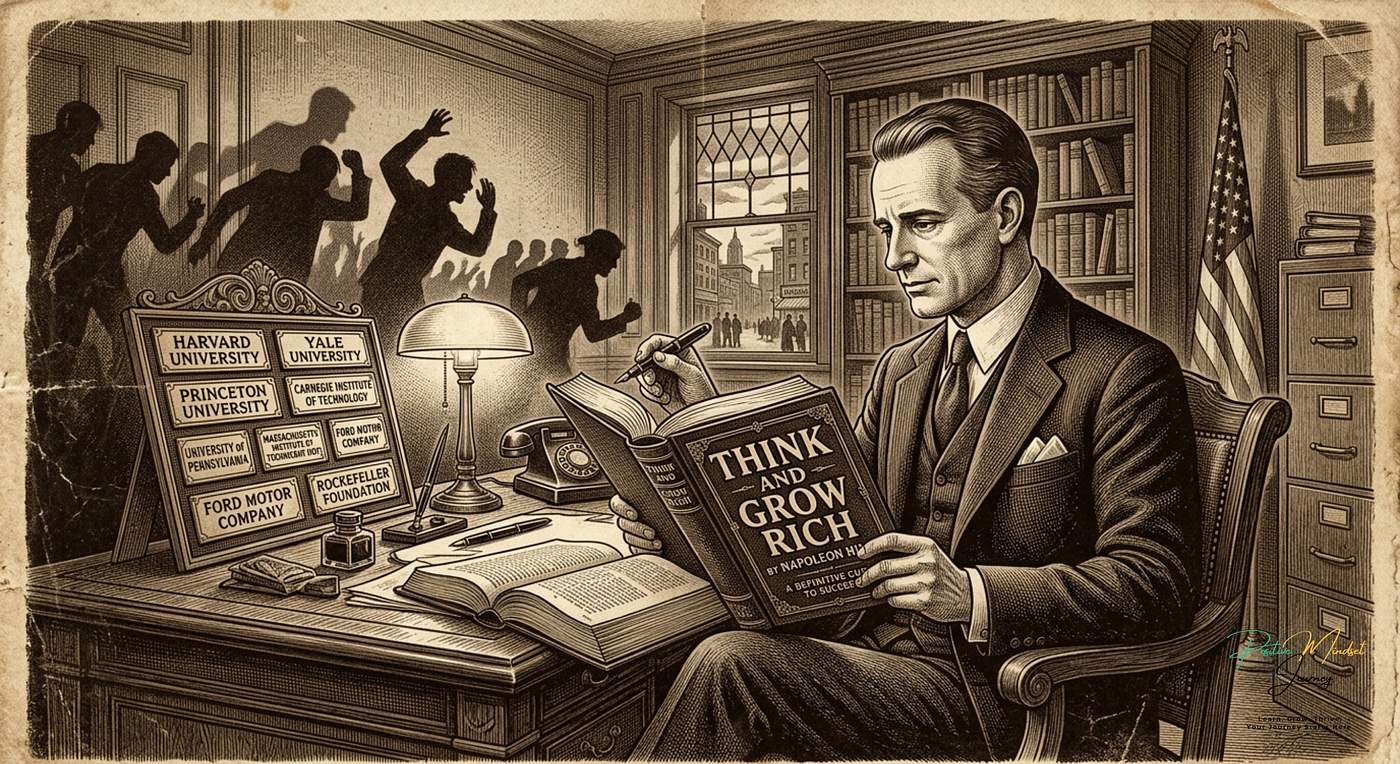
Napoleon Hill, born in poverty in rural Virginia in 1883, lands a job as a young journalist and in 1908 is sent to interview Andrew Carnegie, the richest man in the world.
Carnegie is so impressed that he gives Hill an extraordinary mission: spend twenty years interviewing the five hundred most successful people in America, find the common thread, and write a book that will give ordinary people access to the same principles.
Carnegie provides introductions to Thomas Edison, Henry Ford, Alexander Graham Bell.
Hill accepts the challenge without pay. Twenty years of work. The result, in 1937, is Think and Grow Rich, the book that essentially invented the self-help genre and has sold over one hundred million copies since.
It’s a remarkable story. It has everything: the poor boy, the great mentor, the noble mission, the patience, the eventual triumph.
There’s just one problem.
What was actually happening in 1908
Carnegie’s biographer, David Nasaw, one of the most respected historians of the gilded age, spent years in Carnegie’s personal papers, letters, and records.
When a journalist asked him about the famous Hill interview, Nasaw said he had found “no evidence of any sort that Carnegie and Hill ever met.” He went further: “Let me put it this way. I found no evidence that the book was authentic.”
Hill only started talking about Carnegie after Carnegie died in 1919. The man who was supposedly his greatest mentor had no opportunity to confirm or deny anything.
And what was Hill actually doing in 1908, the year he claimed to be sitting in Carnegie’s sixty-four-room mansion receiving the principles of success? Court records and newspaper archives tell a different story.
He was running a lumber company in Alabama, buying timber on credit, selling it for cash below market value, and not paying his suppliers.
By the end of the year there were fraud warrants out for his arrest, a lawsuit from the Babcock Brothers Lumber Company, and a postal service investigation for mail fraud.
Hill fled to Washington D.C., changed his name from Oliver to Napoleon, and reinvented himself as an automobile educator.
The Automobile College of Washington, his next venture, promised to teach students to build and sell cars.
It turned out to be a front for getting people to provide free labor to a motor company. By 1912, a trade magazine had called its marketing “a joke to anyone of average intelligence.”
Then came the George Washington Institute of Advertising. Then a candy company franchise. Then a charity for prisoners in Ohio, directed by a former convict who was himself sent back to prison the following year.
At each stop, there were fraud accusations, legal disputes, and a trail of people who felt they’d been misled.
This is the man who wrote the definitive book on integrity, persistence, and the mastermind principle.
The cult nobody mentions
And then there’s the part that doesn’t appear in any of the YouTube videos about Think and Grow Rich.
In the late 1930s, around the time Think and Grow Rich was becoming a bestseller, a group in New York called the Royal Fraternity of the Master Metaphysicians was using the book as their primary sacred text.
The group believed that disease was caused by negative emotions and that a human being raised in a perfectly positive environment, surrounded only by kind words, good food, and complete absence of any mention of death or illness, could theoretically live forever.
In 1939, they decided to test this theory.
The group informally adopted a newborn girl named Jean Gauntt. She would have personal nurses who would never speak of death or disease.
No unkind word would ever reach her. She would eat only vegetarian food. She would be surrounded entirely by positive thought, in an environment purified of anything that might suggest mortality.
Hill was not just a member of the group. He was named the baby’s godfather.
By now, I’ll leave you to draw your own conclusions about how that experiment ended.
Before we get to the part that actually matters, a quick question: which specific inner pattern is most actively shaping your results right now? The Manifestation Archetypes Test was built to map exactly that.
👉 **Manifestation Archetypes Test**
None of this makes Think and Grow Rich wrong
I know that might be hard to hear, especially if you’ve just spent several paragraphs reading about fraud warrants and immortal baby experiments. But stay with me, because this is the most important part.
The principles in Think and Grow Rich are not Napoleon Hill’s invention.
They are New Thought principles, drawn from a tradition that runs through Quimby, Hopkins, Wattles, and Atkinson, repackaged in the language of American business success.
The concept of the burning desire, the faith, the visualization, the mastermind, the subconscious as a medium between conscious intention and outer reality: all of this was in the air of New Thought for decades before Hill put it in a suit and called it a philosophy of achievement.
Hill didn’t discover the principle. He dressed it up for an audience that would never have bought a metaphysical book but would buy a business book. And in doing so, he brought these ideas to millions of people who needed them.
The biography of the messenger doesn’t change the content of the message.
Quimby’s healing insights didn’t become less true because he had no medical degree. Wattles’ understanding of creative thinking didn’t become less accurate because he spent most of his life in poverty. And the principle that your dominant inner state precedes and shapes your outer reality didn’t become less real because the man who popularized it was running fraud schemes in Alabama while claiming to be taking notes from Andrew Carnegie.
Yes, I know what you’re wondering. What happened to Baby Jean?
The experiment lasted fifteen months.
In December 1940, Catherine Gauntt, Jean’s mother, retained a lawyer who sent an ultimatum demanding her daughter back.
The Master Metaphysicians returned Jean without a legal fight, since they’d never officially adopted her.
Schafer tried to put a positive spin on things for the press, announcing that whether Jean continued to be immortal was now “for her parents to decide.”
He also sent detailed instructions on how to maintain the eternity diet. The parents did not maintain the eternity diet. According to press reports, within hours of her return, Jean was happily eating prunes, a food strictly forbidden under the immortality regime.
Schafer was sued for grand larceny, spent five years in Sing Sing prison, and died by suicide in 1955, at 59. The leader of a movement that promised immortality didn’t make it to sixty.
As for Jean: as of 2002, she was reported to be alive, married, with children of her own. She preferred not to discuss her past as the world’s first immortal baby.
And Hill?
He lost the royalties to Think and Grow Rich when his fourth wife, Rosa Lee, who was twenty-four years younger and had helped him write the book, persuaded him to sign a prenuptial agreement giving her those rights.
She subsequently sold off nearly everything they owned, and then married her divorce lawyer.
Hill died in 1970 with very little to his name.
The man who wrote the manual for getting rich died poor. The godfather of the immortal baby didn’t make it to eighty-seven. The eternity diet lasted fifteen months.
The principle, somehow, survived all of them.
What Hill understood, in spite of himself
Here is the detail that I find most extraordinary about this entire story.
Hill, in private, knew exactly what he was. Late in life, he wrote: “I had spent the better portion of my life in chasing a rainbow. I had begun to place myself in the category of charlatans who offer others a remedy for failure which they, themselves, cannot successfully apply.”
He saw himself clearly. And he kept writing and lecturing anyway.
But here’s the thing: in a profoundly strange way, Hill also demonstrated the principle he was teaching.
He decided, at some point, that he was a man who had met Carnegie, who had spent twenty years distilling the secrets of the most successful people in America, who had a message worth delivering to the world.
He acted from that identity so consistently, so completely, that the world eventually agreed with him.
Think and Grow Rich has sold over one hundred million copies.
It’s been in print continuously since 1937. It’s been cited by some of the most successful people of the twentieth and twenty-first centuries as a formative influence. The Napoleon Hill Foundation, established during his lifetime, continues to generate revenue and influence decades after his death.
He declared himself successful and influential. And then, over time, through the sheer consistency of that declaration, it became true.
The irony is almost too neat. The man who may have fabricated his greatest success story ended up living inside a different, real version of the exact principle he was describing. He became the thing he claimed to be, through the mechanism he was writing about, just not in the way he said he did.
That is either a cautionary tale or the most literal possible proof of the principle. Possibly both.
What to do with this
If you’ve read Think and Grow Rich and found something real in it, you don’t have to throw it away. The principles are real. They come from a tradition that predates Hill by half a century and will outlast him by considerably longer.
What’s worth keeping: the burning desire as the starting point, the role of the subconscious in translating intention into action, the idea that your habitual inner state shapes what you attract and what you notice.
What’s worth releasing: the mythology around the book itself, the idea that Hill was some kind of saintly researcher who spent twenty years in selfless service to humanity’s understanding of success. He wasn’t.
He was a complicated, often dishonest, occasionally brilliant man who found the right ideas at the right moment and packaged them in a way that resonated with millions of people who needed exactly that message in exactly that form.
The principle doesn’t need the myth to survive. It was already surviving before Hill got to it.
And it’ll still be here long after everyone has forgotten about the immortal baby in Queens.
Stay in the flow
메타데이터
- post_id
- e80cfded61ca
- slug
- napoleon-hill-think-grow-rich-true-story-e80cfded61ca
- url
- https://articles.positivemindsetjourney.com/napoleon-hill-think-grow-rich-true-story-e80cfded61ca
- canonical_url
- https://articles.positivemindsetjourney.com/napoleon-hill-think-grow-rich-true-story-e80cfded61ca
- author_url
- https://medium.com/@amaralane
- status
- ok
- fetched_at
- 2026-07-09 05:26:43