What Schools and Universities Need to Know About Electronics Recycling in Oklahoma City
What Schools and Universities Need to Know About Electronics Recycling in Oklahoma City
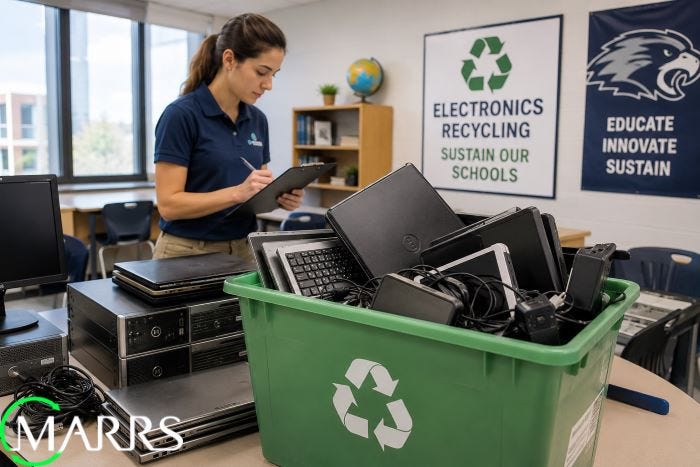
Technology turnover in education happens fast. A district that deployed Chromebooks in 2021 is already looking at end-of-life units. A university that upgraded its server infrastructure is sitting on racks of retired storage hardware. The devices accumulate, the storage rooms fill up, and the compliance clock keeps running whether anyone is paying attention to it or not.
MARRS Recycling works with K-12 districts, community colleges, and research universities across Oklahoma City to manage this process from asset pickup and reliable electronics recycling through certified data destruction and R2v3-compliant downstream processing.
[Call (866) 884–0266]()
Which Oklahoma City Schools and Universities Need Electronics Recycling?
The pressure lands on specific people. District technology directors managing thousands of student devices. University IT managers coordinating equipment retirement across multiple departments. Procurement and compliance officers who get involved once the word “FERPA” comes up in the conversation.
According to the Consortium for School Networking (CoSN), the average K-12 district refreshes student devices on a three-to-four-year cycle. (Source: CoSN Annual EdTech Leadership Survey, cosn.org) For an Oklahoma City district with 4,000 deployed devices, that is a significant volume of end-of-life equipment entering the electronics disposition stream every cycle. At the university level, the volume is higher and the equipment more varied: high-performance computing systems, research data storage, laboratory instruments, and administrative servers all carry different data sensitivity profiles.
The people seeking ewaste recycling services in Oklahoma City education are typically not doing it because things are going smoothly. They are doing it because a storage room is at capacity, an audit is approaching, or a device refresh is scheduled and nobody has a documented plan for the outgoing units. At MARRS Recycling, the Oklahoma City institutions we work with most frequently are mid-to-large school districts, community colleges, and research universities managing recurring refresh cycles. Technology directors typically initiate the process, but compliance officers and CFOs are usually involved by the time the project gets approved, especially when FERPA documentation is part of the requirement.
Why FERPA Makes Proper Data Destruction Non-Negotiable for Schools in Oklahoma City
FERPA, the Family Educational Rights and Privacy Act, requires educational institutions to protect personally identifiable student information and ensure its destruction prevents unauthorized recovery. That obligation extends to every data-bearing device an Oklahoma City institution has ever issued, including laptops with cached credentials, tablets with locally stored files, and Chromebooks enrolled in Google Admin that have not been deprovisioned.
Deleting files is not data sanitization. Reimaging a device is not data destruction. NIST SP 800–88 Rev. 1 defines the federal standard for media sanitization and distinguishes clearly between Clear, Purge, and Destroy categories based on media type and sensitivity. For most functional student devices, a software-based overwrite to Purge standard is appropriate. For devices with failed operating systems, locked bootloaders, or damaged storage, physical destruction of the NAND flash or hard drive is the only defensible method.
Universities in Oklahoma City handling federally funded research face an additional layer under the Cybersecurity Maturity Model Certification (CMMC) framework if they store Controlled Unclassified Information (CUI). For those institutions, sanitization method is not a preference. It is an auditable requirement.
“We have processed equipment from university decommissioning projects where no one could confirm which drives had been wiped. That is not an edge case, it is common. When documentation does not exist at the individual asset level, the institution has no protection if something surfaces later.” — Matt Self
[Call (866) 884–0266]()
What Types of Equipment Do Educational Institutions in Oklahoma City Need to Recycle?
Schools and universities in Oklahoma City generate e-waste across a much broader range of device categories than most people account for when planning a cleanout.
Classroom technology produces the highest volume: laptops, Chromebooks, tablets, desktop computers, interactive whiteboards, projectors, and audio-visual equipment. Administrative departments add servers, networking switches, wireless access points, printers, and telephony systems. Research-intensive universities layer in high-performance computing clusters, laboratory instruments, and specialized data storage arrays, many of which hold sensitive research data or intellectual property.
Infrastructure components also get overlooked: server racks, UPS units, cable management hardware, and decommissioned network equipment that does not fit cleanly into standard recycling categories. A capable ITAD and electronics recycling provider handles all of it in a single coordinated pickup, which matters when Oklahoma City school IT teams are already stretched thin.
What Is the Difference Between Electronics Recycling and ITAD for Oklahoma City Schools?
These terms overlap but they are not the same, and the difference affects both your documentation and your budget.
Electronics recycling handles end-of-life equipment with no residual market value: broken units, obsolete hardware, devices that have aged past any refurbishment potential. R2v3-certified recycling ensures those materials go through vetted downstream vendors rather than ending up in jurisdictions with inadequate environmental enforcement.
ITAD, IT Asset Disposition, is a broader process that includes evaluating devices for residual resale value before they reach end-of-life recycling. A three-year-old Chromebook from an Oklahoma City school that still boots and holds a charge has secondary market value. A certified ITAD provider identifies that value, processes the device appropriately, and returns proceeds to offset disposal costs. For Oklahoma City districts operating on constrained budgets, that is a meaningful difference.
Using a provider who handles both ITAD and certified recycling means you get value recovery where it is possible and compliant end-of-life processing where it is not, with a single chain-of-custody document trail covering everything.
How Does the Disposition Process Work for a School or University?
A well-managed electronics recycling and ITAD project for Oklahoma City institutions follows a clear sequence.
- Asset intake and serialized logging. Every device is catalogued by make, model, and serial number at pickup. For mobile devices and Chromebooks, IMEI or device ID is recorded. Chain of custody begins here.
- Chromebook and managed device deprovisioning. Google Admin deprovisioning is a required step for managed Chromebooks before reuse or resale. Apple devices enrolled in Apple School Manager require similar handling. Skipping this step creates liability for the Oklahoma City district if a device is resold.
- Condition triage and value assessment. Devices with residual market value are flagged for refurbishment or resale through the ITAD process. End-of-life units proceed directly to destruction.
- Data sanitization. NIST 800–88 Rev. 1-compliant software wiping for functional devices. Physical shredding or crushing of storage components for inaccessible media. The method applied to each individual device is recorded.
- Certificate of Destruction issued at the asset level. Not a batch summary. Each device receives its own serialized CoD tied to its serial number. That is what holds up in a FERPA audit for Oklahoma City institutions.
- R2v3-certified materials processing. Post-sanitization components enter the certified recycling stream. Metals, plastics, glass, and circuit board materials are recovered through downstream vendors vetted for environmental compliance.
- Final disposition report. The Oklahoma City institution receives complete documentation covering every device processed: sanitization method, disposition outcome, and materials handling.
Document What It Confirms Certificate of Destruction (CoD) Individual asset-level proof of data destruction Certificate of Recycling Confirmation of materials processing and disposal Disposition Report Complete project-level accounting of all assets Chain of Custody Record Document trail from pickup to final processing
[embed]
[Call (866) 884–0266]()
What Should Schools Look for in an Electronics Recycling Partner?
Not every recycler can support the documentation requirements that FERPA audits and institutional governance demand. R2v3 certification is the baseline for responsible downstream materials handling. NAID AAA certification covers data destruction operations and is particularly relevant if the provider handles on-site shredding. ISO 14001 certification verifies that environmental management systems are in place.
A vendor who provides a single Certificate of Recycling for a batch of 500 devices from an Oklahoma City school has not provided data destruction documentation. Those are two different records with two different compliance functions. If your provider does not know the difference, that is your answer.
Can Schools Recover Value from Older Equipment?
Yes, and this surprises many Oklahoma City district IT directors who assume retired devices have no value. Laptops, Chromebooks, and desktops retired at the three-to-four-year mark often retain secondary market value, particularly if they are commercial or education-grade units in working condition. The proceeds from remarketing refurbished equipment can reduce or in some cases eliminate pickup and processing fees.
This only works when your provider has the refurbishment infrastructure and secondary market access to realize that value and pass it back to the institution. Ask specifically how value recovery is calculated and what the Oklahoma City institution receives before signing an agreement.
How MARRS Recycling Supports Schools and Universities in Oklahoma City
MARRS Recycling provides electronics recycling, ITAD, and certified data destruction services for Oklahoma City K-12 school districts, community colleges, and universities. The process covers coordinated pickup, serialized asset logging, NIST 800–88-compliant data sanitization, individual Certificates of Destruction, managed device deprovisioning, and R2v3-certified materials processing with full documentation for FERPA compliance and institutional audits.
Schedule a Pickup with Marrs Recycling.
Have a device refresh or audit coming up?
[Call (866) 884–0266]()
The post What Schools and Universities Need to Know About Electronics Recycling in Oklahoma City appeared first on MARRS.
메타데이터
- post_id
- e80f424dfd32
- slug
- what-schools-and-universities-need-to-know-about-electronics-recycling-in-oklahoma-city-e80f424dfd32
- url
- https://medium.com/@marrsllc/what-schools-and-universities-need-to-know-about-electronics-recycling-in-oklahoma-city-e80f424dfd32
- canonical_url
- https://medium.com/@marrsllc/what-schools-and-universities-need-to-know-about-electronics-recycling-in-oklahoma-city-e80f424dfd32
- author_url
- https://medium.com/@marrsllc
- status
- ok
- fetched_at
- 2026-08-10 14:12:41