Keeping Kids in School with Clean Air
These are the steps schools should take to ensure students stay healthy and in school.
Keeping Kids in School with Clean Air using ASHRAE 241

Image by vectorpocket on Freepik
With the school year approaching, we need a proper plan to ensure our schools are healthy environments. We now have ASHRAE standard 241 to control infectious aerosols. Here’s how it can be implemented at schools.
What tools do we have?
There are 4 categories of tools for providing equivalent clean air:
- Ventilation — supplying outdoor air to a space
- Filtration — passing recirculated air through a filter to remove particles
- UV — using ultraviolet light to disinfect the air
- Alternative Methods — supplying compounds or reactive particles to the space with the goal of inactivating pathogens or increasing their deposition rate. Examples include ionization, photocatalytic oxidation, gaseous hydrogen peroxide and hydroxyl generators.
Ventilation and filtration are the two main tools to remove airborne pollutants and improve indoor air quality. Some methods of using UV, including in-duct UV and UV in portable air cleaners can be replaced by filtration. Filtration has the added benefit of removing all particulate matter and not just pathogens. Both upper room UV or far-UV are effective methods to provide very high clean air delivery rates to spaces above capabilities of many ventilation or filtration systems, however they are currently not approved for use in Canada, so cannot be currently considered as viable options.
Alternative methods can produce harmful byproducts including ozone, formaldehyde and particulate matter. They also are not currently required to provide information about effectiveness. Consequently, it is likely best to avoid them until they are regulated in accordance with ASHRAE 241.
We know ventilation and filtration are both safe, effective and have additional benefits beyond mitigation of airborne diseases, so these methods should be preferred. Therefore, these are the two air cleaning methods that schools can implement to comply with ASHRAE 241.
What facilities can do

The Lancet COVID-19 Commission
The Lancet COVID-19 commission published a report outlining the first four healthy building strategies facilities can take to reduce the risk of airborne transmission of COVID-19. The four strategies are:
- Commission building systems — ensure they are running properly
- Maximize the amount of outdoor air supplied to the space
- Upgrade filtration to MERV-13 filters
- Supplement with portable air cleaners
Explanation

Schematic of a RTU. Source: Lorenzo Cremaschi & Pedro Perez Paez (2017) Experimental feasibility study of a new load-based method of testing for light commercial unitary heating, ventilation, and air conditioning (ASHRAE RP-1608), Science and Technology for the Built Environment, 23:7, 1178–1188, DOI: 10.1080/23744731.2016.1274628
The blue arrows show the outdoor air (OA), exhaust air (EA), return air (RA) and supply air (SA) of a typical rooftop unit. The OA damper and RA damper select how much return or outdoor air is mixed and supplied to the space. The air then passes through a filter, heating and cooling sections and then supplied to the space.
The dampers can be adjusted to increase the amount of outdoor air and exhaust more return air. The filter can then be changed to a filter that is more efficient at removing fine particulate matter and infectious aerosols. Consequently, the supply air to the space will be cleaner.
Air Quality Monitoring
I would add a fifth strategy which would be transparency through monitoring CO2 with a readable display and creating a building readiness plan.
What occupants can do
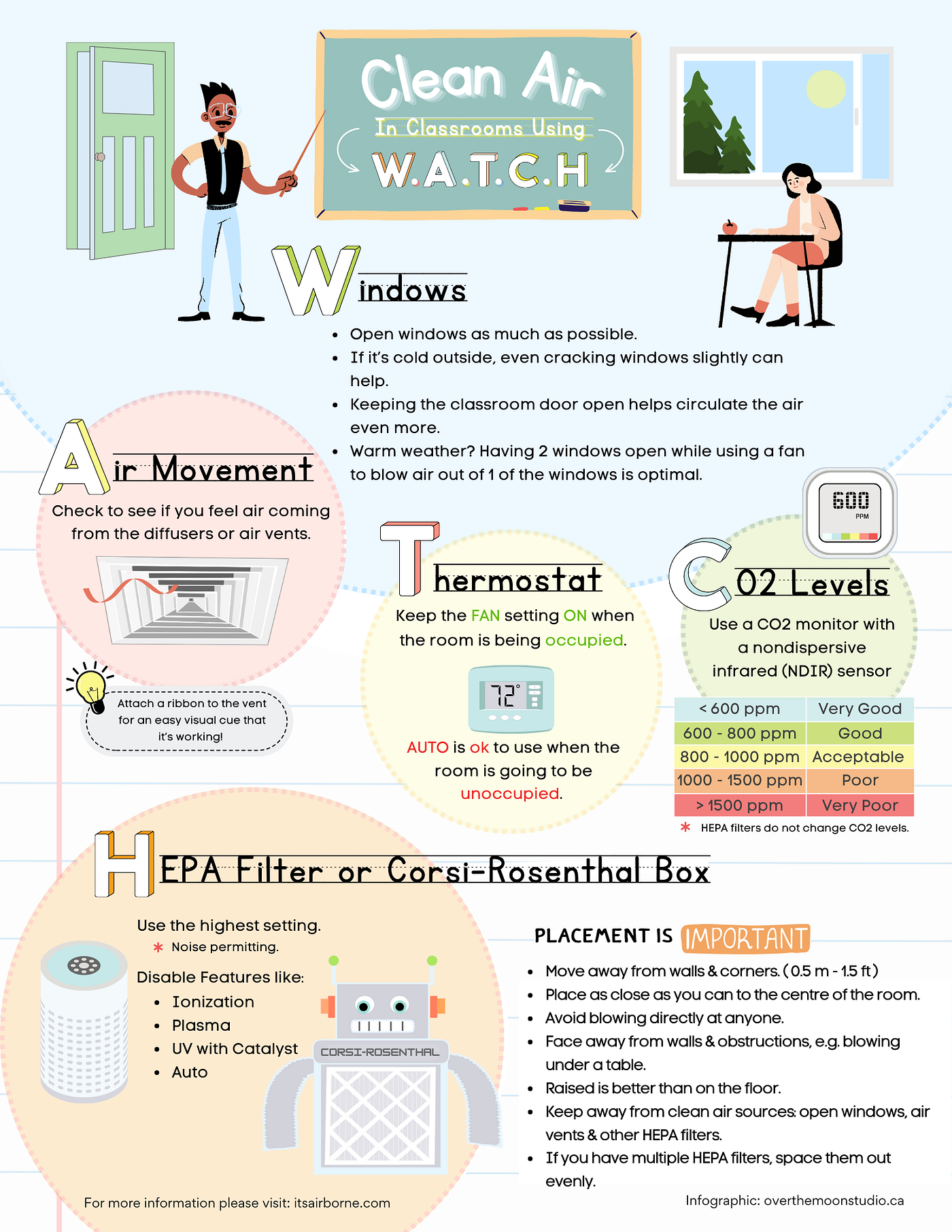
The previous strategies apply mostly to HVAC equipment which occupants have no control over. However, there are air cleaning strategies that can be done in each occupied room for occupants to create a lower risk space.

High Resolution PDF.
The five things individuals can do are:
- Windows — open as much as possible, weather permitting
- Air movement — monitor the airflow from ventilation supply diffusers
- Thermostat — Ensure the fan setting on thermostats are set to ON when the space is occupied
- CO2 — monitor CO2 and ensure the levels align with the ventilation rates the facility is supposed to provide
- HEPA filter — ensure the HEPA filters are placed and being operated properly.
Summary of the Tools
Here’s a summary of the tools to ensure clean air:

Procedure to ensure clean air
1. Setting a Target
Ensuring the correct minimum amount of clean air supplied is the first thing that needs to be done. Setting a target has always been a challenge with many different standards and recommendations provided. The CDC recommends 5 air changes per hour and Lancet COVID-19 commission recommends 6 air changes per hour or 15 liters/second/person (lps/person). The most accurate standard that should be used moving forward is ASHRAE 241. In classroom environments, the requirement is 20 lps/person. Consequently, take the amount of people in a classroom, multiply it by 20 and you will know how much clean air you need in lps. Although I’ll be discussing classrooms, the same procedure can be applied to all spaces using the rates in ASHRAE 241.
Examples: Classroom with 25 people: 25 people x 20 lps/person = 500 lps
Classroom with 15 people: 15 people x 20 lps/person = 300 lps
2. Determining Ventilation Rate
When determining how much clean air is provided to a space, start with measuring the outdoor airflow rate. There are 3 main ways to do this:
- Have an air balancer directly measure the airflow and use the value from the balancing report.
- Use a tracer gas and measure how quickly it is removed from a room. The best way to do this is with dry ice and a CO2 monitor. The procedure is explained here on page 16.
- Measure the steady state CO2 in the room. It will tell you the approximate outdoor airflow per person according to the following table:

Outdoor airflow rates based on CO2 concentrations. Differences between elementary and high schools are because older people have higher CO2 generation rates. Derivation of the table is explained here.
Windows and infiltration (air leaking into the building) also count towards the ventilation rate. The best way to confirm the magnitude of these contributions is through CO2 monitoring.
Example — a elementary school class with 25 people, CO2 is 1200 ppm: Outdoor airflow rate is 5 lps/person. Total outdoor airflow is 5 lps/person x 25 people = 125 lps.
A school that is compliant with minimum ventilation requirements (designed for comfort and not for controlling airborne diseases), would have a CO2 concentration around 1000 ppm or less. This does not imply good general air quality, but compliance with minimum requirements. Classrooms with CO2 concentrations above 1000 ppm should have the ventilation improved for general comfort and health. According to the CDC (FAQ #9), 800 ppm is generaly representative of a well-ventilated space. Specifically to mitigate airborne disease transmission, filtration is an acceptable alternative.
3. Upgrade Filters to MERV-13
Based on ASHRAE 241 table 7–1, MERV-13 filters are 77% effective at removing infectious aerosols. Mechanical drawings need to be viewed or air balancing measurements are required to determine how much recirculated air is supplied to a space.
Example — a HVAC unit is designed to supply 500 lps to a classroom. 20% is outdoor air and 80% is recirculated air. Upgrade to MERV-13. Outdoor airflow = 0.2 x 500 = 100 lps Recirculated airflow = 0.8 x 500 = 400 lps Clean recirculated airflow = 400 lps x 0.77 = 308 lps Total clean airflow = outdoor airflow + clean recirculated air = 100+308 = 408 lps
4. Supplement with HEPA Filters
Why We Usually Need to use HEPA Filters Most HVAC systems are not designed to be capable of supplying 20 lps/person at full occupancy. In schools, minimum ventilation rate is about 6-7.5 lps/person. HVAC systems can often be improved by increasing outdoor air and upgrading filtration, but it is generally difficult to increase the clean air delivery rate above 15 lps/person at full occupancy. This means that in most cases, for fully occupied classrooms, additional in-room air cleaning will be required to comply with ASHRAE 241. In Canada, that is currently limited to in-room filtration.
Selecting HEPA Filters Once the first three steps are complete of verifying and improving the HVAC system, we can determine how to size HEPA filters:
HEPA Filter CADR = Target clean airflow — outdoor airflow — clean recirculated airflow
Once the required CADR is known, the Clean Air Stars tool can be used to select the proper air cleaners. Another option is to use the PC Fan CR boxes and purchase the correct amount of Luggable units from Clean Air Kits. These are quiet options that would be compatible with any classroom. A luggable XL has a CADR 150 lps and a Sickle Flow has a CADR of 100 lps.
Examples
Example 1
Elementary school classroom with 28 people, rooftop unit supplying 500 liters/second, 30% outdoor air.
Step 1: Set the target 28 people x 20 liters/second/person = 560 lps of clean air
Step 2: Determine ventilation rate 500 lps x 0.3 (outdoor air) = 150 lps 150 lps/28 people = 5.3 lps/person outdoor air, expected CO2 is 1200 ppm. Measured CO2 at 1000 ppm because of windows and infiltration. Actually 7 lps/person outdoor air. Total of 200 lps/person outdoor air.
Step 3: Unit upgraded to MERV-13 filters. Recirculated air is 70% of 500 lps = 350 lps. MERV-13 filters are 77% efficiency: 350 x 0.77 = 270 lps
Step 4: In-room filtration CADR = Target — outdoor air — recirculated clean air = 560–200–270 = 90 lps A single Sickle Flow of 100 lps would be sufficient
Example 2
High school classroom with 20 people. No mechanical ventilation.
Step 1: Set the target 20 people x 20 liters/second/person = 400 lps of clean air
Step 2: Determine ventilation rate Measured CO2 2000 ppm = 3 lps/person. Outdoor airflow rate = 3 lps/person x 20 people = 60 lps
Implement open window policy. New CO2 = 1200 ppm. Outdoor airflow rate = 6 lps/person x20 = 120 lps.
Step 3: No mechanical ventilation. Cannot upgrade HVAC filtration.
Step 4: In-room filtration CADR = Target — outdoor air — recirculated clean air = 400–120–0 = 280 lps Two luggable XLs provide 300 lps. Would be sufficient.
Implementation
Currently, we do not have any operations standards or requirements for indoor air quality, so there are no legal avenues to ensure low risk indoor spaces. Having these policies implemented currently requires advocacy, building relationships and educating decision makers which can be done on the local level. This website has resources on how to do this:
OHCOW Presentation
A webinar I gave with OHCOW on this topic can be viewed here:
[embed]
Slides from the presentation can be seen here.
Disclosure: I have no conflicts of interest.
메타데이터
- post_id
- e82efcd43e86
- slug
- keeping-kids-in-school-with-clean-air-e82efcd43e86
- url
- https://itsairborne.com/keeping-kids-in-school-with-clean-air-e82efcd43e86
- canonical_url
- https://itsairborne.com/keeping-kids-in-school-with-clean-air-e82efcd43e86
- author_url
- https://medium.com/@joeyfox.85
- status
- ok
- fetched_at
- 2026-08-21 21:42:39