Why Good Wiring Diagrams Still Don’t Exist (And How VoltPlan Is Trying to Fix It)
If you’ve ever tried to plan a boat or camper electrical system, you’ve probably fought with messy diagrams, missing labels, and tools that
Why Good Wiring Diagrams Still Don’t Exist (And How VoltPlan Is Trying to Fix It)
The messy, inconsistent reality of DIY wiring diagrams — and one stubborn attempt to make them look good, read easily, and actually help you make decisions.
I’ve drawn more wiring diagrams than I care to admit. On paper. In Visio. In CAD. On the back of a pizza box once.
Every time, the same outcome:
- Either it looks messy and scares off beginners.
- Or it’s so simplified it hides the details that actually matter.
If you’ve ever planned a camper or boat electrical system, you know the feeling. You start with “battery → fuse → load.” Four hours later you’re negotiating with your diagram tool about why your fuse is floating in space and your battery is upside down. Meanwhile, you still don’t know if your cable gauge is right.
The strange part: the world is full of software for drawing things — flowcharts, network maps, PCBs. But clean, readable wiring diagrams? Still kind of an unsolved problem.
The Pain Points Nobody Talks About
Here’s the awkward truth: tools for hobbyists who want good-looking wiring diagrams basically don’t exist. Not if you want something you’d be proud to share and that someone else can read without calling you.
Some diagrams in the wild are OK. A few are great. But it’s wildly inconsistent — everyone invents their own visual language from scratch. There’s no shared standard. A fuse looks one way here, another way there. Some people label amps, some volts, some nothing.
What a good wiring diagram should have isn’t rocket science:
- Clear labeling — not just “battery” and “switch,” but the useful stuff: wire gauge, amperage, ratings, lengths.
- Good-looking components — instantly recognizable symbols that don’t make you squint to guess what they are.
- Clean wiring — as few intersections as possible, logical routing, consistent color coding so your eyes can follow a path without getting lost.
This sounds obvious. Try making all three happen at once with current tools. You’ll end up compromising on at least two.
How VoltPlan Tries to Crack It
VoltPlan wasn’t born from a grand business plan. It came out of frustration — and a stubborn belief that it should be possible to get a diagram that looks like a meticulous human drew it by hand.
What it does differently:
- Autogenerated, but human-grade
- You pick components; VoltPlan builds a high-quality diagram automatically — clearly labeled, neatly divided by category, and still interconnected so the whole system makes sense at a glance.
- Looks like someone cared
- The layout, spacing, proportions — this isn’t “boxes and noodles.” It feels like a careful person laid it out with intent.
- Understands when something’s off
- An assistant suggests what to add next and flags inconsistencies: battery capacity too low (or absurdly high), cable gauge mismatches, an inverter that doesn’t match reality. It’s like having a second brain that’s seen a few dozen installs go wrong and learned from them.
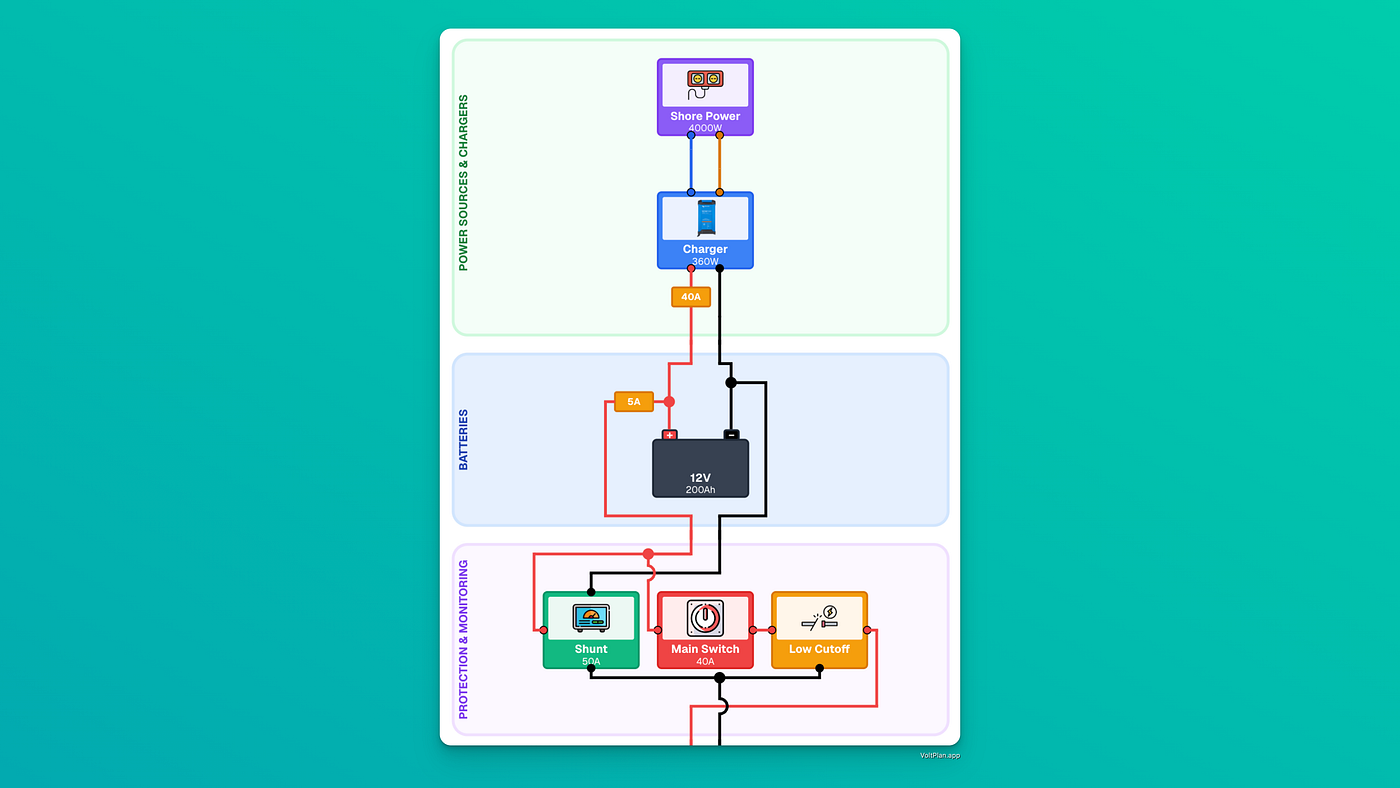
Clean VoltPlan diagram with categories clearly marked
This isn’t about shipping features for a checklist. It’s about making the process easier and the result better — both or nothing.
Why I Ended Up Building My Own Tool
After three years with my boat LARGO, I had to admit something slightly embarrassing: I still didn’t fully understand my own wiring.
Not in the “where are the batteries” sense — more in the “can I add another fridge without breaking the system” sense.
One afternoon I sat down to figure it out. Notebook. Then a sketch. Then a diagramming app. Two hours later, my “system” looked like a committee of caffeinated spiders held a sprint review in my bilge.
I thought: surely there’s a tool for this.
There wasn’t. Not one that gives you a diagram that’s accurate, easy to read, and helps you decide what to change. So I built it.

Hand drawn wiring diagram
What “Good” Looks Like (For Me)
A good wiring diagram should help you make decisions, not just decorate a wall. That means:
- If a cable is the wrong gauge, the diagram should make that obvious.
- If your battery capacity doesn’t match your loads, you should see it — before buying new hardware.
- If a component is missing (fuse, isolator, shunt), the tool should nudge you like a friendly electrician: “Hey, you’ll want this.”
VoltPlan aims for that mix of clarity, aesthetics, and guidance. The end result should be something you’re happy to share with your partner, a forum, or an actual electrician — without adding a paragraph of apology below it.
Where I’m At Now (And Where You Come In)
Right now, I’m looking for early users and honest feedback. Personal use will always be free for early adopters — because I genuinely value the input at this stage more than payments.
What I’m asking from you:
- Try it. Build a diagram you actually care about — boat, camper, off-grid cabin.
- Think out loud. Write down what confuses you. Or just record your screen and talk.
- Tell me where it fails. The rough edges are where the tool learns the most.
I call the community a family on the homepage. Maybe that’s too personal. Maybe it’s exactly right. Either way, that’s the energy: we make it better together, and we share what we learn.

VoltPlan homepage with “Family” tagline visible
The Goal
I don’t think wiring diagrams are glamorous. But when they’re clear, beautiful, and accurate, they unlock confidence. They help you explain your setup to someone else. They prevent expensive mistakes. They make the whole project feel doable.
That’s the bar for VoltPlan. And I’ll keep building until it feels like the obvious way to do this.
If you wire campers, motorboats, or micro-homes — come break this thing with me.

The VoltPlan Homepage
→ Try VoltPlan now!
메타데이터
- post_id
- e84140da3a30
- slug
- why-good-wiring-diagrams-still-dont-exist-and-how-voltplan-is-trying-to-fix-it-e84140da3a30
- url
- https://medium.com/@blackmacde/why-good-wiring-diagrams-still-dont-exist-and-how-voltplan-is-trying-to-fix-it-e84140da3a30
- canonical_url
- https://medium.com/@blackmacde/why-good-wiring-diagrams-still-dont-exist-and-how-voltplan-is-trying-to-fix-it-e84140da3a30
- author_url
- https://medium.com/@blackmacde
- status
- ok
- fetched_at
- 2026-06-17 16:37:43