Before They Were White: How Different Groups Were Treated as Immigrants to America
From the Founding to the Semiquincentennial, the Argument Over ‘Who We Are’ Never Stops
Before They Were White: How Different Groups Were Treated as Immigrants to America
From the Founding to the Semiquincentennial, the Argument Over ‘Who We Are’ Never Stops
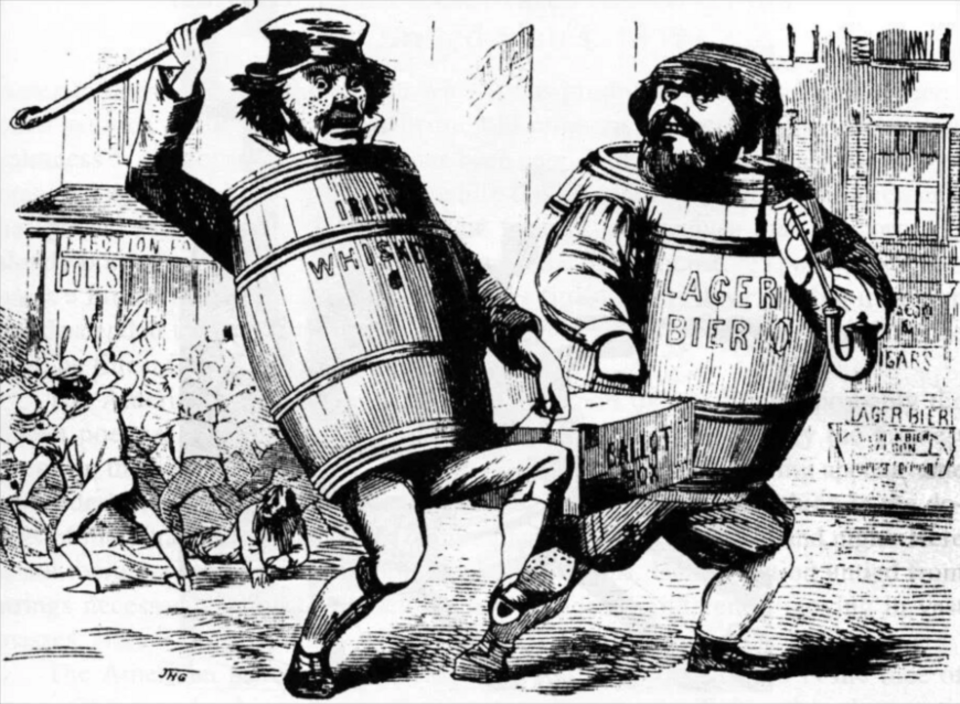
John H. Goater, Public domain, via Wikimedia Commons
Most cover photos work because they immediately convey the story's theme. This one, unfortunately, needs explanation. It shows drunken Irish and German immigrants stealing a ballot box. John H. Goater created the political cartoon from the 1850s. It portrays caricatures representing Irish and German voters engaging in what appears to be election theft, with chaos unfolding in the background at the “Election Day Polls” building.
The cartoonist uses stereotypical imagery to convey fear of immigrant voters exerting undue political influence. The portrayal of the Irish and German voters in a negative light, with exaggerated features and behaviors, perpetuates harmful stereotypes associated with these immigrant communities. By depicting them as thieves, the cartoon suggests that these groups are unlawfully manipulating the electoral process to their advantage. The people the elections were being stolen from were white people. Early Irish and German immigrants weren’t initially considered white. They say ex-smokers are the hardest on those who still smoke. Former non-white people who have become white, now lead the way in protecting whiteness, making sure people of color never get the power, especially in elections, to take what is theirs.
Whiteness didn’t exist until America invented it. The word “white” as it applied to a race of people didn’t occur in print until 1671. White and Black indentured servants often worked together, and the rich white landowners depended on them to perform labor and work their fields. That doesn’t mean these servants were all treated the same. In 1640, a slave named Emmanuel was caught attempting to escape along with six European indentured servants. As a penalty, the Europeans had their terms of servitude extended. Emmanuel’s term wasn’t extended; he was branded with an “R” for runaway; he was already considered a servant for life, so there was no need to extend his service. Many Black indentured servants were illegally kept after their service had expired. Many of them spoke little English, and most were forbidden to read. Also, in 1640, John Punch escaped along with two other servants. When captured, they were given an additional four years to serve their master; Punch was required to serve the rest of his natural life.
It was 1661 when Virginia first passed slavery laws, which some historians consider to be when slavery began in America, although Massachusetts had passed similar laws as early as 1641. While white indentured servants still existed, all enslaved people were Black (though not all Black people were enslaved). White masters were producing so many children via the rape of slave women that they had to change the law, not only condemning any children born to those women to a lifetime of slavery but also absolving white men of any responsibility for the children and any charges of rape.
1676 marked a dramatic change in indentured servitude. Virginia plantation owner Nathaniel Bacon took matters into his own hands after his relative, Governor William Berkeley, wasn’t moving fast enough to rid the area of Native Americans so Bacon could own even more property. Berkeley was concerned that the tribes would join forces and be impossible to control. Bacon gathered up his white and Black indentured servants along with his Black slaves, forming a militia to fight the various tribes that had been raiding the farms (defending their land). In return for their support, he promised them their freedom. Thousands of Virginians and their indentured servants joined Bacon and ultimately burned down Jamestown, then the capital of Virginia.
The thought of white and Black servants and slaves joining forces scared the shit out of colonists. It marked the end of heavy reliance on indentured servitude in favor of chattel slaves. Term limits on indentured servants gave way to a lifetime of slavery, making up for any labor shortage from the loss of white servants. The elite powers created a wedge between whites and Black of similar low status. Even the poorest white person was placed above any Black person. By 1705, Virginia established its first slave codes, codifying white supremacy into law by doing the following:
- Established new property rights for enslavers
- Allowed for the legal, free trade of enslaved people, with protections granted by the courts
- Established separate courts of trial
- Prohibited blacks, regardless of free status, from owning arms [weapons]
- Blacks could not employ whites
- Allowed for the apprehension of suspected runaways
The initial motive for pitting Black people against whites was always economics. The threat of them working together against the elite was too great to allow them to merge. Whiteness was literally created to distinguish itself from those it wished to control, and not all light-skinned people were initially allowed to be considered white. Among the people not initially regarded as white in America were Germans, Greeks, white Hispanics, Spaniards, Jews, Slavs, Italians, Afghans, Iranians, and Irish. The Immigration Act of 1790 only offered naturalization to “any alien, being a free white person.” In 1923, the Supreme Court ruled that people of Indian descent were not white and couldn’t become citizens.
“The average man knows perfectly well that there are unmistakable and profound differences” between Indians and white people.”
In 1925, an Armenian immigrant successfully argued his whiteness due to his family’s and country’s Christian traditions.” People of Jewish and Arab descent were generally considered white, though many of them objected to the classification. The Census Bureau once proposed a new category to classify people from the Middle East and North Africa in the 2020 Census, but the proposal was abandoned.
No Middle Eastern Or North African Category On 2020 Census, Bureau Says : NPR
Group‑by‑Group Breakdown
Germans
Not considered white in the 18th–19th centuries. They were seen as:
- “swarthy,” “boorish,” “drunk,” “non‑English”
- politically dangerous (1848 radicals)
- culturally unassimilable
They faced:
- riots against German neighborhoods
- bans on German language schools
- anti‑German hysteria during WWI (lynchings, book burnings, forced name changes)
Irish
The most famous case of “not white yet.”
They were depicted as:
- ape‑like
- criminal
- drunk
- violent
- racially inferior Celts
They faced:
- “No Irish Need Apply” job discrimination
- segregated neighborhoods
- anti‑Catholic riots
- political disenfranchisement
- being treated as a separate race in newspapers and science
The Irish were recruited to man the first police forces in the Northeast and Midwest. Their main job was to protect the property of “white people” and control other immigrant groups. In the South, the same job was initially done by slave patrols.
Italians (especially Southern Italians)
Seen as:
- non‑white “Mediterraneans”
- racially closer to Africans than Europeans (per 19th‑century racial science)
- criminal, mafia‑associated
- anarchists
They faced:
- the largest mass lynching in U.S. history (New Orleans, 1891)*
- immigration quotas targeting them
- segregated housing
- job discrimination.
*The largest mass lynching requires one to disregard dozens of lynchings of Black people, Native Americans, and Chinese workers, but it was still bad.
Greeks
Viewed as:
- “Asiatic,” not European
- racially ambiguous
- Orthodox Christians (seen as foreign)
They faced:
- anti‑Greek riots (e.g., Omaha 1909)
- exclusion from unions
- bans on Greek coffeehouses
- being legally classified as “not white” in some court cases
Jews (Eastern European and Sephardic)
Seen as:
- a separate Semitic race
- unassimilable
- politically radical
- physically distinct
They faced:
- university quotas
- housing covenants
- exclusion from clubs and professions
- anti‑Jewish riots
- FBI surveillance
They were not accepted as white until after WWII. Some people have yet to accept them.
Slavs (Poles, Ukrainians, Russians, Czechs, etc.)
Seen as:
- “Mongoloid” or “Asiatic”
- racially inferior to Anglo‑Saxons
- prone to radicalism
- unfit for democracy
They faced:
- exclusion from skilled labor
- segregated ethnic enclaves
- anti‑Slavic violence
- immigration quotas are designed to keep them out
Spaniards
Seen as:
- “swarthy”
- too close to North Africa
- Catholic and therefore foreign
They faced:
- job discrimination
- racialization as “Spanish‑Indian” in the Southwest
- suspicion during wars with Spain
White Hispanics
Even when phenotypically white, they were often treated as:
- “Mexican” (a racial category)
- “Latin” (non‑white)
- foreign, regardless of citizenship
They faced:
- segregation in schools
- exclusion from juries
- being classified as non‑white in the census and court cases
- lynchings in the Southwest
Iranians
Before 1979, often treated as exotic but not white. After 1979, treated as:
- Middle Eastern
- Muslim
- racially suspect
They faced:
- hate crimes
- job discrimination
- FBI surveillance
- being classified as “non‑white” in many social contexts despite legal whiteness
Afghans
Historically classified as “Caucasian” legally, but socially treated as:
- Middle Eastern
- Muslim
- non‑white
They faced:
- post‑9/11 surveillance
- hate crimes
- immigration barriers
- racial profiling
What It Was Like for All of Them
Across all these groups, the experience included:
1. Racialization
They were assigned a racial identity below the Anglo‑Saxons.
2. Violence
Riots, lynchings, mob attacks, arson, and police harassment.
3. Labor Exploitation
They were funneled into:
- mining
- railroads
- factories
- domestic work
- agriculture
Often at lower wages than “native” whites.
4. Housing Segregation
Ethnic ghettos were common:
- Little Italy
- Greektown
- Jewish quarters
- Polish Hill
- German Towns
5. Political Exclusion
They were:
- denied voting rights
- gerrymandered
- excluded from unions
- targeted by nativist parties (Know‑Nothings, KKK, Immigration Restriction League)
6. Religious Discrimination
Catholics, Orthodox Christians, and Jews were all treated as foreign religions.
7. “Becoming White”
Over generations, many groups:
- assimilated linguistically
- intermarried
- moved to the suburbs
- aligned politically with whiteness
- distanced themselves from Black Americans
This is how they eventually became accepted as “white.”
Most European, Middle Eastern, and some Latin American immigrants were not considered white when they arrived in the U.S.; they became white over time through assimilation, political alignment, and distancing from Blackness — but only after facing discrimination, violence, and exclusion.
Groups that “become white” often adopt the norms of whiteness — including participating in systems that disadvantage those still outside it. This is one of the most consistent findings in U.S. racial history.
Across Germans, Irish, Italians, Greeks, Jews, Slavs, Spaniards, white Hispanics, and Middle Eastern groups (Iranians, Afghans), the pattern is:
Once a group is accepted as white, it gains access to the benefits of whiteness — and often defends those benefits, sometimes at the expense of groups still excluded. This is not about individual prejudice. It’s about structural incentives.
What These Groups Have in Common After Becoming White
1. They gained access to the “wages of whiteness.”
Historian David Roediger’s term describes the social, political, and economic advantages that come with being classified as white:
- better jobs
- safer neighborhoods
- political inclusion
- police protection
- access to the GI Bill
- access to suburban housing
- freedom from racial profiling
Once inside this system, groups often defend it, even if they were once excluded from it.
2. They distanced themselves from Black Americans.
This is the most consistent pattern across all groups.
To become white, groups historically had to:
- reject alliances with Black workers
- avoid intermarriage
- move into white neighborhoods
- join white political machines
- adopt anti‑Black attitudes to signal belonging
This is documented for:
- Irish dockworkers
- Italian and Slavic labor unions
- Jewish and Greek merchants
- German and Scandinavian settlers
- Spanish and white Hispanic communities in the Southwest
Whiteness required boundary‑keeping.
3. They embraced nativist or exclusionary politics once they were no longer the target.
Examples:
- Irish Americans joined the police forces and political machines that enforced segregation.
- Italians and Slavs joined unions that excluded Black and Asian workers.
- Jews, Greeks, and Armenians moved into white suburbs protected by restrictive covenants.
- White Hispanics in the Southwest sometimes enforced segregation against darker‑skinned Latinos and Indigenous people.
- Middle Eastern groups (legally white since 1909) often emphasized whiteness to avoid being classified as “Asian” or “non‑white.”
This is not about malice — it’s about incentives.
4. They adopted the American racial hierarchy to secure upward mobility.
Sociologists call this “strategic assimilation.”
To succeed in America, immigrant groups often:
- adopted English
- adopted white norms
- joined white institutions
- avoided being mistaken for non‑white groups
- emphasized European ancestry
- downplayed ethnic differences
This helped them gain:
- jobs
- mortgages
- political power
- safety
But it also meant reinforcing the existing racial hierarchy.
5. They benefited from policies that excluded others.
Once classified as white, these groups gained access to:
- New Deal programs
- FHA loans
- GI Bill homeownership
- union protections
- suburbanization
These programs were often denied to Black, Asian, Indigenous, and darker‑skinned Latino Americans.
Thus, even without intent, these groups participated in systems that disadvantaged others.
Whiteness in America is not just a skin color — it’s a political and economic category.
When groups enter that category, they often:
- defend its boundaries
- adopt its norms
- benefit from its privileges
- participate in its exclusions
This is how whiteness maintains itself as a dominant identity.
Once formerly non‑white immigrant groups became white, they tended to participate in — and sometimes enforce — the same racial hierarchy that once excluded them, because whiteness offered safety, opportunity, and power. The current targets are Hispanics, Palestinians, and Black people (Somalians and Haitians in particular). As white people in America become a smaller percentage of the populace, they recruit others to join them. The price of entry is the requirement that they suppress the remaining non-whites.
In the end, nothing happening in America right now is new. The tensions we’re living through — over belonging, power, race, immigration, and who gets to call themselves “real” Americans — are the same struggles that have shaped every one of this country’s 250 years. Each generation believes its crisis is unprecedented, but the pattern is older than the republic itself: new groups arrive, old groups defend their status, and the nation renegotiates who counts. The faces change, the accents change, the borders of whiteness expand and contract, but the machinery remains the same. America has always been a country arguing with itself about who it is and who it’s for. What we’re seeing now isn’t a break from history — it is the history, repeating its familiar rhythms as we approach the Semiquincentennial.
메타데이터
- post_id
- e84466fbd740
- slug
- before-they-were-white-how-different-groups-were-treated-as-immigrants-to-america-e84466fbd740
- url
- https://medium.com/the-polis/before-they-were-white-how-different-groups-were-treated-as-immigrants-to-america-e84466fbd740
- canonical_url
- https://medium.com/the-polis/before-they-were-white-how-different-groups-were-treated-as-immigrants-to-america-e84466fbd740
- author_url
- https://medium.com/@williamspivey
- status
- ok
- fetched_at
- 2026-06-22 17:31:34