I Have No Idea How a SQL Engine Works — So I’m Building One | Stage -1
Hello everyone, back to Medium after a looong break… and I’m not coming back empty handed. I’m coming back with a new project. A big one.

I Have No Idea How a SQL Engine Works — So I’m Building One | Stage -1
Hello everyone, back to Medium after a looong break… and I’m not coming back empty handed. I’m coming back with a new project. A big one.
It’s called sql-engine — and no, I don’t fully know how it works yet. That’s kind of the point.
I’m learning and building it simultaneously. No course. No tutorial. Just me, C++, and a lot of confused staring at the screen. I’m documenting everything as I go — the wins, the bugs, the moments where I had absolutely no idea what I was doing.
You can follow along everywhere:
- 🎥 YouTube — https://youtu.be/A9iKONyU0yU?si=O592VJJSCR695r2a
- 🐦 X — https://x.com/aryanmh0
- 💻 GitHub — https://github.com/zoolpher/sql-engine
So what even is a SQL engine?
When you write something like:
SELECT name FROM users WHERE age > 20;Something has to read that. Something has to understand it, validate it, figure out the cheapest way to execute it, and then actually go fetch the data.
That something is a SQL engine. And it’s not magic — it’s a pipeline. A series of components, each doing one job, handing off to the next.
Here’s what the full pipeline looks like:
Raw SQL string
     ↓
Lexer          → breaks string into tokens
     ↓
Parser         → builds an Abstract Syntax Tree (AST)
     ↓
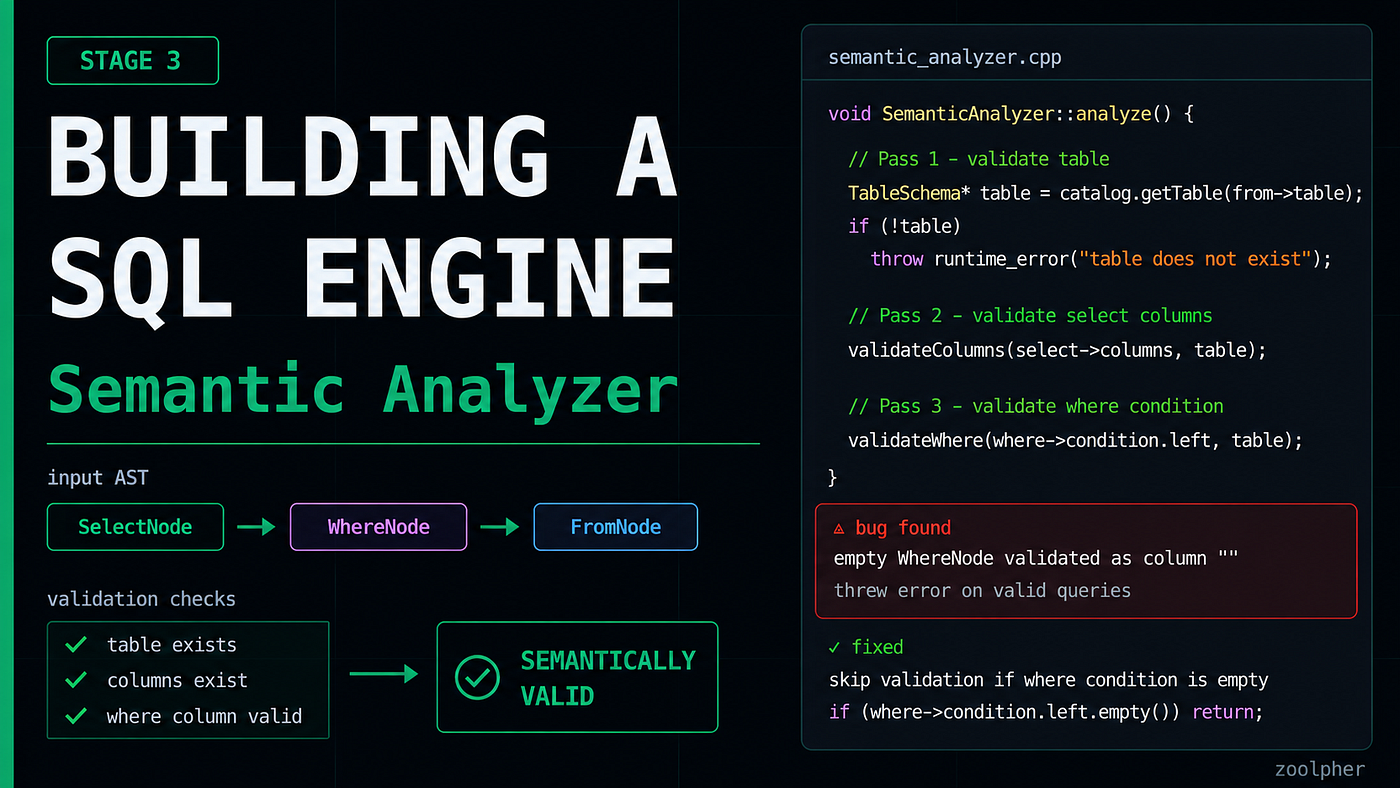
Semantic Analyzer → validates tables, columns, types
     ↓
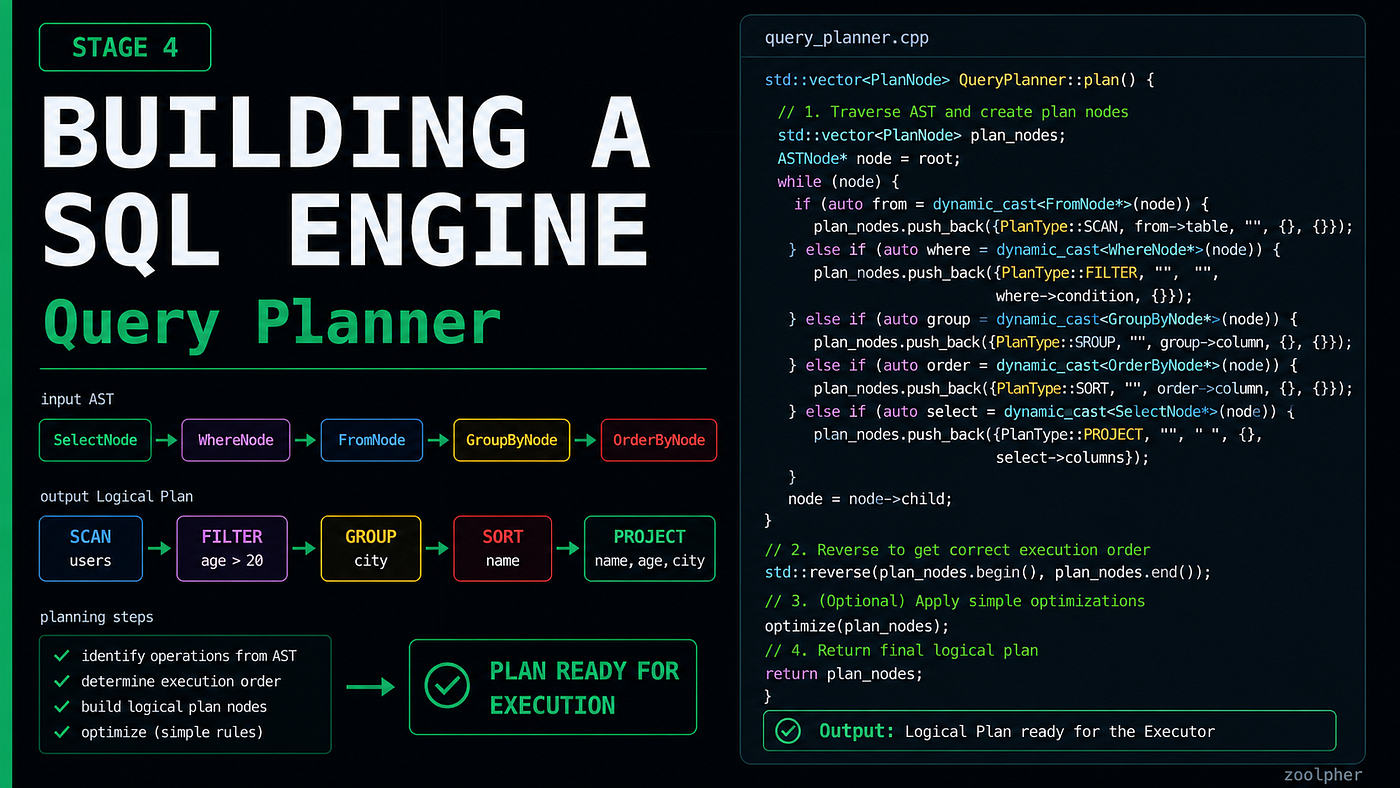
Query Planner  → converts AST into a logical execution plan
     ↓
Optimizer      → picks the cheapest way to execute
     ↓
Executor       → fetches data, returns results
I’m building every single one of these from scratch. In C++. No shortcuts.
Stage 1 — The Lexer
Stage 1 is complete and it’s the Lexer — also called a Tokenizer.
The lexer’s job is simple to explain and surprisingly fun to build: take a raw SQL string and break it into a list of tokens. A token is just a pair — a type and a value.
So this:
SELECT name FROM users WHERE age >= 18;Becomes this:
[SELECT]      => "SELECT"
[IDENTIFIER]  => "name"
[FROM]        => "FROM"
[IDENTIFIER]  => "users"
[WHERE]       => "WHERE"
[IDENTIFIER]  => "age"
[GTE]         => ">="
[INTEGER]     => "18"
[SEMICOLON]   => ";"
Every keyword, every operator, every identifier, every literal — all classified and labeled before the parser ever sees them.
The interesting parts
A few things in the lexer that I found genuinely interesting to implement:
The >= lookahead — when the lexer hits a > character, it can't just immediately emit a GT token. It has to peek at the next character first. If it's =, the token is GTE. This peek-ahead pattern is a classic lexer technique and shows up everywhere.
The i-- trick — the lexer uses a for loop with i++ at the end. But when scanning a multi-character token like a keyword or number, the inner while loop already advances i. So before returning control to the for loop, you have to i-- to avoid skipping a character. Miss this once and you'll spend an hour debugging disappearing characters.
Integer vs Float detection — when scanning a number, the lexer checks for a . character mid-scan. If it finds one, the token type flips from INTEGER to FLOAT. Simple, but satisfying.
A Bug I Found — and Why It Matters
While writing tests for the lexer, I found a silent bug that I think is worth talking about.
Take this broken query:
SELECT name FROM users WHERE city = 'DelhiNo closing quote. The lexer hit the opening ', started collecting characters, and just... kept going until it ran out of input. Then it quietly emitted a STRING token with value Delhi and moved on like nothing happened.
No error. No warning. Nothing.
The problem? Everything downstream — the parser, the semantic analyzer, the planner — receives what looks like a perfectly valid token stream. They have no idea the original query was broken. The error surfaces deep inside the pipeline, far from where it actually happened, which makes debugging a nightmare.
The fix is one line — after the string scanning loop, check why the loop exited:
if (i >= input.length()) {
    throw std::runtime_error("Lexer error: unterminated string literal");
}
If the loop ran out of input before finding a closing quote, throw immediately. Fail loudly and early.
A lexer that silently swallows malformed input makes debugging hell for every stage that comes after it.
This is a real principle — Postgres, SQLite, and MySQL all catch this at the lexer level for exactly this reason.
What’s Next
Stage 2 is the Parser.
The lexer hands off a flat list of tokens. The parser’s job is to take that list and build an Abstract Syntax Tree — a nested structure that actually represents the meaning of the query, not just its characters.
That’s where things get genuinely hard. And genuinely interesting.
I’ll be documenting it the same way — building in public, sharing everything, bugs included.
If you want to follow along, the GitHub repo has the full source with stage-by-stage documentation:
See you in Stage 2.
Google Machines Geekologi™ Microsoft + Open Source FAANG Master
Built by [zoolpher](https://github.com/zoolpher/sql-engine.git) — B.Tech CS, systems engineering track.
메타데이터
- post_id
- e849cdf6574b
- slug
- i-have-no-idea-how-a-sql-engine-works-so-im-building-one-stage-1-e849cdf6574b
- url
- https://medium.com/@zoolpher/i-have-no-idea-how-a-sql-engine-works-so-im-building-one-stage-1-e849cdf6574b
- canonical_url
- https://medium.com/@zoolpher/i-have-no-idea-how-a-sql-engine-works-so-im-building-one-stage-1-e849cdf6574b
- author_url
- https://medium.com/@zoolpher
- status
- ok
- fetched_at
- 2026-07-11 20:50:18