From Green Screen to REST APIs: The Rise of z/OSMF
For years, the mainframe world existed in a universe of its own.
From Green Screen to REST APIs: The Rise of z/OSMF
For years, the mainframe world existed in a universe of its own.
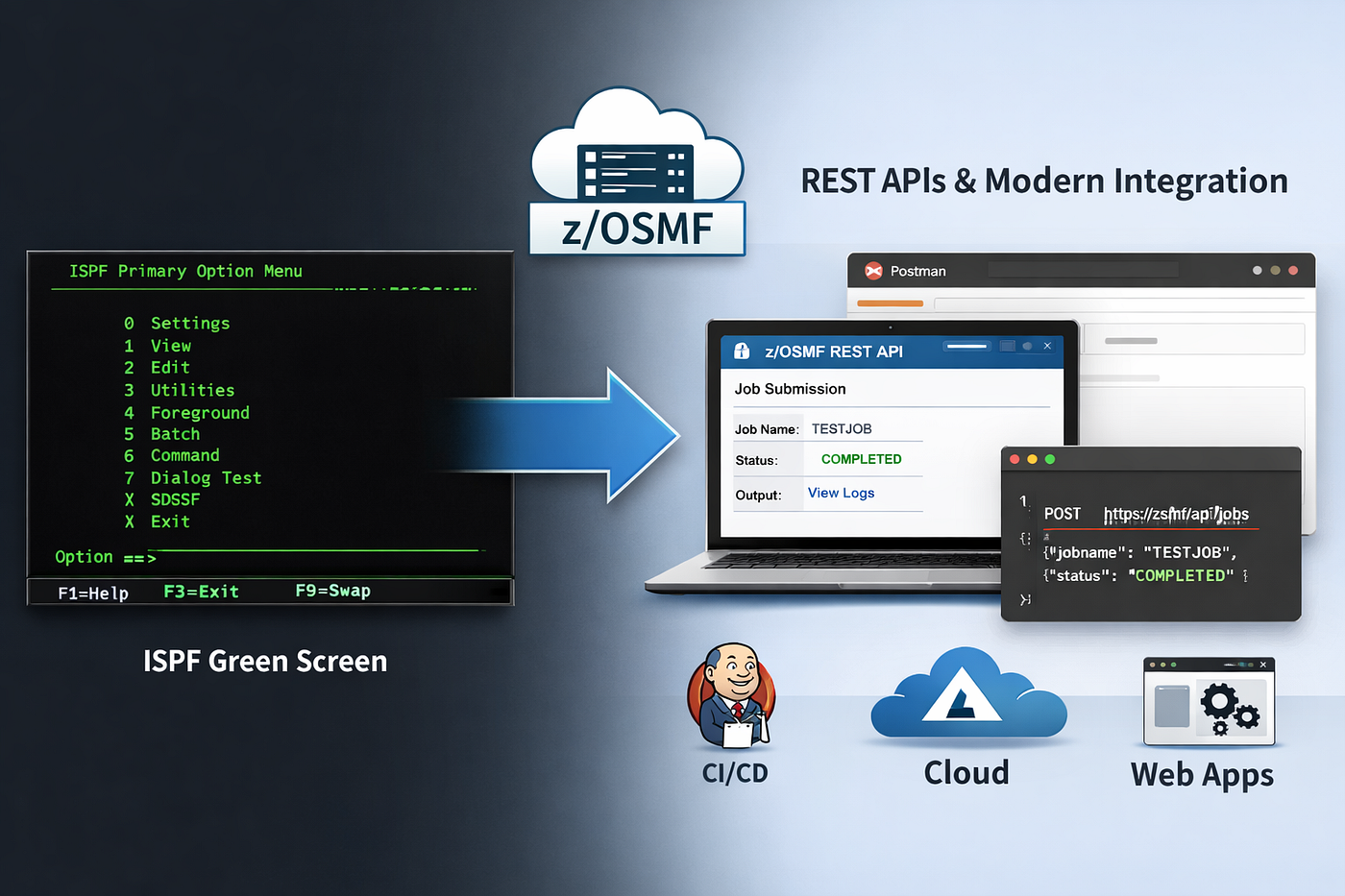
Developers and system programmers interacted with systems through green screens, navigating ISPF panels, issuing TSO commands, and submitting JCL jobs with precision and discipline. It was efficient — if you knew it — but also exclusive. The barrier to entry was high, and integration with the outside world was minimal.
Meanwhile, the rest of the industry moved toward web interfaces, APIs, and automation.
This growing divide raised an important question: Can the mainframe evolve without losing its core strengths?
The answer began to take shape with z/OS Management Facility (z/OSMF).
The Shift: From Terminal-Centric to Service-Oriented
To understand the significance of z/OSMF, it’s important to recognize what changed — not just technically, but philosophically.
Traditional mainframe operations were terminal-centric. Every action — editing datasets, submitting jobs, checking outputs — required human interaction through tightly coupled interfaces. These interactions were powerful, but they were not designed to be consumed by other systems.
z/OSMF changes this model by introducing a service-oriented layer on top of z/OS.
Instead of interacting with screens, you interact with services.
This shift is subtle but profound. A job submission is no longer just a command typed into ISPF — it becomes an API call. A dataset is no longer just a file browsed manually — it becomes a resource accessible programmatically.
In effect, z/OSMF turns the mainframe into something the modern world understands: 👉 A platform of services.
REST APIs: Making the Mainframe Speak Modern Language
At the heart of this transformation lies the adoption of REST APIs.
REST is not just a technology choice — it’s a universal language of modern systems. By exposing z/OS capabilities through REST endpoints, z/OSMF allows external applications to interact with the mainframe in a standardized way.
Consider what this means in practice.
An application running outside the mainframe — perhaps a web portal or a testing tool — can:
- Submit a batch job
- Monitor its execution
- Retrieve its output
All of this happens over HTTP, using JSON payloads.
Tools like Postman make it trivial to explore these capabilities. What once required deep mainframe expertise can now be demonstrated with a few API calls.
But the real power isn’t in manual testing — it’s in automation.
Automation Becomes Native, Not Forced
Before z/OSMF, automation in the mainframe world often meant scripting around limitations — writing REXX scripts, building custom wrappers, or relying on scheduler-driven workflows.
These approaches worked, but they were often tightly coupled to the environment and difficult to integrate with external systems.
With z/OSMF APIs, automation becomes native.
Now, a CI/CD pipeline can directly trigger mainframe jobs. A monitoring system can fetch real-time data. A web application can orchestrate backend processes on z/OS without human intervention.
For example, a pipeline in Jenkins can:
- Trigger a build
- Call a z/OSMF API to run a COBOL compile job
- Validate the output
- Proceed with deployment
This is not adaptation — it’s alignment with modern engineering practices.
A New Kind of Mainframe Professional
As the interface changes, so does the mindset required to work with it.
The traditional mainframe expert was defined by deep knowledge of system internals, command structures, and operational procedures. These skills are still valuable, but they are no longer sufficient on their own.
The modern mainframe professional needs to think in terms of:
- APIs instead of commands
- Workflows instead of manual steps
- Integration instead of isolation
Understanding JSON payloads, REST semantics, and automation pipelines becomes just as important as knowing JCL or RACF.
This shift is not about replacing expertise — it’s about expanding it.
The Transition
The transition from green screens to REST APIs is more than a technical upgrade — it’s a redefinition of what the mainframe is.
With z/OS Management Facility (z/OSMF), the mainframe is no longer just a system you log into. It’s a platform you can integrate, automate, and innovate on.
And that changes everything.
메타데이터
- post_id
- e84f71afd7bc
- slug
- from-green-screen-to-rest-apis-the-rise-of-z-osmf-e84f71afd7bc
- url
- https://medium.com/@div25singh/from-green-screen-to-rest-apis-the-rise-of-z-osmf-e84f71afd7bc
- canonical_url
- https://medium.com/@div25singh/from-green-screen-to-rest-apis-the-rise-of-z-osmf-e84f71afd7bc
- author_url
- https://medium.com/@div25singh
- status
- ok
- fetched_at
- 2026-06-10 18:44:10