Collaborate Combat Aircraft in a System of Systems
In the Context of System Engineering
Collaborate Combat Aircraft in a System of Systems
In the Context of System Engineering
Introduction
The Collaborative Combat Aircraft (CCA) program is one of the Air Force’s most ambitious efforts to date. Its goal: design, build, and field a family of unmanned aircraft that fly alongside manned fighters, under the direction of human pilots.
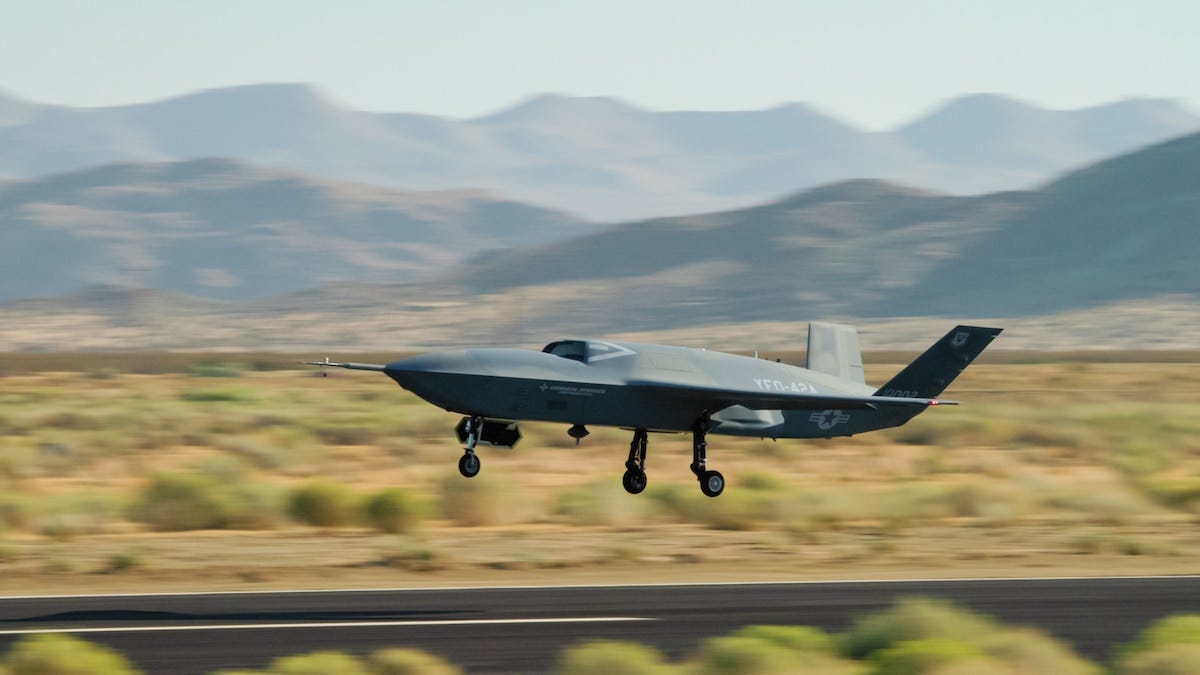
Figure 1: A YFQ-42A Collaborative Combat Aircraft takes off during flight testing at a California test location. The aircraft was developed in partnership with General Atomics as part of the Air Force’s effort to accelerate delivery of affordable, semi-autonomous aircraft. Photo Credit: General Atomics
The System of Interest
The CCA initiative is part of the U.S. Air Force’s Next Generation Air Dominance (NGAD) strategy, which aims to deploy a large number of autonomous unmanned aircraft to team with 5th and 6th-generation manned fighters [1]. These CCAs will enhance airpower through autonomy, Artificial Intelligence, and cost-effective capabilities. The CCA program is structured to leverage aircraft developed by multiple vendors and integrate open systems architectures. The aircraft are expected to be in the 3000 to 6000 lb thrust class with operational range similar to today’s manned aircraft, such as the F35 [2].
As of October 2025, General Atomics’ YFQ-42A has completed its first flight, and Andruil Industries’ YQ-44A Fury will take its first flight in mid-October as part of Increment 1 for the CCA program [3,4]. Additional contractors will compete for Increment 2 of the program, as it is a continuous acquisition program that is expected to require multiple types of air capabilities and associated costs [5,6]. Lockheed Martin’s Vectis platform, Boeing’s MQ-25 Stingray and MQ-28 Ghost Bat, and other yet-to-be-named programs could be competitors for future CCA Increments [7].
Stakeholders
The stakeholders for the CCA program are vast and range from the United States Congress to the maintenance units that will care for the equipment, so only a subset of relevant stakeholders will be discussed here. As taxpayers, the average American becomes one of the most concerned stakeholders for the CCA program. The overall program cost, as well as efficacy, will be the key interest of the U.S. Citizen.
The Department of the Air Force is the primary stakeholder within the Department of Defense for the program, with Air Combat Command as the ultimate users of the aircraft [8].
The Program Executive Office for Fighters and Advanced Aircraft (PEO(FA&F)) within the Air Force Lifecycle Management Center (AFLCMC) is a stakeholder due to the need to integrate the CCA platforms into operation with the F-22 and F-47. The F-35 Lightning II Joint Program Office (JPO) is also a stakeholder for the same reasons.
The final layer of stakeholders includes the maintainers and operations personnel who will ultimately interact with the systems in the field, and the pilots who will depend on the Loyal Wingmen for combat effectiveness and survivability.
Environment
The CCA platforms will operate as a system in a system of systems. The aircraft themselves are composed of many highly integrated subsystems, including the airframe, avionics (flight controls, radar, communications, Position, Navigation, and Timing (PNT)), thermal management, and propulsion system. There will also be specialized systems for given missions, such as kinetic weapons, electronic attack equipment, or tanker equipment.
To operate in contested airspace, the CCAs will be required to communicate with other CCAs and uncrewed aircraft, manned fighters, including a blend of 5th and 6th generation aircraft, High Value Air Assets (HVAA) such as airborne early warning and control aircraft (AEW&C) like the E-2C, E-3 or E-7, tankers, and reconnaissance aircraft such as the U2. They will provide critical information about the battle space, as well as receive orders from various sources [9].
The CCA will also be exposed to natural and artificial environments. It will experience extreme temperature ranges and weather conditions. The system is expected to operate out of airfields in locations such as Alaska, Qatar, or Japan. It will be exposed to electromagnetic emissions from friend and foe aircraft. The platform must handle all of these environmental factors while providing reliable operation.
INCOSE Systems Engineering Processes
The CCA program is a complex effort involving numerous stakeholders, a range of technical challenges, and ongoing budgetary scrutiny. It far exceeds the threshold for a Major Defense Acquisition Program, and thus follows the US Department of Defense (DoD) Lifecycle model. Increment 1 of the program is currently in the engineering and manufacturing development (EMD) phase, and based on the YFQ-42A’s recent first flight, we can infer that the program recently successfully completed test readiness reviews (TRR). In the validation phase of EMD, the test team will demonstrate the system's capabilities and verify compliance with specific requirements through testing. After testing is complete, the program will conduct the functional configuration audit (FCA), the next step toward the production phase [10].

Figure 2: The United States Department of Defense Lifecycle Model — INCOSE Systems Engineering Handbook, Fifth Edition
Due to the complexity and interoperability requirements of the CCA platforms, the engineering team most likely utilized the DoD Architecture Framework. ISO/IEC/IEEE 42010 defines an architecture description framework as:
A set of “conventions, principles and practices for the description of architectures established within a specific domain of application or community of stakeholders” [11].
The architecture framework provides viewpoints to “cover the target domains and their typical stakeholder’s concerns.” [10] The framework may also provide a method for describing the “building blocks” of the system, and how those blocks fit together. These attributes are critical to the successful design of a system like the CCA, which must have all its interfaces clearly defined for the success of its initial configuration, as well as for handling continuous improvement, addition, or removal of systems as the technology matures within an open architecture mindset. As additional increments of the program are initiated, the architectural framework can continue to be applied to prevent major deviations in the development of new aircraft. From the mindset of affordable mass and an ever-changing adversarial environment, the stakeholders cannot afford financial and schedule losses due to architectural misses.

Figure 3: An F-35A Lightning II and two F-16 Fighting Falcons. Collaborative Combat Aircraft will operate under the custody of a manned aircraft, providing affordable mass for future conflicts. Photo Credit: U.S. Air Force
Conclusion
The Collaborative Combat Aircraft program has a wide-reaching impact on the United States Air Force’s ability to project power. These complex systems will operate within an already complicated, interconnected, and distributed system comprising numerous air, land, and sea assets. Robust systems engineering practices ensure that the system is appropriately designed for its operational environment and that it meets the needs of all stakeholders. The application of the DoD Lifecycle Model and Architecture Frameworks is an example of such practices that ensure the successful design and implementation of complex systems.
Citations
- Collaborative Combat Aircraft (CCA), USA. Airforce Technology. (2024, June 21). https://www.airforce-technology.com/projects/collaborative-combat-aircraft-cca-usa/
- Sharp, T. (2025). Ready Player None? https://csbaonline.org/uploads/documents/CSBA8400_(Ready_Player_None_Report)_web.pdf
- Collaborative Combat Aircraft, YFQ-42A takes to the air for flight testing. Air Force. (2025, August 27). https://www.af.mil/News/Article-Display/Article/4287627/collaborative-combat-aircraft-yfq-42a-takes-to-the-air-for-flight-testing/
- Losey, S. (2025, September 26). Anduril nears first drone wingman flight, promises early autonomy. Defense News. https://www.defensenews.com/air/2025/09/24/anduril-nears-first-drone-wingman-flight-promises-early-autonomy/
- Tirpak, J. (2024, April 25). Competitors not picked for CCA look forward to Increment 2. Air & Space Forces Magazine. https://www.airandspaceforces.com/competitors-not-picked-cca-look-forward-increment-2/
- Tirpak, J. (2025, August 24). Collaborative combat aircraft first flights are imminent, sources say. Air & Space Forces Magazine. https://www.airandspaceforces.com/collaborative-combat-aircraft-first-flights-are-imminent/
- Lockheed Martin VectisTM: Best in CCA class survivability. Media — Lockheed Martin. (2025, September 21). https://news.lockheedmartin.com/2025-09-21-Lockheed-Martin-Vectis-TM-Best-in-CCA-Class-Survivability
- Gunzinger, M., Stutzriem, L., & Sweetman, B. (2024, February). The Need for Collaborative Combat Aircraft for Disruptive Air Warfare. The Mitchell Institute for Aerospace Studies. https://www.mitchellaerospacepower.org/app/uploads/2024/02/The-Need-For-CCAs-for-Disruptive-Air-Warfare-FULL-FINAL.pdf
- Global lightning. Air Force Research Laboratory. (2025). https://afresearchlab.com/global-lightning/
- Walden, D. D., Shortell, T. M., Roedler, G. J., Delicado, B. A., Mornas, O., Yew-Seng, Y., & Endler, D. (2023). Systems engineering handbook: A guide for system life cycle processes and activities. Wiley.
- ISO/IEC/IEEE 42010 (2022). Systems and Software Engineering — Architecture Description, The International Organization for Standardization, The International Electrotechnical Commission, and The Institute of Electrical and Electronics Engineers.
메타데이터
- post_id
- e85054adc2c4
- slug
- collaborate-combat-aircraft-in-a-system-of-systems-e85054adc2c4
- url
- https://medium.com/the-systems-engineering-scholar/collaborate-combat-aircraft-in-a-system-of-systems-e85054adc2c4
- canonical_url
- https://medium.com/the-systems-engineering-scholar/collaborate-combat-aircraft-in-a-system-of-systems-e85054adc2c4
- author_url
- https://medium.com/@christopher.hart.anderson
- status
- ok
- fetched_at
- 2026-07-06 21:09:28