QNX Reintroduces Self-Hosted Development Desktop 8.0
With the initial release of the QNX Self-Hosted Developer Desktop, QNX has taken a notable step toward modernizing how developers interact…
QNX Reintroduces Self-Hosted Development Desktop 8.0
With the initial release of the QNX Self-Hosted Developer Desktop, QNX has taken a notable step toward modernizing how developers interact with its real-time operating system. For the first time in many years, QNX is once again presented not just as a deployment target, but as a system developers can actively work inside — complete with a graphical desktop and native compilation.
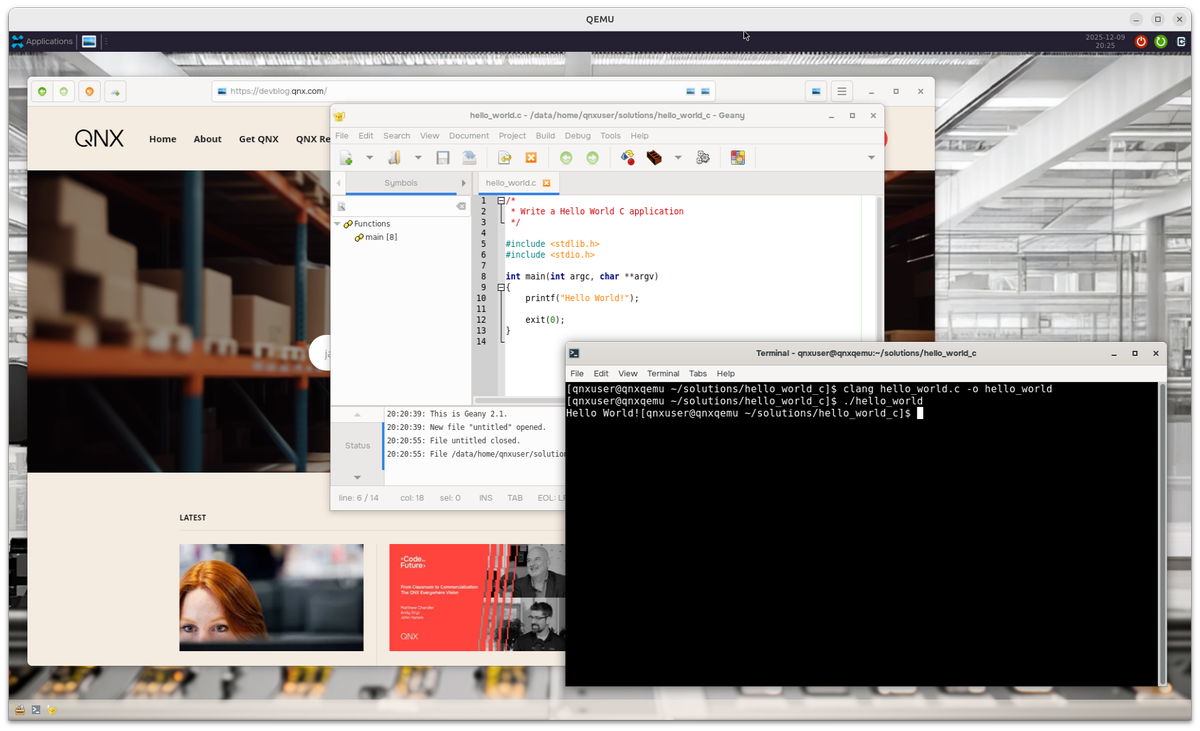
Official QNX 8.0 Qemu Screenshot
The new Developer Desktop runs directly on QNX 8.0 and is delivered initially as a QEMU virtual machine image for Linux hosts. Its headline feature is straightforward but strategically important: self-hosted development. Instead of relying exclusively on cross-compilation from Linux or Windows, developers can now build, run, and debug software natively within a QNX environment.
Out of the box, the Desktop provides a Wayland-based XFCE graphical environment, standard development toolchains (GCC, Clang, LLVM), build systems such as CMake and Make, Python and Git, a browser, terminal, file manager, and a selection of familiar editors and lightweight IDEs including Vim, Neovim, Emacs, and Geany. Preinstalled sample applications cover C, C++, Python, GTK, and OpenGL ES, offering immediate hands-on entry points.
The environment is also preloaded with a substantial subset of software from the QNX Open-source Dashboard, which currently tracks more than 1,400 ports across QNX versions, architectures, and targets. For developers evaluating QNX 8.0 or porting existing Linux applications, this significantly reduces friction and setup time.
QNX is positioning this first release as an early but usable foundation. Setup still involves assembling the QEMU image from multiple components, and the company openly describes the experience as “rough around the edges.” Even so, the intent is clear: to make QNX feel more approachable, familiar, and productive for developers accustomed to Linux-centric workflows.
A Return to Familiar Ground
While the Self-Hosted Developer Desktop may feel new in today’s QNX ecosystem, it has deep historical roots.
In the late 1980s and early 1990s, early versions of QNX — most notably QNX 2 and QNX 4 — were well known for running comfortably on extremely modest hardware. Minimal systems could boot from a single 3.5-inch floppy disk, delivering a multi-user, multitasking, POSIX-style operating system at a time when MS-DOS was single-tasking and many Unix systems required hard disks.
This was possible because of QNX’s microkernel architecture: only scheduling and message passing lived in the kernel, while filesystems, drivers, and networking ran as user-space processes. The result was a compact, modular, and resilient system that scaled down remarkably well.
By the 1990s, QNX was also a desktop operating system in its own right. With the introduction of the Photon microGUI, QNX systems booted into graphical desktops featuring terminals, native editors, compilers, debuggers, and networking. Development was typically self-hosted — code was written, compiled, and debugged directly on QNX machines, which served as everyday workstations in industrial labs, factories, and universities.
This continued into the early QNX Neutrino (QNX 6) era. Photon-based demo images and evaluation systems were common, and self-hosted development remained technically viable. However, the center of gravity was shifting. Automotive, telecom, and safety-critical embedded markets became dominant, while Linux rapidly established itself as the universal developer desktop.
Over time, QNX development workflows standardized around host-target cross-compilation, supported by IDEs such as Momentics running on Linux or Windows. Desktop environments on QNX persisted mainly as demos or showcases, not as primary development platforms. Open-source availability was limited, and QNX gradually became perceived as “the OS you deploy to,” rather than one you develop on directly.
Why the Desktop Matters Again
The QNX 8.0 Developer Desktop should be understood against this backdrop. It is not a nostalgic experiment, but a response to modern realities.
Today’s developers expect:
- Native toolchains and package ecosystems
- Familiar build systems and scripting languages
- Easy porting of open-source software
- Integration with CI and automated workflows
By offering a self-hosted desktop built around Wayland, XFCE, LLVM, and a large catalog of open-source ports, QNX is aligning its developer experience more closely with contemporary expectations — without abandoning the microkernel architecture and determinism that define the platform.
In that sense, the new Desktop is less a reinvention than a reconciliation: bringing QNX’s original self-contained development model forward into a world shaped by Linux, open source, and large-scale automation.
What Comes Next
QNX has already outlined an expansive roadmap beyond this initial release. Planned updates include:
- QEMU images for Windows and macOS hosts
- Native desktop images for x86 systems
- A native Raspberry Pi desktop image
- Improved documentation and onboarding
- Features to support CI and automated builds
- More samples, ports, and overall stability improvements
If executed well, these steps could significantly broaden QNX’s appeal — particularly for developers evaluating real-time operating systems or porting complex software stacks to safety-critical platforms.
The arc from a one-floppy OS to a modern Wayland desktop may seem dramatic, but the underlying idea remains consistent: QNX as a system that is small, robust, and capable of standing on its own. With the QNX 8.0 Self-Hosted Developer Desktop, QNX appears to be reclaiming that identity — this time with modern tools, modern expectations, and a renewed focus on developer experience.
Continue reading at: https://devblog.qnx.com/qnx-self-hosted-developer-desktop-initial-release/
메타데이터
- post_id
- e856f9301065
- slug
- qnx-reintroduces-self-hosted-development-desktop-8-0-e856f9301065
- url
- https://medium.com/@Re-News/qnx-reintroduces-self-hosted-development-desktop-8-0-e856f9301065
- canonical_url
- https://medium.com/@Re-News/qnx-reintroduces-self-hosted-development-desktop-8-0-e856f9301065
- author_url
- https://medium.com/@Re-News
- status
- ok
- fetched_at
- 2026-06-17 12:55:42