Charter schools fought to keep Mamdani from City Hall. Now, they’ll have to work with him.
Marching across the Brooklyn Bridge, a sea of schoolchildren in purple and yellow were at the vanguard of a mid-school-day charter school…
Charter schools fought to keep Mamdani from City Hall. Now, they’ll have to work with him.
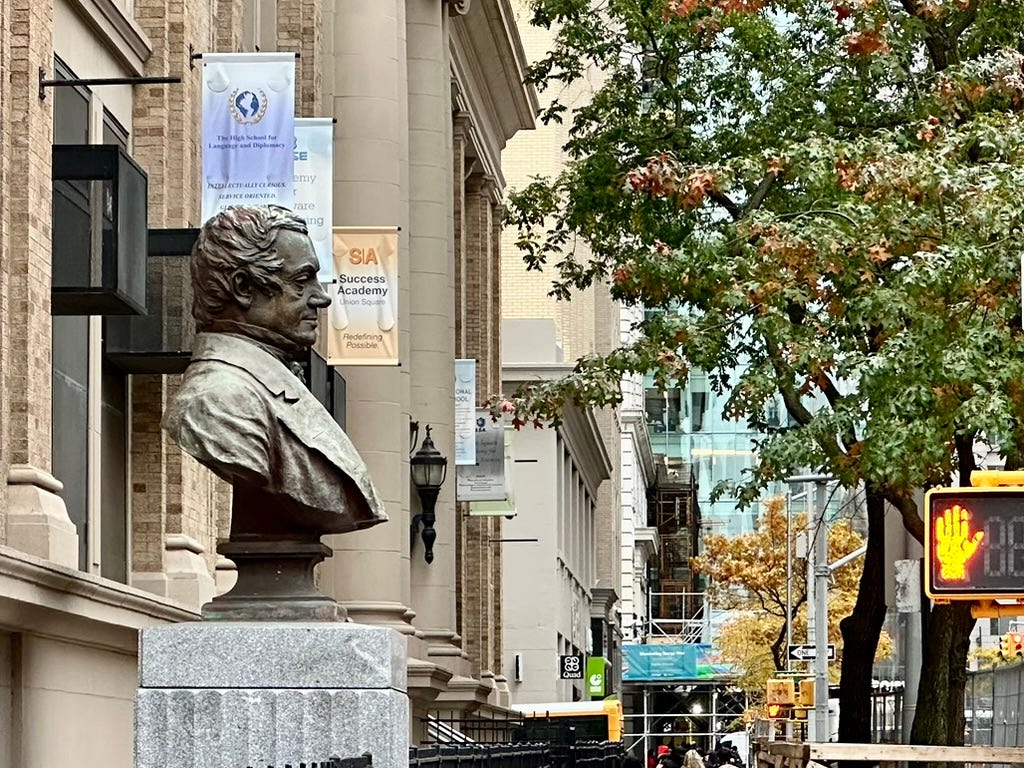
A Success Academy elementary school in Union Square, Manhattan is co-located with five other schools.
Marching across the Brooklyn Bridge, a sea of schoolchildren in purple and yellow were at the vanguard of a mid-school-day charter school rally this September, unwitting participants in a demonstration of a brewing battle between some of New York’s most powerful forces.
At the center of the rally attended by over 15,000 of families, educators, and students, per organizers, was Eva Moskowitz, the CEO of the city’s largest charter school chain, Success Academy. Days prior, Moskowitz was caught on a secret tape obtained by WNYC urging her employees to take action in the then-upcoming election against Mayor-Elect Zohran Mamdani.
Success Academy started as a single Harlem school less than two decades ago, but today represents one of the most powerful forces in education in all of New York City. It takes in nearly $500 million in revenue, most coming from per-pupil dollars from New York State, per a 2024 audit.
Now, with days until the mayor-elect takes office, a decades-old battle is poised to reignite: should charter schools get a subsidy from America’s largest public school system? The incoming City Hall, and its transition committee staffed with union leaders and activists for racial equity in schools could trigger yet another showdown in a national fight over school choice.
“A number of charter operators felt [during the campaign] that he was a threat,” Brooklyn College professor of education leadership, law and policy David Bloomfield said of the mayor-elect, adding that the Brooklyn Bridge rally “clearly was” about Mamdani.
Across the country, debates over the allocation of public resources in education have only gotten tenser. In the last five years, charter enrollment is up by as many as 400,000 students nationwide, while the Trump administration tries to take the school choice movement national.
On the campaign trail, Mamdani indicated in a candidate questionnaire that he planned to oppose charter school expansion and oppose new co-locations of charters in DOE buildings, promising a “comprehensive review of charter school funding” for those already co-located.
Success Academy seems to take these promises seriously. Social media and TV streaming ads directing viewers to “take action now” and send a pre-filled, pro-charter school message to their elected officials were placed by Success Academy, disclosures on TikTok confirm, though the group’s name and logo do not appear in the ad or linked website.
Before this year, the group was already spending big. Success Academy reported spending in 2021 nearly $1.5 million in paid political advertisements, almost $200k in direct lobbying, and more for rallies, mailers and other expenses in service of “advocacy to support” that mission, per the firm’s most recent Schedule C tax form filings, a political disclosure form for nonprofits. Figures on the sum spent in 2024 and 2025 were not yet available, but the ads themselves have irked some, who say education funds shouldn’t be spent on politics.
“Success really raises a ton of money for various things that do not necessarily show up in the classrooms, and I think that political spending is one of them,” Collins said. “I think that’s our concern, is that they’re raising all this money … and then still expecting the district to fund space and building and things like that.”
For Success Academy, weighing in on politics is a valuable way to ensure continued growth. Though the school declined to comment for this article, Moskowitz has not shied away from firing warning shots, telling the Wall Street Journal in October that she “would not recommend” pols like Mamdani taking on the charter school industry.
But public school advocates seem to think the charter bubble is ready to burst. “Charters aren’t necessarily growing at the rate that they may have used as a reason to expand their networks,” Christina Collins, the director of education policy for the United Federation of Teachers, the union representing most public educators in New York City, said in an interview.
Part of that slowing growth could come from increasingly soured opinion on Success Academy, both from the public and local leaders.
That September rally raised eyebrows from some state officials tasked with education oversight.
“Canceling classes during a school day and forcing families and students to engage in a political rally is an egregious misuse of instructional time and state funds,” New York State Senators Shelley Meyer and John Liu wrote in a September letter obtained by Chalkbeat urging the state education department to look into the “potential violations of state law.”
The network contends that it prepares kids much better than public schools, in part due to those higher standards and discipline, citing higher standardized test scores and better college performance.
But those results have been called into question for nearly the entirety of the school’s existence, with one former Success Academy teacher who requested anonymity claiming in an interview that low rates of “attrition” were responsible.
“The retention rate is so, so low that only a tiny amount of kids actually make it, make it through to the end, because they just like they throw away kids,” he said, adding that they often choose to suspend kids for so long that parents are forced to pull them out, rather than expel them. “They don’t care about the kids. They care about having the 100% graduation rate to colleges.”
The practice is one that Collins says can hurt families who have bought into Success Academy’s messages on opportunities, especially, when their children are sent back to the public system.
“It seems so unfair to the kids, right? To be told, ‘you’re being given this amazing opportunity.’ And, ‘oh no, you’re not a good fit here, now you need to leave.’ And there is some catch up work there,” Collins said.
But like many of the parents of the more than 150,000 students in the city’s charter schools, one Bushwick mother still prefers Success Academy over a public classroom.
“It’s very strict. Kids need that,” a parent waiting outside the Union Square Success Academy campus who only gave her first name, Diana, said. “We have friends with kids in public school, and they are way behind,” she said.
The challenges faced by public schools in New York are well-documented. Overcrowding, teacher shortages and other complications have given the nation’s largest school district a reputation, but one of its newest financial pressures is the charter schools themselves.
The Department of Education (NYCDOE) has been required to pay facilities costs for charters or provide classroom space in existing DOE public school buildings since 2014, when the state imposed new duties to boost charter schools onto the city.
The law, passed by then-Governor Andrew Cuomo as a check against former Mayor Bill de Blasio, means the city is “still on the hook for supporting charter schools” with their rent it denies co-location, Bloomfield explained.
“[Mamdani] certainly has the ability to put pressure on charter schools, both against their expansion… and refusing increased space for new enrollments in currently operating charter schools,” Bloomfield said. But it’s not without cost. “If he forces the charters out, it’s a further drain on the city budget if the city has to pay the rent.”
While Mamdani indicated his opposition to charter co-location in a June questionnaire, his transition team did not immediately respond to a request for comment on his position.
Per an Independent Budget Office estimate, the city spent $75 million in charter rental payments alone in Fiscal Year 2023, not including colocation costs. The “enormous amount” spent on housing charter schools is an issue of concern for public schools, Collins said.
“At the city level, there’s certainly lots of questions about [whether] Success schools really, do they really need all the space that they’ve been assigned?” Collins said, citing a recent push by three Boerum Hill public schools co-located with a Success Academy to reclaim eight classrooms the charter had left sitting empty.
The body governing education in the city and made up of mayoral appointees, the Panel for Educational Policy (PEP) will likely be at the heart of future battles over class space. The body, characterized by some during the Bloomberg era as a “rubber stamp” on the mayor’s support for charters, okayed the classroom reallocation in Boerum Hill this summer, per the UFT.
Another wrinkle, Mamdani has floated eliminating mayoral control and the mayor’s right to appoint the majority of the PEP, the largest source of the mayor’s leverage over charter schools, a move which would make fights like Boerum Hill’s even less predictable. Ultimately, it could be schools and neighborhoods themselves that unseat charter schools.
“I think that this is more going to play out at the micro level than at the macro level,” Bloomfield said. ”I don’t think it’s going to be about the charter sector in general. I think it’s going to be about a co-location at one particular site, and the co-location of some other particular site, and how that will play out on the citywide stage.”
Across the board, support for charters is slipping since the 2014 decision to sic costs on the city. An August poll conducted by PDK, an education professional group, shows approval has fallen by nearly a third since 2013 to 46% of the American public in favor.
Another potential battlefield may be the fight over the charter cap. In New York State, legislation dictates the maximum number of charter schools that can operate. Last expanded in 2023 by allowing new operators to assume abandoned charters, the vast majority of the maximum of 460 charters are in use.
“There are just so many questions right now about school construction and where the current kids are going to go for both charters and district students that lifting the cap for New York City at this point, I just don’t think would make any sense at all,” Collins said.
Bloomfield isn’t sure if the support exists in Albany, either. “There doesn’t seem to be appetite for much of an expansion,” Bloomfield said, adding that enrollment seems to have “stabilized.”
“It seems that we’ve reached some point of equilibrium among the charter schools, the private schools, and the traditional publics,” he said, meaning the hard ceiling in New York may remain as-is.
메타데이터
- post_id
- e862199a5f27
- slug
- charter-schools-fought-to-keep-mamdani-from-city-hall-now-theyll-have-to-work-with-him-e862199a5f27
- url
- https://medium.com/advanced-reporting-honors-seminar/charter-schools-fought-to-keep-mamdani-from-city-hall-now-theyll-have-to-work-with-him-e862199a5f27
- canonical_url
- https://medium.com/advanced-reporting-honors-seminar/charter-schools-fought-to-keep-mamdani-from-city-hall-now-theyll-have-to-work-with-him-e862199a5f27
- author_url
- https://medium.com/@gce2013
- status
- ok
- fetched_at
- 2026-06-13 16:00:06