DeSciCoLab Research Landscape Overview: Examining Key Areas of Decentralized Scientific Research
Research collaboration today still depends on fragmented systems for identity, attribution, data sharing, review, and funding. While…
DeSciCoLab Research Landscape Overview: Examining Key Areas of Decentralized Scientific Research
Research collaboration today still depends on fragmented systems for identity, attribution, data sharing, review, and funding. While digital tools have expanded access and participation, they have not fully solved core problems such as incomplete recognition of contributions, weak provenance tracking, limited reproducibility, and poor interoperability between platforms. These gaps become even more visible in cross-institutional and data-intensive research, where trust, transparency, and compliance are essential.
Against this background, DeSciCoLab carried out an extended market analysis to assess how decentralized technologies and existing research infrastructure can support more verifiable and portable forms of collaboration. The work examined both the academic state of the art and the current ecosystem of projects, protocols, and platforms relevant to decentralized science. Its purpose was to identify what is already available, where the main limitations remain, and which design priorities should guide the next phases of the project.
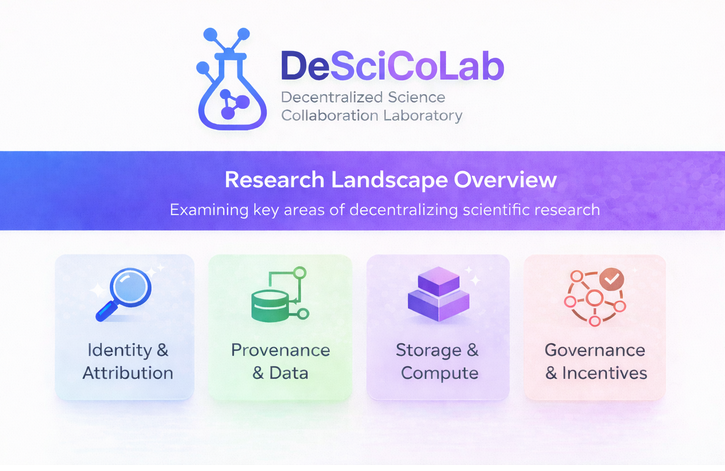
A key finding of the analysis is that the current decentralized science (DeSci) ecosystem is best understood as a set of four interconnected but still fragmented layers. The first consists of funding communities and research DAOs, which help coordinate grants, priorities, and research agendas in areas such as longevity, women’s health, synthetic biology, and psychedelic science. The second includes data and knowledge infrastructure, which supports metadata, provenance-aware knowledge graphs, governed data flows, and structured research outputs. The third layer covers attribution and integration services, where scholarly graphs, review platforms, and identifier systems help connect people, outputs, and contributions across repositories and venues. The fourth layer includes storage and compute infrastructure, which provides content-addressed storage, durable persistence, and reproducible or attestable execution environments for research artifacts and workflows.
Taken together, these layers provide important building blocks for decentralized research collaboration. However, the review shows that they rarely operate as a coherent system. In many cases, identity, provenance, storage, assessment, and incentives remain separated across platforms, weakening portability, creating duplication of effort, and limiting the ability of researchers to carry verified contribution records or research objects across tools and institutions.
To complement this ecosystem mapping, the market analysis applied a comparative framework to evaluate how existing initiatives support decentralized research collaboration. Projects were assessed across six criteria: governance and decentralization, identity and interoperability, data and compute verifiability, incentives and sustainability, user experience and adoption, and compliance and intellectual property. This structured approach enables comparison across initiatives using transparent evidence, and helps identify where solutions are most mature, where capabilities are still emerging, and where important gaps remain for future platform development.
The literature review confirms that identity and attribution remain central challenges. Existing scholarly infrastructure already relies heavily on persistent identifiers such as ORCID for researchers and DOIs for publications and datasets. These remain essential anchors. At the same time, newer approaches based on decentralized identifiers and verifiable credentials can extend this stack by enabling portable, cryptographically verifiable claims about activities such as peer review, replication, dataset stewardship, curation, or workflow execution. The evidence suggests that the most practical path is not to replace existing scholarly identifiers, but to build on them. This points toward an ORCID-first model, with decentralized credentials added where stronger portability, selective disclosure, or verifiable attestations are needed.
Another major conclusion concerns provenance. Reliable collaboration depends on more than storing files or linking publications. It requires machine-readable records of how research outputs were produced, including who contributed, which data and methods were used, what transformations were applied, and how outputs evolved over time. The review highlights standards such as W3C PROV and RO-Crate as especially relevant for this purpose. It also makes clear that provenance is only dependable when it is generated automatically during normal workflows. If researchers are expected to add provenance manually after the fact, adoption and quality will remain limited. For DeSciCoLab, this means that provenance should be treated as an automatic by-product of deposit, review, computation, and reuse rather than as an extra administrative task.
The market analysis also shows that decentralized storage and compute can strengthen the reliability of research artifacts, but only if they are connected to familiar scholarly practices. Content-addressed storage improves integrity and fixity by ensuring that the same content always resolves to the same identifier. Durable storage networks and endowment-based persistence models can strengthen long-term access. Replayable pipelines and attestable execution paths can improve reproducibility and trust. However, technical assurance alone is not enough. These systems need to be linked to persistent scholarly identifiers, human-readable citations, metadata standards, and clear retention policies if they are to support research practice rather than remain isolated technical components.
The review further identifies important gaps in the treatment of contributions that fall outside traditional publication models. Peer review, replication, data curation, annotation, and community evaluation are all essential to research quality, yet they are often poorly recognised and difficult to transfer across platforms. A central implication is that reviews and replications should be treated as portable research objects in their own right. When linked to identifiers, signed, and structured appropriately, they can become reusable and citable contributions rather than platform-bound activity traces.
Governance and incentives emerged as another critical area. The evidence suggests that decentralized collaboration in science cannot rely on technical decentralization alone. Governance maturity, transparency, dispute resolution, and clear role definitions are essential if systems are to be trusted, especially where decisions affect credit, funding, or scientific validity. The review also found that incentive mechanisms are most effective when tied to verifiable outcomes rather than vague participation signals. Rewards linked to successful replications, reusable datasets, curated outputs, or documented research contributions are more robust than systems that can be easily gamed. This has direct implications for how future platform features related to review, contribution recognition, and funding should be designed.
Usability is equally important. Across the literature and market scan, one of the clearest barriers to adoption is the friction created when decentralized systems introduce new complexity into already demanding research workflows. Researchers are unlikely to adopt tools that require visible cryptographic ceremony, unfamiliar onboarding, or major changes to established practices. The strongest design pattern identified in the review is therefore simple: verifiability should be built into ordinary work. Researchers should be able to sign in through familiar systems, connect existing identifiers, deposit outputs through standard workflows, and generate provenance, citations, and contribution records automatically in the background. Integration with repositories, code platforms, review tools, and scholarly graphs is therefore not optional, but essential.
The review also emphasises that compliance, privacy, and ethical safeguards must be built into the system from the start. For sensitive or governed data, especially in health-related contexts, lawful reuse depends on clear licenses, consent-aware metadata, auditable access, and data protection measures aligned with regulatory requirements such as the GDPR. These are not secondary concerns. They shape architecture, storage design, metadata models, and access workflows. A viable DeSci platform must therefore treat compliance and ethics as core product requirements rather than later additions.
Based on the evidence gathered, DeSciCoLab’s literature review and market analysis provide a clear direction for the next design and specification phases of the project. The findings support an ORCID-first identity model with optional decentralized credentials, automatic provenance recording at deposit and execution, portable review and replication records, stable integration with repositories and scholarly metadata systems, and transparent governance and compliance structures. More broadly, the analysis shows that the future of decentralized research collaboration lies not in replacing existing systems, but in connecting them through verifiable, interoperable, and researcher-friendly layers.
These results now provide the evidence base for the next stages of the project, including stakeholder validation, wireframe development, and technical specification. In particular, they will inform DeSciCoLab’s work on identity integration, provenance-by-default workflows, interoperability with existing research infrastructure, and mechanisms for recognizing a broader range of research contributions.
We welcome input from researchers, research managers, and open science practitioners interested in decentralized collaboration, attribution, and research workflows.
To follow project updates, you can visit the project website hosted by the University of Nicosia and INNOV-ACTS LTD.
You can also follow DeSciCoLab on Medium and X (Twitter), or reach the team at descicolab@unic.ac.cy.
The Project is financed by the Republic of Cyprus through the Research and Innovation Foundation (RIF).
메타데이터
- post_id
- e879e6a50c71
- slug
- descicolab-research-landscape-overview-examining-key-areas-of-decentralized-scientific-research-e879e6a50c71
- url
- https://medium.com/@descicolab/descicolab-research-landscape-overview-examining-key-areas-of-decentralized-scientific-research-e879e6a50c71
- canonical_url
- https://medium.com/@descicolab/descicolab-research-landscape-overview-examining-key-areas-of-decentralized-scientific-research-e879e6a50c71
- author_url
- https://medium.com/@descicolab
- status
- ok
- fetched_at
- 2026-06-23 03:48:11