Why In-App Traffic Is Becoming a Serious Channel for Performance Teams in 2026
How In-App Advertising Is Reshaping Performance Marketing in 2026
Why In-App Traffic Is Becoming a Serious Channel for Performance Teams in 2026
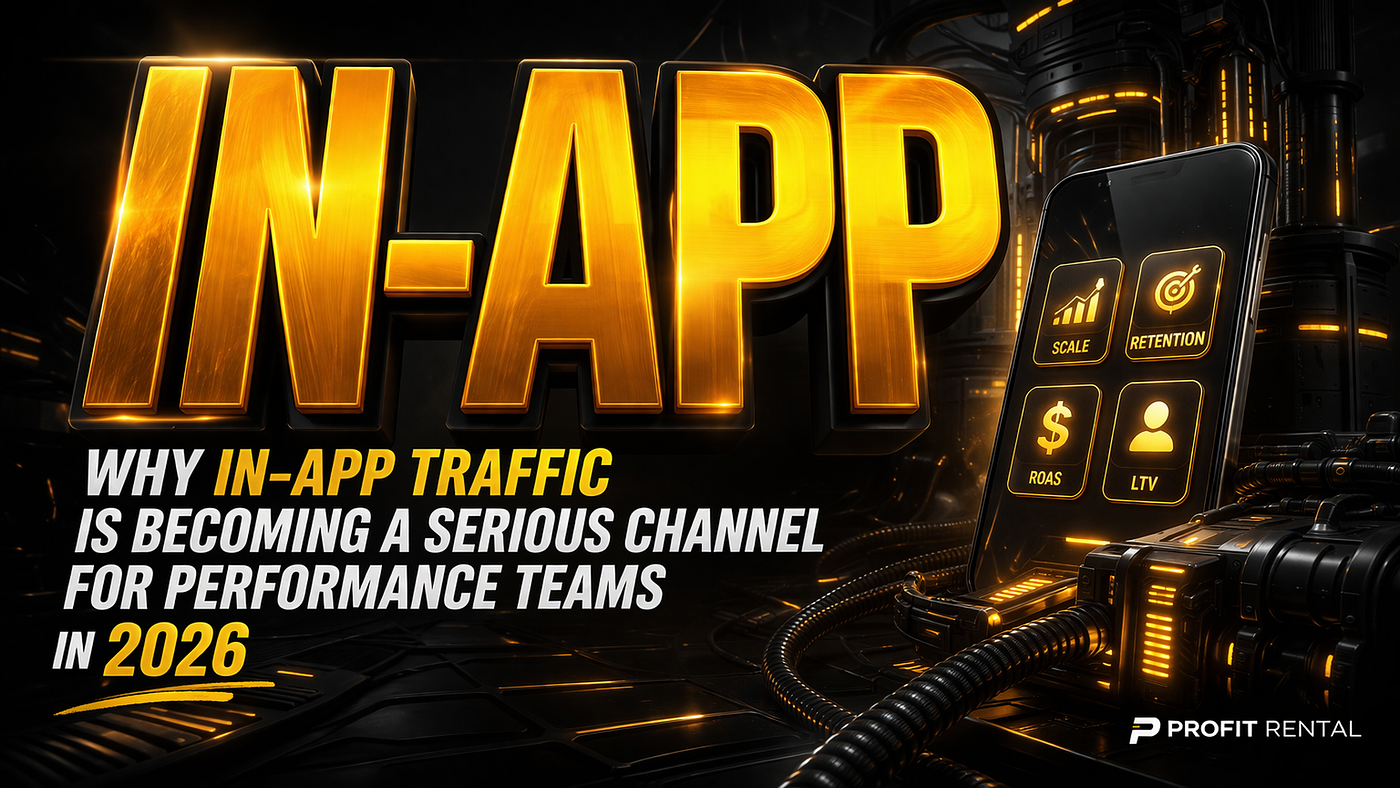
How In-App Advertising Is Reshaping Performance Marketing in 2026
Contents
- Why buyers are paying attention to in-app again
- How in-app differs from Facebook traffic
- Which offers and verticals fit this source
- Major platforms in the in-app market
- How to approach launch and optimization
- Why the entry barrier is still high
- Is in-app worth the effort?
Why buyers are paying attention to in-app again
In-app traffic means advertising impressions delivered inside mobile applications. These can be game placements, utility app banners, native ad blocks, interstitials, rewarded formats, and many other mobile placements users interact with every day.
For a long time, many affiliates treated this channel as secondary. Facebook and Google were easier to understand, easier to explain to new team members, and more familiar from an operational point of view. In 2026, that привычка is fading. Buyers are returning to in-app advertising because the economics of social traffic have changed. Auctions are tougher, moderation is harsher, and campaign stability is much harder to maintain over time.
In-app is getting attention for a different reason: it gives teams another way to buy volume without living inside a constant cycle of bans, payment problems, and endless account replacement. For many media buyers, that alone is enough reason to test the channel seriously.
How in-app differs from Facebook traffic
People often compare in-app sources to Facebook because both are mobile-first environments with large user pools. The difference is in how advertisers actually work with them. In practice, these are two very different systems with different strengths, weaknesses, and optimization logic.
Less operational chaos
One of the biggest appeals of in-app is operational consistency. Teams that come from Facebook usually notice this first. A campaign in an ad network can keep running with far fewer interruptions when the setup is correct and the creative meets technical requirements. That gives buyers room to focus on the actual performance side of the job: placements, bids, budgets, funnels, and creative testing.
On social traffic, too much time is often spent on survival tasks. In-app shifts that balance. The work becomes more about analysis and less about firefighting.
Creative policy is usually more workable
Another reason in-app attracts experienced buyers is creative flexibility. A lot of ideas that would be immediately flagged or restricted on social platforms can still be tested inside mobile ad networks, depending on the source. This creates more space for strong hooks, direct messaging, and more aggressive visual approaches.
That matters in competitive verticals where bland creatives usually die fast. If your creative cannot grab attention quickly, mobile traffic becomes expensive. In-app gives more room to experiment with what actually stops the user and generates installs or clicks.
Targeting works differently
The trade-off is targeting depth. Facebook still offers far more granular audience settings. In-app usually does not. You are not building campaigns around detailed social signals. You are buying traffic from apps, publishers, bundles, and placements, then shaping the campaign after the first data comes in.
That is why this source rewards buyers who are comfortable with data. You review where the traffic comes from, identify the strongest placements, and build a whitelist. Underperforming publishers are cut, stronger ones are scaled. The system is less about perfect targeting upfront and more about filtering quality after launch.
Which offers and verticals fit this source
The reach of in-app traffic is broad because app ecosystems are broad. Users spend time in hyper-casual games, financial tools, phone cleaners, shopping apps, entertainment products, messengers, and countless other mobile environments. That makes in-app suitable for many verticals if the angle and context match.
Gaming offers naturally align with gaming inventory. Utility and finance audiences can respond well to monetization and investment-related propositions. Entertainment and content-driven funnels also find room here. The important point is simple: the ad should make sense inside the app environment where the user sees it.
Why tougher niches often move here
In-app also keeps attracting buyers from higher-risk niches. The reason is practical. Some networks allow more room for testing than large social platforms do. That does not mean moderation disappears completely, because it does not. Many larger platforms have already tightened policies and now require additional approvals in certain categories.
Still, compared to the largest self-serve ecosystems, there are usually more options available. That makes run in-app campaigns a realistic route for teams that need traffic sources with fewer creative restrictions and a more forgiving operating environment.
Major platforms in the in-app market
The mobile ad market includes many networks, but a small group attracts most of the attention from performance teams because they provide scale, recognizable inventory, and workable optimization tools. Learning these platforms is a necessary step for anyone who wants to treat in-app as a real channel rather than a side experiment.
Moloco DSP
Moloco DSP is source that often comes up in discussions about quality mobile traffic. Buyers value it for traffic depth, machine-learning optimization, and its ability to work across multiple markets. For many teams, Moloco becomes attractive because it can offer a solid balance between quality and scalability.
With the right app, correct tracking, and a workable creative strategy, Moloco can become a meaningful driver of ROI. It is especially interesting for advertisers who want strong traffic quality and a more data-oriented optimization process.
How to approach launch and optimization
Launching in-app traffic successfully is less about luck and more about assembly quality. A weak setup usually fails early, even if the source itself is strong. Before launch, a team needs three basic components working together: a decent offer, a functional app, and a creative that can pull attention fast.
Start with the core setup
The offer must have enough payout margin for testing. The application should look real, function normally, and be connected to an MMP tracker such as Adjust or AppsFlyer so that conversion events are visible and optimization is possible. The creative needs to communicate the idea almost instantly. Mobile users do not wait around for a slow reveal.
If these basics are weak, buying more traffic only accelerates losses.
Track the first metrics correctly
At the beginning, many buyers focus on IPM. It is one of the first signals showing whether the creative is strong enough to win delivery. Higher IPM usually helps the campaign get more impressions at better economics. If the ad fails to attract attention, the network has little reason to push it further.
Once enough data comes in, the real optimization starts. This is where buyers sort publishers by quality, exclude waste, and concentrate on sources that produce better installs or stronger post-install behavior. Over time, that turns into a cleaner whitelist structure and improves the probability of profitable scaling.
Common mistakes that burn budget
A frequent beginner mistake is trying to copy a Facebook funnel directly into in-app and expecting similar results. User behavior is different, ad contexts are different, and placement logic is different. That makes direct duplication unreliable.
Another common issue is weak bid and budget management. Some buyers leave too much to automatic settings and do not read publisher-level data closely enough. In-app is usually more rewarding for teams that manage numbers actively instead of waiting for the platform to fix everything on its own.
Why the entry barrier is still high
Compared to social platforms, the entry threshold for in-app advertising is still relatively high. Technical setup is heavier, real testing requires budget, and direct access to major networks is not always simple for small teams or solo buyers. Larger platforms prefer advertisers with history, volume, and infrastructure.
That is why many affiliates and media buying teams use services for renting in-app accounts instead of trying to solve every access issue on their own. It is often the fastest way to start working with proven sources without getting stuck in registration delays and account-side administration.
Is in-app worth the effort?
For teams that want a simpler path, in-app may feel harder at first. The setup is more technical, the optimization process is more analytical, and the source does not forgive lazy execution. At the same time, that extra effort is exactly what makes it valuable for serious operators.
In-app traffic gives buyers access to a large mobile audience, more room for creative testing, and a workflow that can be more stable than social traffic. If a team is ready to work with data, refine placements, and build campaigns carefully, this channel can become a strong part of the media mix in 2026.
메타데이터
- post_id
- e87da12241b4
- slug
- why-in-app-traffic-is-becoming-a-serious-channel-for-performance-teams-in-2026-e87da12241b4
- url
- https://medium.com/@profit-rental/why-in-app-traffic-is-becoming-a-serious-channel-for-performance-teams-in-2026-e87da12241b4
- canonical_url
- https://medium.com/@profit-rental/why-in-app-traffic-is-becoming-a-serious-channel-for-performance-teams-in-2026-e87da12241b4
- author_url
- https://medium.com/@profit-rental
- status
- ok
- fetched_at
- 2026-06-15 20:49:13