How to Track Machine-Wise & Labour-Wise Profitability with Odoo ERP in Manufacturing
Learn how Odoo ERP for manufacturing helps track machine-wise and labor-wise costs, identify hidden profit leaks, and improve factory profit
How to Track Machine-Wise & Labour-Wise Profitability with Odoo ERP in Manufacturing
Manufacturing businesses usually know how much they sold.
Some also know how much they spent.
But surprisingly, very few know where they actually made or lost money.
Imagine this.
At the end of the month, your factory reports ₹2 crore in sales.
- Production was running.
- Orders were delivered.
- Customers were happy.
Yet, when you look at your profit, the numbers don’t match your expectations.
The obvious question is:
Where did the profit go?
For many manufacturers, the answer isn’t lower sales.
It’s hidden inside production.
- Maybe one machine consumes more electricity than expected.
- Maybe one production line takes longer to complete the same job.
- Maybe overtime labour is increasing your manufacturing cost.
- Or perhaps frequent machine downtime is quietly reducing your margins without anyone noticing.
These aren’t accounting problems.
They’re manufacturing problems.
And unless you measure them properly, they’ll continue reducing profitability month after month.
This is where Odoo ERP for Manufacturing changes the way manufacturers analyse their business.
Instead of showing only revenue and expenses, Odoo helps you understand the actual cost of manufacturing by tracking machines, labour, work centres, production orders, and operational efficiency in real time.
The result?
The result is clear: you stop guessing why profits are falling and start making decisions backed by accurate production data.
Why Revenue Doesn’t Always Mean Profit
High sales don’t automatically translate into healthy profits. Without understanding the actual cost of producing every product, manufacturers may continue accepting orders that generate revenue but deliver very little profit.
Many factory owners believe that increasing sales will automatically increase profit.
Unfortunately, manufacturing doesn’t work that way.
Consider two products manufactured in the same factory.
Product Performance Comparison
| Product | Monthly Sales | Profit Margin | | — — — — — -| — — — — — — — | — — — — — — — -| | Product A | ₹40 Lakhs | 28% | | Product B | ₹60 Lakhs | 7% |
Looking only at sales, Product B appears to be the better performer.
However, after analysing production costs, you discover that Product B consumes:
- More machine hours
- Higher labour hours
- More electricity
- More setup time
- Higher rejection rates
Although it generates higher revenue, it contributes significantly less profit.
Without tracking machine and labour costs separately, these hidden cost differences often remain unnoticed.
This is why modern manufacturers focus on profitability per production order, not just total sales.
Where Does Factory Profit Actually Leak?
Profit rarely disappears because of one major issue. In most factories, it leaks through small operational inefficiencies that remain invisible without detailed production costing and real-time reporting.
Most manufacturers can identify obvious expenses such as raw materials and salaries.
The real challenge lies in identifying hidden costs that quietly reduce profitability every day.
Some common examples include:
- Machines running longer than planned.
- Excessive operator idle time.
- Frequent machine breakdowns.
- Higher-than-planned production cycle time.
- Overtime labour.
- Increased scrap and rework.
- Poor production scheduling.
- Underutilised machines.
- Unexpected maintenance costs.
Individually, these may seem like small issues.
But over hundreds of production orders every month, they can reduce overall factory profitability by a significant margin.
The problem is that traditional spreadsheets rarely connect these operational costs with individual products or production orders.
As a result, management sees declining profits but cannot identify the exact reason.

Why Excel Can’t Measure Factory Profitability Accurately
Excel is useful for maintaining reports, but it cannot capture real-time production data from machines, labour, inventory, and manufacturing operations. This limits its ability to provide accurate profitability analysis.
Many factories still calculate production costs manually.
Production teams record machine hours on paper.
Supervisors maintain labour attendance separately.
Inventory is updated in another spreadsheet.
Finance prepares costing reports at the end of the month.
By the time management reviews the reports, the information is already outdated.
Even worse, every department is working with different numbers.
Questions like these become difficult to answer:
- Which machine generated the highest profit?
- Which production order exceeded the estimated cost?
- Which operator consistently takes longer to complete similar jobs?
- Which product is the most profitable to manufacture?
- Which work centre is reducing overall profitability?
Without connected production data, these answers remain assumptions rather than facts.
Manufacturers don’t need more spreadsheets.
They need a system where production, labour, machines, inventory, and costing work together automatically.
That’s exactly where Odoo ERP for Manufacturing delivers value.
In the next section, we’ll explore how Odoo captures machine costs, labour costs, work centre expenses, and production data in real time to show manufacturers where every rupee is earned — or lost.
How Odoo ERP Gives You Complete Visibility into Manufacturing Costs
Understanding that profits are leaking is one thing. Finding where they’re leaking is another. **Odoo ERP for Manufacturing** captures production data as work happens, helping manufacturers measure machine costs, labour costs, and production expenses in real time instead of relying on month-end estimates.
Instead of waiting until month-end to find out why profits dropped…, you can ask, “Which production order, machine, or work centre caused the extra cost?” — and get the answer in minutes.
Step 1: Every Product Starts with a Bill of Materials (BoM)
Every manufactured product is built using a Bill of Materials (BoM).
A BoM doesn’t just list raw materials. It also defines:
- Components required
- Operations to perform
- Work Centres involved
- Expected production time
- Quantity to produce
For example, if you’re manufacturing an industrial gearbox, the BoM tells Odoo exactly which materials, machines, and production steps are required before manufacturing begins.
This becomes the foundation for accurate cost calculation.
Step 2: Manufacturing Orders Capture the Actual Production Cost
When a production order is created, Odoo links it with the **product’s BoM** and starts tracking manufacturing activities.
Instead of estimating production costs later, the ERP records them as the job progresses.
Each Manufacturing Order stores information such as:
- Raw materials consumed
- Machine hours used
- Labour hours spent
- Production quantity
- Scrap generated
- Time taken to complete the job
This gives manufacturers complete visibility into the actual cost of producing every batch.

Step 3: Track Machine-Wise Costs Automatically
One of the biggest advantages of Odoo ERP for Manufacturing is its ability to measure how much each machine actually costs during production.
Every Work Centre in Odoo can have its own operating cost.
These costs may include:
- Machine running cost
- Electricity consumption
- Maintenance expenses
- Depreciation cost
- Utility charges
For example:
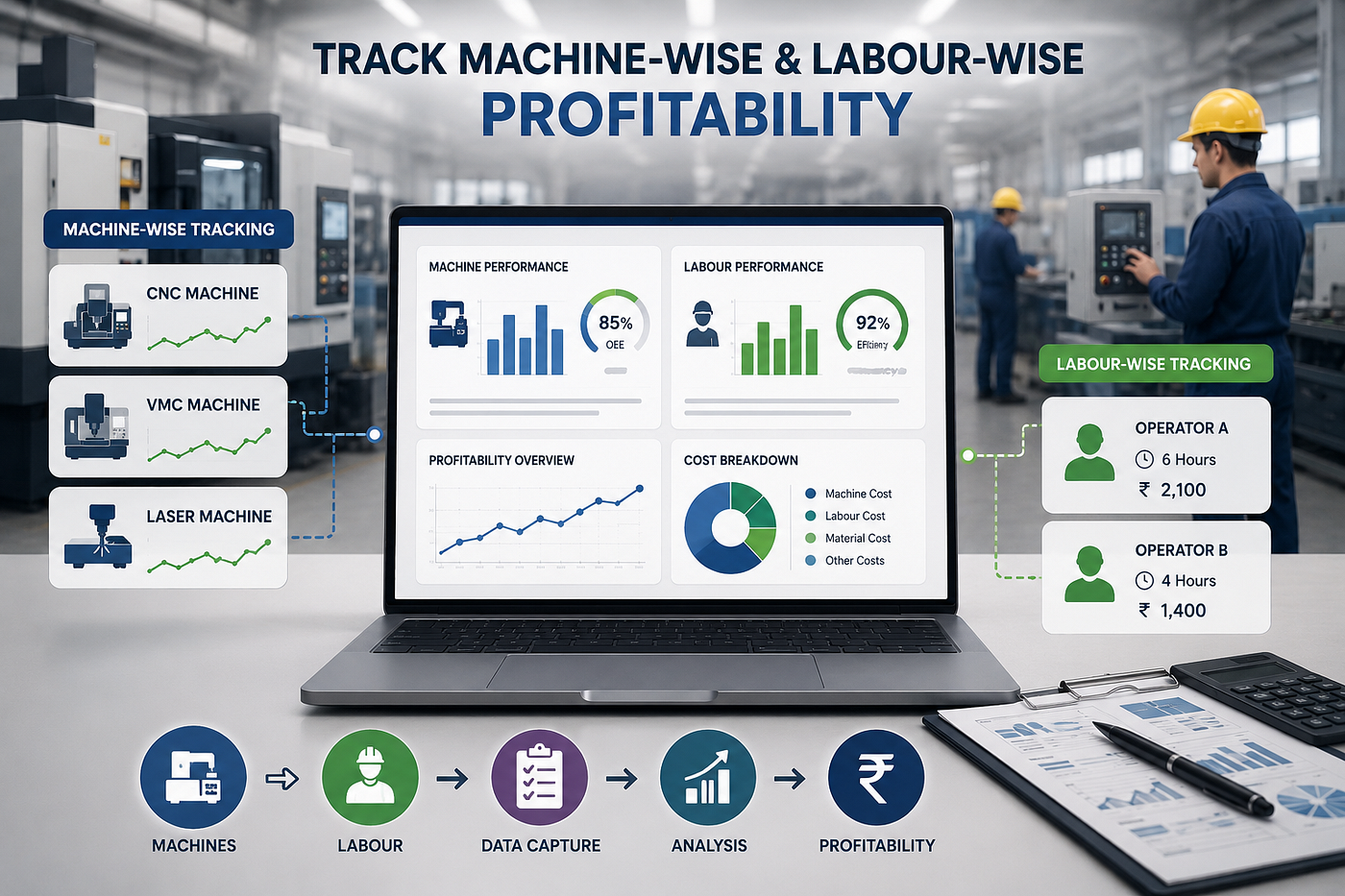
| Machine | Cost Per Hour | | — — — — — | — — — — — — — -| | CNC Machine | ₹1,800 | | VMC Machine | ₹2,400 | | Laser Cutting Machine | ₹3,000 |
If a Manufacturing Order uses the CNC machine for four hours, Odoo automatically calculates the machine cost for that production order.
Instead of assuming production costs, manufacturers can see exactly how much each machine contributes to the final product cost.
Step 4: Measure Labour Cost for Every Production Order
Machine costs tell only half the story.
Labour is one of the biggest manufacturing costs, yet many factories calculate it only at month-end.
Odoo links labour costs directly to each production activity.
As operators complete manufacturing operations, the system records:
- Operator assigned
- Time spent
- Work Centre
- Manufacturing Order
- Production activity
If your factory maintains hourly labour rates, Odoo can automatically calculate labour costs for every operation.
For example:
| Operator | Hours Worked | Hourly Rate | Labour Cost | | — — — — — -| — — — — — — -| — — — — — — | — — — — — —| | Operator A | 6 | ₹350 | ₹2,100 | | Operator B | 4 | ₹350 | ₹1,400 |
Instead of dividing monthly salaries across all products, manufacturers get a much more accurate picture of actual labour costs.
Step 5: Compare Estimated Cost vs Actual Cost
This is where manufacturers often discover hidden profit leaks.
Before production begins, every product has an estimated manufacturing cost based on the BoM.
After production is completed, Odoo calculates the actual cost using live production data.
Management can immediately compare:
| Estimated Cost | Actual Cost | | — — — — — — — -:| — — — — — — :| | ₹48,000 | ₹53,500 |
The difference could be caused by:
- Longer machine runtime
- Additional labour hours
- Material wastage
- Machine downtime
- Higher electricity usage
- Production delays
Instead of waiting until month-end reports, production managers can identify these cost variances immediately and investigate the root cause.
Step 6: Identify Your Most Profitable Machines
Not every machine contributes equally to your factory’s profitability.
Some machines complete jobs faster, consume less power, and require less maintenance.
Others frequently experience breakdowns, require more operator time, or increase production costs.
With Odoo’s reporting capabilities, manufacturers can compare work centres based on:
- Machine utilisation
- Operating cost
- Production time
- Output quantity
- Downtime
- Cost per production order
This helps management answer practical business questions like:
- Which machine generates the highest return?
- Which machine increases production costs?
- Should an old machine be replaced?
- Is outsourcing a particular operation more profitable?
These decisions are based on real production data rather than assumptions.

Step 7: Analyse Labour Productivity
Tracking labour cost is useful.
Tracking labour productivity is even more valuable.
Odoo helps manufacturers compare planned production time with actual execution time.
This makes it easier to identify:
- Operations taking longer than expected.
- Underutilised workforce
- Frequent overtime
- Productivity gaps
- Training requirements
Rather than evaluating employees only by attendance, manufacturers can understand how labour performance impacts production cost and profitability.
Step 8: Monitor Factory Profitability with Real-Time Dashboards
Collecting production data is only useful if decision-makers can understand it quickly.
**Odoo ERP software** provides real-time dashboards and reports that combine production, inventory, purchasing, and costing information into one place.
Factory owners and production managers can monitor:
- Manufacturing cost by product
- Machine-wise operating cost
- Labour cost by production order
- Production efficiency
- Work Centre performance
- Material consumption
- Cost variance reports
- Overall manufacturing profitability
Instead of waiting for monthly spreadsheets, management gets live visibility into factory performance and can make faster, data-driven decisions.
A Practical Example
Imagine two production lines manufacturing the same product.
Both produce 500 units.
At first glance, they appear equally productive.
After reviewing Odoo’s reports, you discover:
| Production Line | Machine Cost | Labour Cost | Total Cost | | — — — — — — — — -:| — — — — — — -:| — — — — — — :| — — — — — -:| | Line A | ₹38,000 | ₹18,000 | ₹56,000 | | Line B | ₹46,000 | ₹25,000 | ₹71,000 |
The difference isn’t caused by raw materials.
It’s caused by longer machine hours and higher labour time.
Without detailed machine-wise and labour-wise tracking, both production lines would appear equally successful.
With Odoo, management immediately identifies the less efficient line and takes corrective action before it continues affecting profitability.
This is the difference between looking at factory sales and understanding factory profits.
How Tracking Machine & Labour Costs Improves Factory Profitability
Tracking machine and labour costs isn’t just about creating reports. It helps manufacturers identify profit leaks, improve production efficiency, control manufacturing costs, and make faster business decisions. With Odoo ERP for Manufacturing, every production order becomes an opportunity to improve profitability.
1. Know Which Products Actually Make Money
Many manufacturers judge product performance based on sales volume.
But strong sales don’t always translate into healthy profits.
Odoo calculates the actual manufacturing cost of every production order, helping you identify products that generate healthy margins and those that quietly reduce profitability.
2. Reduce Unnecessary Manufacturing Costs
When machine hours, labour time, and material consumption are tracked in real time, unnecessary expenses become visible immediately.
Instead of discovering cost overruns at the end of the month, production managers can take corrective action while production is still running.
3. Improve Machine Utilisation
Expensive machines should improve profitability — not sit idle or increase production costs.
Odoo’s Work Centre reports help manufacturers analyse machine utilisation, operating costs, downtime, and production efficiency, making it easier to optimise capacity and plan future investments.
4. Increase Labour Productivity
By comparing planned production time with actual execution time, manufacturers can identify productivity gaps, unnecessary overtime, and inefficient production processes.
This helps improve workforce planning without relying on assumptions.
5. Make Faster, Data-Driven Decisions
Instead of waiting for month-end costing reports, factory owners can monitor production costs, machine performance, and labour efficiency through real-time dashboards.
This helps manufacturers make faster, more informed decisions.
[embed]
Common Costing Mistakes Manufacturers Still Make
Many factories lose profit not because of low demand, but because they don’t measure manufacturing costs accurately. Avoiding these common mistakes can significantly improve factory profitability.
1. Measuring Sales Instead of Profit
Revenue looks impressive, but profit is what keeps a business growing. Always analyse manufacturing costs alongside sales performance.
2. Calculating Costs at Month-End
By the time monthly reports are ready, the opportunity to correct production issues has already passed. Real-time costing enables faster action.
3. Ignoring Machine Operating Costs
Many factories calculate raw material costs but overlook machine running costs, electricity, maintenance, and depreciation. These hidden expenses can have a major impact on product profitability.
4. Treating Labour as a Fixed Expense
Labour costs vary across products and production orders. Tracking actual labour hours gives a clearer picture of manufacturing costs.
5. Relying on Excel for Cost Analysis
Spreadsheets are useful for reporting, but they cannot automatically connect production, inventory, labour, machines, and costing into a single live system.
Real Manufacturing Example: Better Cost Visibility with Odoo ERP
One of our clients, **Globe Star Valves Pvt. Ltd.**, a manufacturer of PTFE-lined valves, struggled with inaccurate cost calculations, excess WIP, and reactive production planning. Although production was running smoothly, management couldn’t identify where costs were increasing.
After implementing Odoo ERP for Manufacturing, production, inventory, purchasing, and accounting were connected into a single system. This gave the team better visibility into material consumption, production activities, and overall manufacturing costs, enabling faster and more informed decisions.
The impact was significant: 28% reduction in WIP, 22% lower dead stock, 18% reduction in operational costs, and 40% improvement in business transparency. The implementation proved that when manufacturers gain real-time visibility into production costs, improving profitability becomes much easier.
Conclusion
Many factories focus on increasing sales, but sustainable growth comes from understanding where profit is earned — and where it’s lost.
With Odoo ERP for Manufacturing, machine costs, labour expenses, production time, and material consumption are tracked in real time, giving manufacturers complete visibility into the true cost of every production order.
Instead of relying on assumptions or month-end reports, you can make faster decisions, improve operational efficiency, and build a more profitable manufacturing business based on accurate production data.
Curious Minds Want to Know
1. What is machine-wise profitability in manufacturing?
Machine-wise profitability measures how much profit each machine or work centre generates after considering its operating costs, production time, and output.
2. Can Odoo ERP track labour costs automatically?
Yes. Odoo records operator time against Manufacturing Orders and Work Centres, allowing businesses to calculate labour costs based on actual production activities.
3. How does Odoo calculate manufacturing costs?
Odoo combines raw material consumption, machine operating costs, labour costs, work centre expenses, and production time to calculate the actual manufacturing cost of every production order.
4. Why is real-time cost tracking important?
Real-time cost tracking helps manufacturers identify cost overruns, production delays, and inefficiencies before they impact profitability.
5. Can Odoo compare estimated and actual production costs?
Yes. Odoo compares planned costs from the Bill of Materials (BoM) with actual production costs, making it easy to identify cost variances and improve production planning.
6. Which industries benefit from machine-wise profitability tracking?
Manufacturers in engineering, automotive, pump manufacturing, food processing, pharmaceuticals, textiles, plastics, and metal fabrication can all benefit from detailed production costing.
7. Is Odoo suitable for small and medium-sized manufacturers?
Yes. Odoo is scalable and can be implemented for small, medium, and large manufacturing businesses, allowing companies to expand the system as their operations grow.
8. How can you identify hidden profit leaks in your factory?
By tracking machine costs, labour costs, production time, material consumption, downtime, and cost variances in real time, manufacturers can identify exactly where profitability is being lost.
Ready to Build a More Profitable Factory?
We first understand your manufacturing process, then configure Odoo ERP for Manufacturing to match your workflows, improve cost visibility, and help you make more profitable decisions.
메타데이터
- post_id
- e87e35ef635f
- slug
- how-to-track-machine-wise-labour-wise-profitability-with-odoo-erp-in-manufacturing-e87e35ef635f
- url
- https://medium.com/@teknovativemkt/how-to-track-machine-wise-labour-wise-profitability-with-odoo-erp-in-manufacturing-e87e35ef635f
- canonical_url
- https://medium.com/@teknovativemkt/how-to-track-machine-wise-labour-wise-profitability-with-odoo-erp-in-manufacturing-e87e35ef635f
- author_url
- https://medium.com/@teknovativemkt
- status
- ok
- fetched_at
- 2026-08-10 03:35:04