Beyond Brute Force: A Deep Dive into Meta’s REFRAG, the Model That Makes RAG 30x Faster
Retrieval-Augmented Generation (RAG) has been a transformative development for Large Language Models (LLMs). By giving models the ability…
Beyond Brute Force: A Deep Dive into Meta’s REFRAG, the Model That Makes RAG 30x Faster
Retrieval-Augmented Generation (RAG) has been a transformative development for Large Language Models (LLMs). By giving models the ability to “look up” information from external knowledge bases, RAG grounds their responses in verifiable facts, mitigating hallucinations and expanding their knowledge beyond their static training data.1 This capability holds the promise of AI systems that can reason over entire libraries of information — legal contracts, scientific literature, or enterprise knowledge bases.
However, this promise comes with a steep, often hidden, technical penalty. The very architecture that makes LLMs powerful also punishes them for consuming the vast amounts of context that RAG provides. In a new paper from Meta Superintelligence Labs, researchers have introduced a framework that doesn’t just incrementally improve this process but fundamentally rethinks its most expensive component: decoding.4 This framework, called REFRAG (REpresentation For RAG), marks a pivotal shift in AI design philosophy. It moves away from the brute-force scaling of context windows toward a more intelligent, efficient model of context
management, with profound implications for the future of practical, scalable AI.
The Hidden Tax on Knowledge: Why Long-Context RAG is Broken
To understand the significance of REFRAG, one must first appreciate the architectural constraints that have made large-scale RAG applications prohibitively slow and expensive. The problem lies deep within the Transformer architecture that powers virtually all modern LLMs.
The Core Problem: Quadratic Attention Scaling
The engine of a Transformer is its self-attention mechanism, which allows every token in the input to weigh its relationship with every other token. While incredibly powerful, this mechanism is also the primary performance bottleneck. Its computational cost grows quadratically with the length of the input sequence, a relationship described by the complexity notation O(n2), where n is the number of tokens.5
This is not a linear cost. Doubling the length of a document doesn’t just double the work; it quadruples it. A ten-page document isn’t ten times the work of a one-page document; it’s a hundred times the work.5 This quadratic scaling has a direct and crippling effect on system latency, particularly the Time-to-First-Token (TTFT) — the time a user waits for the model to begin generating a response. For interactive applications like chatbots or search engines, a high TTFT creates a frustratingly sluggish user experience.2
The Memory Hog: The Key-Value (KV) Cache
As an LLM generates text token by token, it stores intermediate calculations from the attention layers in a memory buffer known as the Key-Value (KV) cache. This prevents the model from having to recompute the entire context for each new token. However, the size of this cache grows linearly with the length of the input sequence.5 Feeding a model a 100,000-token document means maintaining a massive KV cache that consumes gigabytes of expensive GPU memory, creating a direct and costly trade-off between the amount of knowledge an LLM can access and the hardware required to run it.7
The Inefficiency of RAG’s “Stuffing” Approach
The authors of REFRAG identified a crucial inefficiency specific to RAG applications. When a RAG system retrieves documents, it concatenates them and “stuffs” them into the LLM’s context window. Yet, only a small fraction of these retrieved passages is typically relevant to the user’s query.2 Standard LLMs, however, are blind to this distinction; they must pay the full computational and memory price for every single token, whether it’s a critical piece of evidence or irrelevant filler.5 This process results in highly sparse attention patterns, where chunks of context have strong internal connections but very few connections to other chunks — a clear signal of computational waste that can be exploited.7
This confluence of issues has led the industry down an architectural cul-de-sac. The prevailing solution to handling more information has been a brute-force approach: building models with ever-larger context windows, such as Gemini 1.5’s two-million-token capacity.10 While an impressive engineering feat, this strategy still fights a losing battle against the fundamental
O(n2) scaling law; it simply pushes the limits of an inefficient paradigm rather than changing the paradigm itself. This is where REFRAG diverges. Instead of trying to process an ever-larger number of raw tokens, it fundamentally reduces the effective number of items the attention mechanism needs to process, sidestepping the scaling problem through algorithmic intelligence rather than just raw power.2
Rethinking the RAG Pipeline: The “Compress, Sense, and Expand” Philosophy
The central epiphany behind REFRAG is a simple but profound observation: most of the computation performed over a RAG context during decoding is unnecessary and can be eliminated with minimal impact on performance.2 This insight forms the basis of a new philosophy for handling context, built on three pillars:
- Compress: Proactively reduce the informational volume of the retrieved context. Instead of a long, unwieldy sequence of thousands of tokens, the context is transformed into a short, dense sequence of meaning-rich embeddings.4
- Sense: Intelligently identify the small, critical subset of information that is too important to be summarized and must be preserved in its original, high-fidelity form to ensure accuracy.11
- Expand: Decompress only these critical chunks back into their raw token form. The LLM is then fed a hybrid input that is both remarkably compact and surgically precise.11
To make this concrete, consider an analogy of briefing a CEO. A traditional RAG model is like handing the CEO a thousand pages of raw field reports and financial statements (the tokens) and forcing them to read every word. REFRAG, in contrast, acts like an expert analyst. The analyst reads all thousand pages and prepares a concise, one-page executive summary (the compressed embeddings), but also staples the three most critical, verbatim paragraphs from the reports to the back (the expanded tokens). The CEO gets 99% of the necessary information with 1% of the reading effort but can still refer to the crucial, unaltered details when a decision hinges on them.
Under the Hood: How REFRAG Achieves the Impossible
REFRAG’s “Compress, Sense, and Expand” philosophy is implemented through a clever, multi-stage process that modifies how data is prepared for the LLM’s decoder, without altering the decoder itself.
Step 1: Chunking and Compression — From Tokens to Concepts
The process begins after the standard retrieval step. The retrieved documents are first split into small, fixed-size chunks of text (e.g., 16 tokens each).5 A separate, lightweight encoder model, such as RoBERTa, then processes each of these small chunks and compresses its semantic meaning into a single vector known as a “chunk embedding”.5 This embedding acts as a conceptual summary of the original 16 tokens. This step introduces a major efficiency gain: the chunk embeddings can be pre-computed during the retrieval or re-ranking phase and then cached. This eliminates redundant work, as the system can reuse these pre-calculated summaries for subsequent operations.2
Step 2: The “Relevance Sensor” — The Reinforcement Learning Policy
This is the “Sense” phase, and it is where REFRAG’s intelligence truly shines. A lightweight Reinforcement Learning (RL) policy is trained to act as a relevance sensor. For each chunk, this policy makes a critical decision: should this chunk be represented by its compact embedding, or is it too important to compress?.2
The RL agent is trained with a specific goal: to make decisions that maximize the final performance of the LLM (measured by perplexity, a proxy for accuracy) while staying within a predefined computational budget.11 Through this training, it learns to identify textual patterns that signal indispensable information — things like precise numerical data, rare proper nouns, or specific quoted text — that would lose their fidelity if summarized into an embedding.5 This dynamic, learned selection process is what allows REFRAG to perform aggressive compression without sacrificing factual accuracy.6
Step 3: The Hybrid Input — A Language of Tokens and Embeddings
The final sequence passed to the LLM’s decoder is a novel, hybrid construct. It consists of the user’s query in its original token form, followed by a sequence that mixes compressed chunk embeddings with the full-token representations of the chunks the RL policy chose to expand.2 A critical innovation here is that REFRAG’s framework allows chunks to be compressed at
any arbitrary position within the context. This preserves the sequential, autoregressive nature of the decoder and is essential for dynamic applications like multi-turn conversations or agentic workflows, where the context is constantly being updated.2
It is important to distinguish REFRAG’s contribution from other advanced RAG techniques. Methods like “Fine-Grained RAG” focus on improving the retrieval step by, for example, breaking documents into individual sentences to find more precise matches.1 REFRAG, by contrast, is a
decoding strategy. It assumes the documents have already been retrieved and focuses exclusively on how to process that retrieved context with maximum efficiency.2 These two approaches are not mutually exclusive; in fact, they are complementary. A system could use a fine-grained retrieval method to gather highly relevant sentences and then use REFRAG to feed those sentences to the LLM with minimal latency.
The Results Are In: Speed, Scale, and Smarts
The performance gains reported by the Meta AI team are not merely incremental; they represent a step-change in efficiency for RAG systems.
The Headline Numbers
The key results from the research validate the effectiveness of the “Compress, Sense, and Expand” approach:
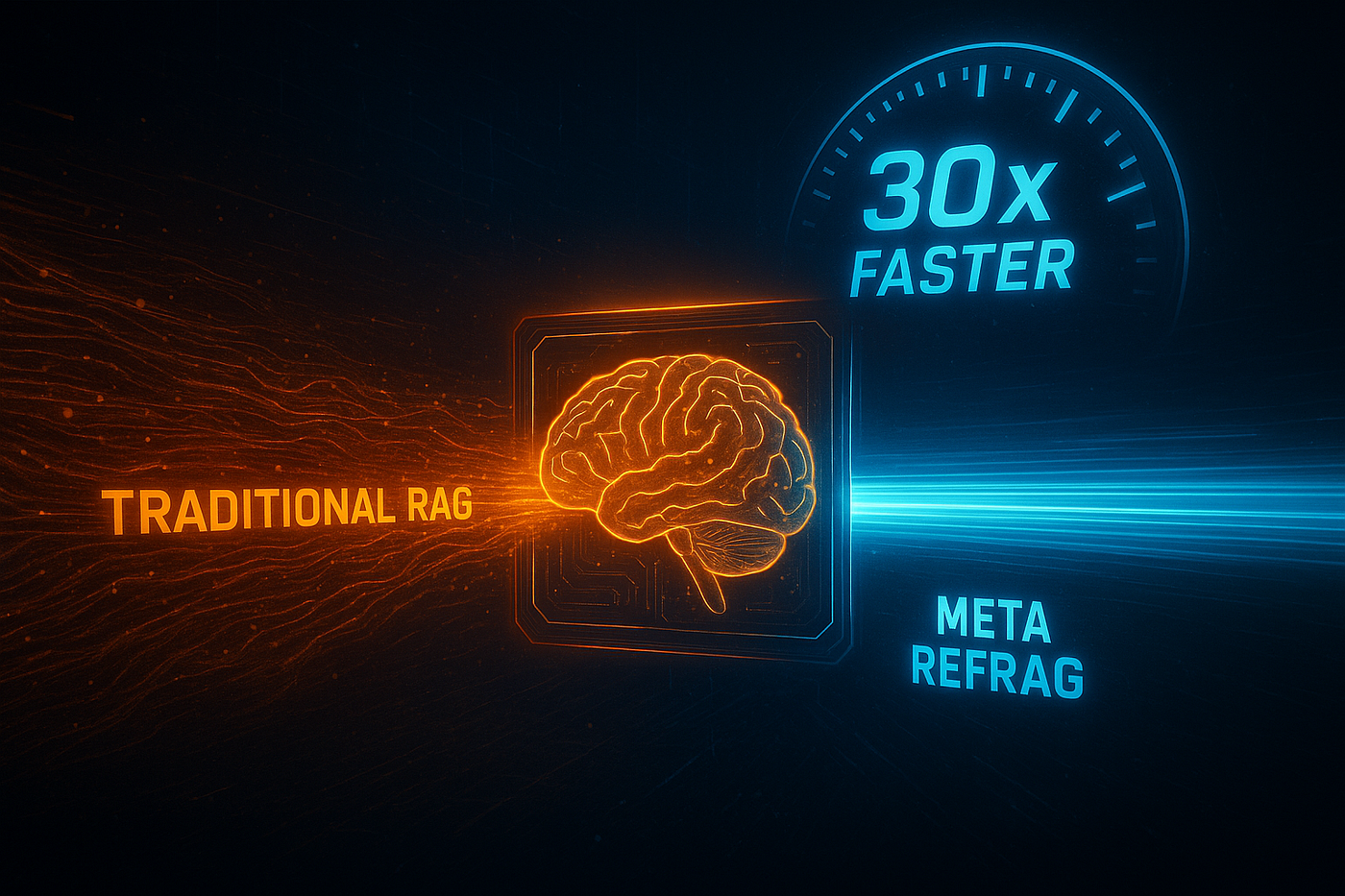
- Up to 30.85x TTFT Acceleration: REFRAG can begin generating a response over 30 times faster than a standard RAG implementation. This is a 3.75x improvement over the previous state-of-the-art in efficient decoding, effectively eliminating the perceptible lag between a user’s query and the start of the AI’s response.2
- 16x Context Window Extension: The compression technique allows a model like LLaMA-2, with a native 4,096-token context window, to effectively process a context of over 64,000 tokens without incurring the typical latency penalty.2 This unlocks the ability to analyze entire technical manuals, lengthy legal documents, or dense research papers in a single pass.
- No Loss in Accuracy: These dramatic speed and scale improvements are achieved with no degradation in model accuracy, as measured by perplexity. In certain benchmarks, REFRAG’s ability to process more context even led to improved performance compared to the baseline.2
The following table provides a clear comparison of the architectural differences and their resulting impact.

Beyond the Benchmarks: Smarter Under Pressure
One of the most compelling findings is that REFRAG demonstrates greater resilience when the retrieval component of the RAG system supplies irrelevant or “noisy” documents.5 This is a crucial advantage for real-world applications, where retrieval systems are never perfect. The compression mechanism naturally acts as a filter; less relevant passages are condensed into single, less-impactful embeddings, preventing their noisy tokens from overwhelming the decoder’s attention and distracting it from the truly important information.13
The Bigger Picture: REFRAG’s Ripple Effect on AI Architecture
REFRAG is more than an optimization; it represents a new architectural path for building long-context models and has significant implications for the design of future AI systems.
A New Branch in the Long-Context Tree
Previous attempts to solve the long-context problem have largely focused on modifying the Transformer’s core components.
- Transformer-XL introduced a recurrence mechanism, allowing information to be passed from one segment of text to the next, much like an RNN.15
- Longformer re-engineered the attention mechanism itself, replacing the dense, all-to-all attention pattern with a sparse combination of local windowed attention and a few global attention points, reducing the complexity from O(n2) to O(n).17
REFRAG charts a third path. It leaves the core attention mechanism untouched and instead fundamentally changes the representation of the input being fed into it. This is a less intrusive yet highly effective strategy that avoids complex architectural surgery on the base LLM.
By solving the decoding bottleneck so decisively, REFRAG effectively shifts the primary performance bottleneck in RAG systems back to the retrieval and re-ranking stages. This will likely have a cascading effect on system design. In traditional RAG, developers are often forced to be conservative, retrieving only the top 3–5 most relevant documents because the cost of feeding more to the LLM is prohibitive. With REFRAG, the marginal cost of adding more documents to the context is drastically lower. This enables a new architectural pattern: “retrieve broadly, let the LLM sort it out.” Developers can now afford to retrieve the top 20, 50, or even 100 documents, giving the LLM a much richer and more comprehensive pool of information to synthesize its answer from. This could lead to a new focus on building extremely fast, high-recall retrieval systems, confident that the generation step can efficiently handle the increased volume.
Unlocking Enterprise and Agentic AI
The practical benefits of REFRAG directly address the primary barriers to adoption for advanced AI applications.
- Enterprise AI: For businesses dealing with massive, domain-specific knowledge bases — such as legal firms analyzing case law, financial institutions reviewing compliance reports, or pharmaceutical companies parsing research papers — REFRAG makes large-scale RAG feasible. The combination of low latency, reduced computational cost, and the ability to process entire documents makes it a commercially viable solution for enterprise search and analysis.5
- Agentic Systems: The development of sophisticated AI agents that can perform complex, multi-step tasks depends on their ability to maintain a long-term “memory” or “scratchpad” — an evolving context of past actions, observations, and retrieved information. REFRAG’s efficiency in handling long, dynamic contexts and its near-instantaneous TTFT make it a critical enabling technology for building faster, more capable, and more responsive AI agents.20
Conclusion: The Dawn of Efficient, Scalable RAG
REFRAG’s core contribution is a powerful demonstration that the path to more capable AI does not always lie in building bigger models, but in building smarter data-processing pipelines for those models. It proves that we can achieve immense performance gains by intelligently managing the information we ask our models to process.
By delivering near-instantaneous speed, massively expanded context, and robust accuracy — all without requiring modifications to the underlying LLM architecture — REFRAG provides a clear path forward.2 It is more than just a new model; it is a new design pattern for AI systems. This work paves the way for a future where AI can leverage vast stores of knowledge not just in theory, but efficiently, affordably, and at scale, moving powerful RAG applications from the research lab into widespread, real-world deployment.22
메타데이터
- post_id
- e88cd1ee3c39
- slug
- beyond-brute-force-a-deep-dive-into-metas-refrag-the-model-that-makes-rag-30x-faster-e88cd1ee3c39
- url
- https://medium.com/@elamir/beyond-brute-force-a-deep-dive-into-metas-refrag-the-model-that-makes-rag-30x-faster-e88cd1ee3c39
- canonical_url
- https://medium.com/@elamir/beyond-brute-force-a-deep-dive-into-metas-refrag-the-model-that-makes-rag-30x-faster-e88cd1ee3c39
- author_url
- https://medium.com/@elamir
- status
- ok
- fetched_at
- 2026-06-09 14:34:10