You Can Use AWS Bedrock to Help Pass Your Solutions Architect Professional Without Cheating
Back in my on-premises days, a lot of certification was about knowing specific commands or configurations. You memorized CLI syntax…
You Can Use AWS Bedrock to Help Pass Your Solutions Architect Professional Without Cheating
Back in my on-premises days, a lot of certification was about knowing specific commands or configurations. You memorized CLI syntax, esoteric settings in a GUI, and vendor-specific hardware limitations. The AWS Certified Solutions Architect — Professional exam is entirely different. It demands making tough architectural decisions under pressure, often with incomplete information. This guide details how to use AWS Bedrock for Solutions Architect Professional exam preparation, which transforms study from passive memorization into an active, engaging experience.
I quickly found that the exam tests your judgment on architectural trade-offs. For example, you need to justify a Direct Connect over a Site-to-Site VPN when you have tight budget constraints but still need rock-solid, low-latency failover across AWS Regions. The exam forces weighing cost, performance, and resilience, which are often competing priorities. My old study habits, built around flashcards and static question banks, were completely inadequate for this kind of scenario-based testing. This is why using AWS Bedrock to study for the AWS Certified Solutions Architect Professional certification proved to be a critical differentiator.
I realized I needed a way to simulate these complex decision points. The questions are designed to find the best solution among several technically viable options. Static materials just give you a question and an answer; they do not force you to articulate the reasoning behind your choice. I had to find a method that would challenge my understanding of the why, not just the what.
This shift in focus from simple recall to deep architectural reasoning is the central challenge of the SA Pro exam. To help visualize the breadth of this challenge, it is useful to see how the core domains interconnect.

Why use an AWS Bedrock simulated examiner for exam preparation?
I was initially skeptical about using generative AI for serious AWS Bedrock exam preparation. My on-premises experience taught me to trust hard data, official documentation, and repeatable processes, rather than probabilistic models that can hallucinate. The risk of learning incorrect information seemed too high. But I discovered that when harnessed correctly with careful prompt engineering, tools like Amazon Bedrock are not about finding shortcuts or cheating the system; instead, they are about creating a dynamic, interactive study partner, essentially an AWS Bedrock simulated examiner.
My breakthrough came when I stopped asking for answers. Instead, I started using a model like Anthropic’s Claude on Bedrock as a Socratic-style tutor. By providing the model with a knowledge base built from official AWS documentation, I could transform it from an answer machine into a questioning engine. This method forced me to explore AWS Bedrock architectural trade-offs deeply without getting direct answers.
It would challenge my assumptions and push me to defend my design choices. This was incredibly valuable, as it simulated the real-world pressure of justifying a technical strategy. It felt very similar to my past experiences, where I had to articulate the business case and technical reasoning for new hardware purchases to senior management. This interactive process, driven by my own inputs, was the key to unlocking a deeper level of understanding during my AWS Bedrock interactive study sessions.
The entire workflow revolves around this principle of using AI to probe, not to answer. Here is a diagram of how I structure this Socratic learning loop.

A step-by-step guide to AWS Bedrock prompt engineering for exam study
After some trial and error, I honed a specific, multi-step prompting technique within the Bedrock console that felt practical and highly effective. This was not about clever phrasing; it was a structured process to constrain the AI and force it to act as a specialized tool. I found breaking my prompt into three distinct parts was the most reliable way to get high-quality, challenging questions that mirrored the exam’s style. This step-by-step guide to using AWS Bedrock for exam preparation follows a simple, repeatable structure.
My AWS Bedrock prompt engineering process follows these steps:
- Define the persona: The first instruction sets the stage for the entire interaction. I tell the model exactly what role to play. My go-to is: ‘You are an expert AWS Solutions Architect Professional exam proctor. Your goal is to test my understanding of architectural trade-offs, not provide answers.’
- Provide context: Next, I ground the model in facts by providing it with specific, official documentation. This can be done by pasting text directly into the prompt or, more effectively, by using a Bedrock Knowledge Base that you have populated with relevant PDFs from AWS.
- Submit the scenario: Finally, I give the AI a concrete problem to work with. This could be a short description of a customer’s requirements or a simplified architecture diagram.
Practical tip: Be explicit in your final instruction. Instead of asking for ‘questions,’ ask the model to ‘ask me five difficult AWS Bedrock practice questions about the resilience of this hybrid network architecture, focusing on BGP configuration and failover. I need to justify my choices, not just list facts.’
This setup ensures the AI challenges my understanding of architectural best practices, based on official source material. It is the same critical lens I had to apply when I challenged hardware vendors on their proposed solutions in my old sysadmin role.
This structured approach is crucial for getting consistent and useful results, as visualized in the following sequence.

Mastering architectural trade-offs: A hybrid networking example
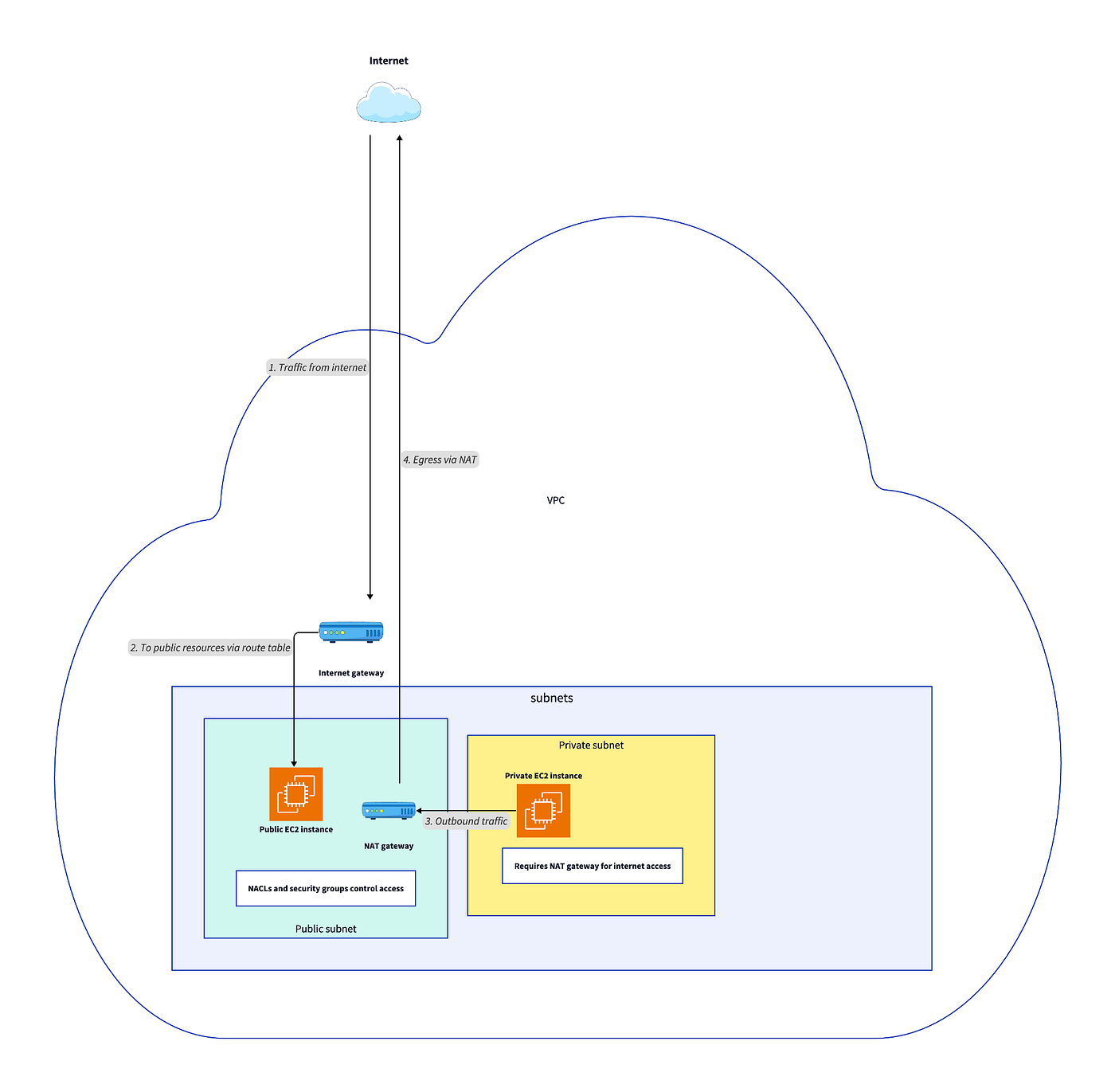
Let us apply my workflow to a classic scenario that gave me persistent challenges during my on-premises migration planning: hybrid networking. The complexity of connecting a private data center to the cloud involves many moving parts and critical trade-offs. I would start with a base architecture: for example, an on-premises data center connected to a single AWS VPC via a 10 Gbps AWS Direct Connect link. Mastering hybrid networking concepts with AWS Bedrock becomes much easier with this interactive method.
After setting the persona and providing the Bedrock model with the latest Direct Connect user guide as context, I would present this scenario. Then, I would ask it to generate questions designed to test my resilience and cost-optimization knowledge. A typical question generated by my ‘Bedrock proctor’ might be: ‘Your primary Direct Connect location is impacted by a regional fiber cut. What is the most cost-effective failover solution to maintain at least 1 Gbps of critical connectivity? Justify your choice by comparing a secondary DX connection to a VPN backup, detailing the latency implications and BGP configuration changes required for each.’
Note: The exam loves to test knowledge of BGP attributes like AS_PATH prepending for influencing traffic patterns during failover scenarios. This is a detail static question banks often miss.
This question forces me to think beyond the ideal scenario. I have to evaluate multiple valid solutions (a second DX link, a VPN, maybe even AWS Direct Connect SiteLink) and justify my choice based on specific constraints. I must consider not just the technical implementation but also the financial impact and operational complexity, which my sysadmin background always emphasized. Every single design decision has a direct or indirect cost.
This interactive method ensures I am prepared to defend my architectural choices, a skill essential for both the exam and my day-to-day role. It moves the study process from passive memorization to active problem-solving.
Applying this interactive study method to other exam domains
What I appreciate most about this interactive study method is its remarkable versatility. It is not limited to just networking, which was a significant relief for me when tackling the vast scope of the SA Pro exam. I have successfully adapted this exact same prompting framework for other complex exam domains, simply by swapping the context and the base scenario. It is a pragmatic, repeatable approach that scales across the entire syllabus, enhancing study sessions with AWS Bedrock generative AI.
For instance, to study for multi-account governance, I would:
- Change the persona: ‘You are an expert on enterprise cloud governance and billing.’
- Update the context: Provide the model with the official documentation for AWS Organizations, Service Control Policies (SCPs), and AWS Control Tower.
- Define a new scenario: ‘A company with 50 AWS accounts needs to enforce preventative guardrails to block the creation of resources outside of approved regions. Propose a solution and be prepared to defend it.’
The AI would then generate probing questions about the trade-offs between using SCPs vs. IAM permission boundaries, or the long-term operational costs of managing a landing zone manually vs. using Control Tower. I have used this for data migration patterns with AWS DMS and for complex serverless application security. It provides a consistent way to prepare for the ambiguity and complexity that defines the professional-level certification exams. This method of active learning helped me build the mental models needed to excel.
Ultimately, this workflow transformed my preparation from a passive review of facts into an active, engaging simulation of architectural decision-making. Try this AWS Bedrock course. It is a comprehensive study guide that ensures I am always addressing trade-offs, optimizing for cost, and prioritizing security, making the entire study process more effective than any static guide I have ever used.
Frequently Asked Questions About AWS Bedrock for Exam Preparation
How can AWS Bedrock assist in preparing for the AWS Solutions Architect Professional exam?
AWS Bedrock assists by acting as a dynamic study partner. Instead of providing direct answers, you can use AWS Bedrock generative AI for exam preparation to simulate a proctor who asks probing, scenario-based questions. This method forces you to articulate the ‘why’ behind architectural decisions, deeply exploring trade-offs in areas like cost, resilience, and performance, which is the core skill tested by the SA Pro exam.
Is using AWS Bedrock for exam preparation considered ethical?
Yes, when used as described in this guide, it is completely ethical. The goal is not to ask the AI for exam answers or ‘cheat.’ Instead, the workflow focuses on using the AI as a tool to challenge your own understanding and force you to defend your design choices based on official documentation. It is a method for active learning and critical thinking, not for finding shortcuts.
What are the benefits of using AWS Bedrock for exam preparation?
The primary benefit is moving beyond static practice questions. Leveraging AWS Bedrock for interactive learning experiences allows you to create unlimited, complex ‘what-if’ scenarios tailored to your weak areas. This dynamic approach improves your readiness for the exam’s ambiguous, multi-faceted questions far more effectively than memorizing answers from a fixed question bank.
How do you create a simulated examiner using AWS Bedrock?
You can create a simulated examiner by using a structured, three-part prompt. First, define the AI’s persona (e.g., ‘You are an expert AWS exam proctor’). Second, provide it with context, such as official AWS documentation. Third, submit a specific scenario or problem. This AWS Bedrock prompt engineering technique for exam study constrains the AI, ensuring it generates challenging questions rather than simple answers.
메타데이터
- post_id
- e8a3a1fe6f1e
- slug
- you-can-use-aws-bedrock-to-help-pass-your-solutions-architect-professional-without-cheating-e8a3a1fe6f1e
- url
- https://medium.com/@repobaby/you-can-use-aws-bedrock-to-help-pass-your-solutions-architect-professional-without-cheating-e8a3a1fe6f1e
- canonical_url
- https://medium.com/@repobaby/you-can-use-aws-bedrock-to-help-pass-your-solutions-architect-professional-without-cheating-e8a3a1fe6f1e
- author_url
- https://medium.com/@repobaby
- status
- ok
- fetched_at
- 2026-06-24 11:06:28