Swayambhunath
I visited India and Nepal for the first time on a Buddhist pilgrimage led by Shantum Seth in 2007. The following is from my 2008 trip to…
Swayambhunath
I visited India and Nepal for the first time on a Buddhist pilgrimage led by Shantum Seth in 2007. The following is from my 2008 trip to India, Nepal, and Tibet. This excerpt is about Kathmandu, Nepal.

Swayambhunath has SO MANY MONKEYS! Do not smile at ninja attack monkeys. Oh, yeah, it also has countless little reliquary stupas. And many merchants, but I still didn’t feel like shopping.
The Swayambhunath Temple in Kathmandu, Nepal, is up on a hill or small mountain. When Naresh the travel agent and I reached the top of the steps, guards in uniforms stood under a dark red archway reminiscent of the archways to Hindu temples in India.
After Naresh and I passed through the archway, straight in front of me was a round artificial pool, currently empty of water, above the center of which stood a gold Buddha statue on a gold lotus throne. I turned to the right, approaching the temple itself, which is extremely elaborate.
Swayambhunath has, if possible, more little reliquary stupas than the Mahabodhi Temple in Bodh Gaya. The small stupas are mostly dark stone in rows, some with red coloring (probably the kind of powder paint used for the third eye chakra or for throwing during the Hindu festival of Holi), and some with flower offerings. Here and there beyond these small stupas stand medium-sized whitewashed stupas, such as those at Boudhanath.

The temple complex contains several buildings, including a festive red, yellow, and gold Tibetan temple decorated with gold Buddhas and Bodhisattvas. Some buildings were small rectangular one-story structures that seem simple at a glance, but up close the detail on these buildings is breathtaking. Columns and doors are elaborately carved of wood, and windows are covered with hand-carved wooden trelliswork. One little red brick building displayed a wooden door flanked by red snake reliefs, representing either Nagas (snake deities) or the snake that according to myth protected Siddhartha Gautama, the historic Buddha, during a rainstorm.

Both Boudhanath and Swayambhunath have countless colorful Tibetan prayer flags blowing in the breeze; but an observer generally sees prayer flags billowing in Kathmandu. The center of Swayambhunath Temple is a large white dome, the main stupa. We circumambulated it, and I’m tempted to say some devout monkeys did the same.
Near the center of the temple stands a dark wooden Hindu shrine, covered with elaborate carvings, where many Nepalese visitors prayed, delivered flower offerings, and rang a metal bell, and where a sign stated that photography was not permitted. Smoke wafted up from this shrine, probably from incense. The shrine in question stood to the left of the door to a formidable stone square structure covered with elaborate carvings. I gazed at this structure and peeked into the dark interior through a latticework window.
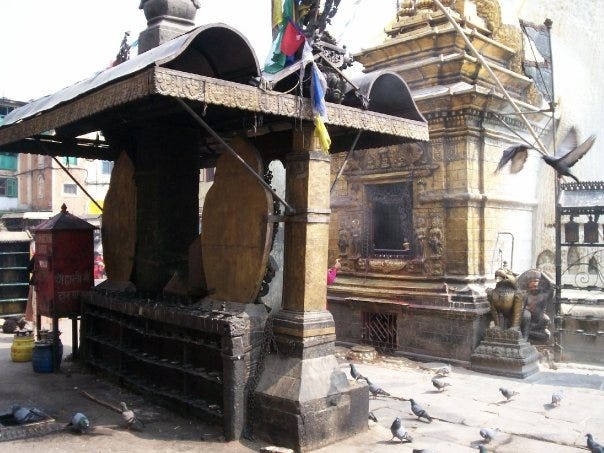
During my circumambulations, I stepped inside a small one-room museum full of stone Buddhist artwork and some Hindu artwork. Ancient statues and plaques lined the walls on simple wooden shelves, Most of these works of art had paper labels that looked like they had been written a hundred years ago; the English was in old-fashioned script.

The amusing aspect of Swayambhunath Temple is the monkeys, monkeys, and monkeys! They run around freely, climb on the little stupas and the big stupa and the walls and window frames, and people should be careful not to stand below a monkey while it’s pooping. I was just about to get closer to the big stupa, and thought better of it as I warily eyed a monkey. I encountered families of monkeys while climbing the steps, and that’s the point at which I started taking pictures of them. Near the large stupa is a lotus pedestal several feet around, on top of which lies an enormous gold dorje or thunderbolt; it was about five feet, lying from side to side, and a large monkey climbed up it and sat in the center. I can never get tired of monkeys. Oh, yes, they’re the brown monkeys with pink butts, not the beautiful, black-faced lemurs.

Monkey on a dorje (Tibetan Buddhist thunderbolt)
Something I found disturbing at Swayambhunath, despite all the above positive comments, was not the quantity of scruffy stray dogs, but the condition of one of the dogs. I abruptly heard loud and suffering whimpering and howling coming from a lookout point, a balcony overlooking Kathmandu. I turned to look and watched, to my horror, a large scruffy dirty black dog walk slowly and awkwardly away from the lookout point. It kept howling in agony, and nobody seemed to care. It moved slowly, slowly, toward a downward flight of steps and started getting a little quieter, then loud again as it went down the steps.
I wondered whether the dog had rabies or was wounded, and although I was horrified by its pain, I didn’t want to get anywhere near it because it might have a contagious disease. I felt useless, while everyone else completely ignored the dog as if it didn’t matter. I walked well around the dog and headed for the lookout point, where indeed I had a fine view of Kathmandu. I still thought of the dog as its whimpering died down and I felt helpless. The suffering this dog experienced and my inability to help and everyone’s apparent indifference did not sit well with me.
Merchants are right there amid the little stupas, occupying sacred space. Sure, they’re selling Buddhist and Hindu items, mostly statues, incense, and malas, but it seems like an odd spot for shopping and I still was not in a shopping mood. On the other hand, on the pilgrimage last year, wallahs followed us in sacred places such as the Bamboo Grove. India and Nepal are the homes of many poor people, and they need to make a living. Tourists from other countries can afford to purchase souvenirs and meditation supplies.

As pilgrims start descending the stairs to depart, they pass a little café, “Ajima Fast Food,” where one can get packaged food and cold beverages. Outside the café, to the right of the door, stand a couple antique and beautiful three-foot-tall black reliquary stupas, like the ones around the large stupa. Propped up in front of one of these stupas was a sign with an arrow saying, “Ajima Fast Food.” It seemed a strange contrast of the sacred and the mundane. I entered and purchased a big bottle of water. On one hand, the sign seems irreverent, but on the other hand people need to quench their thirst even at a temple.
In my house, Buddha statues sit in front of fantasy novels on bookcases. I believe in mixing art into everyday life, so who’s to say it isn’t appropriate to mix spiritual art with everyday things? Nepal is like India and London; everything is crowded together in riotous chaos, and it’s best to go with the flow. For that matter, I probably shouldn’t be critical of the merchants around the stupa, either; they need the money.
Naresh led me toward the stairs leading down, down, down the mountain. Indeed, from the top of the steep stairs, it didn’t resemble a hill anymore. It was surely a mountain, although I’m sure it’s short by Himalayan standards.

As we headed down the stairs, an orange-clad Theravada monk stood silently, sideways in relation to the steps, and he held a large silver begging bowl. I recalled that people put food in the Buddha’s bowl rather than money, and the only food I had with me was a few vestiges of dried candied ginger in a plastic bag. I had been eating out of the bag, so it was no longer full.
In hindsight, it belatedly occurred to me that I could have put the last of my ginger in his bowl. But by the time that occurred to me, we were far below the monk on the steps.

A Buddhist stupa
My travel memoir Every Day is Magical: A Buddhist Pilgrimage in India and Nepal is available on Amazon here:
메타데이터
- post_id
- e8ad1a8a231d
- slug
- swayambhunath-e8ad1a8a231d
- url
- https://medium.com/@sewigget503/swayambhunath-e8ad1a8a231d
- canonical_url
- https://medium.com/@sewigget503/swayambhunath-e8ad1a8a231d
- author_url
- https://medium.com/@sewigget503
- status
- ok
- fetched_at
- 2026-08-29 17:59:33