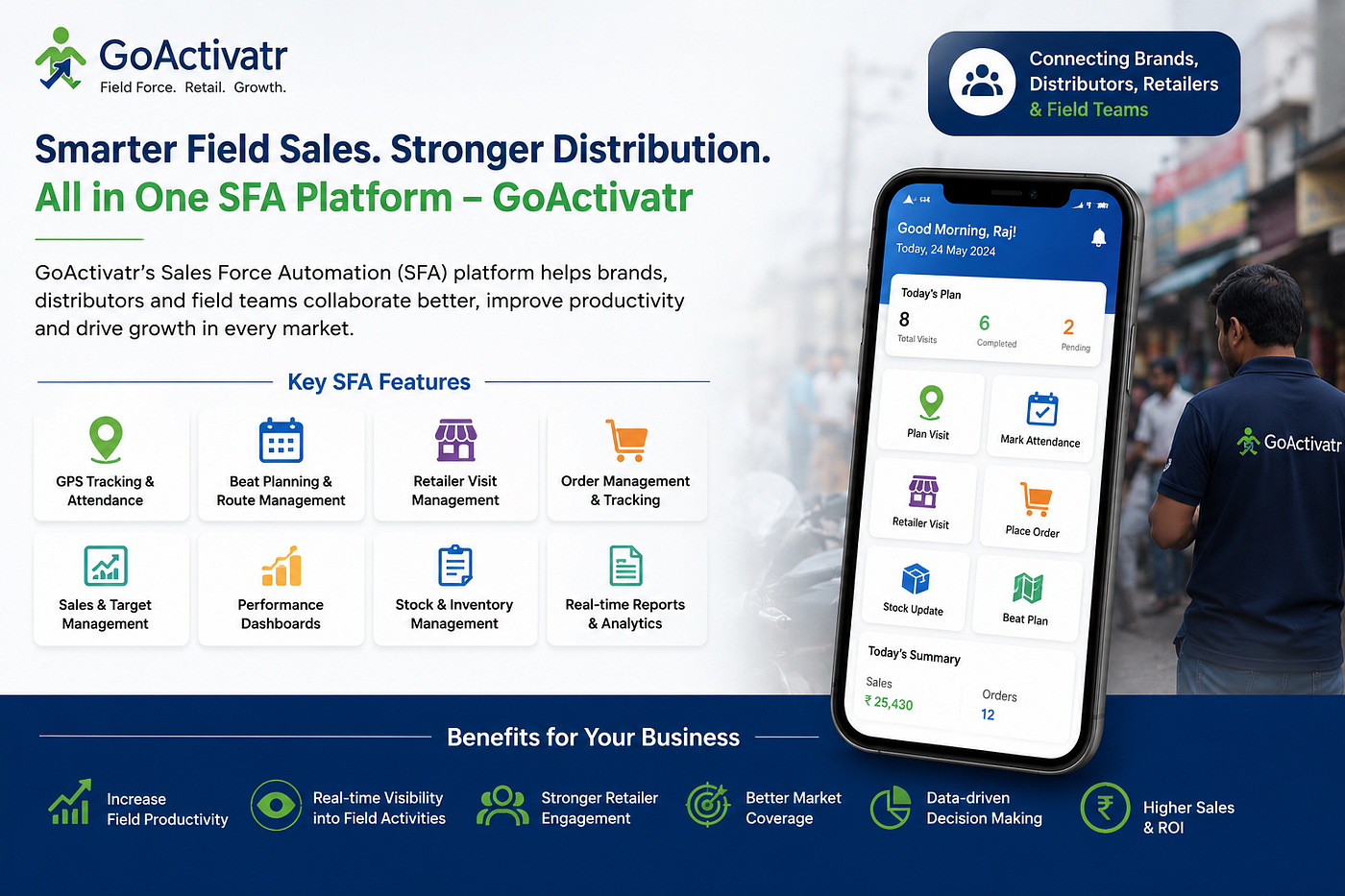
Offline Execution for D2C Brands: The Missing Layer in India’s Retail Growth Story
India’s D2C ecosystem has matured rapidly over the last few years. Brands today can launch a Shopify store in hours, acquire customers…
Offline Execution for D2C Brands: The Missing Layer in India’s Retail Growth Story
India’s D2C ecosystem has matured rapidly over the last few years. Brands today can launch a Shopify store in hours, acquire customers through Meta ads, and scale online operations with modern logistics partners.
But there’s one problem most fast-growing D2C brands eventually face:
Online growth plateaus.
Customer acquisition costs rise. Performance marketing becomes unpredictable. Margins shrink. And brands begin looking toward the next growth frontier:
Offline retail execution.
For many D2C brands, entering offline retail sounds simple in theory:
- onboard distributors,
- place products in stores,
- hire field sales teams,
- track inventory,
- and scale city by city.
In reality, offline expansion is one of the most operationally fragmented parts of the Indian consumer ecosystem.
And that’s exactly why *offline execution* is becoming the defining differentiator for modern D2C brands.
Why Offline Still Matters for D2C Brands
Despite the growth of ecommerce, a significant share of India’s retail economy still happens offline.
Consumers continue to discover and purchase products through:
- kirana stores,
- supermarkets,
- pharmacies,
- modern trade chains,
- cosmetic stores,
- and local retail networks.
For categories like:
- FMCG,
- beverages,
- personal care,
- snacks,
- wellness,
- and beauty,
offline visibility directly impacts brand recall and repeat purchases.
A D2C brand may build awareness online, but retail shelves still influence buying decisions at scale.
The challenge is not whether to go offline.
The challenge is:
how to execute offline efficiently without recreating the inefficiencies of traditional distribution.
The Traditional Offline Distribution Problem
Most D2C founders entering ***offline retail*** discover the same operational bottlenecks:
1. Distributor Dependency
Brands often lose visibility once products move through regional distributors.
There’s limited real-time tracking for:
- inventory movement,
- stock availability,
- shelf placement,
- or retail execution quality.
2. Fragmented Field Operations
Managing PSRs (Product Sales Representatives) across multiple cities becomes difficult.
Common issues include:
- poor beat planning,
- manual reporting,
- lack of accountability,
- inconsistent store coverage,
- and delayed market insights.
3. No Real-Time Retail Intelligence
Most brands operate blind at the retail level.
Questions like these become difficult to answer:
- Which stores are stocked out?
- Which SKUs are moving fastest?
- Which competitors dominate shelf space?
- Which distributor is underperforming?
Without execution visibility, scaling offline becomes reactive instead of strategic.
4. Offline Expansion Becomes Expensive
Building a traditional offline sales infrastructure requires:
- distributor relationships,
- field teams,
- supervisors,
- operational managers,
- inventory coordination,
- and reporting systems.
For early-stage D2C brands, this creates high operational overhead before meaningful scale is achieved.
Offline Execution Is Becoming a Data Problem
The next generation of D2C brands is approaching offline differently.
Instead of treating offline retail as a disconnected channel, modern brands are beginning to treat it as:
a measurable, trackable, data-driven growth engine.
That changes everything.
Offline execution today is no longer just about placing products in stores.
It’s about:
- retail intelligence,
- execution visibility,
- inventory synchronization,
- geo-based sales tracking,
- and operational automation.
The brands that scale fastest offline are the ones that can connect execution with real-time decision-making.
What Modern Offline Execution Looks Like
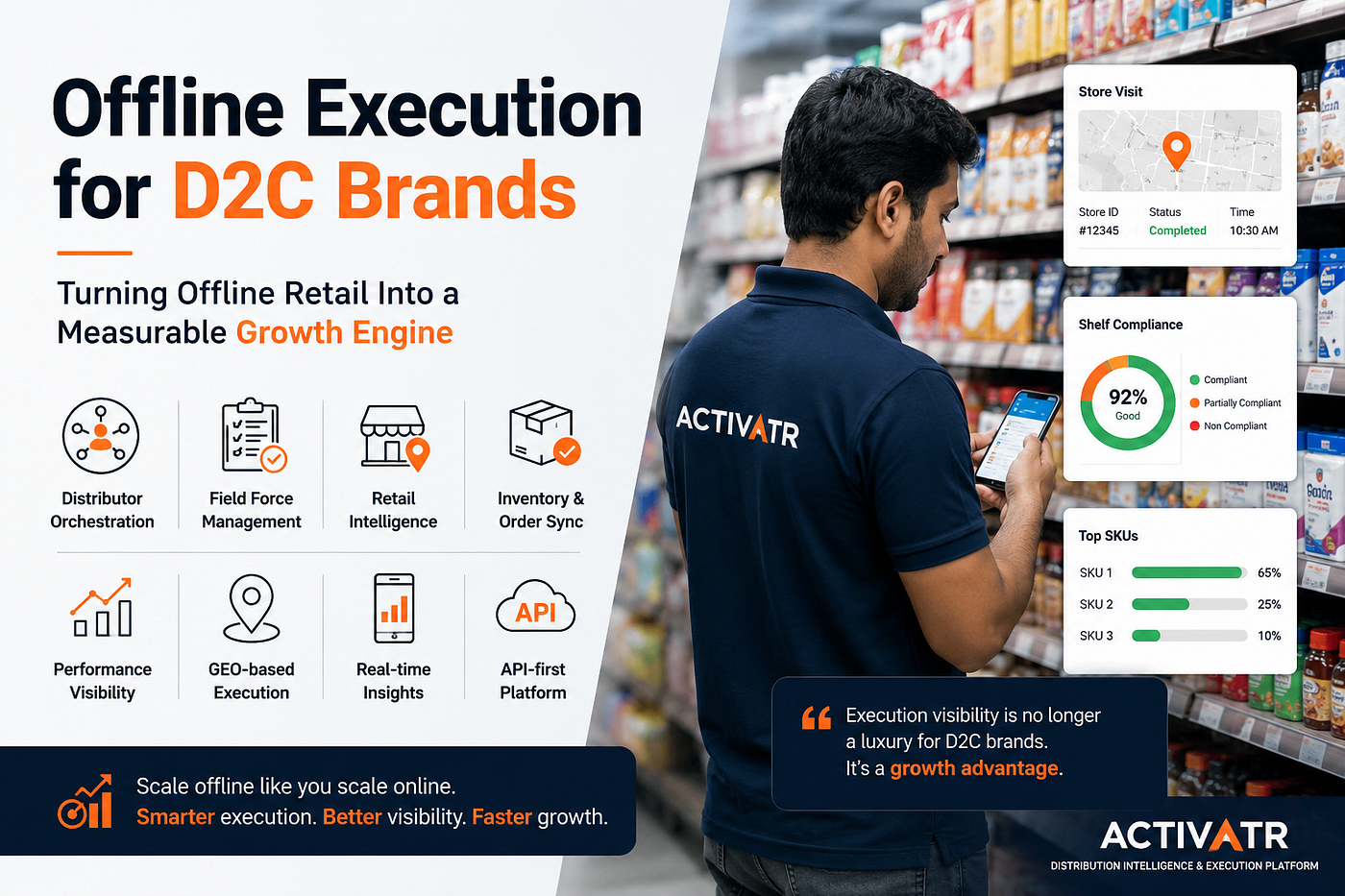
A scalable offline execution model typically includes:
Distributor Orchestration
Instead of depending on isolated distributor relationships, brands need centralized visibility across regions.
This allows:
- standardized execution,
- faster onboarding,
- and performance benchmarking.
Retail-Level Visibility
Brands need real-time insights from the market:
- stock availability,
- shelf share,
- pricing compliance,
- and competitor activity.
This creates actionable retail intelligence rather than delayed reporting.
Smart Field Force Management
Modern execution platforms enable:
- geo-tagged store visits,
- digital beat tracking,
- attendance visibility,
- image-based audits,
- and automated reporting.
This improves accountability while reducing operational inefficiencies.
Integrated Order & Inventory Systems
Offline execution works best when inventory, order management, and retail operations are connected into one operational layer.
This reduces:
- stock-outs,
- fulfillment delays,
- and distributor coordination gaps.
Why Matters in Offline Retail Execution
One of the biggest shifts happening in offline retail is the rise of execution models.
Brands are now optimizing offline expansion based on:
- geography,
- store density,
- retail demand clusters,
- hyperlocal consumption behavior,
- and territory-level performance.
This enables smarter decisions around:
- distributor allocation,
- field team deployment,
- inventory planning,
- and market expansion.
Instead of scaling blindly across cities, brands can scale based on execution intelligence.
For D2C companies, this creates a major competitive advantage.
The Future of D2C Growth Is Hybrid
The future is not online versus offline.
The future is connected commerce.
The strongest consumer brands in India will likely combine:
- online acquisition,
- offline retail presence,
- retail intelligence,
- and execution infrastructure
into a unified growth engine.
Offline retail is no longer just a distribution channel.
It is becoming:
- a data layer,
- a visibility layer,
- and a growth infrastructure layer.
Final Thoughts
For D2C brands in India, ***offline execution*** is no longer optional once growth reaches a certain scale.
But replicating traditional FMCG distribution systems is expensive, slow, and difficult to manage.
The opportunity lies in building:
- intelligent distribution,
- measurable retail execution,
- and geo-driven operational visibility.
Brands that modernize offline execution early will likely outperform competitors not just in retail reach, but in operational efficiency and market intelligence.
And in the next phase of India’s consumer economy, execution visibility may become just as important as product quality itself.
메타데이터
- post_id
- e8afff7a9c72
- slug
- offline-execution-for-d2c-brands-the-missing-layer-in-indias-retail-growth-story-e8afff7a9c72
- url
- https://medium.com/@magicmoments6363/offline-execution-for-d2c-brands-the-missing-layer-in-indias-retail-growth-story-e8afff7a9c72
- canonical_url
- https://medium.com/@magicmoments6363/offline-execution-for-d2c-brands-the-missing-layer-in-indias-retail-growth-story-e8afff7a9c72
- author_url
- https://medium.com/@magicmoments6363
- status
- ok
- fetched_at
- 2026-06-09 15:37:30