The Future of Contributor Trust: Linking DIDs and VCs to the Pull Request Workflow
The Identity Crisis in Open Source
The Future of Contributor Trust: Linking DIDs and VCs to the Pull Request Workflow
The Identity Crisis in Open Source
Currently, open-source collaboration relies almost entirely on email-based identity. While convenient, this model is built on a “honor system” that is increasingly under fire. In a world of decentralized code, our identity remains dangerously centralized and easily forged.
The Problem: Attribution is not Authentication
As it stands, your “identity” on a platform like GitHub is essentially a string of text in a config file.
- Metadata Spoofing: It takes exactly one command to change your Git email to match a famous maintainer’s.
- Fragmented Trust: Your reputation in one ecosystem doesn’t follow you to the next; you are constantly re-verifying yourself.
- The Rise of the Machines: With the advent of Agentic AI, we are facing a future where malicious agents can “flood” repositories with low-quality or dangerous contributions, perfectly mimicking human metadata.
The Current State: The “Honor System”
Today, identity on GitHub is basically a suggestion. By default, anyone can change their local Git config to use your email, and GitHub will display your profile picture next to their code. It’s an honor system that is very easy to spoof.
To fight this, GitHub offers GPG Signing — a “Cryptographic stamp” for your code that earns you a green “Verified” badge. But there’s a catch: it is completely optional. Most developers don’t use it because it’s technical and annoying to set up. And even if they do, that “trust” is locked into one central platform. This is the crack in the foundation that leads us to a better way.
The Path Forward: Decentralized Trust
While there are many technical ways to fix identity, not all of them fit the spirit of open source. If we solve spoofing by forcing every developer to register with one central company, we create a “Walled Garden.”This prevents people from working together freely. It makes the setup process too difficult for beginners.
To protect the relationship between projects and people, we need a solution built on two non-negotiable principles: Decentralized Trust and Self-Sovereign Identity (SSI).
Self-Sovereign Identity (SSI)
In the current model, your identity is “leased” from a platform. If the platform goes away, so does your reputation. With SSI, you are the master of your own identity. You hold your credentials in a digital wallet, and you decide who gets to see them.
The Building Blocks: DIDs and VCs
To turn this philosophy into a working system, we rely on two tools that shift the power back to the developer:
- **Decentralized Identifiers (DIDs): **Think of a DID as a permanent, global address for your identity. Unlike a username on GitHub or an email on Gmail, no company “owns” this address and no admin can delete it. It’s your permanent spot in the digital world — one that stays with you even if the platforms you use change or disappear. You can’t be “unplugged.
- **Verifiable Credentials (VCs): Your Digital Passport* If the DID is your address, the VC is the ID card you carry. It’s a tamper-proof digital “stamp” from a trusted authority. Instead of showing your whole life story, you just show the specific proof needed for the job — like a badge that says, “I am a verified human contributor,” or “I have permission to push to this repo.”* It’s portable, private, and impossible to fake.
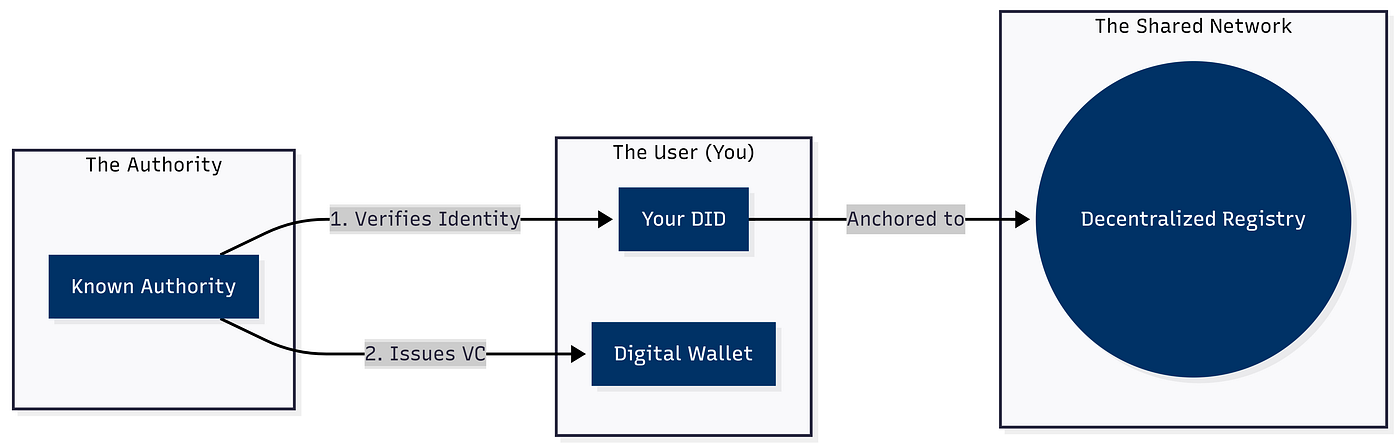
The DID tells the world who you are, and the VC proves what you can do. Together, they live in your Digital Wallet, allowing you to prove your identity to any project without ever needing a middleman.
The Building Blocks of Trust
We’ve built the ‘Who’ (DIDs) and the ‘What’ (VCs). Now, it’s time for the ‘How’ — the seamless flow that bridges the gap between a local git config and a globally trusted contribution.
The Onboarding — Establishing the Root of Trust
Before we can secure a single line of code, we have to move the developer from a simple, spoofable “username” to a cryptographically verified entity. This is a one-time setup — a digital handshake that creates your permanent “Root of Trust.”
Think of this as getting your passport before you travel. You only do it once, but it makes every future border crossing seamless.
1. The Binding (The Cryptographic Link)
The developer doesn’t just “claim” an identity; they prove it. They take their GPG Private Key — the secret half of their signing pair — and use it to sign a message containing their DID.
This act “welds” the two together. By generating this signature, the developer provides undeniable proof that the person who holds the keys to the code is the same person who owns the Decentralized Identity anchor. It turns a “claim” into a cryptographic fact.
2. The Authority’s Role (The Witness)
This proof is sent to a Known Authority (like a project maintainer or an organization). The Authority doesn’t “own” your identity; they act as a cryptographic witness. They verify your signature and confirm the link is valid.
3. The Issuance (The “Passport”)
Once the Authority is satisfied, they issue a Verifiable Credential (VC). This is your digital “Developer ID Card.”
- It is sent directly to your Digital Wallet.
- It is signed by the Authority, making it impossible to forge.
- You now have a portable proof of “Verified Contributor” status.
4. Anchoring the Registry
Finally, a record of this link is stored on the Decentralized Registry. This isn’t a central database of your private info; it’s a public ledger that allows the verification system to look up your DID and confirm that your “passport” is still valid, without ever needing to ask a central server for permission.’

The Onboarding Handshake
With the registry anchored and the VC in the wallet, the ‘Trust’ is established. But a passport is only useful if there is a guard at the gate. Next, let’s look at how the system uses this foundation to catch a spoofed Pull Request in real-time.
The Verification Flow: Policing the Pull Request
A passport is only useful if there is a guard at the gate. In our system, that gate is the Pull Request (PR). This is where the static credentials we built during onboarding are put to the test against a live contribution.
We call this the “Double-Lock” Verification. Here is how the system ensures that every line of code is as authentic as the developer who wrote it:
1. The Trigger (The Detection)
The moment a developer pushes code and opens a PR, a Git Hook or a GitHub Action triggers our verifier. The system doesn’t just look at the username; it looks at the GPG signature attached to the commit.
2. The Static Check (The First Lock)
The Verifier performs a standard GPG check. It asks: “Is this code signed by a valid GPG key?” If yes, it moves to the next, more secure phase.
3. The Challenge-Response (The “Live” Proof)
To prevent “replay attacks” (where a hacker steals an old signed commit), the system generates a Nonce — a random, one-time string.
It sends this challenge to the developer’s digital wallet. The developer must sign this specific, live string using the private key associated with their DID.
4. The Cross-Reference (The Registry Check)
The Verifier then pulls the DID Document from the Decentralized Registry we anchored earlier. It compares the live signature against the public keys stored on the ledger.
5. The Verdict (Success or Block)
- Success: Both locks open. The PR is marked with a “Fully Authenticated” status.
- Failure: If the GPG signature is missing, or if the “Live” proof doesn’t match the registry, the PR is flagged or blocked. Even if the attacker has a matching email address, they cannot forge the live cryptographic proof.

The Double-Lock Verification Flow
The Verdict: Why This Matters
Securing our code shouldn’t just be about adding more “red tape” for developers. It’s about trading guessing games for math.
Standard Git signatures were a good start, but they aren’t enough. Right now, it’s too easy for a hacker to fake an email or reuse an old signature. When we use those old tools, we’re basically just crossing our fingers and hoping for the best.
By using a decentralized registry and a live challenge, we stop guessing. We move the proof away from big companies and put it into the code itself. We stop trusting “usernames” and start verifying facts.
Here is how the new way stacks up against the old:
[embed]
The goal of this architecture isn’t just to stop hackers — it’s to give developers back the power over their own reputation. By moving the root of trust from central databases to math, we ensure that open source remains open, but also undeniably secure.
References
[1] Self-Sovereign Identity (SSI)
[2] w3c-Decentralized Identifiers (DIDs)
메타데이터
- post_id
- e8b142b0261b
- slug
- the-future-of-contributor-trust-linking-dids-and-vcs-to-the-pull-request-workflow-e8b142b0261b
- url
- https://medium.com/@shadyshiko2004/the-future-of-contributor-trust-linking-dids-and-vcs-to-the-pull-request-workflow-e8b142b0261b
- canonical_url
- https://medium.com/@shadyshiko2004/the-future-of-contributor-trust-linking-dids-and-vcs-to-the-pull-request-workflow-e8b142b0261b
- author_url
- https://medium.com/@shadyshiko2004
- status
- ok
- fetched_at
- 2026-07-09 13:22:05