Strategic Capacity Planning: Transitioning to Microsoft Fabric Unified Analytics
1. The Strategic Imperative for Analytics Transformation
Strategic Capacity Planning: Transitioning to Microsoft Fabric Unified Analytics
1. The Strategic Imperative for Analytics Transformation
The modern enterprise stands at a critical juncture, pivoting away from fragmented, organically evolved data estates toward unified, intelligent platforms. For the forward-thinking leader, the objective has evolved: the goal is no longer to serve as a “Chief Integration Officer” tasked with stitching together disparate tools, but to drive competitive advantage through AI and data consolidation. Microsoft Fabric mitigates the friction of the traditional “Starting Line” — an environment defined by geographically fragmented data residing across multi-cloud, on-premises, and external silos.
By implementing Fabric, organizations standardize the storage layer via OneLake and decouple compute from proprietary storage formats. This “Mission Critical Foundation” addresses the systemic risks of redundant data copies, infrastructure inefficiencies, and limited interoperability. Transitioning to a unified foundation ensures that data is not merely stored but is business-ready, serving as a catalyst for AI innovation. This transformation begins with a fundamental shift from per-user licensing to capacity-based economics.
2. Decoding the Capacity-Based Subscription Model
Microsoft Fabric introduces a capacity-based subscription model, best envisioned as a high-performance “Engine.” Unlike traditional per-seat licensing, you are purchasing computational power sized to your organization’s specific throughput requirements. This model enables a more agile IT procurement strategy where a single capacity pool fuels everything from light reporting to massive, parallel-processed data pipelines.
The “Capacity Unit” (CU) is the primary measure of this engine’s power, representing a blend of CPU, memory, and I/O resources. The following table details the Fabric SKUs based on early 2026 GBP estimates:
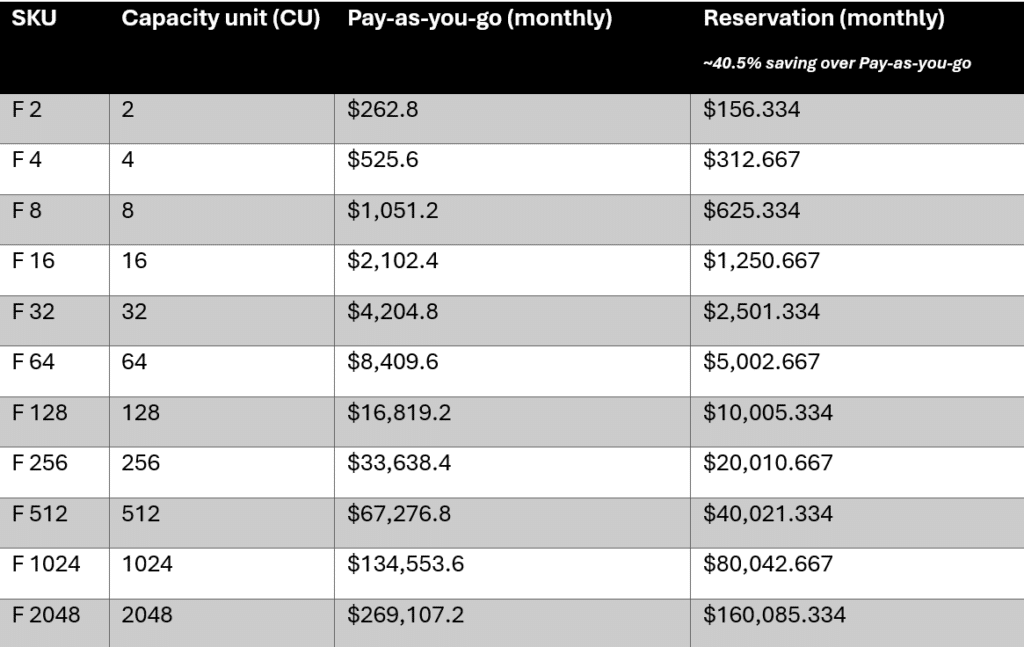
Included for Viewers
Largest Global Deployments
Note: Even at F64 and above, creators/developers still require a Power BI Pro license to publish content; the SKU covers unlimited “viewers” only.
Sizing this engine depends on five critical factors: refresh frequency, concurrency, workload mix (e.g., Spark vs. T-SQL), data volumes, and the requirement for overnight batch processing versus 24/7 real-time access.
3. The Power BI Licensing Threshold: The F64 Pivot Point
The F64 SKU is the most vital decision point in enterprise financial planning. Strategically, this threshold marks the transition from user-centric costs to infrastructure-centric costs.
Below F64, every consumer of a Power BI report requires a Pro license (~£12.50/month). For an organization with 500 viewers, this adds £6,250 in monthly licensing alone on top of the capacity cost. At F64 and Above, viewer licenses are included. Organizations must “run the numbers”: if you have more than 512 users, the jump from F32 to F64 is effectively cost-neutral or even a net saving.
Furthermore, a Solutions Architect must weigh the legacy Power BI Premium P1 (~£4,500) against the Fabric F64 (~£6,400). While the F64 has a higher entry price, it delivers six additional enterprise-grade workloads — including Data Factory, Warehouse, and Real-Time Intelligence — that P1 does not.
4. Financial Rationale for Workload Consolidation
The Total Cost of Ownership (TCO) advantage of Fabric stems from the consolidation of disparate tools into a single performance engine. The cost of maintaining separate licenses for Power BI Pro, Azure Synapse, and Data Factory frequently exceeds the cost of a consolidated F8 or F16 subscription.
A single Fabric capacity unlocks:
- Data Factory: Ingestion pipelines and ETL orchestration.
- Synapse Data Engineering/Science: Spark notebooks, lakehouses, and ML development.
- Data Warehouse: Scalable SQL-based analytics.
- Real-Time Intelligence: KQL databases and event stream processing.
- Data Activator: No-code, event-driven automation.
- OneLake: The unified “No data movement” storage layer.
Fabric virtualizes the data estate through “Shortcuts” (symbolic links to ADLS, S3, or Google Cloud) and “Mirroring.” Mirroring is particularly transformative; it ensures an entire external database reflects in OneLake continuously, capturing schema and data changes without the user having to manage complex Change Data Capture (CDC) logic.
5. Procurement Strategy: Pay-As-You-Go vs. Reserved Capacity
Procurement choices directly impact budget agility and long-term ROI. Organizations should align their purchasing with their workload maturity.
The recommended Right-Sizing Strategy is to start with an F4 or F8 PAYG instance for a Proof of Concept. Monitor consumption through the Fabric Capacity Metrics App to establish a baseline. Once usage patterns are verified, organizations should lock in the 30–40% savings by transitioning to a 1-year Reserved Capacity.
6. Governing the Unified Data Estate
Financial consolidation does not necessitate a compromise in security; rather, it allows for a “Unified Security and Governance” framework across the multi-cloud estate. Fabric utilizes several layers of protection:
- Identity Layer: Entra Conditional Access Policies govern traffic based on location, application, and device.
- Data Classification: Purview labels automatically classify downstream items and enforce protection policies even when data is exported.
- Access Granularity: OneLake Data Access Roles (including specific roles like “ReadAll”) allow for federated security.
Administrative control is maintained through a strict permissions hierarchy. Workspace Permissions (Admin, Member, Contributor) allow for item management, while Item Permissions provide granular engine access. For example, a “Viewer” has read-only access to SQL Endpoints and reports, whereas a “Contributor” is required to execute Spark Notebooks or write files to OneLake.
7. Strategic Recommendations and Next Steps
Microsoft Fabric represents a smarter, more scalable way to manage an enterprise analytics environment by utilizing the Delta-Parquet open standard to create an AI-ready lakehouse. To maximize ROI, we recommend a three-step implementation:
- Pilot: Initiate an F4/F8 PAYG instance for a Proof of Concept to test the “No data movement” principle.
- Monitor: Utilize the Capacity Metrics App to track CU consumption and identify peaks in concurrency.
- Optimize: Right-size based on data and transition to 1-year Reserved Capacity.
Honestly? The hardest part of any transformation isn’t the technology — it’s convincing yourself to let go of what “worked well enough.” If this report does one thing, I hope it makes that leap feel a little less daunting and a lot more worth it.
메타데이터
- post_id
- e8bd8e70acfa
- slug
- strategic-capacity-planning-transitioning-to-microsoft-fabric-unified-analytics-e8bd8e70acfa
- url
- https://medium.com/@sumsamali189/strategic-capacity-planning-transitioning-to-microsoft-fabric-unified-analytics-e8bd8e70acfa
- canonical_url
- https://medium.com/@sumsamali189/strategic-capacity-planning-transitioning-to-microsoft-fabric-unified-analytics-e8bd8e70acfa
- author_url
- https://medium.com/@sumsamali189
- status
- ok
- fetched_at
- 2026-06-09 15:37:30