Deciphering zkSync: Everything Degens and Builders Need to Know
The Layer 2, which started as a scaling experiment, has quietly become the infrastructure layer for the next wave of Web3 and most people…
Deciphering zkSync: Everything Degens and Builders Need to Know
The Layer 2, which started as a scaling experiment, has quietly become the infrastructure layer for the next wave of Web3 and most people still don’t fully understand what it is.
So, What Even Is zkSync?
At its core, zkSync is an Ethereum Layer 2 network built by Matter Labs. Its job? Take the congestion, high fees, and slow throughput of Ethereum mainnet and fix them without sacrificing Ethereum’s security.
It does this using zero-knowledge rollups (ZK rollups): a cryptographic method that bundles thousands of transactions off-chain, compresses them into a single cryptographic proof, and posts that proof to Ethereum. Ethereum doesn’t need to re-execute every transaction, it just verifies the proof. That’s the magic. You get Ethereum-grade security at a fraction of the cost.
If that sounds abstract, here’s the practical version: transactions that cost $10–50 on Ethereum mainnet cost fractions of a cent on zkSync. And they settle faster.
ZK Proofs: The Engine Under the Hood
Zero-knowledge proofs let one party (the prover) convince another (the verifier) that something is true without revealing why it’s true or any underlying data.
In zkSync’s case, the network proves to Ethereum that thousands of transactions were executed correctly, without Ethereum having to check each one. This is fundamentally different from optimistic rollups (like Arbitrum or Optimism), which assume transactions are valid and only challenge them if someone raises a fraud dispute. ZK rollups prove validity upfront — which means faster finality and stronger security guarantees by design.
The Evolution: From Lite to Era to Elastic Network
zkSync didn’t arrive fully formed. It matured through three distinct phases:
zkSync Lite (v1) launched in 2020 as a simple payments rollup, with fast, cheap ETH and token transfers, and nothing more. It served its purpose as a proof of concept. As of 2026, it’s being sunset with an orderly wind-down (funds remain withdrawable to L1 throughout).
The zkSync Era was the real leap, a full EVM-compatible Layer 2 where developers could deploy Solidity smart contracts with zero code changes. DeFi, DApps, DEXs, NFTs all of it became possible on zkSync.
The Elastic Network is where things get genuinely interesting. Rather than a single chain, zkSync is now an interconnected network of purpose-built ZK chains each inheriting Ethereum security, each interoperable with the others. Think of it like the internet: individual networks connected by shared rules, not a single monolithic system.
The ZK Stack: Build Your Own Chain
The ZK Stack is zkSync’s open-source toolkit for launching custom ZK chains. Developers and enterprises can spin up their own blockchain with EVM support, smart accounts, gasless onboarding, custom gas tokens, and their own data availability options while remaining connected to the broader Elastic Network.
The latest major upgrade, Airbender (June 2025), supercharged this with a RISC-V-based proving system that generates sub-second block proofs on standard GPUs. And Atlas (October 2025) pushed toward unified liquidity across the entire chain network meaning capital no longer gets stranded in isolated pools.
Who Has Built on zkSync?
The ecosystem has grown to 291+ dApps and is no longer just crypto-native. Here’s who’s in:
DeFi & Trading
- **1inch** the largest DEX aggregator on zkSync, routing $767B+ in total swap volume with fees as low as $0.0001 per transaction
- **SyncSwap, Mute.io, and [Maverick Protocol](https://www.mav.xyz/)** — native DEXs providing deep liquidity
Institutional & Real-World Assets
- **Deutsche Bank is running** DAMA 2, a tokenized fund issuance platform, on a private Memento ZK Chain. Fund deployment compressed from months to weeks.
- Tradable — tokenized nearly $2 billion in alternative assets on zkSync
- Buenos Aires government — digital identity infrastructure for 3.6 million residents
- **GRVT** — a regulated hybrid DEX for institutional traders
Consumer & Social
- Abstract — a consumer-focused ZK chain supporting 100+ apps at launch, built to onboard non-crypto users with Web2-style UX
- **Lens Protocol** — decentralized social media built on a ZK chain
- **WonderFi** (acquired by Robinhood) — deployed its own ZK chain for gasless DeFi access
Gaming
- XPLA and multiple gaming studios building on ZK Stack chains for fast, low-cost in-game transactions
zkSync’s Unique Selling Proposition
Here’s why zkSync stands out in a crowded L2 landscape:
1. Mathematical security, not economic games. ZK proofs verify correctness by math. Optimistic rollups rely on someone catching fraud. ZK rollups don’t need watchers; the proof is the security.
2. The Elastic Network is genuinely different. Most L2s are single chains. zkSync is building a network of chains with native interoperability, meaning assets and messages can flow between chains without bridges (the #1 exploit surface in Web3).
3. Privacy at the infrastructure level. Prividiums are permissioned ZK chains where transaction data stays private inside an organization’s infrastructure, but correctness is still anchored to Ethereum via ZK proofs. This is what unlocks real institutional adoption.
4. EVM compatibility with no rewrites. Developers deploy Solidity as-is. The barrier to entry is near zero for any existing Ethereum developer.
5. Speed and cost trajectory. Current throughput sits at 434 TPS; already the leading ZK rollup; with a roadmap targeting 10,000–30,000 TPS at $0.0001 per transaction.
The $ZK Token
The ZK token (21 billion supply) serves governance, network fees, and upcoming validator staking. A three-body governance model; Token Assembly, Security Council, and Guardians handles protocol decisions with built-in separation of powers.
In November 2025, governance proposal TPP-12 passed with 905M+ ZK votes, approving a staking pilot that routes protocol revenue to burns and staking rewards; creating a deflationary feedback loop tied to actual network usage. The full ZK Token Utility Overhaul is slated for Q1 2026.
What Should Builders Know Right Now?
If you’re building, a few things matter today:
- Solidity works out of the box. Deploy to ZK Stack Era with no modifications.
- Account abstraction is native. Smart wallets, social recovery, and gasless transactions are first-class features; not retrofits.
- Developer tooling improved dramatically. The solx compiler beta and LLVM-based infrastructure dropped the barrier for ZK-native development. Developer engagement grew 230% in late 2025 as a result.
- Data availability is modular. Choose between Ethereum calldata, EigenDA, Celestia, or Avail; depending on your cost vs. security tradeoff.
- Proving is being decentralized. Matter Labs committed to routing up to 75% of proving to external provers (Lagrange, Fermah); reducing centralization risk over time.
The Bottom Line
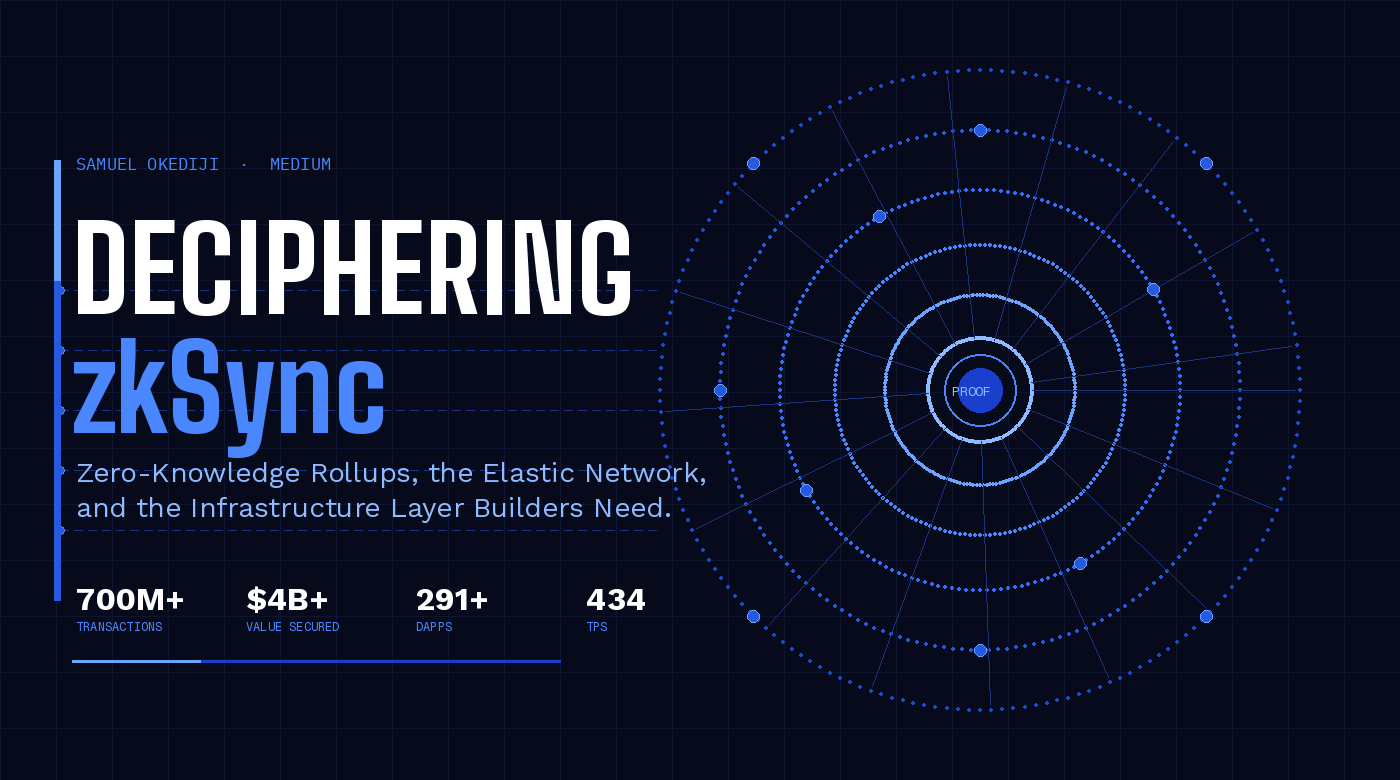
zkSync started as a way to make Ethereum cheaper. It has quietly evolved into one of the most technically serious infrastructure layers in all of Web3; securing over $4 billion in value, processing 700 million+ transactions, and landing Deutsche Bank, Goldman Sachs, and Sony as institutional adopters.
For degens: the ecosystem is live, fees are negligible, and the DeFi rails are mature. For builders: the ZK Stack is one of the most powerful toolkits available for launching production-grade chains today.
Zero-knowledge proofs aren’t just a scaling trick. In the hands of zkSync’s Elastic Network, they’re becoming the trust infrastructure for the internet of value.
Samuel Okediji is a Web3 researcher and technical writer. Follow for deep dives on blockchain infrastructure, ZK systems, and developer tooling: samuelokediji.medium.com
메타데이터
- post_id
- e8dbef1c3252
- slug
- deciphering-zksync-everything-degens-and-builders-need-to-know-e8dbef1c3252
- url
- https://medium.com/@samuelokediji/deciphering-zksync-everything-degens-and-builders-need-to-know-e8dbef1c3252
- canonical_url
- https://medium.com/@samuelokediji/deciphering-zksync-everything-degens-and-builders-need-to-know-e8dbef1c3252
- author_url
- https://medium.com/@samuelokediji
- status
- ok
- fetched_at
- 2026-07-16 01:31:33




