One Malicious VS Code Extension Breached 3,800 GitHub Repositories: The Supply Chain Attack That…
One Malicious VS Code Extension Breached 3,800 GitHub Repositories: The Supply Chain Attack That Exposed the Weakest Link in Modern Software Security
Billions of dollars spent on firewalls, intrusion detection systems, zero-trust network architectures, and multi-factor authentication. Entire security operations centers staffed around the clock. And yet, one of the most significant breaches in recent memory at one of the most security-conscious technology companies on the planet was made possible not by a sophisticated exploit against hardened infrastructure but by a single developer installing the wrong browser extension.
This is the uncomfortable truth about modern cybersecurity. The perimeter is not where the attack happens anymore. The attack happens in the tools developers use every single day, in the packages they install without reading, in the extensions that sit silently in their editors collecting everything they type and every credential they touch.
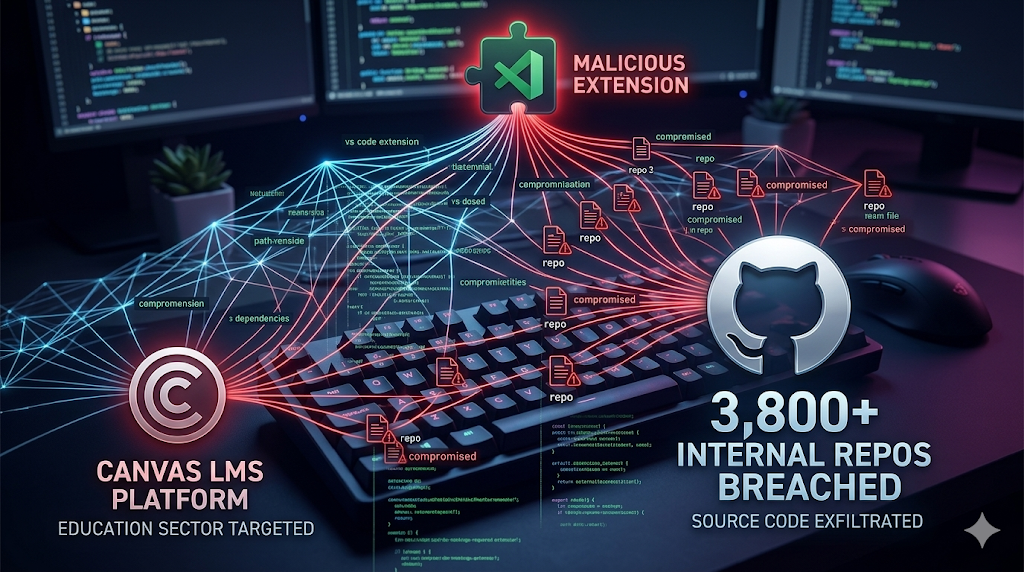
The GitHub breach and the simultaneous assault on the global education sector through the Canvas LMS platform together form a case study in the two dominant threat vectors of the current era: supply chain attacks and the relentless exploitation of human trust.
The GitHub Breach: 3,800 Internal Repositories Compromised Through One Extension
GitHub is not a typical target. As the platform that hosts the source code for the majority of the world’s software projects, it has long been among the most security-hardened organizations in technology. The company employs dedicated red teams, conducts continuous penetration testing, and operates under the assumption that it will be targeted by sophisticated threat actors at all times.
None of that preparation prevented the TeamPCP threat group from gaining access to approximately 3,800 internal repositories containing GitHub’s own proprietary source code.
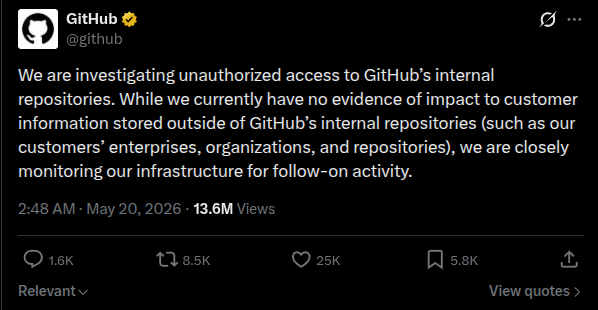
The attack vector was a malicious VS Code extension installed on the machine of a single employee. Not a zero-day vulnerability in a server component. Not a flaw in the infrastructure that GitHub uses to serve hundreds of millions of developers. A compromised developer tool on one workstation.
The extension appeared legitimate. It was designed to look like a productivity tool or a helpful utility of the kind that developers routinely install to streamline their workflows. Once installed, it operated silently in the background, harvesting credentials, tokens, and session data that gave the attacker authenticated access to internal systems. From there, lateral movement through the internal network enabled access to repositories that were never meant to be visible outside the organization.
The consequence is that source code representing years of engineering work across thousands of internal projects became accessible to a threat actor whose capabilities and affiliations remain under active investigation.
What Is a Supply Chain Attack and Why It Has Become the Dominant Threat Vector
A supply chain attack does not target the organization directly. It targets something the organization trusts: a package it installs, a library it depends on, a tool its developers use, or a vendor whose software runs inside the organization’s systems. By compromising the supply chain upstream of the target, the attacker bypasses all defenses that assume attacks come from outside the network.
The effectiveness of supply chain attacks comes from the fundamental economics of software development. No team builds everything from scratch. Every project depends on dozens, hundreds, or sometimes thousands of external packages, libraries, plugins, and tools. Each of those dependencies represents a potential vector. Reviewing every external component for malicious code before trusting it is not feasible at the scale at which modern software is developed.
VS Code extensions are a particularly attractive attack surface because the VS Code marketplace has historically applied less rigorous vetting than, for example, the process for publishing to major package registries. An extension that presents as a useful tool can accumulate thousands of installs before any malicious behavior is detected. By that point, the damage is done across many organizations simultaneously.
The scale of the problem is difficult to overstate. A moderately active developer might have 20 to 30 VS Code extensions installed. A team of 50 developers collectively maintains exposure to hundreds of extensions, any one of which could be compromised or replaced with a malicious version at any time. The attack surface grows with every tool added, and it grows silently.
The Anatomy of a Compromised Extension
Understanding how a malicious extension operates in practice helps explain why detection is so difficult and why the damage can be so extensive before the compromise is identified.
A malicious VS Code extension typically operates within the permissions that VS Code grants to all extensions by default. These permissions include access to the file system, the ability to make network requests, access to environment variables, and in some configurations, the ability to execute shell commands. An extension that appears to offer code formatting, snippet management, or theme customization has access to all of the above.
Common behaviors seen in malicious extensions include exfiltrating environment variables that contain API keys, cloud credentials, and access tokens; capturing clipboard contents that frequently contain passwords and tokens copied during development work; reading SSH keys and other credential files from standard locations; injecting code into terminal sessions to capture authentication flows; and establishing persistent outbound connections to attacker-controlled infrastructure that are difficult to distinguish from legitimate extension telemetry.
Detection is complicated by the fact that extensions run in the same process space as legitimate VS Code operations. A security tool scanning for anomalous network traffic may not distinguish between an extension sending telemetry to its legitimate update server and an extension exfiltrating credentials to an attacker. The behavior looks similar from the outside.
The Instructure Breach: When the Campus Goes Dark
While the GitHub incident demonstrated the danger of supply chain attacks against technology companies, the ShinyHunters threat group chose a different and equally consequential target: the global education sector.
Instructure is the company behind Canvas LMS, the learning management system that powers the academic infrastructure of some of the most prestigious educational institutions in the world, including MIT, Oxford, and Harvard. When ShinyHunters breached Instructure, they did not compromise a single university. They compromised the platform that serves more than 8,800 educational institutions simultaneously.
The scale of the resulting data exposure is significant. The breach resulted in the exfiltration of personal information belonging to millions of users including students, faculty, and administrative staff. The compromised data includes names, email addresses, private messages exchanged through the platform, and sensitive academic content including grades, assessments, and course materials.
The simultaneous impact across thousands of institutions from a single breach is precisely what makes platform-level attacks against educational technology so attractive to threat actors. The leverage is extraordinary. One successful compromise yields access to the data of millions of individuals spread across organizations that, in many cases, have minimal dedicated security staff.
Why Educational Institutions Remain Persistently Vulnerable
The cybersecurity posture of most educational institutions reflects a structural mismatch between their threat environment and their available resources. Universities and schools hold extraordinarily sensitive data: personal information about students including minors, financial aid records, medical information managed by campus health services, cutting-edge research data with significant intellectual and economic value, and authentication credentials for systems that extend far beyond the campus network.
At the same time, the operational culture of academic environments actively works against strong security practices. The emphasis on open collaboration and information sharing that drives academic progress is fundamentally in tension with the access controls and compartmentalization that security requires. Faculty and students expect to be able to access systems from personal devices, from off-campus networks, and from locations around the world. Enforcing the kind of device management and network controls that a comparable corporate environment would apply is often politically and operationally impractical.
The result is that educational institutions consistently appear in data breach reports at rates disproportionate to their size and apparent strategic value. They are frequently targeted by ransomware groups precisely because they are more likely to pay to restore access to systems that support ongoing academic work, and because the personal data they hold is valuable in secondary markets for identity fraud.
The Human Factor: The Attack Surface That No Firewall Covers
Both incidents share a common thread that runs through the majority of significant security breaches regardless of the target sector: the human factor.
In the GitHub case, the critical moment was a single employee making a single installation decision. No amount of server hardening, network segmentation, or intrusion detection could prevent that action. The employee was not acting carelessly by any reasonable standard. Installing productivity tools and extensions is a normal, expected part of development work. The problem is that the trust model underlying that behavior, specifically the assumption that a tool available on an official marketplace is safe to install, is no longer reliable.
In the Instructure case, the institution-wide impact was amplified by the concentration of access in a single platform and by the absence of security awareness training that would help students and faculty recognize phishing attempts, report suspicious activity, or protect their credentials effectively.
The human factor is not a failure of individual intelligence or diligence. It is a systemic condition that reflects the gap between how security professionals think about threats and how everyone else thinks about their tools. A developer who installs a VS Code extension is thinking about productivity. A student logging into Canvas from a coffee shop is thinking about their assignment. Neither is conducting a threat assessment.
Closing that gap requires sustained security awareness programs, clear organizational policies about tool and software installation, and a culture in which reporting a suspicious installation or a potential compromise is expected rather than stigmatized.
Practical Steps for Developers and Security Teams
The specific threat model presented by malicious VS Code extensions calls for concrete responses at both the individual and organizational level.
At the individual level, the most important practice is periodic auditing of installed extensions. Removing extensions that are no longer actively used reduces the passive attack surface without requiring any ongoing effort:
# List all installed VS Code extensions
code --list-extensions
# Remove a specific extension
code --uninstall-extension publisher.extension-name
Before installing any extension, verifying the publisher identity, checking the install count and review history, and reviewing the permissions the extension requests are all practices that meaningfully reduce risk. Extensions requesting broad file system access or network permissions for functionality that does not obviously require them warrant additional scrutiny.
At the organizational level, managing approved extension lists through VS Code’s policy settings prevents individual developers from installing unreviewed tools:
{
  "extensions.allowedExtensionIDs": [
    "approved-publisher.approved-extension",
    "another-publisher.another-extension"
  ]
}
This configuration, deployed through organization-wide VS Code settings management, ensures that only extensions that have been reviewed and approved by the security team can be installed on developer machines.
Monitoring for unusual network traffic patterns from development machines, implementing endpoint detection and response tools that can identify anomalous extension behavior, and establishing clear procedures for reporting suspicious tool behavior are all organizational measures that reduce both the likelihood and the impact of a supply chain compromise.
The Broader Lesson: Awareness Is the First Line of Defense
The technical controls available to security teams are necessary but not sufficient. Firewalls block traffic from known malicious sources, but a compromised extension making requests to infrastructure that was legitimate before it was weaponized does not appear in threat intelligence feeds. Malware scanners detect known malicious signatures, but a newly weaponized extension has no existing signature to match against.
The first practical line of defense in both cases is a security-aware workforce. An employee who understands supply chain risks thinks differently about installing an extension than one who does not. A student who understands that their Canvas credentials are valuable thinks differently about reusing passwords across services than one who does not.
Security awareness is not a one-time training session. It is an ongoing practice of communicating current threat landscapes, explaining the reasoning behind security policies rather than just enforcing them, and creating an environment where security questions are welcomed rather than dismissed.
The GitHub breach and the Canvas LMS breach are not isolated incidents. They are data points in a trend that has been consistently moving in one direction: attackers are increasingly targeting the tools and platforms that legitimate users trust, because trust is the most valuable vulnerability of all.
Conclusion
The lesson drawn from these two incidents is not that VS Code extensions are inherently dangerous or that learning management platforms are fundamentally insecure. The lesson is that the attack surface of any organization extends far beyond its own infrastructure to include every tool its people use, every platform it depends on, and every decision its employees make about what to install and what to trust.
Supply chain attacks succeed because they exploit the legitimate behavior of legitimate users. The defense against them requires a combination of technical controls at the organizational level, individual habits of security hygiene among developers and end users, and sustained investment in the awareness programs that make those habits possible.
Every developer who audits their installed extensions today, every security team that implements approved extension policies this week, and every institution that delivers meaningful security training this semester is contributing to a collective defense that no single firewall or intrusion detection system can replicate. The human factor is the weakest link in security. It is also, when properly cultivated, the most resilient one.
메타데이터
- post_id
- e8e6ab224d46
- slug
- one-malicious-vs-code-extension-breached-3-800-github-repositories-the-supply-chain-attack-that-e8e6ab224d46
- url
- https://medium.com/techsync/one-malicious-vs-code-extension-breached-3-800-github-repositories-the-supply-chain-attack-that-e8e6ab224d46
- canonical_url
- https://medium.com/techsync/one-malicious-vs-code-extension-breached-3-800-github-repositories-the-supply-chain-attack-that-e8e6ab224d46
- author_url
- https://medium.com/@eng.fadishaar
- status
- ok
- fetched_at
- 2026-06-10 13:37:17