10 Shared Sequencer Models L2 Teams Are Betting On
A practical tour of how shared sequencers could unlock smoother L2 coordination, cross-rollup UX, and saner MEV — without hand-wavy…
10 Shared Sequencer Models L2 Teams Are Betting On
A practical tour of how shared sequencers could unlock smoother L2 coordination, cross-rollup UX, and saner MEV — without hand-wavy buzzwords.
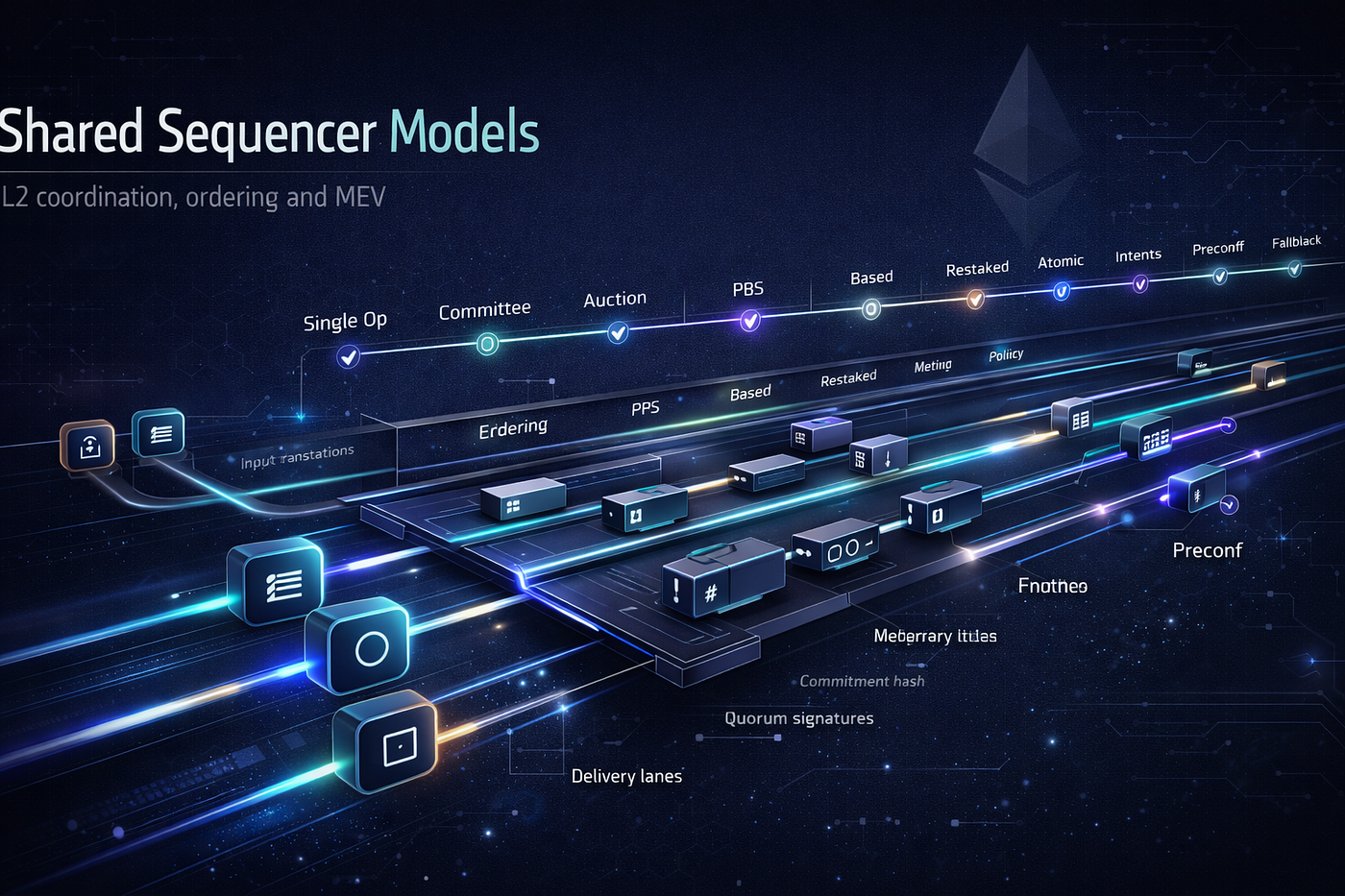
Top 10 shared-sequencer models reshaping L2 coordination: based sequencing, auctions, committees, restaked sets, preconfirmations, and more.
Let’s be real: rollups didn’t just scale Ethereum. They also turned composability into a geography problem.
Swap on one L2, borrow on another, bridge a third token, wait, refresh, pray. The UX tax isn’t always gas — sometimes it’s coordination.
That’s why “shared sequencer” conversations keep resurfacing. A shared sequencer isn’t a single product. It’s a design space: different ways multiple L2s can share ordering, inclusion, and confirmation guarantees so users experience “an ecosystem” instead of “a dozen islands.”
Before we jump into the models, here’s the core thing shared sequencing tries to control:
(1) Ordering   → which tx goes first?
(2) Inclusion  → will my tx land quickly?
(3) Finality   → when is it safe to act on it?
(4) MEV policy → who captures value from ordering?
Now the fun part: the models.
1) The “Single Shared Sequencer” Operator Model
This is the simplest — and the one people quietly prototype first.
One sequencer service orders transactions for multiple rollups:
- one mempool endpoint
- one ordering policy
- rollups consume ordered batches
Why teams explore it
Fastest path to cross-rollup UX experiments: atomic bundles, consistent latency targets, fewer integration surfaces.
Tradeoff
You’re buying coordination with centralization. If the operator censors or goes down, everyone feels it.
Best for: early-stage ecosystems proving product demand before decentralizing.
2) Sequencer Committee (Hot-Path BFT)
Instead of one operator, you have a committee running a BFT-style protocol (or committee voting) to agree on ordering.
Think: “mini-consensus just for sequencing.”
Users → committee mempool
      → committee proposes order
      → quorum signs block order
      → rollups ingest the signed order
Why it’s interesting
It makes shared sequencing feel like infrastructure, not a company. You can also rotate members, enforce policies, and define clear liveness thresholds.
Tradeoff
BFT adds coordination overhead. Low latency is possible, but it’s not free.
Best for: teams chasing decentralization without betting the farm on full permissionless sequencing day one.
3) Auction-Based Shared Sequencing (MEV Becomes a Market)
Here, the right to order the next block (or time-slice) is auctioned. Winning bidder sequences transactions for that slot.
Why teams explore it
MEV doesn’t disappear. This model tries to price it transparently and route proceeds to:
- rollups
- users (rebates)
- ecosystem public goods
Tradeoff
Auctions can incentivize aggressive behavior: spam, latency games, and strategies that maximize extraction.
A tiny sketch of the flow:
Slot S auction → winner gets sequencing rights for S
             → winner outputs ordered batch + commitment
             → rollups verify commitment + include batch
Best for: ecosystems that want explicit MEV economics and can design mitigation (fee caps, refund rules, inclusion constraints).
4) PBS-Style Shared Sequencing (Builders vs Proposers)
Borrowing from Ethereum’s PBS thinking: separate who builds the ordered block from who finalizes/accepts it.
- Builders assemble optimal blocks (often MEV-aware)
- Proposers choose among builders’ bids under policy constraints
Why teams explore it
You reduce the power of any single builder while keeping high-quality execution. It’s also easier to enforce guardrails (censorship rules, inclusion lists) at the proposer layer.
Tradeoff
More moving parts. More latency surfaces. And you still need robust rules for “what proposers are allowed to choose.”
Best for: L2 clusters that want MEV efficiency without handing all power to one sequencer.
5) Based Sequencing (Outsource Ordering to L1)
“Based sequencing” typically means: sequencing derives directly from Ethereum (or an L1) proposer set, so ordering inherits L1 properties.
In spirit, it’s saying: “Let’s not invent our own trust assumptions for ordering.”
Why teams explore it
It aligns rollups with Ethereum’s neutrality story and reduces bespoke sequencing trust.
Tradeoff
Latency. If your ordering cadence depends on L1 rhythm, you may sacrifice responsiveness — unless you pair it with preconfirmations (more on that below).
Best for: rollups prioritizing credible neutrality over ultra-fast UX.
6) Restaked Shared Sequencer Sets (Economic Security as a Service)
This model uses an external economic security layer (often discussed in restaking terms) to recruit operators who run shared sequencing software.
Why teams explore it
Instead of bootstrapping a sequencer network from scratch, you inherit:
- an operator marketplace
- shared slashing or reputation mechanisms
- standardized participation
Tradeoff
Security depends on the exact slashing and verification design. “Restaked” can be a real guarantee — or a marketing adjective — depending on what’s actually enforceable.
Best for: teams that want faster decentralization and are comfortable composing security layers.
7) Cross-Rollup Atomic Bundle Sequencing (The “One Click” Dream)
This model isn’t just “shared ordering.” It’s shared ordering with atomicity across rollups.
User submits a bundle:
- swap on L2-A
- borrow on L2-B
- repay on L2-C …and either all of it executes, or none.
Why teams explore it
This is the UX unlock people actually care about. It feels like the return of composability.
Tradeoff
Atomicity requires tight integration: messaging guarantees, synchronous proofs/commitments, or a shared settlement layer design.
A simple mental model:
Bundle = {txA on rollup A, txB on rollup B}
Sequencer commits bundle hash H
Rollups include txA/txB referencing H
If any leg fails → revert entire bundle
Best for: ecosystems willing to engineer coordination deeply, not just share a mempool endpoint.
8) Intent-Based Shared Sequencing (Users Stop Choosing Routes)
Instead of submitting raw transactions, users submit intents (“I want X outcome”), and the shared sequencer network (or solvers) competes to satisfy them.
Why teams explore it
It’s a clean abstraction for cross-rollup coordination. Users don’t need to pick the bridge, the route, the DEX, or the timing.
Tradeoff
Solver systems introduce new trust questions: censorship, preference manipulation, and “who decides the best outcome?”
A minimal intent example:
{
  "want": "1000 USDC on Rollup B",
  "give": "ETH on Rollup A",
  "max_slippage_bps": 30,
  "deadline": 1735689600
}
Best for: consumer-facing L2 clusters where UX is the moat.
9) Preconfirmations Layer (Fast UX, Later Settlement)
Preconfirmations give users a fast “yes, you’re in” signal before full finality. The shared sequencer (or committee) signs an inclusion promise, then later settles normally.
Why teams explore it
It makes L2 UX feel instant without pretending settlement is instant.
Tradeoff
Preconfirmations are only as credible as:
- the signer set’s penalties
- the probability they can actually include the tx
- the policy for conflicts/reorgs
A quick sketch:
User submits tx → sequencer returns preconfirm signature
              → app updates UX immediately
              → tx lands in canonical batch later
Best for: high-frequency apps (trading, gaming) where responsiveness matters more than immediate finality.
10) Fallback Sequencing (Shared When Possible, Local When Needed)
This model is underappreciated because it’s not sexy, but it’s realistic.
- Rollups use shared sequencing as the primary path.
- If shared sequencing fails or censors, rollups fall back to a local sequencer or alternative path.
Why teams explore it
It’s operationally sane. You get the coordination benefits without creating a single failure domain.
Tradeoff
Fallback paths can be MEV-ridden or inconsistent. The hardest part is designing clean switching rules that don’t break user expectations.
Best for: production teams that want coordination but refuse to be held hostage by it.
The Architecture Pattern That Shows Up Everywhere
No matter the model, you see the same loop:
1) Ingest:     user tx / intent enters shared layer
2) Decide:     ordering policy + inclusion rules
3) Commit:     publish commitment (hash, signature, proof)
4) Consume:    rollups import commitment into their batches
5) Enforce:    penalties / reputation / governance handle misbehavior
If you’re evaluating a shared sequencer proposal, don’t get hypnotized by branding. Ask boring questions:
- Who can censor, and how do users bypass it?
- What’s the liveness guarantee under load?
- Where does MEV go — builders, rollups, users, or “whoever is fastest”?
- What’s the failure mode when two rollups disagree?
Boring questions save ecosystems.
Conclusion: Shared Sequencers Aren’t Inevitable — Coordination Is
Shared sequencing is one of those ideas that sounds abstract until you ship a cross-rollup product. Then it becomes painfully concrete.
The next wave of L2 winners likely won’t be determined only by fees or throughput. They’ll be determined by coordination quality: how fast users can move value, how predictable execution feels, and how safely the ecosystem handles ordering power.
I’m curious: which model feels most plausible to you — and which one feels like a coordination disaster waiting to happen? Drop a comment, follow for more L2 deep dives, and if you want a follow-up, I can map these models to a decision framework for rollup teams choosing a sequencing strategy.
메타데이터
- post_id
- e8ec7109e22a
- slug
- 10-shared-sequencer-models-l2-teams-are-betting-on-e8ec7109e22a
- url
- https://medium.com/@Modexa/10-shared-sequencer-models-l2-teams-are-betting-on-e8ec7109e22a
- canonical_url
- https://medium.com/@Modexa/10-shared-sequencer-models-l2-teams-are-betting-on-e8ec7109e22a
- author_url
- https://medium.com/@Modexa
- status
- ok
- fetched_at
- 2026-07-20 18:16:01