The Story of Magdalena Carmen Frida Kahlo Calderón
The bisexual, communist, feminist, Indigenous, pain-soaked, unapologetically Mexican artist refused to be anything less than all of it
They said she could not survive the accident. She survived 35 surgeries, two divorces, and one man who could not stop betraying her.
The Story of Magdalena Carmen Frida Kahlo Calderón
The bisexual, communist, feminist, Indigenous, pain-soaked, unapologetically Mexican artist refused to be anything less than all of it
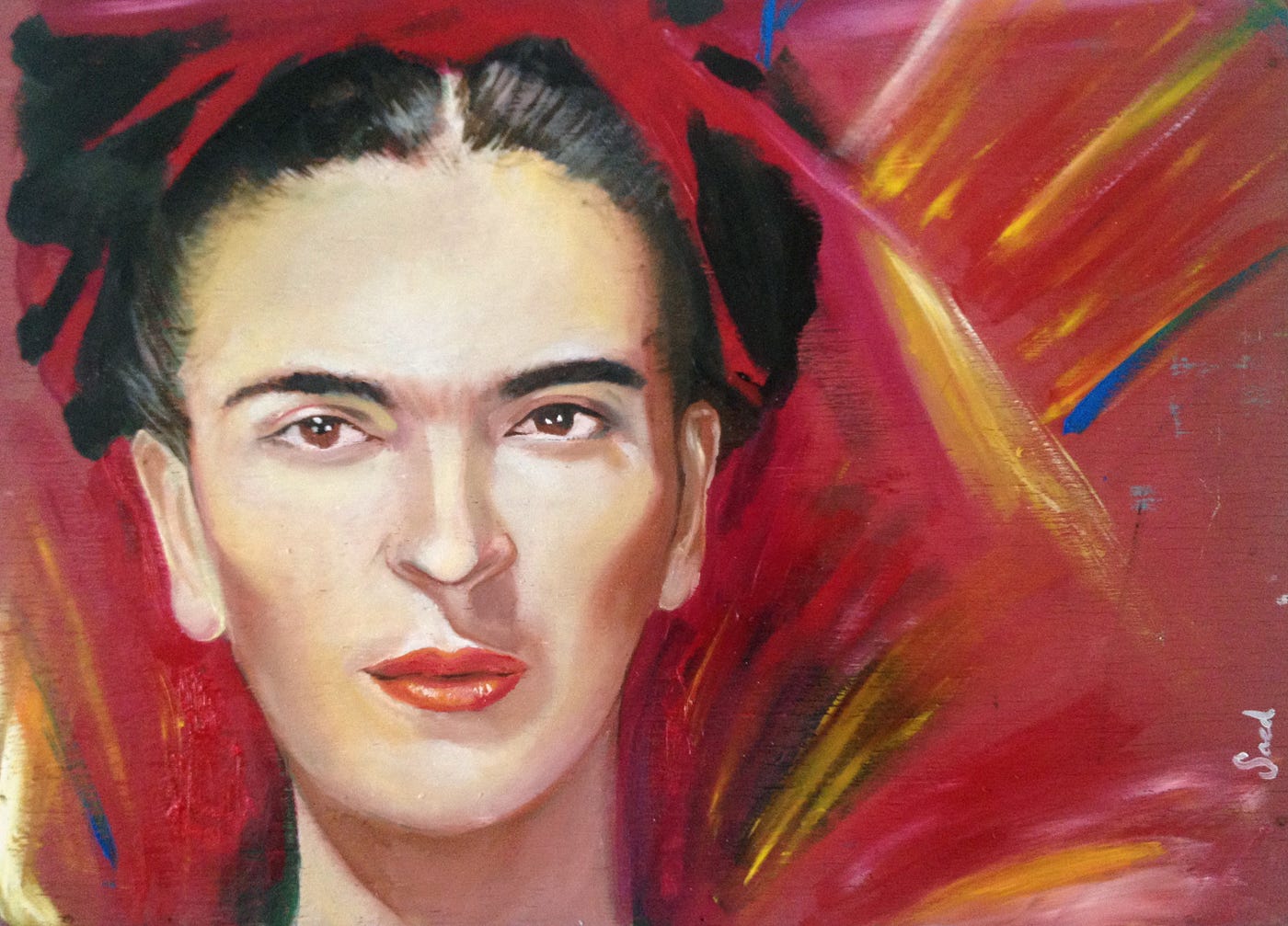
Portrait of Frida Kahlo, oil on wood. By Mexican artist Saed de los Santos, digitally released 6 January 2013. (CC BY-SA 3.0)
She was born Magdalena Carmen Frida Kahlo Calderón on July 6, 1907, in Coyoacán, Mexico, in the house her father had built, a vivid blue structure that would later become known as *La Casa Azul,* the Blue House, and that now stands as a museum to her life and work.
She would spend much of her life in that house, born there, raised there, and dying there forty-seven years later; and the house absorbed everything that happened to her in between.
Her mother, Matilde Calderón y González, was a woman of mixed blood, part Spanish and part Indigenous Mexican, a combination that placed her at a particular crossroads of colonial history and native identity that Frida would spend her entire adult life consciously inhabiting and celebrating. Her father, Guillermo Kahlo, was a German-Hungarian Jewish immigrant who had come to Mexico as a young man and built a life there as a celebrated photographer.
The Kahlo family was upper middle class; educated, cultured, and politically engaged. Guillermo’s photography work had earned him a commission from President Porfirio Díaz to document Mexico’s architectural heritage, and the family lived comfortably in La Casa Azul in the leafy, intellectual neighborhood of Coyoacán.
That relative privilege gave Frida access to books, ideas, and eventually to the political and artistic circles of Mexico City that would define her adult life.
Guillermo recognized something extraordinary in Frida and encouraged it with a deliberateness unusual for fathers of that era and class. She was his favorite child and he hers, and the intellectual bond between them shaped the way she would see the world for the rest of her life.
But before any of that, there was the bed.
At six years old, Frida contracted polio. For nine months she was confined to her room, isolated from other children, her right leg wrapped in bandages, her world reduced to four walls and a ceiling and the particular silence of a sick child left alone with her own mind.
Rather than surrender to that silence, she did something that would define her relationship to suffering for the rest of her life. She invented her way out of it.
She imagined a door in the window of her bedroom, a door that only she could open. On the other side was a world she had built from her own imagination; vivid, detailed and entirely hers. She would breathe on the glass of the window, draw the door with her finger in the fog of her own breath, and step through it in her mind.
On the other side lived another girl, her exact double, her imaginary friend, another version of herself who was healthy and happy in all the ways the real Frida could not be.
This other Frida had a strong body, no pain, no limp, no isolation. She was her constant companion through the nine months of illness, and young Magdalena Carmen Frida Kahlo Calderón would tell her everything, laugh with her, and confide in her the things a sick child cannot say out loud to the adults hovering at the door.
She later said she remembered that imaginary friend vividly her entire life. Some art historians believe this early experience of splitting the self into the one who suffers and the one who watches, the one who is trapped and the one who is free, planted the seed for the doubled self-portraiture that would become one of the most recognizable features of her mature work.
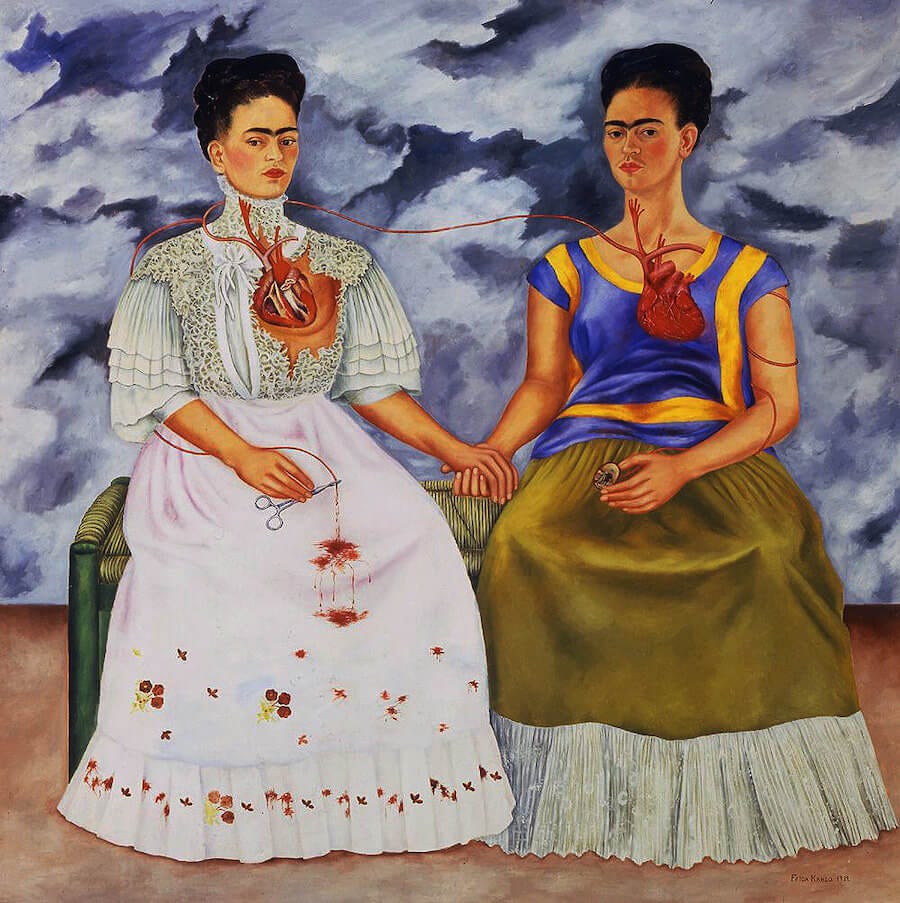
‘The Two Fridas’, 1939, by Frida Kahlo, via www.fridakahlo.org. While two competing foundations vie for the commercial rights to Kahlo’s work, neither objects to this archive making her art available for public viewing.
The Two Fridas, painted in 1939 during the period of her divorce from Diego Rivera, shows two versions of herself seated side by side, their hearts exposed, one heart whole and one cut open and bleeding. The little girl breathing on the window glass in 1913 was already rehearsing that painting.
Polio left her right leg permanently thinner than her left, giving her a slight limp that other children mocked with the cruelty children reserve for visible difference.
She compensated with defiance, becoming athletic, outspoken, and unconventional in ways that alarmed and delighted people in equal measure. She took up swimming, soccer, and wrestling, sports no girl of her class and era was supposed to play, playing them with the same ferocity she brought to everything.
At fifteen she enrolled in the National Preparatory School in Mexico City, one of the few women admitted to an institution that was training the country’s future elite.
She fell in with a group of politically radical, intellectually fierce students who called themselves the Cachuchas, after the caps they wore. She was brilliant, irreverent, and already capable of the particular ferocity that would define her.
She also developed an intense, early obsession with the Diego Rivera, who was painting a mural in the school’s auditorium. She told her friends she was going to marry him. They laughed. She was not joking.
Then the bus came.
On September 17, 1925, eighteen-year-old Frida was riding a wooden bus through Mexico City when it collided with a streetcar. The bus crumpled. A steel handrail impaled her through her hip and exited through her vagina. She suffered a broken spinal column, a broken collarbone, broken ribs, a broken pelvis, eleven fractures in her right leg, a crushed and dislocated right foot, and a dislocated shoulder.
A fellow passenger’s gold powder packet burst in the collision and covered her body, so that witnesses described her lying in the wreckage looking like a golden statue, broken and glittering in the street.
She was not expected to survive. She survived.
She spent months encased in plaster casts, immobilized, looking at the ceiling. Her mother had a mirror mounted above her bed so she could see herself. She began to paint. Self-portraits at first, because she was the subject most available to her, the one she could study in the mirror above, the one she could not escape.
She painted with a specially constructed easel that allowed her to work lying down. She painted in precise, flat, almost folkloric detail, drawing on the tradition of Mexican retablo painting, small devotional images on tin that depicted accidents, illnesses, and miraculous survivals. She was doing what she had done as a six-year-old girl sick with polio. She was building a world from inside a body that had been taken from her.
The accident never really ended for her. She would undergo thirty-five surgeries over the course of her life, enduring chronic pain that became the central subject of her art. She had three miscarriages, unable to carry a child to term because of the damage the accident had done to her pelvis. Each one became a painting, her grief rendered in explicit biological detail that shocked viewers who were not prepared for a woman to paint her own body’s failures with unflinching precision.
She did marry Diego Rivera. The story of how it happened is almost as improbable as the marriage itself.
After the accident, as she was teaching herself to paint during her long recovery, she gathered three of her finished self-portraits and went to find Rivera, who was working on a mural at the Ministry of Public Education in Mexico City.
She climbed the scaffolding to where he was working and told him to come down and look at her paintings and tell her honestly whether they were worth anything or whether she should find another way to earn a living. Rivera came down. He looked. He told her they were extraordinary. He visited La Casa Azul the following Sunday and kept coming back.
What followed was a courtship between two people who had no business being together and could not stay apart. Rivera was forty-one, massive in both physical presence and reputation, a celebrated muralist who had already lived several entire lives, married twice, had children, traveled to Europe, become famous, and developed a voracious appetite for women that he made no effort to conceal.
Frida was twenty-two, just beginning to understand what she could do with a brush, still walking with the limp polio had left her, still carrying the damage the bus had done to her body. Her father approved of Rivera, seeing in him a man who recognized his daughter’s genius. Her mother thought the whole thing was a catastrophe and said so directly, describing the union as a marriage between an elephant and a dove.
They married on August 21, 1929.
Frida wore a Tehuana dress she had borrowed from a servant for the occasion, already making the political statement about Indigenous identity that would define her public persona for the rest of her life. Rivera wept at the ceremony. Frida’s mother did not attend.
In the early years they were genuinely happy in the way two extraordinary and difficult people can be happy when they are also each other’s greatest admirers.
Rivera believed in her work with a conviction that was not strategic or patronizing. He built her a studio. He talked about her paintings to everyone who would listen. Frida traveled with him to San Francisco, to New York, to Detroit, where he painted his famous Industry murals, and she painted through all of it, her canvases getting stranger and more precise and more herself with every year.
But Rivera was constitutionally incapable of fidelity and Frida eventually stopped expecting it.
What she did not expect, and could not absorb without coming apart, was his affair with her younger sister Cristina. That betrayal was different in kind from the others, intimate in a way that made the whole architecture of her life feel fraudulent.
She cut off her long hair, which Rivera loved, and painted herself shorn and angular in a man’s suit, scissors in hand, hair on the floor around her. She had her own affairs, with men and women, including the Russian revolutionary Leon Trotsky, who was living in exile at La Casa Azul under the protection of Rivera and Kahlo.
She and Trotsky began their relationship almost immediately after his arrival, conducting it partly through love notes hidden inside books.
The women she loved
Among the women Frida loved, none is more richly documented than the Costa Rican singer Chavela Vargas, who came to a party at La Casa Azul in the early 1940s and never fully left Kahlo’s orbit.
Vargas moved into the Blue House and lived there for over a year. She later said Kahlo taught her to live without fear. In her autobiographies and in documentary interviews, Vargas called Kahlo her greatest love:
mi gran amor
Newly discovered letters from Kahlo to a friend confirm the desire was mutual. When Vargas eventually left, Kahlo told her:
I know. It is impossible to tie you to anybody’s life.
Vargas was reportedly at Kahlo’s deathbed. Her 1961 recording of La Llorona, dedicated to Kahlo, remains one of the most hauntingly beautiful musical elegies in the Mexican canon.
Kahlo also formed an intense connection with the American painter Georgia O’Keeffe during her years in New York in the early 1930s. The two women drank tequila together, flirted openly, and went out in each other’s company repeatedly.
Rivera himself bragged that his wife had been flirting with O’Keeffe. In 1933, Kahlo wrote O’Keeffe a letter that read:
I thought of you a lot and never forget your wonderful hands and the color of your eyes.
Whether the relationship went further than charged friendship remains genuinely unresolved. What is certain is that Kahlo wanted it to.
Frida and Rivera divorced in 1939 and remarried in 1940 and remained bound to each other until her death. Rivera later said that he did not realize until after her death how much of his life had been defined by loving her.
Photo by Manny Becerra on Unsplash
Frida’s politics were as vivid as her paintings.
She joined the Mexican Communist Party as a young woman and remained committed to leftist politics throughout her life, wearing traditional Tehuana dress as an explicit political statement about Mexican Indigenous identity in opposition to European influence.
The elaborate braided hairstyles, the heavy jewelry, the embroidered blouses and long skirts that became her signature were not simply aesthetic choices. They were arguments. She was making a claim about whose culture mattered and whose history deserved to be worn on the body. Her mother’s Indigenous blood ran through everything she put on her back and everything she put on the canvas.
Photo by Smithsonian on Unsplash
Her international reputation came late and largely through the efforts of others. Andre Breton, the founder of Surrealism, visited Mexico in 1938 and declared her a natural Surrealist, a classification she rejected with characteristic sharpness. She said she did not paint dreams or the subconscious. She painted her own reality.
The distinction mattered to her enormously. Her work was not fantastical. It was documentary. The two-headed deer with arrows in its body was her. The disembodied hearts and severed spines were her medical history rendered visible. The crying woman in the hospital bed was her, after the miscarriage, after the surgery, after the accident that never stopped happening.
Her first solo exhibition in Mexico was held in 1953, the year before her death, when she was already gravely ill. Her doctors told her she could not attend. She had her bed transported to the gallery and received guests lying in it, in full Tehuana dress, surrounded by her paintings, holding court from the position she had occupied for most of her adult life, horizontal, in pain, and absolutely magnetic.
Her right leg was amputated below the knee in 1953 due to gangrene. She wrote in her diary that she hoped the departure would be joyful and that she hoped never to return. On July 13, 1954, she died at La Casa Azul. The official cause was listed as pulmonary embolism. Some who knew her believed it was a deliberate overdose. She was forty-seven years old.
The last entry in her diary read: I joyfully await the exit. And I hope never to return.
Photo by Iulia Cezar on Unsplash
Her reputation exploded after her death in ways she never experienced fully in her lifetime. The feminist movements of the 1970s and 1980s reclaimed her as an icon of female pain, female power, and female refusal to be diminished. Madonna collected her work.
The Mexican government declared her work national patrimony, meaning it could not be exported. Her face appears on the 500 peso note. La Casa Azul receives hundreds of thousands of visitors a year.
What she left behind is a body of work, approximately 143 paintings, 55 of them self-portraits, that document a single human life with a specificity and an honesty that most artists spend their entire careers avoiding. She did not paint what was beautiful.
She painted what was true.
And the truth she painted, of a body in chronic pain, of a woman who loved destructively and was loved destructively in return, of a political animal who wore her convictions on her literal body, of a Mexican woman who carried her mother’s Indigenous blood and her father’s immigrant hunger and refused to disappear into European aesthetic frameworks, turned out to be one of the most universal truths in twentieth century art.
She said:
I tried to drown my sorrows, but the bastards learned how to swim.
That was Magdalena Carmen Frida Kahlo Calderón.
If you believe that a bisexual Communist feminist Indigenous Mexican woman who survived polio, a bus crash, thirty-five surgeries, and Diego Rivera deserves to be known by everyone on this platform, hit the clap button until it will not let you anymore and share this piece with someone who has never heard her name.
Further Reading/Viewing
메타데이터
- post_id
- e90c07125486
- slug
- the-story-of-magdalena-carmen-frida-kahlo-calderón-e90c07125486
- url
- https://medium.com/prismnpen/the-story-of-magdalena-carmen-frida-kahlo-calder%C3%B3n-e90c07125486
- canonical_url
- https://medium.com/prismnpen/the-story-of-magdalena-carmen-frida-kahlo-calder%C3%B3n-e90c07125486
- author_url
- https://medium.com/@jusbouey
- status
- ok
- fetched_at
- 2026-06-22 05:41:33