A Character Analysis of Mike Wheeler, through his relationship with Will and Eleven from Stranger…
Essentially, all of it boils down to the rage I feel with how the writers of the show handled the storylines of 3 of my favorite characters
A Character Analysis of Mike Wheeler, through his relationship with Will and Eleven from Stranger Things
This blog post started out as something and has ended as something else. I tried to stick to one specific idea, but it branched out because I have a lot to say and a lot of ever-changing opinions. Essentially, all of it boils down to the rage I feel with how the writers of Stranger Things handled the storylines of three of my favourite characters on the show.
I’ve had Mike Wheeler living in my mind rent free for the past three months. I’m not even exaggerating when I say this. It has been, honest-to-God, three full months.
Now that the show is over, and we got an ending with a million plot holes and no closure whatsoever, Mike Wheeler has officially moved into the rooms of my brain permanently (seriously, his room is blue painted and decorated with all the ghosts of who he could’ve been in my brain room).
I started watching Stranger Things in 2021. At that point, only three seasons had been out. I binge watched it, and fell in love with the show. The characters, the storyline, the character arcs, the cast and most of all, the fandom, the community it built — it was a beautiful phenomenon. The story was fresh — a culmination of the familiar coming of age story and the unknown of alternate dimensions and monsters. It was innovative cliché (if that makes sense). And it seemed the story was very compelling. It is compelling still…if I choose to ignore the second part of the final season.
See, if I start listing out all the ways they did the story wrong, I would end up with 11-page long questions (quite literally). These past few weeks since the finale, I have been able to think about nothing but. I’ll go about my day, doing my laundry, or sitting through a lecture, and a random detail about the show will pop up in my head, to which there is no explanation in the finale. It is frustrating, truly, because this is a show that has/had all the potential to be a one-of-a-kind story, with so much diversity in terms of themes and ideas explored. It is a story that has touched millions of people’s lives. There were promises of representation of many marginalized identities; it was even initially promoted as a show “for the freaks and the outcasts”. And for four seasons, the writing kept to its word. But the way the stories of these “freaks and outcasts”, (that, at this point, people began to identify with) ended was messy and sloppy, and utterly disappointing.
For now, let’s look at the three main protagonists (supposedly) of the show — Eleven (Jane Hopper), Will Byers and Mike Wheeler.
![[Mike Wheeler (Finn Wolfhard), Jane “Eleven” Hopper (Millie Bobby Brown), Will Byers (Noah Schnapp)]](https://miro.medium.com/v2/resize:fit:736/1*yKJ42hLdaWs-tpUdbHfAXw.jpeg)
[Mike Wheeler (Finn Wolfhard), Jane “Eleven” Hopper (Millie Bobby Brown), Will Byers (Noah Schnapp)]
Now, I say they’re the protagonists because their individual storylines are deeply intertwined with each other and to the entire plot of the show. Let’s look at Season 1. It is immediately clear that Mike Wheeler is a central character in the story. The entire plot of season 1 goes like this — twelve-year-old Will Byers goes missing one night on his way home from Mike’s house. Will’s family (his mom, Joyce and his brother, Jonathan), the town Chief of Police, Jim Hopper, and Will’s friends, Mike Wheeler, Lucas Sinclair and Dustin Henderson are set out and determined to find him. Mike, Lucas and Dustin, on their search for Will, finds a girl stranded in the woods, Eleven. They take her to Mike’s house, where they hide her, in hopes that she might know and can help them find their friend. They find out that she has telekinetic powers, she escaped from Hawkins Laboratory where she was experimented on by Dr. Martin Brenner for all 12 years of her life, the government is after her, and that she knows where Will is and can find him.
In this little summary, I have only touched upon the storyline that follows the children. Parallelly, there are storylines running of the adults — Hopper and Joyce- as well as the teenagers — Jonathan and Nancy Wheeler (Mike’s sister). We’re not delving into that right now.
My point is about the way Mike, Will and El’s storylines intertwine with each other and the plot. Mike is dead set on finding his best friend, Will, no matter what it takes. Even when they find Will’s “body”, and declare him dead, Mike refuses to accept it, and is hell bent that Will is alive and in danger after he hears Will’s small voice faintly through his walkie talkie (channeled by El’s powers). Eleven knows who Will is, and she is the only person who can reach him in the place where he went missing. She is also connected to the laboratory, where the government officials are after her, and are also suspiciously involved in the vanishing of Will Byers.
Now, Will plays the pivotal role, because, of course and obviously, it is his vanishing that triggers the cascade of events that becomes the show, Stranger Things. With his vanishing, he is now irrevocably tied to this other dimension — the Upside Down. We later also learn that Eleven was the one who opened the portal to the Upside Down (or rather, created the Upside Down, as we learn in further seasons). Eleven and Will are highly paralleled to each other this way — they are both connected to the Upside Down and both have a connection to the antagonist, Vecna (or rather, Henry Creel), as we later learn in Season 4.
Not only in connection with Vecna and the Upside down, but, Will and El parallel each other even in their relationship with Mike.
deep breaths …looong sigh
Mike Wheeler. A character that will forever perplex me — for what he is and what he could’ve been.
From the get go, he is paired with Eleven (El), as her love interest. Mike and El’s relationship, from a romantic lens, does not make sense to me, especially after season 3. It is no question that Mike cares deeply about El. But if you look at it, Mike has always been that way. He cares deeply for his friends. Him trying to contact El when she supposedly “died” at the end of season 1, is just who he is as a character. But the general audience, and society, read into this as romance. Which could be the case, but bear with my perspective here for a second.

Stranger Things Season 3 Episode 1 (Source: Pinterest)
The idealization and romanticization of “Mileven” (Mike+Eleven) baffles me and seriously gives me a reality check on the distorted view of romance in society in general. Because to me, it always seemed like Mike showing any sort of romantic interest towards a girl who was locked up in a lab for all 12 years of her life and who has had no opportunity to discover herself and her self-identity, and relationships with other people, much less know how romantic relationships work — is very conformative. It’s almost as if he is caring too much about a girl, so surely, he must be romantically attracted to her, right? Which is a very distorted perception on relationships, and an understatement on how beautiful and complex human relationships can be.
Now, if I say that Mike has been the same with Will in season 1 and 2, that may become controversial. Why? Maybe because of a small term starting with ‘h’ and ending with ‘-omophobia’. Immediately, everyone is pointing out that “they’re kids”, and it is “wrong to romantically ship kids”. Which I totally agree with, but why does it always only apply to queer relationships? I personally think it is because society views queer relationships as solely sexual, which is far from the truth. Queer relationships are also innocent, beautiful, pure and romantic. In fact, I would go as far as to say that straight relationships are far more sexualized in reality (especially with objectifying and commodifying women, etc.). That is a whole topic I could delve into another day.
My point is, Mike’s relationship with El and Will largely influence his character arc in the story. He is a sort of protector and leader, that guides The Party. And Will and El are two of the most important people in his life. It is, then, perplexing to me how the writers managed to write Mike with beautiful subtext, a character with layers of complexity, for four seasons, only to throw it out the window in the final season. Now, he’s just there. And his behaviour towards El and Will shines a bad light on his character and turns him into a shallow, cardboard character.
It is truly sad, because I had personally never seen any other character in any other show or book being written as beautifully as Mike. Giving no closure to his character arc truly ruins everything about “the heart” of the show.
It was an interesting choice the writers made when they chose deliberately not to disclose Mike’s perspective clearly on anything.
A character that started out as a boy who would literally jump off a cliff for his friends, cannot even hug his best friend properly when meeting him for the first time in months. A character who always reassured if his friends were okay and safe whenever they faced any adversity can’t tell his girlfriend ‘I Love You’. The change in Mike’s behaviour from Season 1 and 2 to Season 3 and 4 (and 5, by extension) has no clear-cut explanation, other than that he was a bad friend and boyfriend.
I was really hoping that Season 5 would have some explanation on the sudden shift in Mike’s behaviour; that we would finally get to see his perspective, know what is going on in that brain of his, because clearly, he has been repressing his emotions and not expressing his feelings for 3 seasons straight. Come to think of it, maybe since season 1. We see his perspective in season 1 and 2 only through the way he expresses it towards another character (never in a scene where it’s just him and us, the audience). By season 3, this completely ceases, because now, he’s lying to everyone around him, and in turn lying to himself. Season 3 Mike is textbook example of a person conforming to what’s “normal”, doing things for the sake of it, and then projecting one’s insecurities onto others.
I want to focus on Mike’s relationship with El and Will, to delve deeper into him as a character. Because his character arc heavily orbits El and Will’s storylines. That is not to say that he isn’t a character in and of himself, but since we don’t have his opinions on things, we can only view his feelings in relation to the way he expresses himself to other characters (Will and El being the most important ones).
In Season 3, Mike’s scenes with Eleven and Will highly parallel each other. There are similar scenes set up, and the way Mike reacts in both instances shows who he cares more deeply about (or rather, which relationship he cares deeply about and takes seriously).
Mike is warned by Hopper to stay away from his daughter (Eleven), because he thinks Mike is “corrupting” her. This entire thing has a note of comedy, by the way. So, Mike stays away. He lies to El. He tells her his Nana is unwell, he can’t meet her, etc. There’s a whole comedic sequence of Lucas giving Mike advice to win her back after she dumps him for lying to her. Throughout this entire drama, Mike keeps saying “I don’t know what she wants from me.” “What did I do wrong?” (El has literally been saying that he keeps lying to her, and she doesn’t want to be lied to, clearly). Honestly, I can’t even blame the audience for reading this as a “boys will be boys” type of thing, because in reality, some boys are that dense. But that does not make it romantic.
![(left) Mike after El broke up with him; (right) Mike after Will biked away into the rain [Stranger Things Season 3 Episode 3]](https://miro.medium.com/v2/resize:fit:1400/1*-XWxCfRW3RqJ2h-HaMkiEA.jpeg)
(left) Mike after El broke up with him; (right) Mike after Will biked away into the rain [Stranger Things Season 3 Episode 3]
Now, this is all fine. It’s funny, comedic, it’s a little bit of relatable teenage relationship drama. But the fact that they mirror this situation directly with Mike and Will, is something that once you see, you can’t unsee it. That too in two back-to-back episodes.
In the next episode, Will, who clearly wants to just play Dungeons and Dragons with his friends, who has stayed patient throughout this entire ridiculous predicament, is mad at Mike, because he’s “ruining everything”. When Mike (and Lucas) are sulking because their girlfriends “dumped their ass”, Will tries to lift up their moods by arranging a D&D campaign. He’s just trying to be a good friend. But Mike and Lucas are not in the mood. Will storms out, angry at the two of them, but especially Mike. It is raining. Mike runs after him; tells him he can’t leave because it’s raining. Will expresses his disappointment — how Mike is ruining the party, and he doesn’t even know or care where his friends are anymore, only obsessed with some “stupid girl”. Mike retaliates and says “It’s not my fault you don’t like girls”. He then tells Will that they’re not kids anymore, they’ve grown up, they have girlfriends, and they can’t be sitting in his basement all day playing games for the rest of their lives. This deeply hurts Will, whose childhood was stolen from him, so God forbid he wants to play a few board games with his friends during summer break.
Will then storms out in the heavy rain, Mike calls after him, but he’s long gone. Mike then proceeds to bike in the rain, with Lucas, to Will’s house to apologize to him. The point I’d like to highlight here is how Mike reacts to having hurt Eleven, and having hurt Will. With Eleven, the entire “break-up” is taken lightly and comedically. With Will, it’s intense (a rain fight, for god’s sake), it’s serious.

Stranger Things Season 3 Episode 3 (Source: Pinterest)
On the other side of things (aka Will and Eleven’s perspective), Eleven is having the time of her life exploring herself and her identity — what clothes she likes and doesn’t, what comics she likes and doesn’t, what having a sleepover with a girl friend is like — basically, experiencing girlhood. Will, on the other hand, bikes to his Castle Byers (a fort him and his brother made, a safe haven for Will, that holds all his memories of childhood), where he breaks down, feeling stupid, and destroys Castle Byers — the very thing that represents his childhood.

Eleven, Max and Will in Stranger Things Season 3 Episode 3
These scenes highlight the intensity and seriousness of the absence of Mike in Will and El’s life. El losing him as a romantic partner allows her to find herself. She spends more time with her friends, rather than being obsessed with Mike; she finds herself. Will losing Mike as a friend destroys him, makes him feel stupid, leading to a scene that represents: childhood is over.
Now, the line “It’s not my fault you don’t like girls” is very important in determining Mike’s controversiality. In hindsight, it comes off as mean, and insensitive, because Mike knows Will has been outcast by everyone, has been called slurs all his life, for being “queer”. In fact, in season 1, it is Mike who stands up to a bully who calls Will homophobic slurs. To have the same Mike say that line to Will is…out of character?
Now, I chose to see this in a new light. Stay with me here, because when you look at it as Mike projecting his own insecurity on Will, it makes sense for him to say that. Here begins the subtext of queer-coding of Mike Wheeler.
“Internalized homophobia and oppression happens to gay, lesbian and bisexual people, and even heterosexuals, who have learned and been taught that heterosexuality is the norm and “correct way to be”. Hearing and seeing negative depictions of LGB people can lead us to internalize, or take in, these negative messages. Some LGB people suffer from mental distress as a result. Internalised homophobia manifests itself in varying ways that can be linked to mental health. Examples include: Denial of your sexual orientation to yourself and others, projection of prejudice onto another target group, attempts to pass as heterosexual, sometimes marrying someone of the other sex to gain social approval or in hope of ‘being cured’, etc.” [rainbow-project.org]
View Mike as a young boy in the 1980s, conforming to societal norms (because if you have a girlfriend, that means you can’t be attracted to boys, right? And he loves El, he truly does), suppressing his feelings for his best friend, because of internalized homophobia. His character becomes complex, there are layers, and he represents the journey of many a queer people who had a hard time coming to terms with their sexuality.
Because that entire argument between Will and Mike (which is SO cinematic, by the way. I mean, couples fighting in the rain and one of them running off into the rain is the classic rom-com trope) basically boils down to this –
Will : Mike, you don’t care about The Party anymore and you’ve been a bad friend.
Mike: it’s not my fault you’re gay.
This same-ish argument takes place in season 4, where Mike points out how Will’s been sulking all day and ruining it (even though Eleven legit got brutally bullied in front of him) and Will confronts him about being a bad friend, saying that he never reached out to Will. Mike’s response to this is to emphasize how they’re “Friends. We’re friends”. Mike gets defensive. Will calls out Mike for being a bad friend, but Mike’s counter argument is to emphasize they’re just “friends”.

Stranger Things Season 4 Episode 2
In season 4, Mike and El’s story arc revolves around him not being able to say ‘I love you’ to her. When El confronts him about it, he tells her she’s being ridiculous (gaslighting, much?). He dismisses her feelings, and goes on and on about how she’s his superhero, although it’s clear that “being a superhero” does not make El feel empowered. She has always been used for her superpowers. Her story arc is about finding herself, her identity, being seen as a human being first, and not a weapon to fight monsters with.

Stranger Things Season 4 Episode 3
Mike and Eleven as friends are precious. He takes care of her, listens to her, and she in turn gives him a sense of purpose that he gets only when he knows he can do something to protect his friends. But the moment it turns romantic, it becomes obsessive. The moment their relationship turns romantic, it is detrimental to both their individual character arcs. Mike and Eleven’s romantic relationship tears their self esteem down, instead of fueling it. Mike makes El feel like a monster, like she’s different for all the wrong reasons. El wanting to find her own path makes Mike feel not enough. He feels lost, because he doesn’t know who he is if he’s not a protector. But El doesn’t need protecting. She needs support. Platonically, Mike is by her side, but romantically, he is protecting her. He might have all the right reasons for looking out for El, but it just holds her back from reaching her true potential, from finding herself. In that sense, Mike becomes no different from Hopper or Dr. Brenner, who all want the best for her, but doesn’t trust her enough to make her own decisions.
Contrast this with the character dynamics of Will and Mike and it is astonishing how the writers never went through with this relationship, even though they’ve been building it up since the beginning. The writing has slowly been building up Will and Mike’s relationship, starting with friendship, evolving into a strained friendship, and then there’s flirting, subtle signals and glances, the slow building up of a romance. Slow-burn ultimatum. (Spoiler alert, they do jackshit with all this build-up in the end). In Season 4, it becomes clear to us as audience that Will is in love with Mike. He even confesses (although discreetly), by disguising his feelings as Eleven’s; almost like he’s letting go of Mike, because he knows Mike does love Eleven. He props up Mike and Eleven’s relationship, by building up Mike’s confidence, telling him he’s “the heart” of the party and that Eleven (Will) needs him and always will. Will reminds Mike of how important he is to his friends; how they’ll always need him to hold them all together. Mike does the same for Will too. He makes him feel seen, builds up his confidence, ultimately leading to his self -acceptance. Mike makes Will feel not like a mistake for being different.

Stranger Things Season 4 Episode 8 (Source: Pinterest)
Even though I talk and think about everything that went wrong with season 5, Will’s self-acceptance arc in the fourth episode of Season 5 is beautiful. It is truly one of the best scenes of the entire season.
Will feels like everything is his fault when he becomes possessed by the Mind flayer (who is the ultimate antagonist, controlling Vecna). In season 2, Mike tells Will that this is a good thing, because now he is like a superspy who’ll help them defeat the Mind flayer. In season 5, when Will once again feels at fault for being able to see through the monsters’ eyes but not being able to do anything about it, it is Mike who once again reassures him saying, now Will is like a sorcerer who can tap into the Mind flayer’s hive mind, and help them defeat Vecna.

Stranger Things Season 5 Episode 4 (Source: Pinterest)
Will’s character arc is accepting himself, being able to accept that there isn’t anything wrong with him because he’s different. Mike makes him feel good for being different. Will also boosts Mike’s self-esteem, letting him know that he is important to all of them, and especially to him, regardless of if Mike can protect and lead them or not. Mike is the heart of the party. Mike and Will’s relationship fuel their individual character arcs, empowers and pushes them to be their best selves. They bring out the best in each other.
Moreover, the construction and structure of Mike/El and Mike/Will’s platonic and romantic aspect of relationship is also vastly different, which impacts the way they behave with each other. Mike and El’s platonic relationship and romantic relationship are like two separate blocks, each leading to a different character dynamic between Mike and El. Platonically, their character dynamics thrive. They are there for each other because “Friends don’t lie” (one of the first things Mike teaches El, and which becomes El’s trademark sentence). Romantically, their character dynamics fall apart; all of a sudden, they’re lying to each other, making each other feel at their worst and acting out of character.
Mike and Will’s platonic relationship and romantic relationship are two blocks that build the foundation of their character dynamics. Their friendship forges a strong emotional bond between them, which evolves as they get older, into emotional heart-to-heart moments, intense arguments, dramatic apologies, flirting and romance. It is all subtle. Mike and Will share a lot of heart-to-heart moments in the show (one of the most famous ones being the ‘crazy together’ scene in Season 2). In season 1, when Eleven asks what a friend is, Mike tells her that “…friends tell each other things, things that parents don’t know”. But then, Mike and Will tell each other things that even their friends do not know. What does that make them?

Stranger Things Season 2 Episode 2 (Source: Google)
There is evolution from friendship to romance with Mike & Will, while there is a detriment from friendship to romance with Mike & El.
All this to say, this show could’ve had one of the most beautiful queer representations in mainstream media of this century. As someone who consumes a lot of queer media, I have not come across such a detailed, subtle and beautiful queer relationship…yet.
What is even more beautiful is how they chose to tell this love story — not just through dialogue, but through camerawork, colours, set design, props, lighting, costumes, micro-facial expressions (from the actors [kudos to Finn Wolfhard and Noah Schnapp]), merchandise, and so many other subtle detailing that you really have to keep an eye out for.

Will and Mike throughout Stranger Things Season 3, 4 and 5
If anyone reading this watches Stranger Things (or if you’ve watched it and will rewatch), just look out for these little signs from Seasons 1 to 4 and the first four episodes of Season 5. It truly is incredible and beautiful.
All that said, it is utterly disappointing and baffling how none of this quality holds or has any sort of closure after Episode 4 of Season 5. They built up this relationship and put so much effort into it, just to throw it all away in the last minute. What that did was not just damage possible queer representation, but also injustice to the characters of Mike, Will and El. It royally messed up the friendship between Mike and Will (which in itself was beautiful), the relationship between Mike and El (their conflicts staying unresolved), and Mike’s character as a whole.
Mike’s messy behaviour in Season 3 and 4 towards Eleven and Will could’ve been explained with the concept of him dealing with internalized homophobia. But the way Season 5 ended, it paints Mike as just, for lack of better words, an asshole. He becomes a bland character, who was rude to two of the most important people in his life, for no apparent reason.
Meanwhile, showcasing Mike and Eleven’s relationship in the very final moments of the show, as this sort of doomed love that we, as audience, are supposed to feel devastated about, did not land the way they intended. Because for the entirety of Season 5, the writers were too busy building up Mike and Will’s relationship (possibly to queer-bait until the very last minute), they probably forgot that Mike and Eleven were not on good terms by the end of Season 4. Throughout Season 5, we never see them interact in any way that would suggest that they’re still romantically involved, but in the end, their romance is highlighted and propped up as a tragic love story, the likes of Romeo and Juliet, with a montage of scenes from previous seasons (that has Will in the background yearning in 80% of them). They even have Eleven say that Mike was the only person who truly understood her, when previous seasons prove that to be utterly false. If anything, Mike was the one who understood her the least. Her adoptive father, Jim Hopper, her best friend, Max Mayfield, her brother, Will Byers (not by blood, but through shared traumatic experiences), her sister, Kali Prasad (again, not by blood but through shared traumatic experiences); these were the characters who understood many aspects of her life and struggle.

Stranger Things Season 5 Episode 8 (Source: YouTube)
The way they made Eleven’s death (spoiler alert, oops) all about Mike and his grief, is sickening. Eleven never getting her autonomy, never truly finding herself is devastating. She had one of the worst endings. The way she was used only as a plot device and not a human character is sickening. That is a whole another blog I’ll probably write about later.
This show was truly wonderful, until it wasn’t. The core message of Stranger Things was “for the freaks and the outcasts”. It was a story with the message of breaking free from the cycle of forced conformity at its heart. Every character’s arc was ultimately leading towards breaking the cycle of forced conformity, of finding one’s true self, of not conforming to societal norms and expectations. In the end, the show went against everything it supposedly stood for. All it’s characters, especially, it’s three main protagonists, Eleven, Mike and Will, conformed to their worst nightmares. Eleven ended her life to end a cycle of abuse rather than fighting against it; Mike accepted his fate of being doomed, repressing his true feelings, essentially being reduced to just a love interest grieving his girlfriend for god knows how long; Will escapes the town and tries to find happiness elsewhere, while it’s clear that he could never truly get over his first love.
For my peace of mind, maybe the ending could be interpreted in a different light. Vecna (the antagonist) wins, and all the characters are trapped in their worst nightmares.
In the show, Max Mayfield says,
“The way i see it, when you’re a prisoner in a messed up prison world, you only really have a few doors open to you.
Door one, you take your own life.
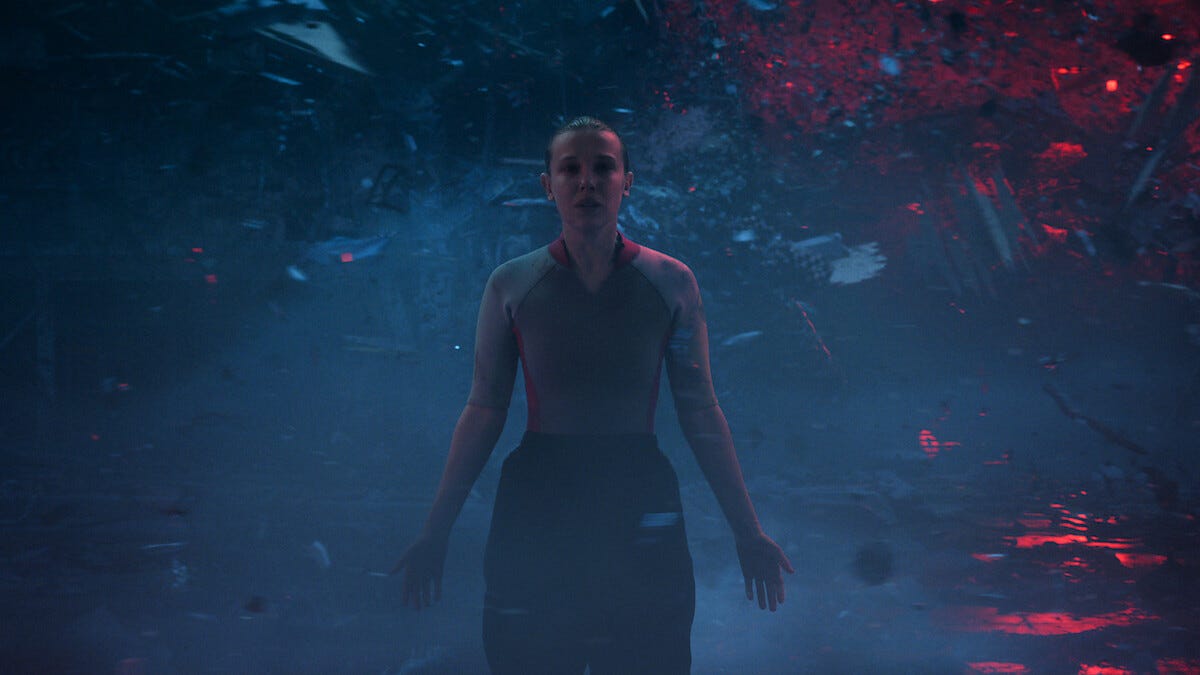
Stranger Things Season 5 Episode 8 (Source: Netflix)
Door two, accept your fate

Stranger Things Season 5 Episode 8 (Source: Pinterest)
Or, door three, you escape.”

Stranger Things Season 5 Episode 8 (Source: Pinterest)
And maybe our three protagonists endings represent these three choices -
-
Take your own life (El)
-
Accept your fate (Mike)
-
Escape (Will)
No matter what, the endings do not give off the right message. The story was supposed to break the cycle, not conform to it. Which is possibly why the ending doesn’t truly feel like an ending at all.
All said and done, Stranger Things made up five years of my life. I learned a lot about myself and others through this show. I got to be part of a community of like-minded people who care deeply about stories and characters as much as I have all my life. Not only that, it taught me a lot about film-making, script-writing, building characters and storylines. It taught me how to write complex and layered plotlines, and it taught me how to not write complex and layered plotlines. It made me think of various perspectives and showed how important representation can be in media. It was a phenomenon that touched many hearts and lives.
I’ll probably (I say probably, because inspiration strikes once in a blue moon for me) do an analysis on Henry Creel/Vecna/One, and how his story was barely touched upon in the show. I’ll also probably write about how Eleven’s ending sends a problematic message, because she’s one of my top three favourites, and she deserved a better ending for carrying this show for ten years.
If you made it all the way here, thank you for reading. Until next time…
메타데이터
- post_id
- e925fbde4bf3
- slug
- a-character-analysis-of-mike-wheeler-through-his-relationship-with-will-and-eleven-from-stranger-e925fbde4bf3
- url
- https://medium.com/@cassiedelrey/a-character-analysis-of-mike-wheeler-through-his-relationship-with-will-and-eleven-from-stranger-e925fbde4bf3
- canonical_url
- https://medium.com/@cassiedelrey/a-character-analysis-of-mike-wheeler-through-his-relationship-with-will-and-eleven-from-stranger-e925fbde4bf3
- author_url
- https://medium.com/@cassiedelrey
- status
- ok
- fetched_at
- 2026-07-13 08:21:40