Walking Through the Ruins of L’Abbaye de Villers
Belgium is often described as one of the most rapidly secularising countries in Europe. Growing up in a Catholic environment and later…
Walking Through the Ruins of L’Abbaye de Villers
Belgium is often described as one of the most rapidly secularising countries in Europe. Growing up in a Catholic environment and later studying the Middle Ages, I have become increasingly aware of the strange dissonance between Europe’s religious past and its present cultural memory. Churches and monasteries still dominate the physical landscape — in town squares, village skylines, and along quiet roads — yet the knowledge of what these places once meant has, in many cases, faded into the background. There is a distinct lack of sanctity and veneration felt and expressed in holy sites. The process of desanctification of churches and their reuse, for instance as a book shop or café is commonplace. The general knowledge of religious history, catechism and even architecture among the wider population seems almost gone.
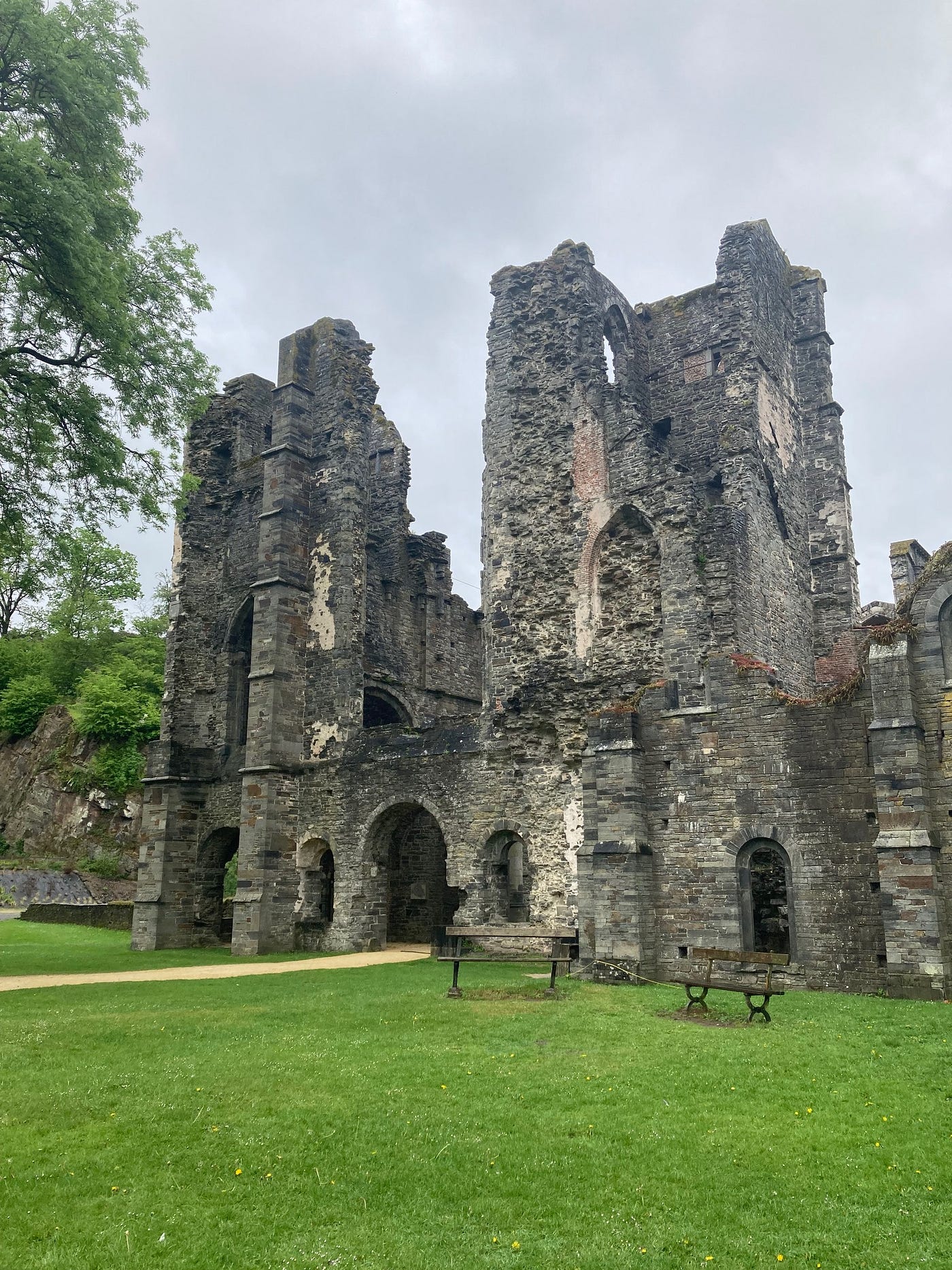
When you travel from Leuven to Fleurus (a journey one makes when experiencing the displeasure of Charleroi airport), you pass Villers-la-Ville, where you will see vast monastic remains rising beside the railway to your right. These are the ruins of L’Abbaye de Villers, a former Cistercian monastery founded in 1146 as a daughter house of Clairvaux Abbey (founded by Bernhard of Clairvaux), and once one of the region’s great religious institutions. Fifteen monks and lay brothers were granted the land and major building happened in 13th century. At its peak, several hundreds of holy men inhabited the space. The Church alone took 70 years to build — at a time where such endeavours were deemed meaningful and worthwhile, compared to the incessant Schnellebigkeit and bleakness of our times. Like many Cistercian foundations, it was not merely a spiritual centre, but also an economic and agricultural power embedded deeply within the surrounding landscape. The abbey’s decline began long before its final destruction. By the late eighteenth century, its fortunes had already diminished, and in 1796, in the aftermath of the French Revolution, the monastery was abandoned. Fortunately, conservation efforts have been sufficient to retain what is left. The site is not lifeless. Once a year a choir festival — la nuit des choeurs — takes place in the Abbey ruins to draw in people, which would be best achieved with sacred music.

As you walk through the impressive cloisters and across the vast grounds and herbal gardens, you can imagine how life must have been like in its vibrancy. A sense of everything there once was remains, a sense of what has been lost. You can enter the spaces where the monks used to sleep, the refectory and the areas designated for penitential practices. You can also climb in nooks and crannies underground imagining secret encounters and moments of visions, chant and prayer. The Church itself enamours through its high arches, and I was reminded of Whitby Abbey (a former Benedictine Monastery and Abbey on the shore of Yorkshire). The rhythms of monastic existence still feel faintly recoverable. Visitors still respond instinctively to the monastic architecture. Your eyes are drawn upward and inward.

Monastic ruins occupy a peculiar position in secular Europe. We preserve them as cultural heritage, admire them aesthetically, and visit them recreationally, while remaining detached from the intellectual and spiritual worlds that produced them. The architecture survives more easily than the worldview behind it. Medieval monasticism shaped education, agriculture, literacy, law, medicine, music, and the rhythms of social life for centuries, yet modern Eurpeans frequently encounter its remains without fully grasping the scale of its historical significance.

We closed our visit at the Bistro de l’Abbaye with one of the abbey beers, La Ténébreuse, a small reminder of the continuity between monastic traditions and contemporary Belgian culture. Even here, traces remain.
메타데이터
- post_id
- e92cc7cfa047
- slug
- walking-through-the-ruins-of-labbaye-de-villers-e92cc7cfa047
- url
- https://medium.com/@jaqueline.bemmer/walking-through-the-ruins-of-labbaye-de-villers-e92cc7cfa047
- canonical_url
- https://medium.com/@jaqueline.bemmer/walking-through-the-ruins-of-labbaye-de-villers-e92cc7cfa047
- author_url
- https://medium.com/@jaqueline.bemmer
- status
- ok
- fetched_at
- 2026-06-09 15:37:30