A Love-Letter to Lewes Bonfire
A Love-Letter to Lewes Bonfire
Today is November the 5th, or as we Brits like to call it, Bonfire Night. There are no bonfires happening locally this evening (that I know of, anyway), but even if there were, I’m not sure they’d go ahead. Aside from a ‘sunshine and showers’ day on Sunday, it’s been raining solidly for almost a week here in West Wales, so much so that the River Teifi that flows through the village where I live in has burst its banks, flooding the park that we walk through every day. This morning, as the rain continued to fall, we bundled up in our dry robes and headed down for our daily stroll, only to be met with inaccessible pathways and huge swathes of the football pitch covered in water.
I’ve not seen flooding like this, with my own eyes, for years. It made me think of when Lewes flooded back in 2000, on the same day that my friends and I went to see Britney Spears play at Wembley Stadium, and nearly didn’t make it home because the flood water rose so dramatically in the intervening hours. And it’s funny, because I was already thinking of Lewes today, because it’s Bonfire Night.
When we lived in the States, I always felt extra wistful around Bonfire Night, it not being something that’s celebrated across the pond. However, the root of my longing wasn’t so much that I was missing out on Bonfire Night per se, but because, where I’m from, in East Sussex, Bonfire Night, specifically Lewes Bonfire Night is one of the biggest, best, and wildest nights of the year.
The origins of Bonfire Night come from the famous ‘Gunpowder Plot’ of 1605, which failed to blow up the Houses of Parliament. Since then, the tradition of lighting fires and burning effigies of Guy Fawkes has continued. All across the UK at this time of year, it’s common for people to gather, to build big bonfires and set off fireworks.
In Lewes, though, November 5th isn’t only about Guy Fawkes and the Gunpowder Plot. It also remembers 17 Protestant martyrs that were burned at the stake in the centre of the town, at the hands of ‘Bloody’ Queen Mary I, around 1550. Over the years, the two events have been conflated into one celebration that has grown exponentially, to the point where now, all main roads in and out of the town are closed mid-afternoon and public transport is limited, in attempts to curb the influx of people wanting to see the spectacle.
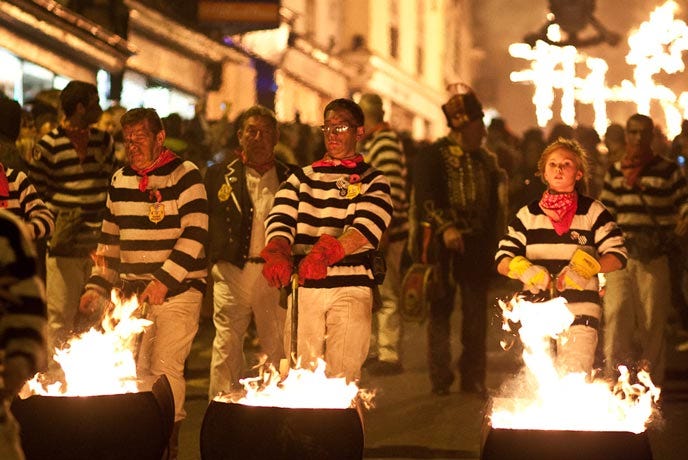
Flaming tar barrells
It’s not a one-off either. In East Sussex, Bonfire celebrations begin in September, with local villages and towns holding scaled-down versions of the main event each weekend until mid-November. Firle, Hastings, Seaford, East Hoalthy — each event has its own flavour, and provides extra opportunity to soak up the bonfire magic.
But Lewes is always the highlight.
It is not for the faint of heart.
It is so loud.
There are people everywhere, thronging the narrow streets and standing, many deep on the pavements edges to watch the processions. The air is thick with smoke, and petrol, and gunpowder residue from the bangers that are being constantly thrown. My jittery nervous system has never done well with bangers — I always used to spend a high proportion of the evening jumping out of my skin and/or shrieking. There’s drumming and cheering and a barely contained energy in the air.

17 crosses for 17 martyrs
The processions move through the streets many times throughout the night comprising the members of the 7 Bonfire Societies based in Lewes and those from the local villages and towns. The costumes worn by those who march are a spectacle in themselves. There’s the traditional Smuggler get up (stripey tops in various colours), alongside Vikings, Tudors, Suffragettes, and Romans to name a few. Most people who march carry a burning torch aloft. There are flaming tar barrels that get rolled down the steep high street, and huge effigies which are burnt on the various fires, and 17 burning crosses, named for the 17 martyrs. There are marching bands, a Bonfire Prayer, and, banners declaring ‘No Popery.’ It’s like stepping into another world.
Each society has a ‘fire site,’ which its members return to after the main procession for a huge bonfire and firework display. When we were younger, we’d sometimes stumble out of the pub and up the steep hill, in the dark, to the Golf Course and watch it all unfold. One of my favourite parts was seeing the torch-lit processions heading off to the various sites, before the fires were lit, one by one, a bit like one of my favourite scenes in Lord of the Rings (THE BEACONS ARE LIT!) Then the fireworks would be set off, and we’d lie back on the damp ground to watch. The fireworks at Lewes are the best I’ve ever seen, hands down.

View from the golf course
I have so many good memories of the various Bonfire Nights over the years. My mum tells me I attended my first ever bonfire night at 2 months old, and watched the procession go by, my face rapt, from a house in Friar’s Walk. We went as kids, and I remember being equal parts terrified and enchanted by the processions and the costumes and the noise. As a teen and in my twenties, we’d get in early to the pubs and then head out armed with hip flasks to keep us going through the night. I remember roaming around with bands of my friends, wide-eyed and high on the atmosphere. We’d spend the night bumping into people we knew from school or college, and everyone would have a slightly unhinged look in their eyes. There’s a kind of wildness, a spirit of rebellion, that takes over the town, and it’s impossible not to get swept up in it. The funniest thing is that Lewes is so pretty and quiet and respectable on the other 364 days of the year.
I’ve not been to Lewes in a while now. Like Glastonbury, it’s something that I associate with pre-Detroit life. Back then, it was a staple in the year and always a highlight. And like Glastonbury, it never seemed to matter who was there, or where you watched from, or which bonfire you went to, or what the weather was like. It was always brilliant. As I made that connection today, I felt a twinge of sadness that these events that used to be such a big part of my life have fallen away. Some of it was being in the States, I’m sure, but some of it has also come from the turbulence of the last 5 or 6 years: the pandemic, all the heartache and loss we experienced, and then our decision to move here to Wales. During this time there’s been such a slow rupture of everything that used to be normal, it sometimes takes being met with these old, familiar rituals to for me to recognise all the change that’s occurred.
Today, as I watched the rain fall outside my window, I had such an ache to be there. To smell the gunpowder and feel the adrenaline spike of a banger going off next to my feet. It’s another thing to add to my list for 2026. Tonight, I’ll take comfort from the livestream (shout out to Rocket FM!), and hope some of the magic seeps through my laptop screen.
We wunt be druv!

Originally published at https://jessicahamlin.substack.com.
메타데이터
- post_id
- e92e6d2b277e
- slug
- a-love-letter-to-lewes-bonfire-e92e6d2b277e
- url
- https://medium.com/@jesshamlin/a-love-letter-to-lewes-bonfire-e92e6d2b277e
- canonical_url
- https://medium.com/@jesshamlin/a-love-letter-to-lewes-bonfire-e92e6d2b277e
- author_url
- https://medium.com/@jesshamlin
- status
- ok
- fetched_at
- 2026-08-19 09:30:13