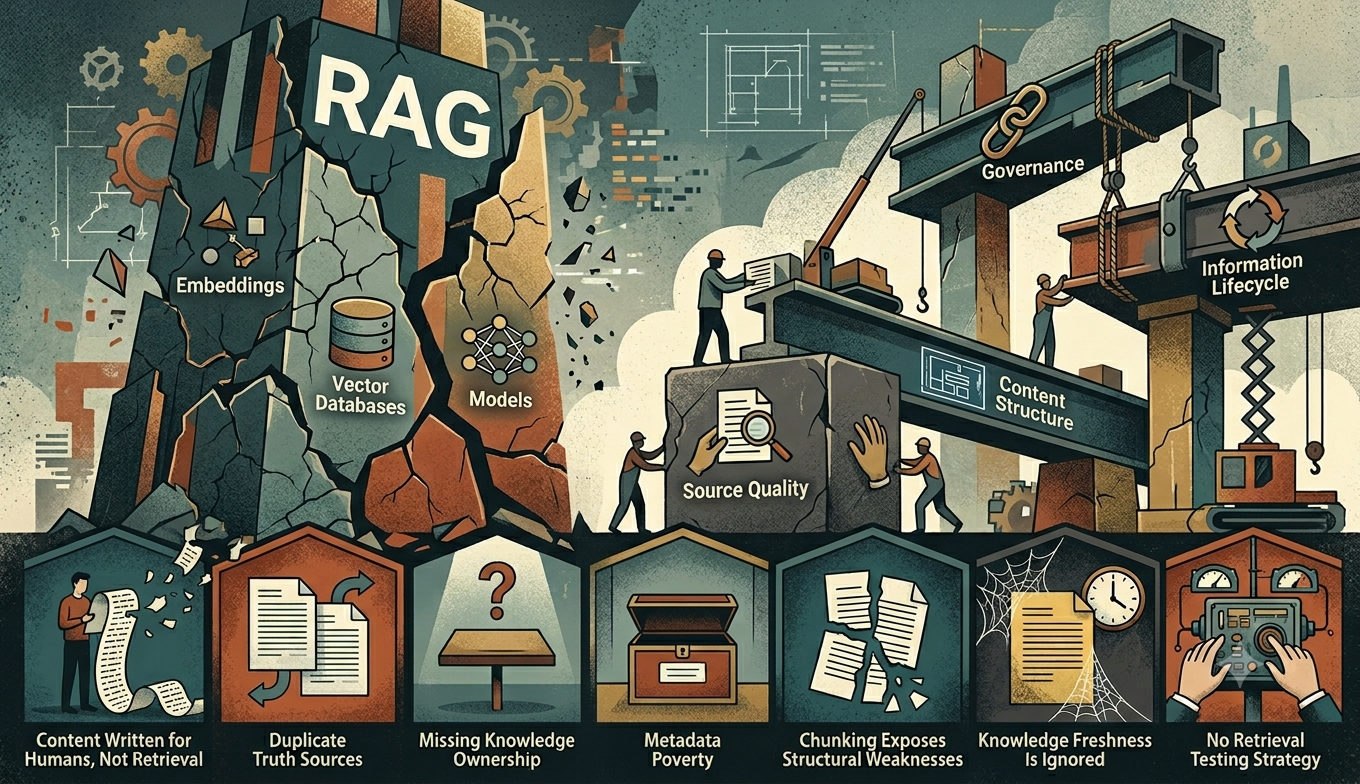
Your AI Agent Is Only as Confident as Your Least Confident Page
Why your retrieval system is giving them both an equal vote
Your AI Agent Is Only as Confident as Your Least Confident Page.
Why your retrieval system is giving them both an equal vote.
(Not a Medium paid member…no worries, read for free here)
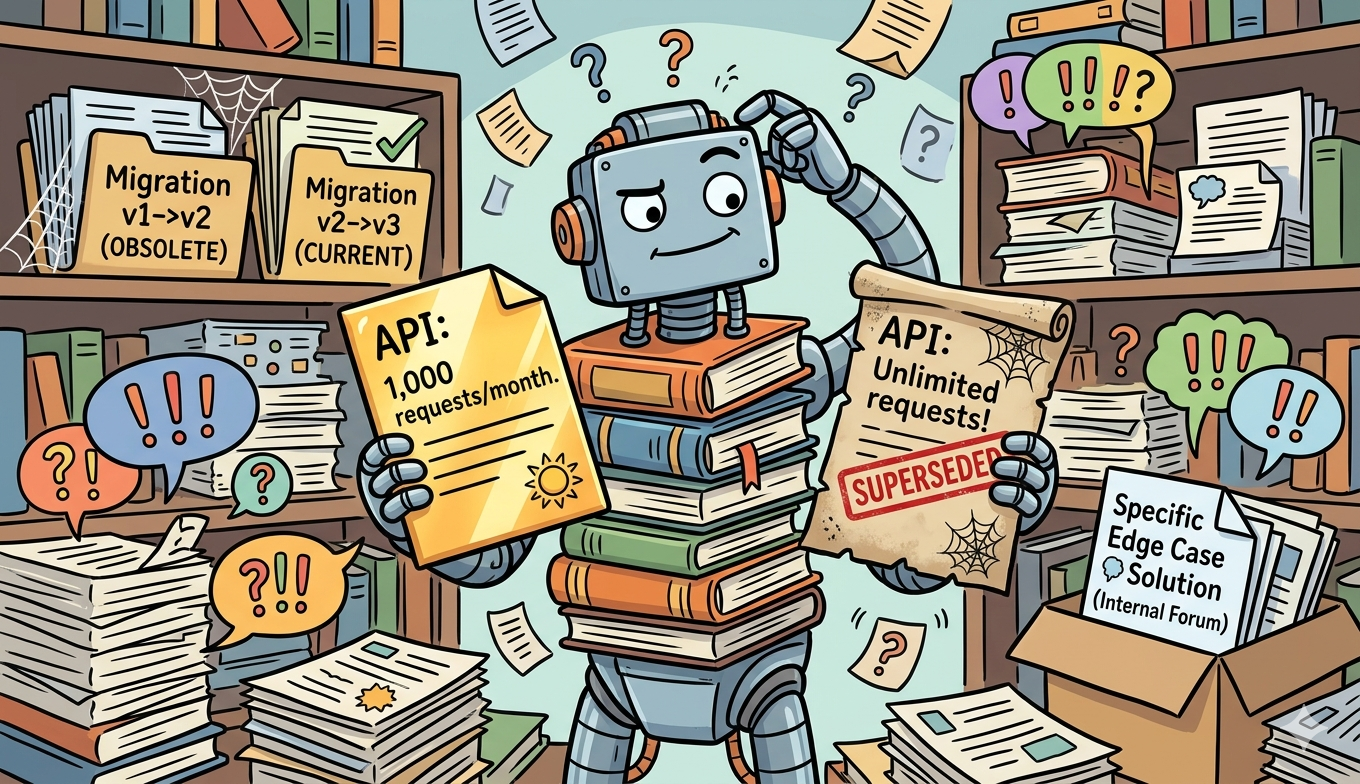
Image owned by Author (Created using Google Gemini)
Most companies spend real effort on their best content.
- Polished onboarding guides.
- Reviewed pricing pages.
- Flagship documentation that goes through three rounds of edits.
And the quiet assumption behind all that effort is simple:
“Our good content will carry the weight. The AI will thus lean on the well-written, well-maintained stuff.”
It won’t.
Retrieval doesn’t know which page you’re proud of.
What it knows is simply which page matches the query. And thus, an outdated FAQ from three years ago can match just as well as the page your team rewrote last month.
Three Real Scenarios, One Missing Signal
Let’s see with the example of 3 quick situations which may look unrelated, but are attracting the same problem.
- The pricing page that moved on without the sales deck: A SaaS company updates its pricing docs the moment limits change. But an old sales pitch deck, still sitting in a shared drive, still says “unlimited API calls on the free tier,” true back in 2023, false today. A support agent is asked about free-tier limits and retrieves both. Sometimes it picks the old one. Sometimes it blends both into a number that was never true on any day
- **The migration guide nobody deleted: **A “how to migrate from v1 to v2” doc is still indexed, still clearly written, still ranks high for “migration.” The company killed v1 eighteen months ago. The doc isn’t wrong. It’s irrelevant. And irrelevance doesn’t lower its retrieval score
- The forum answer that was right for exactly one person: An engineer answers a question on an internal forum, correctly, for their specific edge case. Confident tone, clear writing, technically accurate. It gets retrieved later as if it were a general guidance, because nothing marked it as scoped to a specific situation.
What you saw is: Three different surfaces. Three different authors. One identical mechanic underneath all of them.
And if you realize, none are about bad content. Each one is well-written, accurate, and was true the day it was published.
But all have one thing in common.
Neither of them carries a signal saying whether that’s still the case. And that’s exactly what makes them dangerous.
Let’s zoom in on the first Example:
Most people would picture this failure as:
The AI system hallucinated and made something up.
That’s not what happened. The AI did exactly what it was built to do. The problem sits one layer below it.
What Retrieval Actually Optimizes For:
Retrieval systems rank content by similarity. Given a query, they find the chunks whose meaning sits closest to it in vector space, and return the highest-scoring matches.
That’s it. That’s the whole job.
Nowhere in that math is a concept of “is this still true.”
The old sales deck line, “unlimited API calls on the free tier,” and the current docs line,“1,000 API calls per month on the free tier,” are both, semantically, strong matches for the query “what’s the free tier limit?” They’re talking about the same thing, in similar language, with similar structure.
To a similarity score, they look almost identical in relevance.
One of them just happens to be eighteen months out of date.
The Single Variable That Changes Everything.
Now picture the same company, same agent, same model, same embeddings, before and after they fixed exactly one thing.
Before: The old sales deck content sits in the same indexed knowledge base as the current docs. Nothing in the data tells the retriever, or the model, that the deck has been superseded. Both chunks are eligible. Both chunks can win.
After: The company doesn’t delete the sales deck (it has historical and legal value). They add one field: A superseded_by reference pointing from the old chunk to the current one. At retrieval time, if a superseded chunk surfaces, the system either suppresses it or pulls its replacement alongside it with explicit priority.
That’s the only change. No new model. No new embeddings. No prompt rewritten to say: “please double check for accuracy.”
One missing relationship, added and that’s the whole fix.
And the agent’s answer changes from confidently wrong to correctly current, not because it got smarter, but because the architecture finally told it which page had the authority to answer.
Why This Isn’t Unique to a Specific Problem
Run the same diagnosis on the other two scenarios, and the mechanic doesn’t change.
The migration guide didn’t need better writing. It needed a lifecycle flag saying that this product no longer exists, so retrieval could treat “still indexed” and “still valid” as two separate questions instead of one.
The forum answer didn’t need a disclaimer paragraph. It needed a scope tag tying it to the one situation it was actually correct for, so it couldn’t be retrieved as if it applied everywhere.
Three surfaces. Three authors. The same missing thing each time:
A signal saying this fact has an expiration, a scope, or a successor.
How This Can Actually Get Solved: Simple Fix
Search engines solved a version of this years ago, with recency signals and backlink decay, so a 2010 result stopped outranking a 2024 result on the same query. But that fix doesn’t transfer directly to a knowledge base, because search engines have an external signal to lean on: Time, and how many other pages still link to something. Internal knowledge doesn’t have that. A wiki page doesn’t get “linked to” the way a website does, and a fact doesn’t announce its own expiration date just by getting old.
So the fix has to be built differently, and it comes down to two things working together:
- Every fact that can be overridden needs a pointer to what overrides it, not just a flag saying it’s old. This is the part most teams skip. They’ll add a
last_updateddate and call it done. But a date doesn’t tell the retriever which other chunk replaces this one. What actually works is a direct reference: the old sales deck line carries a field likesuperseded_by: pricing-docs-2025-free-tier, pointing straight at its replacement. Now, the relationship is explicit data, not something the model has to infer from two chunks that happen to discuss the same topic. - That pointer has to be enforced at retrieval time, not just stored. Having the field in your database does nothing if the retrieval logic doesn’t check it. The actual implementation: When a chunk with a
superseded_byfield gets pulled into the candidate set, the retrieval layer either drops it in favor of its successor, or keeps both but re-ranks the successor to the top with the original demoted to context ("this was true until X, now superseded.") Either way, the decision happens in the retrieval pipeline itself, as a rule, applied automatically every time, not as a one-off cleanup someone did last a quarter.
So no need to prompt instructing the AI to “double-check for accuracy.” Just one relationship, captured once, enforced every single time that chunk is a retrieval candidate.
What This Actually Calls For:
Most teams reach for the same three fixes when this problem surfaces:
Tag more content, schedule a recurring audit, or write a longer system prompt telling the model to double-check for accuracy.
Unfortunately, none of these touch the actual mechanism.
- Tags describe content, but they don’t rank it.
- Audits catch staleness weeks or months after it already misled someone.
- And a prompt can ask a model to be careful, but it can’t hand the model a relationship that was never recorded anywhere.
The fix that actually works sits one level lower than any of that:
A successor pointer on anything that can go stale, enforced automatically by the retrieval layer, every time that chunk is a candidate.
Not a policy. Not a checklist. A piece of structure that travels with the data itself, so the system doesn’t need a human to remember it’s there.
To note, however, is the point that you don’t need this on every piece of content in your knowledge base. You only need it on facts that are capable of contradicting each other, numbers, limits, policies, anything with a version. Most content in any knowledge base doesn’t change. The failure only shows up at the small intersection of facts that do change and weren’t told they changed.
To conclude, I would say:
Your best content was never the problem. It was never going to be.
The problem is that your retrieval system can’t tell your best content apart from your oldest, most abandoned, most narrowly-true content, unless you build something into the data that makes that difference visible.
Until then, every confident answer your agent gives is a coin flip between your most current truth, and whatever else happenes to sound similar enough.
And a coin flip dressed up in fluent language is still a coin flip. Thanks for reading this article; don’t forget to clap and follow ❤️
You can send me an invite @ LinkedIn or Substack 😎
Looking forward to connecting with you 🤝
You may also like to read:
Edited for Activated Thinker by Ashley Schmitt
메타데이터
- post_id
- e93b108eb314
- slug
- your-ai-agent-is-only-as-confident-as-your-least-confident-page-e93b108eb314
- url
- https://medium.com/activated-thinker/your-ai-agent-is-only-as-confident-as-your-least-confident-page-e93b108eb314
- canonical_url
- https://medium.com/activated-thinker/your-ai-agent-is-only-as-confident-as-your-least-confident-page-e93b108eb314
- author_url
- https://medium.com/@bhurji.pk
- status
- ok
- fetched_at
- 2026-06-24 11:06:28