The Soviet Union’s Vietnam War
The Soviet-Afghan War and how it crippled the USSR
The Soviet Union’s Vietnam War
The Soviet-Afghan War and how it crippled the USSR
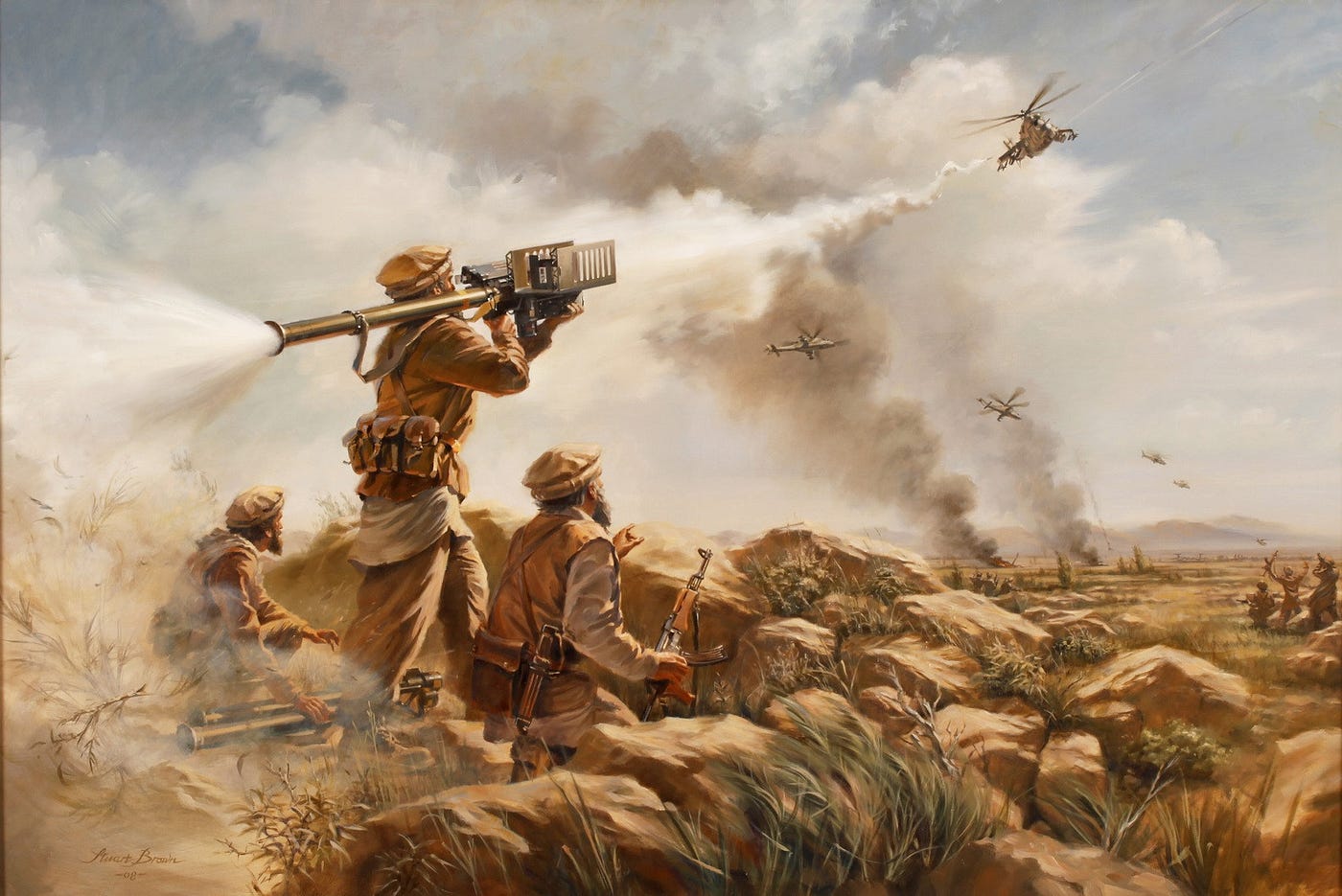
(By Stuart Brown — Central Intelligence Agency Official Web-site, CIA Museum Art Collection, Public Domain, https://commons.wikimedia.org/w/index.php?curid=68673261)
A superpower fighting a rural local population. Cities are in control of the superpower, but the countryside is firmly in control of the local fighters. A prolonged and bloody fight that sapped the strength of the superpower against all odds. Overwhelming firepower against a ragtag band hiding in well-disguised and supplied bases. Does this sound familiar? It sounds an awful lot like the United States’ fight in Vietnam. But this also describes the Soviet Union’s fight against Muslim fighters in Afghanistan.
Just a few years after the United States was forced to flee Saigon in the wake of its own military quagmire, the Soviet Union stepped up to the plate to make the same mistake with disastrous results. After cheering their own victory in Vietnam, the Soviet Union invaded Afghanistan with eerily similar motives. They wanted to prop up an unpopular communist government in a country they knew little about and where they were ill-equipped to fight.
The Soviet-Afghan War was a nine-year conflict that led to the deaths of over 100,000 people and resulted in nearly a million total casualties — arguably including the Soviet Union itself. This was the USSR’s Vietnam War, and it ended just as poorly, perhaps worse so, than Vietnam did for the United States.
In 1978, the Marxist People’s Democratic Party of Afghanistan seized control of the country with the backing of the military. The previous government was disbanded, and dissenters were jailed and executed in large numbers. The rise of a communist government did not sit well with many devoutly religious Muslims who saw communism as an atheist form of government completely opposed to their own desires for a religious government that aligned with their personal religious beliefs.
Between 1978 and 1979, the new communist government executed thousands of people, which pushed the countryside into open rebellion. The United States and Pakistan quickly rushed to the rebels’ aid by giving them money and weapons to oppose the communist government.
Meanwhile, the communist party signed a treaty of friendship with the Soviet Union and repeatedly called on them for aid in crushing the rebellion.
Back in Moscow, General Secretary Leonid Brezhnev fretted over the decision to commit troops to Afghanistan. Many influential members of his party were pressing for a swift intervention, claiming that Afghanistan would be an easy country to invade and occupy. On the other side, Soviet Army General Staff Marshal Nikolai Ogarkov warned that the situation seemed ripe for a prolonged guerrilla conflict that would put the USSR at a severe disadvantage.
The debate raged throughout 1979 until the orders were finally given to invade Afghanistan. On Christmas, the Soviet Defense Minister gave the fateful order, writing:
The state frontier of the Democratic Republic of Afghanistan is to be crossed on the ground and in the air by forces of the 40th Army and the Air Force at 15:00 hrs on 25 December.
What came next was nothing short of a disaster.
The invasion was seen as shocking and senseless by most of the international community. A Christmas invasion against a country seen as impoverished and defenseless immediately soured the global community against the Soviet Union. Meanwhile, thousands of men were being flown into the country to seize Kabul and prepare the way for a full-scale invasion. Pakistan was particularly alarmed and quickly marshalled support for the rebels, who would be henceforth known as the Mujahideen.

(By erwinlux — Private collection; apparently a crop of this image at Flickr, CC BY-SA 3.0, https://commons.wikimedia.org/w/index.php?curid=5310966)
The Soviets quickly managed to seize control of Afghanistan’s handful of key cities and roadways. There were many in Moscow who were still saying that this would be enough to control the country and prop up the communist government. But the communist government remained deeply unpopular and ineffective. The Soviets and the government only managed to gain control of roughly 20% of the country. The other 80%, largely rural and mountainous acres, remained in control of the Mujahideen.
A bloody rhythm was established. Mujahideen rebels would retreat to the mountains, especially those in close proximity to Pakistan, and use them as a base to hit Soviet targets. The Soviets would then respond by launching large offensives into rough terrain to sweep the region clear of rebel bases. Meanwhile, the rebels would melt away into the mountains or flee into neighboring Pakistan to refit and resupply before returning.
On multiple occasions, the Soviets would destroy bases and capture villages only for the Mujahideen to return once the Soviets moved on. The Soviets struggled to destroy supply bases in Pakistan and Iran, which were both tacitly and openly supporting the rebels.
Again, does this sound familiar?
Futile offensives into rural areas. An enemy that vanished and reappeared at will. Supply bases and support in neighboring countries outside of the reach of the military. This was Vietnam all over again, but instead of jungles and rice paddies, the Soviets were fighting in mountains and opium fields.
Despite years of hard fighting, the government’s control of the countryside remained stubbornly low even as losses mounted for the Soviets. The Soviets were losing thousands of men to casualties every single month with little to show for it.
Fighting raged from 1980 until 1985 when Mikhail Gorbachev was elevated to General Secretary of the Soviet Union. Gorbachev saw the war as deeply unfavorable. He was concerned with the economic stagnation that had gripped the Soviet Union for years and was eager to ease Cold War tensions. He believed that for the Soviet Union to survive, it had to be more amenable on the world stage and more robust internally. He began drawing up plans for a withdrawal from Afghanistan, but the war would not end for another four years.
Like the United States before them, the Soviet Union began withdrawing in phases, with the first phase beginning in 1987, the second phase picking up in 1988, and the final phase occurring in 1989. The Soviet Union had lost.

(By PH1 (SW) ARLO K. ABRAHAMSON, USN — http://www.dodmedia.osd.mil/DVIC_View/Still_Details.cfm?SDAN=DNSD0412785&JPGPath=/Assets/Still/2004/Navy/DN-SD-04-12785.JPG, Public Domain, https://commons.wikimedia.org/w/index.php?curid=773914)
Militarily, the war in Afghanistan wasn’t a huge burden to the expansive Soviet Union. It only accounted for 2.5% of their total spending and did nothing to diminish the large number of forces stationed in Eastern Europe, nor did it affect the country’s massive nuclear arsenal. However, the outcome severely damaged the Soviet Union in a number of ways.
First, the image of the Red Army being an invincible force capable of sweeping opposing units from the field was fatally wounded. While the Soviets had participated in the margins of numerous conflicts since World War II, they had rarely engaged openly with the Red Army. Now, the world could see the Red Army’s might on full display, and it was thwarted by rural and underequipped rebels. This put the military’s ability to enforce Soviet foreign policy in serious doubt and alerted politicians like Reagan and Thatcher that the Red Army was not as fearsome as many had been led to believe.
Second, the Soviet Union’s inability to pacify Afghanistan emboldened people within the USSR who wanted independence for themselves. If the Afghans could do it, surely the Poles and the Czechs could too. This inflamed internal tensions within the USSR, which ultimately became untenable, leading to the state's eventual dissolution.
Lastly, the divisions caused by the war ultimately undermined the communist party’s grip on things like the media and the military. As veterans came home, they often formed new veterans groups. People began to doubt that the military could solve their problems. The media began to be more and more cynical about the war and the communist party in general. The erosion of control of these important levers of power within the USSR also contributed to the dissolution of the state.
Finally, the war plunged Afghanistan into yet another wave of violence and instability. A civil war ensued in which the communist government was finally overtaken by a new Islamist government. Militancy, terrorism, nationalism, and religious fervor gripped Afghanistan and spilled out into neighboring Iran and Pakistan, which would lead to a rise in jihadist ideology, which would come home to roost in the coming years, drawing the United States back into the region.
In the end, the Soviet-Afghan War has many striking similarities to the Vietnam War. The Soviets lost, their prestige was damaged, and the resulting ripples helped to shake apart the USSR from within, leading to its final collapse in 1991 and the freedom of many Eastern Bloc nations by 1993. While the war itself did not cause the collapse of the Soviet Union, it was a political accelerant that hastened reforms and discontent that were already festering within the country.
The Soviet Union suffered roughly 600,000 casualties over nine years, equating to 55,000 casualties per year, most of which were attributed to disease. The USSR suffered 70,000 military casualties, a number extremely similar to those suffered by the Americans in Vietnam.
This story reminds us that while history does not repeat itself, it often rhymes and echoes. And the United States would cause yet another echo when it entered the exact same conflict as the Soviet Union in 2001, in the wake of 9/11, with similar results once again.
And so the world turns.

메타데이터
- post_id
- e95cc3eebde2
- slug
- the-soviet-unions-vietnam-war-e95cc3eebde2
- url
- https://medium.com/@grantpiperwriting/the-soviet-unions-vietnam-war-e95cc3eebde2
- canonical_url
- https://medium.com/@grantpiperwriting/the-soviet-unions-vietnam-war-e95cc3eebde2
- author_url
- https://medium.com/@grantpiperwriting
- status
- ok
- fetched_at
- 2026-07-15 06:54:52