WHY “HOW LONG DOES IT TAKE TO BUILD A MOBILE GAME?” IS A TRICK QUESTION
The honest answer is anywhere from 3 months to 3 years. Both timelines are valid.
WHY “HOW LONG DOES IT TAKE TO BUILD A MOBILE GAME?” IS A TRICK QUESTION
The honest answer is anywhere from 3 months to 3 years. Both timelines are valid.
We have delivered a hyper-casual game in 10 weeks and have seen a “simple match-3” take 18 months. The key factor is what the project actually includes.
When founders ask Whimsy Games how long their mobile game will take to build, they usually want a specific number for their pitch deck or board. We understand this need. However, providing a timeline without first understanding the scope is not expertise; it is guesswork.
The real question isn’t “how long?” It’s “how long for what, exactly?”
This article is for anyone who has requested a timeline quote from a studio and received an overly simple answer. We will explain why the question is fundamentally flawed, what truly determines mobile game timelines, and how to scope a project to receive a reliable estimate.
Asking “how long does a mobile game take to build?” is similar to asking “how long does it take to build a house?” The answer depends on whether you are referring to a simple structure or a complex, fully featured property.
“Mobile game” encompasses a wide range of complexity. A hyper-casual title with a single mechanic and placeholder art is vastly different from a mid-core RPG with a meta-layer, live events, and cross-platform progression. Both are mobile games, but their timelines are not comparable.
The challenge is that most early discussions about timelines occur before the game is clearly defined. A brief such as “it’s like Clash Royale but with a farming theme” provides little useful information about scope. Clash Royale required approximately two years and a substantial team. A properly executed farming reskin would still require at least 12 to 18 months.
A timeline quote provided before a thorough scope review is a sales figure, not a project estimate. It is subject to change.
At Whimsy Games, we have reviewed hundreds of briefs. Those described as “simple” rarely are. Typically, “simple” means the client finds the concept easy to explain, not that the engineering or art pipeline is straightforward to execute.
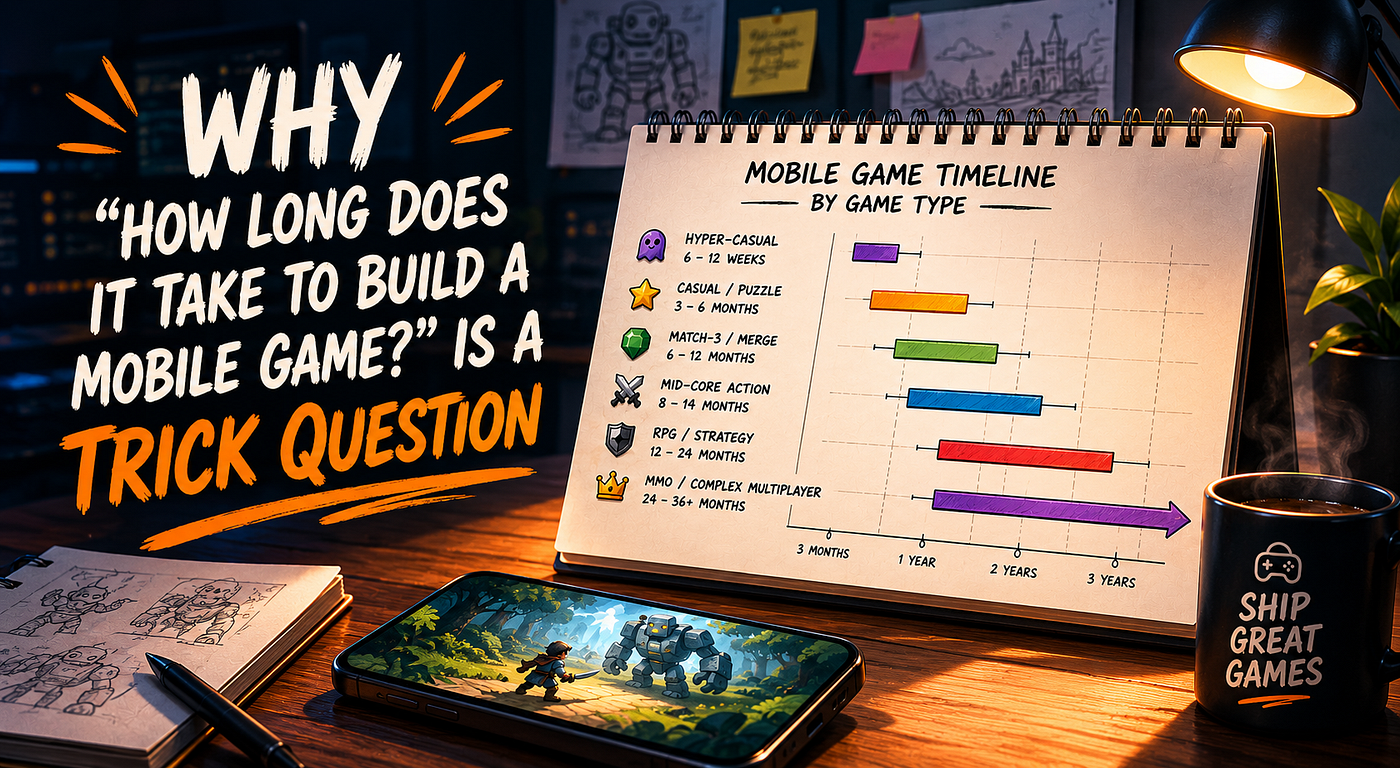
Mobile Game Timeline by Game Type
Here’s a realistic breakdown based on what we see in production. These assume a dedicated team, a single primary platform, and a reasonably clear scope at the start of production.

A few things worth noting from this table.
First, the ranges within each category are wide. A match-3 can take 6 months or 12 months, depending on whether you have 50 levels or 500, whether the meta includes a home-building mechanic, and whether you’re building live-ops infrastructure from day one.
Second, the team size multiplier matters enormously. A 3-person team building a casual puzzle game will take twice as long as a 6-person team with the same brief. Headcount is not just a cost variable - it’s a timeline variable.
Third, “mobile game” increasingly refers to a live-service product. Games like Candy Crush, which took nearly a year with a team of 25, weren’t just built once. They were built to be continuously updated. That infrastructure adds time before launch, not just after.
The 5 Variables That Multiply Timelines
Even within a game type, timelines shift dramatically based on five factors. These are the variables we interrogate on every project before we give any estimate.
1. Scope Clarity at Kickoff
The single biggest timeline killer is a scope that evolves mid-production. When a client comes in with a fully resolved game design document, a clear art direction, and defined monetisation, we can estimate accurately. When the brief is “let’s figure it out as we go,” we add 30 to 50 per cent to any internal estimate before we even start.
Discovery phases exist for a reason. A well-structured discovery phase typically runs for 4 to 6 weeks and saves multiple times that time in production.
2. Art Style and Asset Volume
Art is almost always the longest pole in the tent. A 3D stylised RPG with 40 character classes and 200 unique environments is a fundamentally different production challenge from a 2D puzzle game with a flat graphic style. We’ve seen art pipelines alone run to 8 months on mid-core titles.
The art direction choice isn’t just aesthetic - it’s a project planning decision.
3. Platform Targets
Building for iOS only is faster than building for iOS and Android simultaneously. Adding web or PC ports adds time again. Cross-platform parity testing, performance optimisation across device tiers, and platform-specific certification processes all extend timelines in ways that aren’t always obvious upfront.
4. Backend and Live-Ops Infrastructure
Does the game need a server? Player accounts? Leaderboards? Push notifications? An analytics layer? Each of these is a separate workstream. A game with no backend can ship faster than one that needs cloud save, real-time multiplayer, or seasonal event infrastructure.
We’ve seen founders underestimate backend scope by 40 to 60 percent on their first project. It’s the invisible part of the build.
5. Team Continuity and Decision Speed
A dedicated team that has worked together before moves faster than an assembled-for-this-project team finding its rhythm. Client-side decision speed matters just as much. When feedback cycles run to two or three weeks per iteration, a 9-month project becomes a 14-month project.
The fastest projects we’ve delivered at Whimsy Games shared one trait: the client was available, decisive, and had done the pre-production thinking before we started.
How to Scope a Project to Get a Real Estimate
If you want a timeline you can actually plan around, you need to answer these questions before you approach any studio. This is the same list we work through in Whimsy Games discovery sessions.
Define the core loop first. What is the single action the player repeats? Tap to match, swipe to shoot, drag to build. If you can’t describe the core loop in one sentence, the scope isn’t ready.
List every system, not just the main mechanic. Most games have 5 to 10 interconnected systems beyond the core loop: progression, economy, social features, onboarding, notifications, IAP, analytics, and so on. List all of them. Each one adds time.
Decide on your art direction and get a reference. “Cartoon style” is not an art direction. A mood board with 10 to 15 reference images that your team agrees on is an art direction. The difference in scoping accuracy is significant.
Set a launch definition. Are you launching a soft-launch MVP with 30 levels, or a full global release with 200 levels and three seasonal events? The timeline for each is completely different, and both are valid choices depending on your funding and strategy.
Choose your platform targets up front. iOS only, Android only, or both. Each combination has a different QA and certification overhead.
Once you have answers to these five points, a studio can give you a timeline that means something. Without them, any number you receive is an approximation at best.
According to Autodesk’s mobile game development guide, simple 2D puzzle games take 2 to 6 months while moderately complex 3D titles run 6 to 18 months. Those ranges are accurate — but they only become meaningful once you know which category your game actually falls into.
Red Flags in a Studio’s Timeline Quote
Not all timeline quotes are created equal. Here’s what we’d watch for when evaluating an estimate from any studio, including us.
Red flags that suggest the number isn’t grounded
- A timeline given within 24 hours of first contact. Proper scoping takes time. If a studio quotes you a 6-month timeline after a 30-minute call and no written brief, they’re guessing.
- No discovery phase in the proposal. Every serious studio builds a discovery or pre-production phase into the timeline. If it’s missing, scope creep is almost guaranteed.
- A single number with no range. Real estimates have ranges because real projects have variables. “9 months” is a red flag. “7 to 11 months, depending on art volume and backend complexity” is honest.
- No questions about your launch definition. If a studio doesn’t ask whether you’re building for soft launch or a global launch, they haven’t thought through the scope.
- Timelines that don’t include QA. Quality assurance on a mobile title typically adds 6 to 10 weeks. If it’s not in the timeline, it’s been hidden in another line item or left out entirely.
Green flags that suggest a studio knows what they’re doing
- They ask more questions than you expected.
- They push back on your “simple” brief and explain why it’s more complex.
- Their estimate has a range, with a clear explanation of what determines where you land in it.
- They propose a discovery phase before committing to a full production timeline.
- They can point to shipped titles in a similar genre with real production data.
We’ve built mobile games across genres from hyper-casual to mid-core strategy. The projects that go smoothly aren’t the ones with the smallest scope - they’re the ones where everyone agreed on what “done” meant before the first line of code was written.
The Better Question to Ask
Stop asking “how long will it take?” and start asking “what do we need to define before you can tell me how long it will take?”
That question separates studios that know what they’re doing from studios that are telling you what you want to hear. It also puts you in a stronger position as a client, because it signals that you understand the process.
The answer to “how long does a mobile game take to build?” is always: it depends. But now you know what it depends on, how to prepare for the conversation, and what to watch for when the number comes back.
If you’re scoping a mobile game and want a timeline grounded in real production data, we’re happy to walk you through it. Our mobile game development services begin with the exact discovery process described above. No guesswork. No suspiciously clean answers.
메타데이터
- post_id
- e979095aa436
- slug
- why-how-long-does-it-take-to-build-a-mobile-game-is-a-trick-question-e979095aa436
- url
- https://medium.com/@info_59975/why-how-long-does-it-take-to-build-a-mobile-game-is-a-trick-question-e979095aa436
- canonical_url
- https://medium.com/@info_59975/why-how-long-does-it-take-to-build-a-mobile-game-is-a-trick-question-e979095aa436
- author_url
- https://medium.com/@info_59975
- status
- ok
- fetched_at
- 2026-06-09 14:34:10