Cost and margin management in modern AI applications
TL;DR
Cost and margin management in modern AI applications

TL;DR
- We are rapidly moving toward an agent economy, where AI agents become core units of execution and value creation.
- However, the unit economics of the agents themselves is unstable and poorly controlled today.
- Existing tools — LLM platforms, agent frameworks, and AI observability solutions — help teams see costs, but do not enable margin management.
- Cost tracking ≠ cost attribution ≠ margin attribution — and most solutions are stuck at the first level.
- Without SaaS-grade economic tooling, agent-based products risk scaling technically, but not economically.
- The next wave will likely be driven by one (or more) of three paths: evolution of observability platforms, emergence of AI-native FinOps / RevOps tools, or entry of traditional analytics systems.
- The winners will be platforms that make probabilistic AI systems economically deterministic and manageable.
In this article, I tryed draw a clear line between two closely related — but often confused — ideas. AI agent unit economics refers to the cost and margin structure of an individual agent or an agent-driven workflow. The agent economy, in contrast, describes the broader economic system that emerges from interactions between AI agents, users, and organisations.
The agent economy looks inevitable, its unit economics does not
The idea of an agent economy is rapidly becoming mainstream. AI agents are increasingly framed not as experimental features, but as core execution units — systems that plan, reason, call tools, and deliver outcomes on behalf of users.
Industry research, including recent work by Deloitte, describes a near future where agents:
- replace entire categories of operational work,
- coordinate across systems and other agents,
- and become embedded into business-critical workflows.
At the same time, founders and product leaders building agent-based products are running into a growing set of economic pain points.
Most teams already rely on:
- LLM platforms like OpenAI or Anthropic,
- agent frameworks such as LangChain,
- and observability tools like LangSmith, Helicone, or Weights & Biases.
Technically, this stack works remarkably well. Economically, it often does not.
Teams see a familiar pattern:
- usage is growing, but margins are shrinking;
- customer value is hard to price, but LLM bills are very real;
- identical user requests generate wildly different costs;
- more “intelligent” agents often mean higher burn, not higher profit.
What looks like product-market fit on dashboards can quietly turn into unit economics erosion underneath.
This is not a missing-feature problem. It is a structural economics problem.
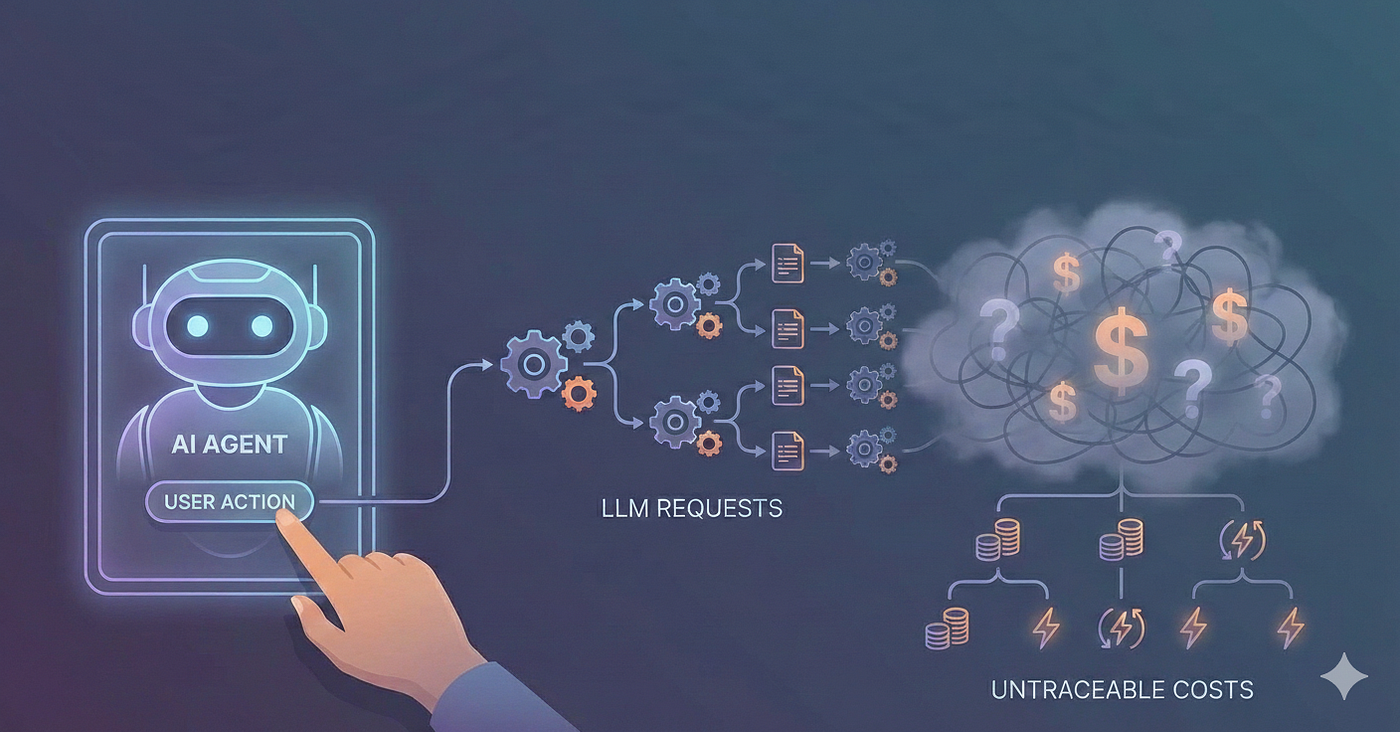
Agents execute in probabilistic, multi-step flows: they retry, branch, loop, call APIs, query data, and adapt dynamically. Yet pricing models, cost controls, and internal analytics still assume linear and deterministic execution.
The result: founders and product teams are forced to make pricing and roadmap decisions without clear answers to basic questions:
- Which users and workflows are actually profitable?
- Which agent behaviours improve outcomes, and which just inflate costs?
- How should pricing react to task complexity and execution variance?
- Where does “more intelligence” stop adding value and start destroying margin?
The uncomfortable truth is simple:
The agent economy cannot scale on intuition and token dashboards alone.
This article explores why today’s AI platforms fall short economically, why cost tracking is only the first step, and what needs to change for agent-based products to achieve SaaS-grade economic discipline.

From cost tracking to margin management: three key concepts
To understand where the ecosystem is today — and why founders feel stuck — it helps to separate three often-confused concepts.

Cost tracking
Cost tracking is the basic ability to record resource consumption and its monetary cost.
In AI systems, this usually includes:
- LLM tokens (prompt and completion);
- model invocation counts;
- execution time;
- base infrastructure cost.
Cost tracking answers a simple question: “How much did we spend?”
This is the earliest and most primitive stage of economic visibility.
Cost attribution
Cost attribution goes one step further by allocating costs to higher-level entities:
- users;
- requests;
- features;
- agents;
- workflows or use cases.
This enables teams to understand:
- which users or tasks are disproportionately expensive;
- which agents or flows are inefficient;
- where cost anomalies originate.
Cost attribution answers the question: “Where and why did we spend this money?”
At this stage, cost data becomes actionable.
Margin attribution
Margin attribution is the most mature — and currently the rarest — capability.
It connects costs to revenue, making it possible to analyze:
- margin by user, plan, feature, or use case;
- which scenarios create value and which destroy margin;
- where pricing diverges from actual unit economics.
Margin attribution answers the question: “Where are we actually making money?”
This level of insight is standard in mature SaaS businesses — and largely missing in today’s AI stack.
How cost control works in AI systems today
LLM and agent platforms
Most LLM providers and agent frameworks offer:
- token usage metrics;
- aggregated spend dashboards;
- sometimes request-level logs.
The limitations are structural:
- data is fragmented;
- there is no link to business logic;
- revenue is completely out of scope;
- margin analysis is impossible.
These tools are designed for billing visibility, not economic management.
AI observability platforms
AI observability tools have pushed the ecosystem forward:
- request tracing;
- latency analysis;
- and in some cases, cost breakdown at the request level.
However, one critical point is often overlooked:
Cost tracking is not their core mission — it is a secondary feature.
As a result, their cost-related capabilities are constrained:
- focus is primarily on LLM calls;
- external tools, APIs, data access, and infrastructure are weakly represented or invisible;
- attribution is limited;
- revenue and margin are entirely absent.
In agent-based systems, a significant portion of cost is generated outside the LLM — and this part is usually not observable at all.
The core gap: visibility into costs, blindness to margins
Current language platforms, agent frameworks, and observability tools only address the cost side of the equation.
They:
- do not understand how the product is monetized;
- have no knowledge of pricing models;
- cannot reason about ARPU, LTV, or contribution margin;
- provide no support for pricing decisions.
As a result:
- teams cannot manage unit economics intentionally;
- pricing decisions are made with incomplete data;
- increased usage can quietly erode margins or push products into loss.
This is the defining economic risk of modern AI products.
What needs to change: bringing SaaS-grade economics to AI
For AI developers to gain the same level of control that SaaS companies take for granted, several shifts are required.
What next-generation tools must support
- Full cost visibility
- LLMs
- tools and APIs
- data access
- infrastructure
- retries, failures, and agent loops
2. Deep cost attribution
- down to request, user, and workflow level
- compatible with probabilistic execution paths
3. Direct linkage to revenue
- usage-based and outcome-based pricing
- real-time margin analysis
4. Active cost and margin control
- budgeting and guardrails
- cost-aware orchestration
- dynamic optimization of agent behaviour
How this market may evolve
Three realistic scenarios are emerging — and they are not mutually exclusive.
Scenario 1: observability platforms evolve into economic platforms
Observability tools may expand beyond technical metrics to:
- first-class cost and margin attribution;
- economic dashboards alongside traces;
- cost-aware debugging and optimization.
The risk is product DNA: connecting deeply to revenue and pricing is fundamentally different from observability.
Scenario 2: a new category of AI-native business analytics emerges
This is arguably the most likely outcome:
- AI-specific FinOps / RevOps platforms;
- built explicitly for agent-based and probabilistic systems;
- sitting at the intersection of engineering, product, and finance.
Think of it as SaaS analytics rebuilt for AI execution models.
Scenario 3: traditional analytics platforms enter the AI stack
Established BI and analytics systems may:
- adapt existing economic models to AI workloads;
- integrate with agent platforms;
- bring mature margin management practices.
Their main challenge will be integration depth and real-time adaptability.
Conclusion: from cost awareness to outcome economics
The next generation of AI tooling will not stop at measuring spend. Its real purpose will be managing the economics of probabilistic systems:
- controlling costs without sacrificing output quality;
- dynamically managing margins;
- enabling transparent, fair pricing;
- tying price to outcomes rather than token counts.
For end users, this should translate into:
- clearer pricing;
- better understanding of what they are paying for;
- pricing that more closely reflects real value delivered.

AI applications are following the same path SaaS once did — from experimentation to economically disciplined, scalable systems.
메타데이터
- post_id
- e97cc2c45454
- slug
- cost-and-margin-management-in-modern-ai-applications-e97cc2c45454
- url
- https://medium.com/measuring-ai/cost-and-margin-management-in-modern-ai-applications-e97cc2c45454
- canonical_url
- https://medium.com/measuring-ai/cost-and-margin-management-in-modern-ai-applications-e97cc2c45454
- author_url
- https://medium.com/@a.maklakov
- status
- ok
- fetched_at
- 2026-06-09 15:37:30