XSLT 1.0 (XML / XSL) — How big companies use it
Its importance As part of my work in one of the biggest LIMS companies in the US and Israel, I was amazed to find out that XML is largely…
XSLT 1.0 (XML / XSL) — How big companies use it
Its importance As part of my work in one of the biggest LIMS companies in the US and Israel, I was amazed to find out that XML is largely used nowadays to produce reports on a large scale. To most unaware readers, one might wrongly think as “how many reports are produced to justify the importance of a certain technology?” — well, hundreds of thousands of reports can be considered a small number of reports to be produced for one company’s department operation in a one-week time-span. To put it in perspective, specifically the company as a LIMS provided the systems and technological infrastructure to huge corporations that owned many hospitals in several countries. Therefore, the SaaS product of the company and the XML technology to produce the reports are used not only for one administrative office but all the laboratories in all hospitals of all the organizations that are its clients.
Its uses Following the case of a LIMS company, each department in each hospital produces anything from a few reports to many thousands of reports every day. For example, a blood test. It goes through the systems from the doctor to the laboratory and back. How many blood tests a hospital does in 24 hours? And for each test, there are results, and these results are handed to the patient or other doctors in the form of a report.
The importance of XML in the organization is not limited to reports. It is widely used in the communication between the systems, mainly between the servers and the databases, as well as external machinery to driver servers, or between servers. And since XML allows to a relatively simple format of storing and transferring text data, it also has its applications internally, and between the client and a company’s services.
Apart from the direct usage of XML, the technology is used indirectly to create other types of data files. The most popular indirect creations of XML technology are HL7, CSV, PDF, and text.
What is HL7 and how is related to XML The HL7 format files are one of the standardized methods of system communications in the medical industry around the world. It is well-established, and any big medical organization uses HL7. Furthermore, it is important to mention that the government also uses HL7 as a way to communicate in their internal systems (such as the ministry of health or public health organizations) but also in their external activity with private companies. A good example of this is the Federal and all States’ medical regulations of the United States. Big medical companies such as hospitals and laboratories not only have to be able to communicate with the government through HL7, they must do it in the format and provide the information legally imposed by the government. Among other reasons, this provides the government with a way to be up-to-date concerning the public’s health. Failing to comply with the government may lead to severe consequences, anything from fines to getting operational licenses revoked.
XML technology as a tool to make files of different formats The XML technology is capable of converting data from an XML and creating an output to many other formats such as HL7, CSV, Text, XML, HTML, and PDF. Similarly to HL7, CSV and Text output files are distinct and their usage is usually oriented to an indirect usage. CSV format files are usually known as the format of “Microsoft Excel” and “LibreOffice Calc” files. The files are created considering how Microsoft Excel, LibreOffice Calc, and any other software capable of reading and processing CSV will be able to extract the information and display it according to the table structure characteristic of these programs. On the other hand, HTML and PDF files are usually the expected results of XML technology as they are directly used by software, systems, and services to display information after going through XML Transformation. Finally, an XML to XML conversion may be necessary when automated processing of functionality is required or when the output in an XML is subject to further processing in another external software.
XML vs HTML The XML technology is not limited to the XML files but is the reason why the XML files are as simplistic and flexible as they are. XML files were created in an attempt to simplify HTML and provide total control of how information is manipulated and displayed. Different than XML, HTML has many predefined tags that hold certain properties and the programmer must override them in case not all of those properties are desired. For example, a <h1> tag will always appear with bold and big font size, regardless of weight or what the actual size will it be in the different editors, one can always expect these attributes to be present. And to modify these attributes, one would commonly recur into displaying the information in an HTML file with the effects of at least one CSS file. The relationship that HTML has with CSS is comparable, with differences but very similar to XML and XSL.
One important aspect of XML is its flexibility. And is important to mention that XML technology does support the usage of many other technologies. In a business such as a LIMS SaaS but not only, the usage of XML technology is commonly involved with HTML, CSS, JavaScript, Java, C#, and VBScript. Despite the great technological flexibility, the balancing flaw is that famous XML IDEs such as the most popular XML IDE, Altova XMLSpy, only support (very) old versions of these technologies. This restriction limits many time-savers and problem-solving tools, and libraries already created presenting an additional challenge to XML programmers when recreating common modern programming conventions and functionality.
XSL, XSLT 1.0 vs XSLT 2.0, and XML Transformation The XSL files are used to manipulate and transform the XML files into XMLT files or XML files that contain effects and attributes similar to an HTML file mixed with CSS. This process is called XSLT or XSL Transformation. Up to today, there are two most famous versions of XSLT, XSLT 1.0 also known as “Vanilla XSLT” and XSLT 2.0. The former is famous for having greater flexibility, part of that flexibility was described in this article as well as being easier to maintain. The last is famous to be easier to manipulate as it allows the usage of very powerful external libraries and coding conventions that ease the process of coding. The difference and the main reason companies only work with one version but not both is similar to C and C++. For ease of comprehension, one could think of XSLT 1.0 as C and XSLT 2.0 as C++ because XSLT 1.0 and XSLT 2.0 advantages and disadvantages are very similar to why one would use C or C++.
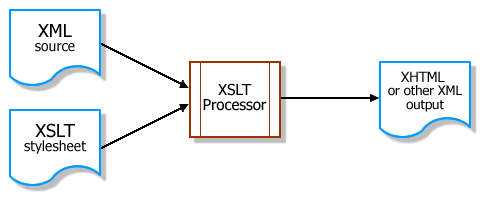
Illustration of the XSLT Processor process of combining XML source file with XSLT stylesheet to create an HTML or other XML output.
XSLT technology: Functional Programming, Procedural Programming, or both? One of the most important aspects that allowed a 27-year-old technology such as XML to be relevant, widely used, and popular even today is how powerful and different are XSL and the XSLT process.
Automatic Programming XSLT is designed to implement functionality and modify XML much more than HTML was originally planned to. Its unique tag-structured programming language is entirely for automation. Perhaps one of the reasons it supports old versions of CSS, JS, Java, C#, and VBScript is because of how extremely hard is to do anything that is not automated. For example, one of the hardest tasks in XSLT 1.0 is to use indexes of a node set (similar to an “array” in XSLT logic) or even to make a simple count — yes, even the loops are automated in XSLT 1.0.
XSLT / XML controversy: Functional or Not Functional Programming The great power, scalability, and ease of maintenance of XSLT technology, are contrasted with the way the language is processed. On one hand, XSLT is completely functional programming — with all its perks and advantages. However what makes XSLT not to be easily labeled as a “functional programming language” is that it restricts the use of functionality that may contradict automation. Many of these restrictions force the programmer to use the supported external languages such as CSS, JS, and Java or even sacrifice some efficiency with recursion. When programming in XSLT, one can’t use functions as a first-class data type, there are no explicit loops, and one can declare a variable but all variables are constant — one can’t change their values after declaration. As many popularly claim, in XSLT one works with input but one does not change the input to create the output — the output is a new file.
Written by Jei Cohen, Published on Wed. 1st of February, 2023
메타데이터
- post_id
- e9964b52f10d
- slug
- xslt-1-0-xml-xsl-how-big-companies-use-it-e9964b52f10d
- url
- https://medium.com/@jei.cohen/xslt-1-0-xml-xsl-how-big-companies-use-it-e9964b52f10d
- canonical_url
- https://medium.com/@jei.cohen/xslt-1-0-xml-xsl-how-big-companies-use-it-e9964b52f10d
- author_url
- https://medium.com/@jei.cohen
- status
- ok
- fetched_at
- 2026-06-29 02:33:43