The Tragedy of Saul: The Man Who Could Not Wait
A king chosen for his reluctance destroyed himself through the one thing he couldn’t master: waiting. What began as a single hurried…
The Tragedy of Saul: The Man Who Could Not Wait
A king chosen for his reluctance destroyed himself through the one thing he couldn’t master: waiting. What began as a single hurried sacrifice unraveled into a lifetime of compromises, massacres, and a final, desperate séance — leaving a kingdom to be buried not in glory, but in unpaid debts.
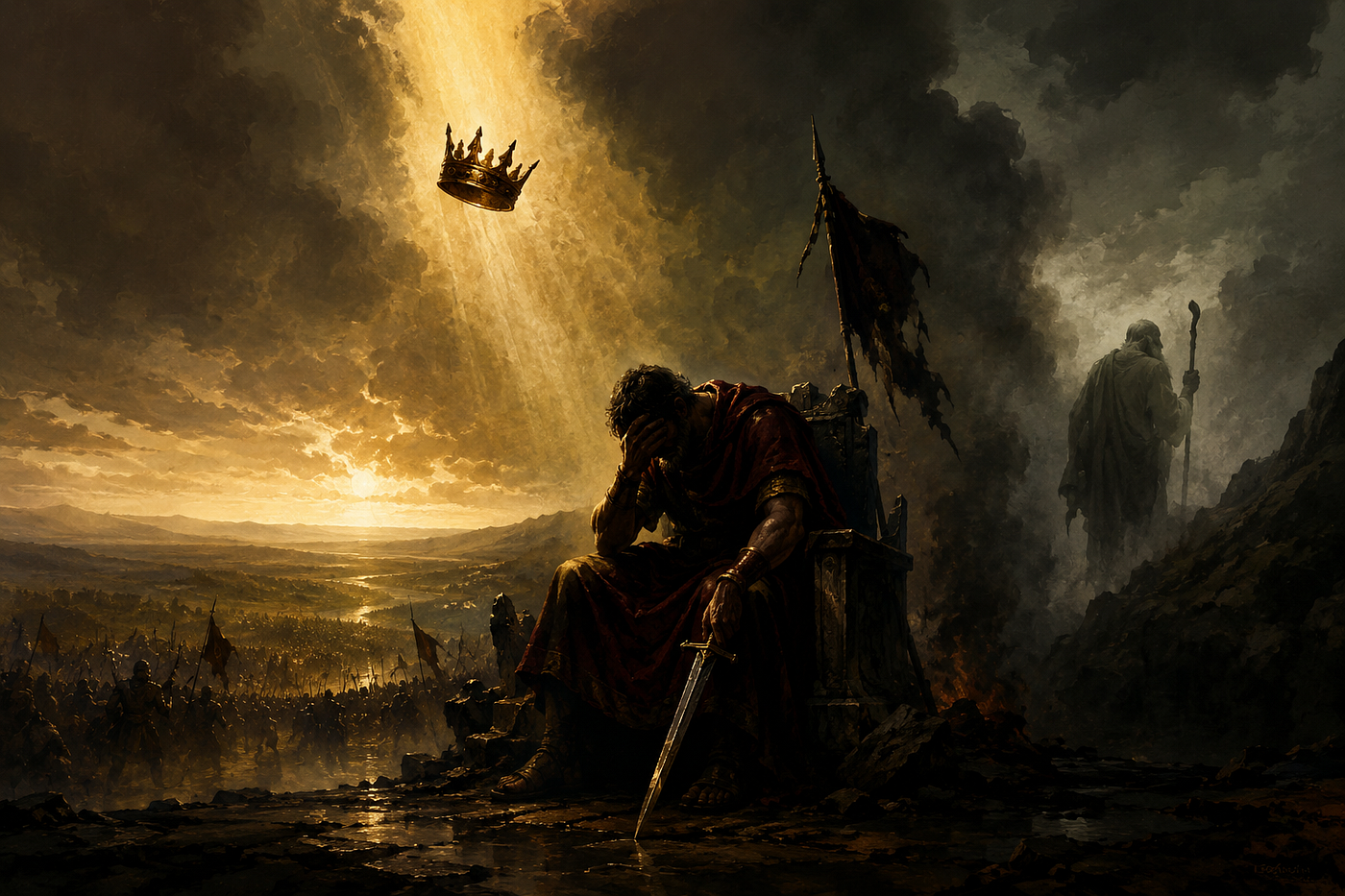
Context:
- The unlawful burnt offering (1 Samuel 13) Saul grew impatient waiting for Samuel to arrive to offer a sacrifice before battle against the Philistines. He offered the burnt offering himself, violating the law that restricted priestly duties to Levites. When Samuel arrived, he told Saul, “You have done a foolish thing… your kingdom will not endure” (1 Samuel 13:13–14).
- Incomplete destruction of the Amalekites (1 Samuel 15) God commanded Saul to “totally destroy” the Amalekites, killing everything. Instead, Saul spared King Agag and kept the best sheep and cattle under the pretense of sacrificing them to God. Samuel confronted him: “To obey is better than sacrifice… Because you have rejected the word of the LORD, he has rejected you as king” (1 Samuel 15:22–23). Samuel then killed Agag himself.
- Consulting the medium at En-dor (1 Samuel 28) After God stopped answering him through prophets or dreams, Saul disguised himself and visited a witch to summon Samuel’s spirit — directly violating his own decree against mediums and God’s law (Deuteronomy 18:10–12). Samuel’s spirit rebuked him, predicting his death the next day.
- The massacre at Nob (1 Samuel 22) Saul ordered the killing of 85 priests and their families at Nob for aiding David, showing how far his paranoia and rage had separated him from justice.
- The Gibeonite bloodguilt (2 Samuel 21:1–2) Years after Saul’s death, a famine revealed that Saul had broken Israel’s ancient treaty with the Gibeonites by trying to annihilate them. David had to make amends by executing seven of Saul’s descendants.
The night was thick with fog when the old woman opened her door. Outside stood a tall man wrapped in a commoner’s cloak, his face half-hidden, his hands trembling. He had not eaten in twenty-four hours. He had not slept in days. The Philistine army was assembling on the plain below, and somewhere in the dark, his own soldiers were deserting by the hour, melting into the hills like snow before rain.
He needed to speak with a dead man.
“Bring up Samuel,” he whispered.
The woman at En-dor recognized the voice before she recognized the face. When the spirit materialized in the smoke and the shadows, it spoke with the same terrible clarity that had once echoed across the high places of Israel: “Why have you disturbed me?”
The king fell to the dirt floor, his body suddenly too heavy for his legs. “God has turned away from me,” he said. “He no longer answers me — not by prophets, not by dreams. So I have called you to tell me what to do.”
But Samuel, or the memory of him, offered no comfort. By morning, the king would be dead on Mount Gilboa, his sons beside him, his army scattered, his crown passed to a shepherd boy from Bethlehem. The unraveling had taken years, but in the end, it had been swift.
Saul had never wanted to be extraordinary. That was the irony history rarely forgives.
When the prophet Samuel first anointed him with oil in a quiet corner of Benjamin, pouring the amber liquid over his head while the boy trembled, Saul was literally hiding among the baggage. He was a head taller than any other Israelite, yes, but he was also a farmer’s son, more comfortable with oxen than armies. When the people demanded a king to be like other nations, God warned them what monarchy would cost: sons taken for chariots, daughters taken for perfumers, fields taken for taxes. But the people shouted until the hills rang. So God gave them what they asked for, and in doing so, gave them a mirror.
For a time, Saul held the reflection steady. He led Israel to victory against the Ammonites. He established a standing army. He walked the fine line between tribal chieftain and national sovereign with the awkward grace of a man still learning the weight of his own shadow. But the machinery of power is unforgiving, and Saul was not a man built for patience.
The crisis came at Gilgal, where the Jordan Valley opens into the hill country like a wound. The Philistines had gathered at Michmash with chariots and thousands of foot soldiers. Saul’s own troops were terrified, some hiding in caves, some fleeing across the river. Samuel had instructed him to wait seven days for the sacrifice before battle — a ritual not of empty ceremony but of trust, a physical act of acknowledging that victory would not come from swords or strategy but from the covenant itself.
Saul waited six days. On the seventh, with the enemy camp visible in the valley and his own men slipping away into the dusk, he could bear the silence no longer. He ordered the burnt offering brought forward. He killed the animals himself. He lit the fire. The smoke had barely risen when Samuel appeared on the road from Bethlehem, his face dark with something beyond anger.
“You have done a foolish thing,” Samuel said. The words landed like stones. “You have not kept the command the Lord your God gave you. If you had, he would have established your kingdom over Israel for all time. But now your kingdom will not endure.”
Saul tried to explain — the men were scattering, the Philistines were approaching, he had to do something. But Samuel was already turning away. The kingdom, Saul must have realized in that moment, was not his. He was merely holding it in trust, and he had broken the vessel.
What the biblical chronicles record as isolated incidents were, in the lived experience of the court, a single continuous erosion. After Gilgal, something shifted in the capital at Gibeah. Saul remained king, but the divine mandate had begun to leak from his administration like water from a cracked cistern. He became a man watched by eyes he could not see, judged by a standard he could not quite grasp.
Two years later, the command came to finish what Moses had begun centuries earlier: the Amalekites, who had ambushed Israel in the wilderness, were to be utterly destroyed. Not conquered. Not plundered. Erased. It was a brutal order by modern standards, but in the ancient Near East, it was understood as a surgical removal of a cancer — a total war against a people who had made total war their theology.
Saul marched to the Negev with two hundred thousand men. He won the battle. And then, standing amid the smoke and the livestock, he made a decision that would define the rest of his life.
He spared the king, Agag, keeping him as a trophy. He spared the best sheep and cattle, telling his officers they would be sacrificed to God at Gilgal. When Samuel arrived, he found Saul erecting a monument to himself and heard the king’s cheerful lie: “The Lord bless you! I have carried out the Lord’s instructions.”
The silence that followed must have been unbearable.
“Does the Lord delight in burnt offerings and sacrifices as much as in obeying the Lord?” Samuel asked. “To obey is better than sacrifice, and to heed is better than the fat of rams. For rebellion is like the sin of divination, and arrogance like the evil of idolatry. Because you have rejected the word of the Lord, he has rejected you as king.”
Saul grabbed the edge of Samuel’s robe as he turned, and the fabric tore in his fist. “The Lord has torn the kingdom of Israel from you today,” Samuel said, looking at the ripped cloth. Then he did what Saul could not: he killed Agag before the Lord at Gilgal, hacking the Amalekite king to pieces on the altar Saul had built.
The years that followed were not recorded in detail, but their outline is clear from the shadows they cast. A young shepherd named David entered the court, playing music that soothed the king’s torment. David killed Goliath. David won the people’s love. And Saul, watching the crowds chant the boy’s name, felt the old terror of Gilgal return — not the fear of Philistines, but the fear of irrelevance, of being found out as the man who could not wait, could not obey, could not finish what he started.
Paranoia is the tax that unpaid conscience levies on the mind. Saul began to see conspiracies in every corner. When David fled, Saul learned that the priests at Nob had given him bread and a sword. Nob was a city of worship, a place of learning, home to eighty-five priests who served at the tabernacle. Saul summoned their chief, Ahimelech, and when the old priest explained that he had aided David in good faith, Saul did not hesitate.
“Will the hand of all of you be like the hand of David?” he screamed at his guards. “You are all conspiring against me.” When they refused to kill the priests, Saul turned to Doeg the Edomite, a foreigner who owed no loyalty to Israel’s covenant, and ordered the massacre. That day, eighty-five priests died. The city of Nob was put to the sword — men, women, children, infants, cattle, donkeys, sheep. The violence was total, the very thing Saul had failed to carry out against the Amalekites now turned inward against his own people.
It was the act of a man who had lost the map and was burning the territory.
By the time Saul arrived at En-dor, he had exhausted every other option. God had stopped speaking to him. Samuel was dead. David was in the wilderness, anointed but not crowned. The Philistines had gathered again at Shunem, and Saul’s army was a skeleton force camped on the slopes of Gilboa.
The witch’s house was a final confession disguised as a strategy session. When Samuel’s shade pronounced the sentence — “The Lord will deliver Israel with you into the hands of the Philistines, and tomorrow you and your sons will be with me” — Saul collapsed. He had spent years running from this moment, and now it had found him in a dark room, on a dirt floor, with a woman he had once condemned to death.
The battle the next day was brief. The Philistine archers found Saul. Wounded, he fell on his own sword rather than be captured. His sons died around him. The crown was taken to David.
Years later, after David had consolidated the kingdom, a famine came. It lasted three years, and when David inquired of the Lord, the answer came back with the weight of old, unpaid debts: Saul and his house were guilty of bloodshed against the Gibeonites, a people Israel had sworn to protect by treaty centuries before. Saul, in his zeal or his madness, had tried to exterminate them. The famine was the land itself refusing to forget.
David had to hand over seven of Saul’s descendants to be executed, a grim postscript to a reign that had begun with such reluctant promise. The bones of Saul and his sons were eventually gathered and buried, not in the royal tomb, but in the territory of Benjamin, among the trees where he had once hidden from his own calling.
Saul’s tragedy was not that he was wicked. It was that he was impatient. He could not wait seven days for a prophet. He could not wait for victory to be given rather than seized. He could not tolerate a rival’s youth, or a priest’s independence, or a silence from heaven that lasted longer than he could endure. Each compromise seemed small — a ritual hurried, a prisoner spared, a village destroyed in a fit of pique. But character is not demolished by catastrophe. It is hollowed out by the small withdrawals we make against our own integrity, until one day we reach for the self we once were, and find only the echo of a man who hid among the baggage, trembling, while the oil dried in his hair.
The kingdom, it turns out, was never his to keep. It was his to hold, faithfully, for just a little while longer than he could bear.
메타데이터
- post_id
- e99fe1fee6ff
- slug
- the-tragedy-of-saul-the-man-who-could-not-wait-e99fe1fee6ff
- url
- https://medium.com/@izaakmaine/the-tragedy-of-saul-the-man-who-could-not-wait-e99fe1fee6ff
- canonical_url
- https://medium.com/@izaakmaine/the-tragedy-of-saul-the-man-who-could-not-wait-e99fe1fee6ff
- author_url
- https://medium.com/@izaakmaine
- status
- ok
- fetched_at
- 2026-07-13 19:25:35