TwainGPT Review: Does It Really Work?
There’s a silent arms race occurring within every content workflow today. Writers use AI to write drafts. Platforms use AI detectors to…
TwainGPT Review: Does It Really Work?
There’s a silent arms race occurring within every content workflow today. Writers use AI to write drafts. Platforms use AI detectors to find and flag what was written by AI. A new breed of tool has surfaced to act as a middleman: the AI humanizer.
TwainGPT is one of the most talked-about tools in that category. It describes itself as a single-stop shop for all things AI writing, with three tools under one roof: an AI Humanizer, an AI Detector, and a Writing Generator. I got access, put it through the wringer, and here’s what I actually found.
What Is TwainGPT?
TwainGPT is an AI writing platform built around a simple idea: AI-generated text has a recognizable fingerprint, and that fingerprint can be rewritten out of it.
The platform bundles three tools:
- **AI Humanizer** — rewrites AI-generated text to read more naturally
- **AI Detector** — scans text and returns a probability score for AI vs. human authorship
- Writing Generator — produces written content from a prompt
The pitch is that you can draft, check, and refine all in one place, without switching between multiple apps. In practice, that framing holds up. The tools connect to each other logically and the interface is minimal enough that there’s no real learning curve.
Why Does AI Text Get Flagged in the First Place?
To understand what TwainGPT offers, you first need to understand the problem it’s solving.
Large language models produce text by predicting the statistically most likely next word in sequence. That produces clean, well-formatted output, but it’s also highly predictable. Researchers call this property “perplexity.” Low perplexity signals AI authorship. High perplexity signals the kind of variance that human writers naturally introduce.
Human writing also tends to be “bursty” — short punchy sentences followed by longer, more elaborate ones. AI defaults to uniform flow. That combination of low perplexity and low burstiness creates a detectable pattern.
An AI humanizer’s job is to disrupt that pattern without losing the meaning underneath it. It’s a harder engineering problem than most product pages let on, which is why I tested it rather than taking the marketing at face value.
Testing the AI Humanizer
Since this is the core product, I started here.
I pasted in a real paragraph — a short descriptive text about a podcast episode featuring a former BBC journalist interviewing an economics expert. The kind of content a marketer or content team might generate with AI and want to clean up before an editor sees it.
The humanizer returned a noticeably cleaner version. It smoothed awkward phrasing, varied the sentence rhythm, and resolved a grammatical stumble in the original. The meaning stayed intact throughout. For short to medium content, the transformation was genuinely useful: less flat, more natural, the kind of edit a competent human writer would have made.
The core use case is clear. If you’re using AI to generate a first draft and want it to feel less machine-written before your editor sees it, TwainGPT accelerates that step.
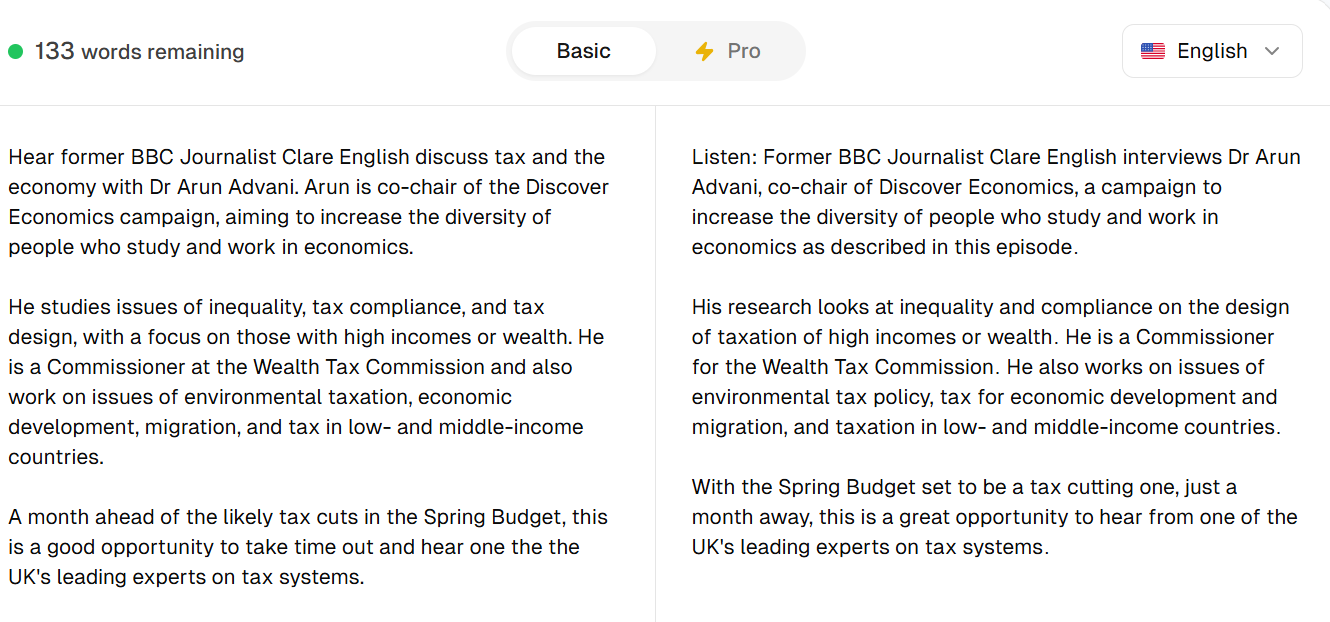
ZeroGPT is one of the most popular AI detection tools used by writers, publishers, and educators. In our testing, TwainGPT’s humanized content successfully bypassed ZeroGPT’s detection, suggesting a stronger ability to mimic natural human writing patterns.

Testing the AI Detector
After humanizing, I ran the output through TwainGPT’s built-in AI Detector to see how it scored.
First, a control: I fed in a generic, AI-written paragraph about economics — the flat, overly organized kind that language models produce with minimal prompting. The detector returned 100% probability of AI. Verdict: “very likely AI generated.” Correct.
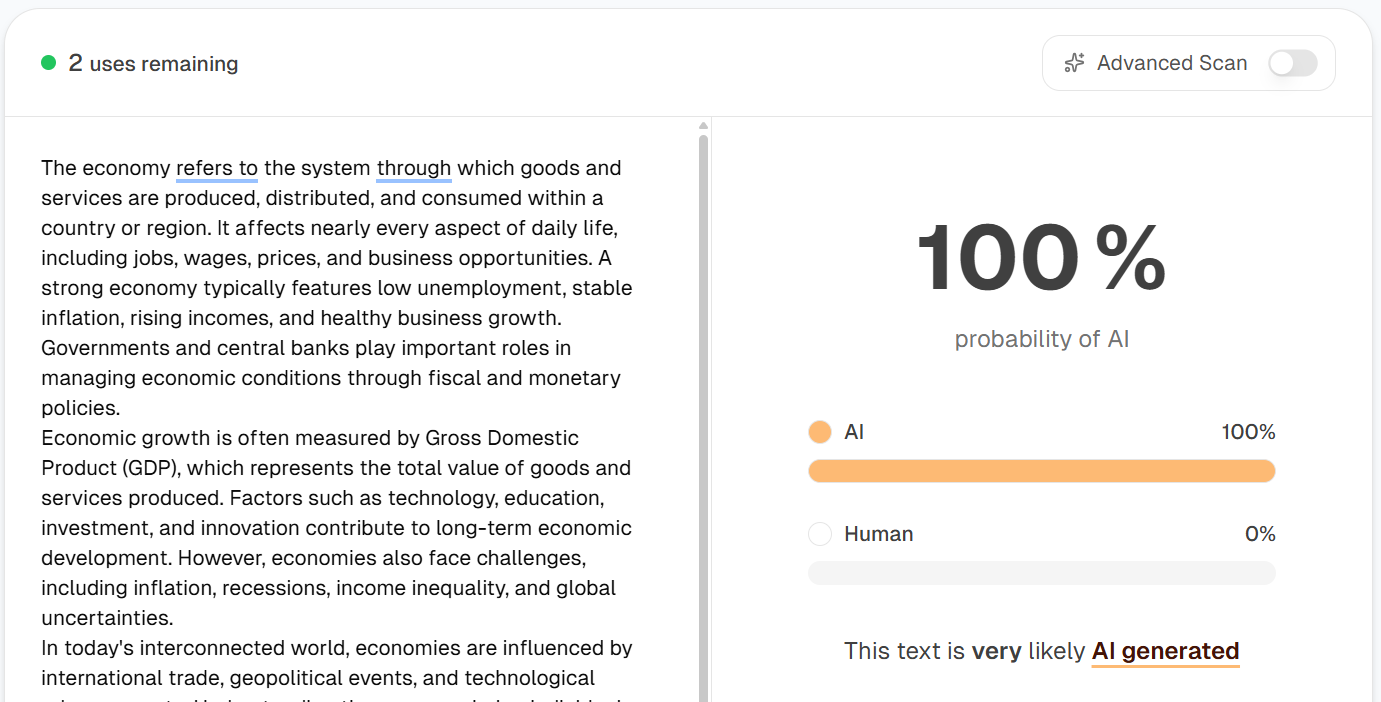
Then I ran the humanized output through the same detector. It returned 0% probability of AI, 100% human. Verdict: “very likely Human.”

That’s a clean before-and-after. Pre-humanization: 100% AI. Post-humanization: 0% AI, by TwainGPT’s own measure.
One thing worth naming clearly: this is the platform’s humanizer being graded by the platform’s own detector. TwainGPT clearing its own output is a useful internal data point, not a universal guarantee. Whether humanized text survives other detectors depends on content type, length, and complexity. But as a fast workflow check before you move to your next step, the detector gives you a clear read on where you stand.
Testing the Writing Generator
The third tool generates written content from a prompt.
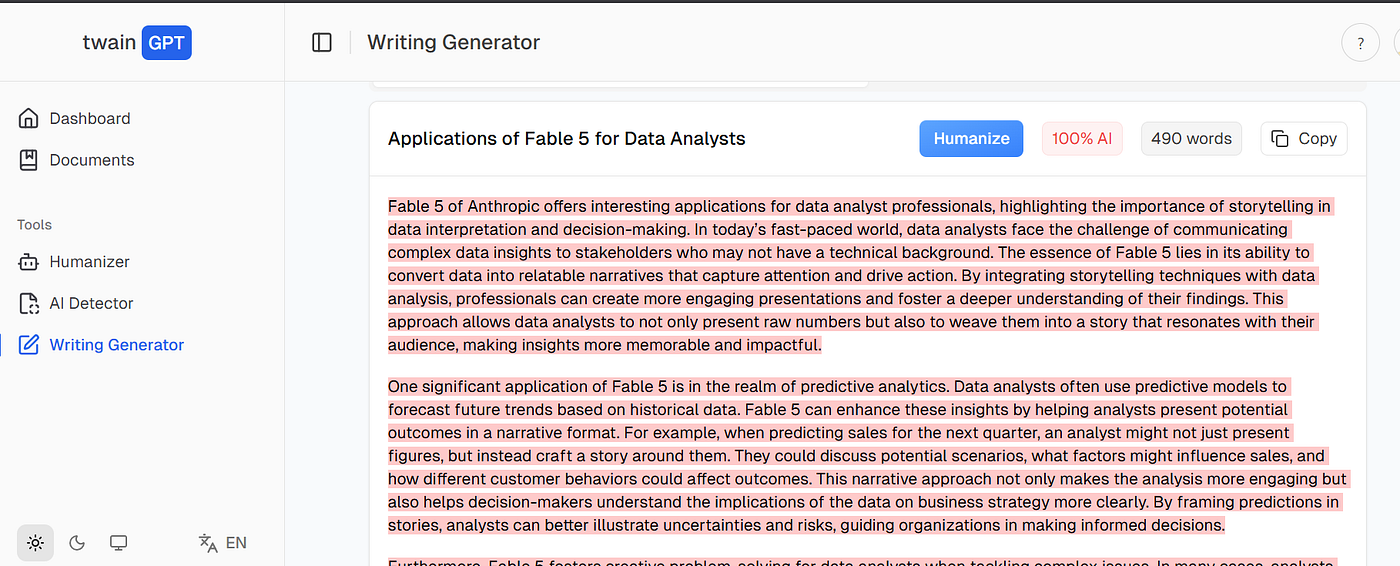
I gave it a prompt and received a 490-word piece — well-structured and readable. But the Writing Generator also revealed something worth knowing: TwainGPT’s own detector immediately flagged the generated output as 100% AI. The Humanize button sits right next to that score by design.
This isn’t a flaw. It’s the intended workflow. Generate content, see it flagged, humanize it, check again. The tools are built to hand off to each other in sequence.
What that also tells you is how to use the platform correctly: the Writing Generator is a drafting accelerant, not a finished content machine. Whatever it produces still needs a human to review, fact-check, and refine before it goes live. The platform is transparent about this — surfacing the AI score immediately on generated output is its way of keeping you in the loop.
Pricing
TwainGPT offers a free tier for exploring how the tools work, with paid plans scaling up humanizer word limits and detector and generator uses per month. The free tier is useful for getting a genuine feel for the platform. Consistent production use lands on a paid plan.
Current pricing is available on TwainGPT’s pricing page
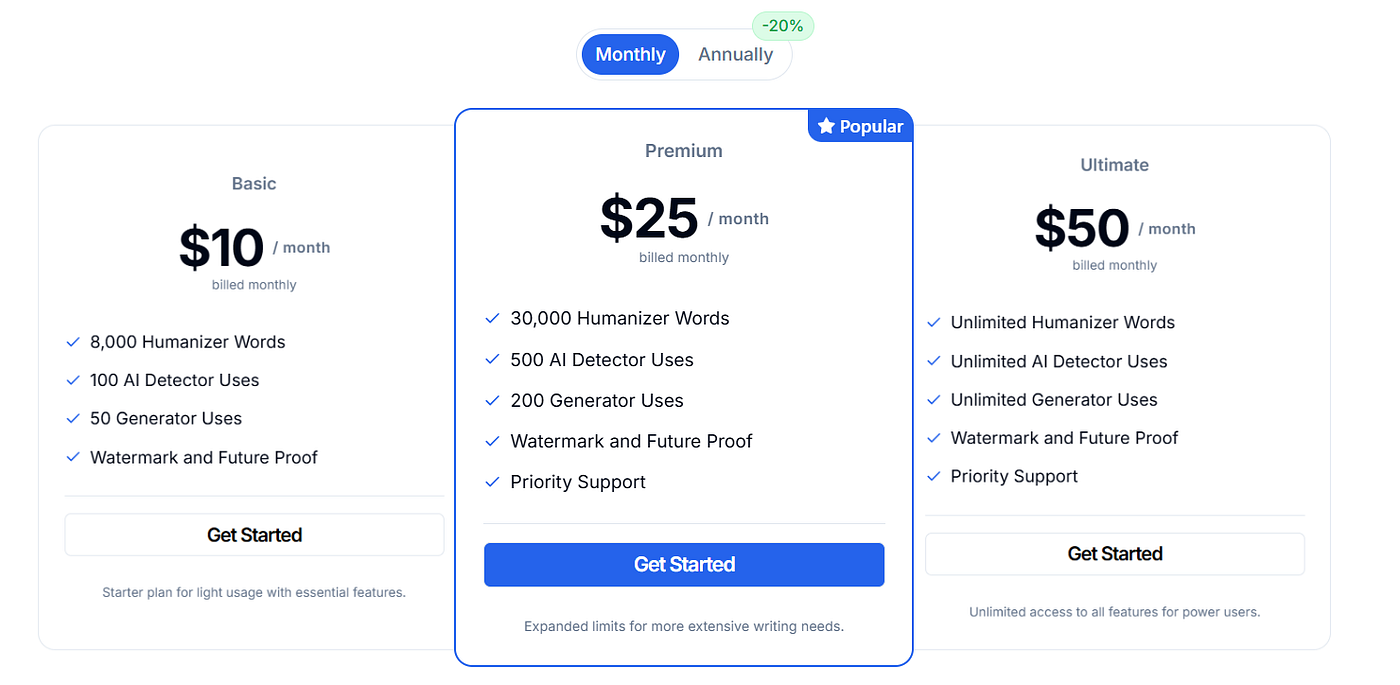
TwainGPT offers three subscription tiers designed for different levels of AI writing needs. The Basic Plan ($10/month, billed monthly) is ideal for casual users, providing 8,000 humanizer words, 100 AI detector checks, and 50 AI content generations each month. For more active writers and content creators, the Premium Plan ($25/month, billed monthly) expands usage significantly with 30,000 humanizer words, 500 detector checks, 200 generator uses, and priority support.
For power users, agencies, and professional publishers, the Ultimate Plan ($50/month, billed monthly) removes usage limits entirely, offering unlimited humanizer words, unlimited AI detector checks, unlimited content generation, and priority support. All plans include TwainGPT’s watermark-free content processing and future-proof humanization technology.
There is 20% discount, if you choose annually plan.
Overall, the pricing structure scales well from individual writers to heavy-volume content teams, with the Premium plan standing out as the best value for most users due to its balance of affordability and generous usage limits.
Who TwainGPT Is Best For
Based on what I tested, TwainGPT works best for:
Content marketers and bloggers who use AI to draft faster and want a readability pass before editing. The humanizer reliably improves tone and flow on short to medium content, cutting time on the most mechanical part of the rewrite.
Business writers producing emails, outreach copy, and internal communications with AI assistance. The shift from AI’s formal, symmetric structure toward natural business language is one of the humanizer’s most consistent outputs.
SEO writers working at scale who generate AI drafts and need a quality layer between raw output and final human editing. TwainGPT fits that gap well.
Multilingual content teams — TwainGPT supports over 100 languages, a genuine differentiator for teams producing content across multiple markets.
Students working on essays, assignments, and research papers who use AI to help structure or draft their writing and want the final piece to read in their own voice before submission.
The Bigger Picture
The AI humanizer category exists because of a specific gap: the speed of AI content generation has outpaced most writing workflows’ ability to make that content sound like a person actually wrote it.
AI writing is fast, organized, and grammatically clean. The problem is voice. It reads like no one in particular wrote it. As AI-generated content has scaled across the web, readers have developed an intuitive sense for its texture, and platforms have responded by prioritizing content that demonstrates real experience and expertise.
TwainGPT sits at that gap and offers a practical solution: a fast, clean pass that makes AI-drafted content read more naturally, in a workflow that keeps a human in the loop at every checkpoint.
Final Verdict
So does TwainGPT actually work? Based on my testing, yes — at what it’s specifically designed to do: taking AI-generated content and making it read like a human wrote it.
The clearest evidence is the before-and-after the AI Humanizer produced. A paragraph that scored 100% AI on the detector came out the other side at 0% AI, 100% human. That’s not a marginal improvement — it’s a complete reversal of the detection score. For anyone whose primary goal is humanizing AI-generated content so it reads naturally and passes detection, that result is the whole point.
The AI Detector is a fast, clear tool for checking where you stand before and after humanizing. The Writing Generator works as a drafting accelerant, not a finished content machine — it needs human review before anything goes live, and TwainGPT is upfront about that by surfacing the AI score immediately on generated output.
The honest framing: TwainGPT does what it says. If you’re using AI to draft content and you need that content to sound human, the Humanizer delivers on that promise in a way that’s fast, clean, and requires no technical knowledge to use.
메타데이터
- post_id
- e9a1a13b1f23
- slug
- twaingpt-review-does-it-really-work-e9a1a13b1f23
- url
- https://medium.com/ai-analytics-diaries/twaingpt-review-does-it-really-work-e9a1a13b1f23
- canonical_url
- https://medium.com/ai-analytics-diaries/twaingpt-review-does-it-really-work-e9a1a13b1f23
- author_url
- https://medium.com/@analystuttam
- status
- ok
- fetched_at
- 2026-06-21 12:17:11






