I Wrote 200+ Suno AI Prompts in 2026 : These 5 Elements Appear in Every One That Works
Most Suno prompts read like grocery lists. Genre, Mood, Tempo.
I Wrote 200+ Suno AI Prompts in 2026 : These 5 Elements Appear in Every One That Works
Most Suno prompts read like grocery lists. Genre, Mood, Tempo.
The output is technically correct. And completely forgettable.
After generating over 200 tracks across six niches : baby sleep, ambient, phonk, lo-fi, focus frequencies, and shop background music. I started auditing what separated the prompts that produced usable, distribution-ready tracks from the ones I deleted immediately.
Five elements kept appearing. Every time.
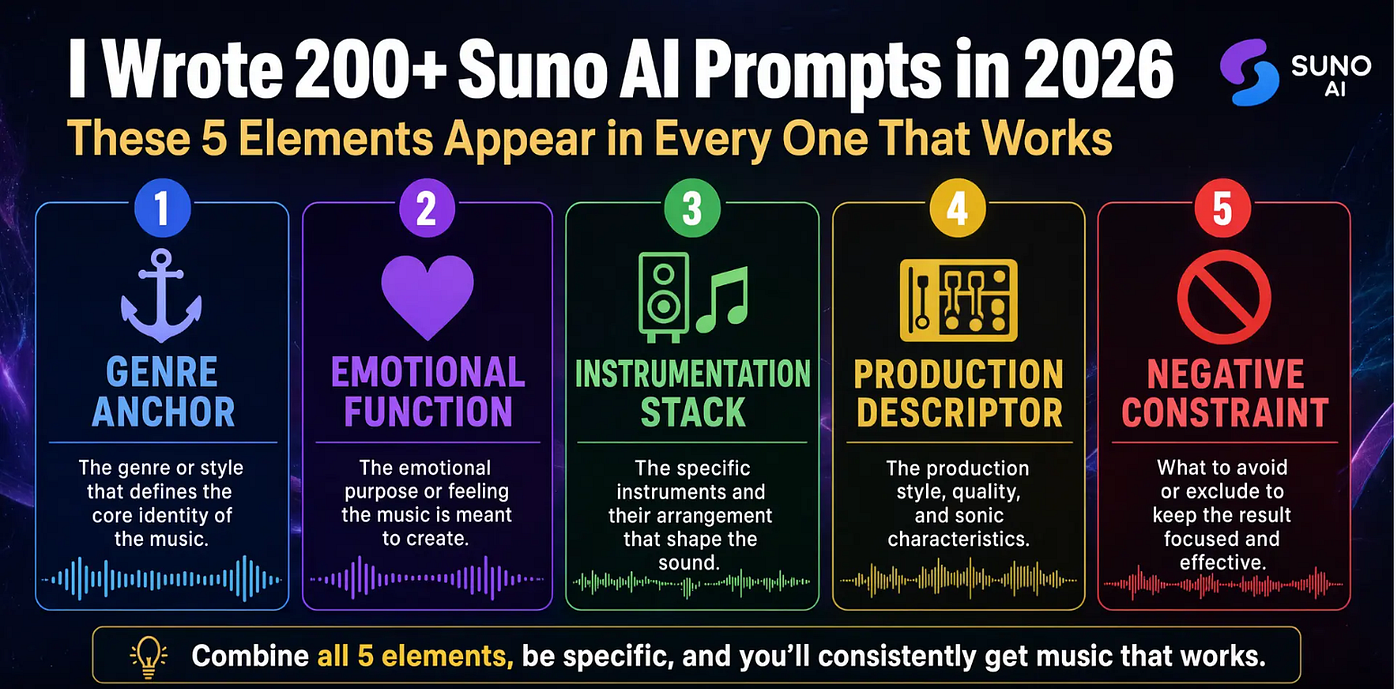
Effective Suno AI prompts in 2026 aren’t about more words, they’re about the right structure. The 5 elements that consistently improve output: (1) Genre anchor (2) Emotional function (3) Instrumentation stack (4) Production descriptor (5) Negative constraint. Remove any one of them and the track drifts. Keep all five and Suno has a real brief to work from.
Why Most Suno Prompts Fail
Suno AI is not a search engine. It doesn’t retrieve music, it generates it from a set of probabilistic signals.
When your prompt is vague, Suno fills the gaps with its own defaults. Those defaults are trained on the average of its training data, which means you get the most common interpretation of “lo-fi chill beat”, not your specific creative intent.
The prompt is not decoration. It’s the brief. And like any creative brief, the quality of the output depends entirely on the specificity of the input.
Here’s a failing prompt I actually used in month one:
“relaxing ambient music, calm, slow, peaceful”Suno AI generated something. It was technically ambient. It was also indistinguishable from ten thousand other ambient tracks already on Spotify.
Here’s what the same intent looks like after I developed the 5-element framework:
“deep space ambient, sparse piano and soft synthesizer pads, slow evolving texture, no drums, minimal movement, designed for focus and deep work, avoid bright tones or sudden changes”
Same niche. Completely different output signal.
Element 1: Genre Anchor
The genre anchor is not just a label. It’s a coordinate.
Suno’s training data is organized around genre conventions tempo ranges, instrumentation norms, production aesthetics, structural patterns. When you specify a genre anchor, you’re activating a cluster of learned associations.
The mistake most people make: they use a single, broad genre word.
- ambient → too wide. Suno AI doesn't know if you want Brian Eno-style drone, new age piano, nature soundscape, or dark industrial texture.
Effective genre anchors use a primary + modifier structure:
- Dark ambient : narrower, activates a specific aesthetic cluster
- Lo-fi jazz, hip-hop : cross-genre anchor, activates a very specific production convention
- Neoclassical ambient piano : genre + instrument origin story in one phrase
- Deep phonk : activates the 808 sub-bass, dark sample aesthetic, Memphis rap DNA
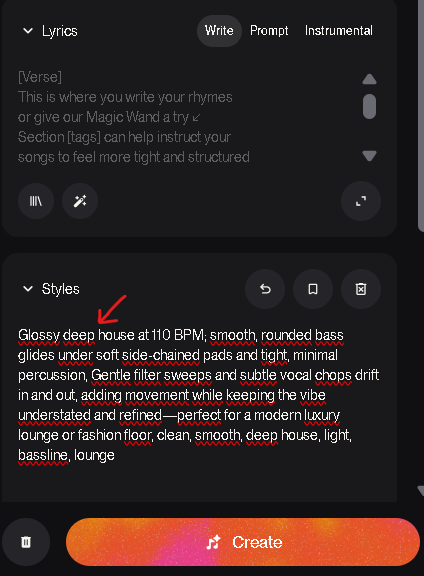
I always start by the genre of the song which is the core
The more specific the coordinate, the less Suno has to guess.
Test this yourself: Run the same prompt with ambient and then with “cinematic dark ambient” . The gap in output specificity is immediate.
Element 2: Emotional Function
What is this track for?
This is the question most prompt writers skip. They describe what the music sounds like, not what it needs to do.
Emotional function is the listener’s purpose. It tells Suno what outcome the music should achieve:
- Designed to help babies fall asleep
- For deep work sessions requiring sustained concentration
- Background energy for late-night highway driving
- Creates calm anticipation before a meditation session
Why does this matter technically? Because Suno AI interprets function-based language as a constraint on dynamics, variation, and tension. A track “designed to help babies fall asleep” will suppress sudden tonal shifts, keep velocity low, and avoid percussive attacks. You’re not just describing a mood, you’re defining a behavioral parameter.
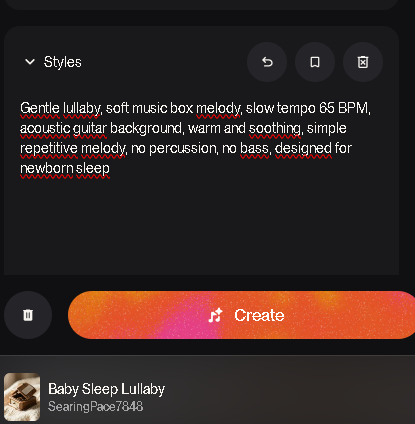
This is the element most responsible for the difference between a track that sounds nice in preview and a track that actually works at 2am when a baby needs to sleep.
Element 3: Instrumentation Stack
Name the instruments. Don’t leave it to chance.
Suno can generate hundreds of instrument combinations. Without guidance, it defaults to the statistical average for your genre, which is usually a safe, generic interpretation.
An instrumentation stack is a short list of 2–4 specific instruments that define the sonic palette:
- Solo acoustic guitar, distant soft percussion, faint string pads
- Rhodes piano, upright bass, brushed snare
- Synthesizer arpeggios, sub bass, filtered hi-hats
- Bamboo flute, slow cello, sparse wind chimes
Two rules for instrumentation stacks:
Rule 1: Lead instrument first.
The first instrument named tends to dominate the mix. Put the one you most need to hear at the front.
Rule 2: Use real instrument names, not vibe words.
“dreamy strings” is a vibe word. “slow vibrato cello and distant violin pads” is an instrument specification. Suno responds better to the second.
Element 4: Production Descriptor
This is where the track stops sounding generated and starts sounding intentional.
Production descriptors communicate the mix aesthetic, how the track should feel from an engineering perspective, not just a compositional one:
- Warm analog mix, slight tape saturation
- Crisp stereo field, wide reverb on the synth pads
- Lo-fi vinyl texture, low-passed drums, dusty room acoustic
- Clean studio recording, no effects, minimal reverb
- Cinematic spatial mix, distant sound placement
Most users never include production descriptors. This is the element that separates tracks that sound like they came from a premium library from tracks that sound like a demo.
You don’t need audio engineering expertise to use this. You need five or six production phrases you rotate across your niche. Learn them once. Use them consistently.
For baby sleep tracks, I use: “warm low-frequency mix, soft room reverb, no sharp transients, gentle stereo width” in almost every prompt. It took me about 15 iterations to land on it. Now I don't touch it.
Element 5: Negative Constraint
Tell Suno AI what NOT to do.
This is the most underused element in Suno AI prompting, and the one with the highest impact-to-effort ratio.
Suno, like most generative models, will introduce variation, tension, and dynamic change by default. For functional music niches, that’s a problem. A baby sleep track that suddenly introduces a drum fill at the 2-minute mark has failed its one job.
Negative constraints are explicit exclusions:
- No drums, No sudden volume changes
- Avoid major key brightness, stay in minor or modal tonality
- No vocal chops or spoken word
- Avoid distortion or aggressive tones
- No key changes
You can stack them: “no drums, no sudden changes, avoid bright or upbeat tones, no vocals” , that's four exclusions in one phrase and it dramatically narrows the output range toward what you actually need.
For ambient and sleep niches, I treat negative constraints as non-negotiable. They’re the quality gate.
The Full Framework: Before and After
Here’s the same creative intent a lo-fi study track written without the framework and with it.
Without the framework:
“lo-fi hip hop beat, chill, study music, relaxing”
With the 5-element framework:
“lo-fi jazz hip-hop [genre anchor], designed for focused study sessions with low cognitive load [emotional function], Rhodes piano, muted upright bass, brushed snare [instrumentation stack], warm vinyl texture, slight tape saturation, dusty room acoustic [production descriptor], no sharp percussion, no vocals, avoid high-energy drops or tempo changes [negative constraint]”
The second prompt is not longer for the sake of length. Every element does specific work. Suno has a real brief.
Run them both. The difference is not subtle.
How to Build Your Own Prompt Library
Once you’ve tested a prompt structure that works for your niche, it becomes a template. You swap the genre anchor and instrumentation stack while keeping your proven emotional function, production descriptor, and negative constraints.
This is how a 20-track catalog becomes manageable. You’re not reinventing the prompt every session, you’re iterating on a proven structure.
I maintain a Notion database of tested prompts organized by niche, with pass/fail tags and notes on what worked. It’s the same logic as an audit workpaper document what you tested, what it produced, and what you’d change.
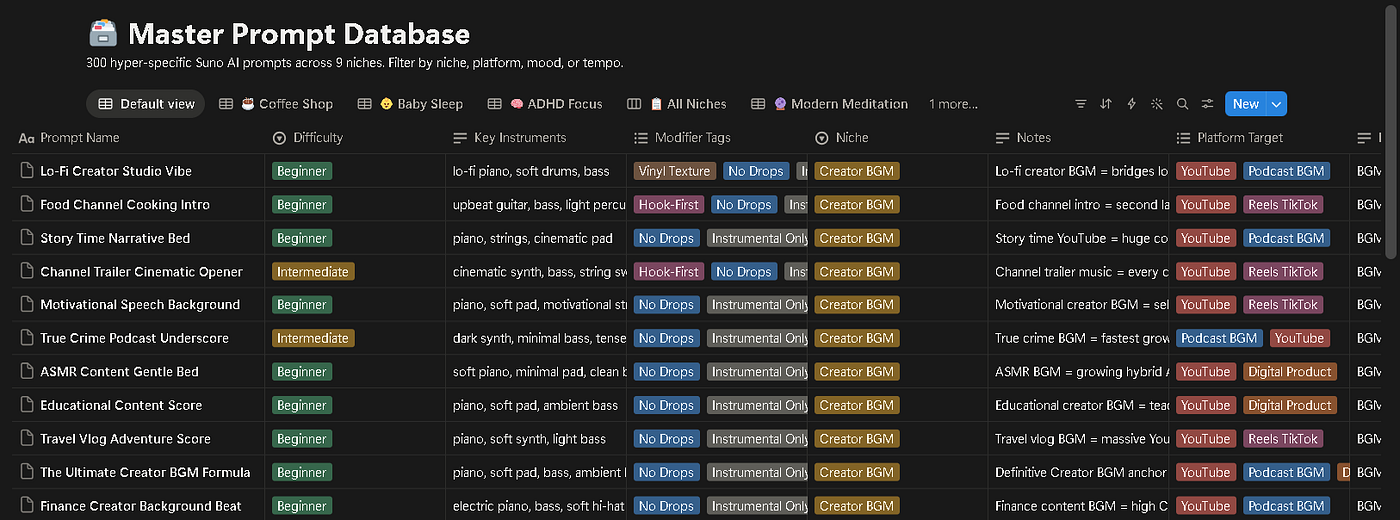
Sample from the Ambient & Passive Income Music Prompt Pack
Useful Resource
**The Ambient & Passive Income Music Prompt Pack** provides 300 engineered, 6-variable Suno AI prompts across 9 niches, designed for producing high-quality, stream-ready audio tailored for platforms like Spotify and YouTube. This system enables creators to generate professional-grade, passive-income tracks, spanning lo-fi to 432Hz meditation using a structured, mix-and-match approach. Explore the Ambient & Passive Income Music Prompt Pack to start generating professional, stream-ready AI music.
What Changes in 2026
Suno AI has updated its model multiple times. Two things I’ve noticed with the current version:
Production descriptors carry more weight now : Earlier versions were less responsive to mix-level language. The current model responds noticeably to analog warmth cues, reverb descriptors, and spatial placement language.
Negative constraints have become more reliable : “No drums” used to be more of a suggestion. In 2026, it’s closer to a rule, Suno AI respects explicit exclusions with much higher consistency than it did in 2024.
Prompt engineering for AI music is not static. The framework stays the same. The weight of each element shifts as the model updates.
This connects to an earlier article: **I Analyzed 50 Viral Suno AI Tracks — These 7 Prompt Patterns Appear in All of Them , **read that one first if you haven’t.
Next up: I will keep breaking Suno AI and the AI music industry piece by piece to take leverage from it before, i start exploring new topics that are unspoken by fake gurus.
메타데이터
- post_id
- e9ab5c68eb84
- slug
- i-wrote-200-suno-ai-prompts-in-2026-these-5-elements-appear-in-every-one-that-works-e9ab5c68eb84
- url
- https://medium.com/@alex-hustler/i-wrote-200-suno-ai-prompts-in-2026-these-5-elements-appear-in-every-one-that-works-e9ab5c68eb84
- canonical_url
- https://medium.com/@alex-hustler/i-wrote-200-suno-ai-prompts-in-2026-these-5-elements-appear-in-every-one-that-works-e9ab5c68eb84
- author_url
- https://medium.com/@alex-hustler
- status
- ok
- fetched_at
- 2026-06-12 07:40:50