Between Transitional Models and Sovereign Frameworks: A Critical Discourse Analysis of Dr.
Scientific Advisor & Researcher: Hassan Hussein Al-Wali
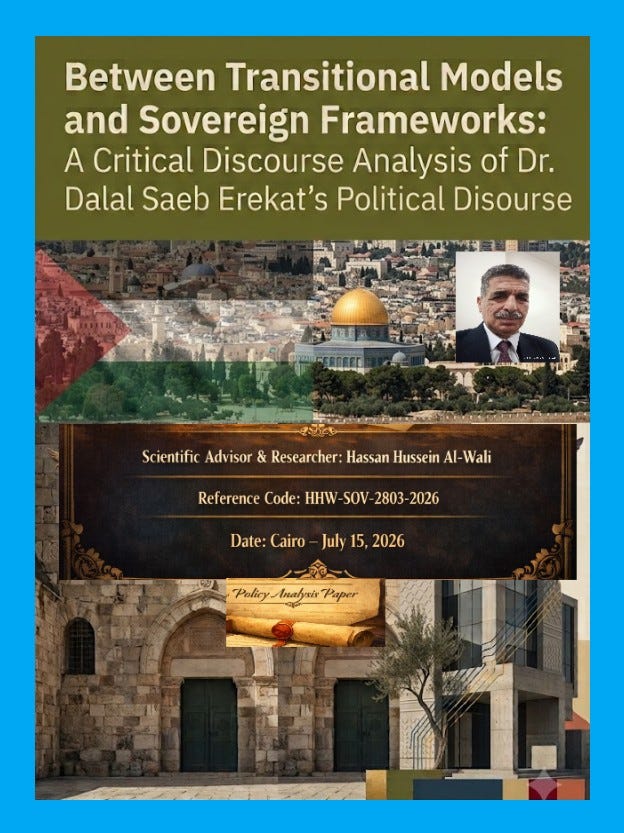
Between Transitional Models and Sovereign Frameworks: A Critical Discourse Analysis of Dr. Dalal Saeb Erekat’s Political DiscourseDocument Type: Policy Analysis Paper
Scientific Advisor & Researcher: Hassan Hussein Al-Wali
Reference Code: HHW-SOV-2803–2026
Date: Cairo — July 13, 2026
Abstract
This policy analysis examines Dr. Dalal Saeb Erekat’s recent political discourse through the lens of two competing but not necessarily contradictory paradigms: the Diplomatic-Legalist approach and the Functional Sovereignty framework. While the former emphasizes international law, human rights, accountability, and the revival of the political process as pathways toward resolving the Palestinian question, the latter focuses on institutional capacity-building, sovereign functionality, and the transformation of transitional governance structures into state-oriented institutions.
Using critical discourse analysis, this paper moves beyond media-centered interpretations of the interview’s message to Israeli society and examines deeper structural questions related to political legitimacy, democratic renewal, public sphere accessibility, and national sovereignty.
The paper argues that the central Palestinian challenge after the Gaza war extends beyond restoring political negotiations or renewing electoral mechanisms, but extends to rebuilding institutional capacity capable of performing state functions under conditions of occupation. Accordingly, democratic renewal and political legitimacy require a prior foundation of institutional stability, functional effectiveness, and sovereign capacity.
The paper proposes that overcoming the limitations of the transitional framework requires a shift from conflict management toward sovereign capacity building through the functional engineering of national institutions.
Keywords
Palestinian Politics; Political Legitimacy; Democratic Renewal; State-Building; Functional Sovereignty; Institutional Engineering; Transitional Governance; Oslo Framework; Two-State Solution; State Under Occupation.
Introduction
This reading comes in the context of the debate sparked by Dr. Dalal Erekat’s recent interview with Sabra magazine. While numerous media commentaries narrowly focused on the dimension of addressing the Israeli public, this paper seeks to transcend such partial readings to analyze the structural, intellectual, and political foundations of the discourse.
The researcher has deliberately refrained from engaging in the accompanying media polemics, guided by the epistemological principle of verification (“Tabayyanu”), aiming instead to contextualize these statements within their broader intellectual and political framework. While a wide wave of analysis focused on the Israeli dimension and the nature of the message directed at Israeli society, this paper aims to highlight other structural aspects of the discourse regarding legitimacy, political renewal, and national sovereignty.
This critique also stems from an intellectual position that intersects with shared scientific and professional trajectories. The late Dr. Saeb Erekat, through his early work on Political Science in the 1980s, constituted one of the early sources of the researcher’s methodological and scientific framing in politics. Furthermore, both parties intersect today in the research and academic sphere through a shared interest in questions of sovereignty and institutional transition management, alongside an operational intersection in managing industrial zones and engaging with modern investment and development models.
Accordingly, this paper does not approach Dr. Dalal Erekat as a political persona, but rather addresses the discourse’s ideas, analytical tools, and socio-political implications.
Methodological Introduction: Between Two Paradigms in Political Thought
This paper does not operate from a logic of personal preference or questioning intentions, but rather from a comparative analysis between two distinct paradigms in approaching the Palestinian cause.
Dr. Dalal Erekat’s discourse represents, in this reading, the Diplomatic-Legalist School, which posits international law, human rights, and the resuscitation of the political track as the primary gateway to resolving the conflict. Conversely, this paper adopts a different paradigm anchored in the concepts of Functional Sovereignty, the institutional re-engineering of national bodies, and the transition from managing a transitional phase to the logic of a State Under Occupation. Hence, the objective is not to negate either model, but to test the explanatory adequacy of each in interpreting the current Palestinian reality and responding to the structural transformations imposed by the war on Gaza.
The structural dilemmas presented can be deconstructed across three primary axes:
First: The Opportunity Environment and Mobility in the Public Sphere
The interview does not directly address the impact of structural disparities on mobility opportunities within the public sphere. Dr. Erekat urged the youth to actively engage in political work and refuse to leave the public sphere closed. From a political sociology perspective, this call faces a structural challenge related to the “distribution of opportunities.”
The paradigm from which the discourse originates relies on a cumulative symbolic, cultural, and social capital. This capital was nurtured within a highly stimulating environment provided by a prominent national figure and leader, the late Dr. Saeb Erekat, through his foundational scientific codification of political science, alongside academic opportunities in Jordanian and European universities.
In contrast, the vast majority of young cadres suffer from a total absence of these enabling channels amidst a deadlocked democratic horizon. This implies that the dilemma of youth alienation is not linked to subjective will as much as it is tied to a closed, elitist structure that requires radical reforms to allow upward mobility based on meritocracy and self-made competence.
This observation does not diminish individual merit or academic achievement; rather, it highlights unequal structural conditions surrounding political mobility.
Second: Impediments to Democratic Renewal in Applied Reality
Dr. Dalal Erekat’s discourse proposes a return to public opinion and elections as the primary gateway for renewing political and institutional legitimacy. However, this proposition necessitates a strict differentiation between three interrelated but non-identical concepts: Legitimacy, Democracy, and Institutional Stability.
Legitimacy is the societal acceptance of the political system and its institutions, whereas democracy represents one of the mechanisms for generating and renewing this legitimacy. Institutional stability, on the other hand, is the prerequisite environment that allows democracy to function effectively. Consequently, the relationship between these concepts is not necessarily synchronous, but rather one of functional sequence.
In stable environments, elections lead to the renewal of legitimacy and the consolidation of stability. However, in environments emerging from wars and institutional collapse, elections can transform into a tool that reproduces division or entrenches existing power balances, unless preceded by a process to rebuild institutions, restore minimum security and services, and unify the political reference.
This challenge manifests at two complementary levels:
-
The Organizational Context: The question arises as to the capacity of factional congresses, such as the Eighth Congress of the Fatah movement, to produce genuine democratic renewal that reflects the will of the organizational grassroots, given the continuous influence of internal balances and power centers on organizational outcomes.
-
The Field Context: Empirical indicators, including the low voter turnout in the Deir al-Balah municipal elections, reveal that citizens in an environment of total destruction reorder their priorities toward personal safety, basic services, and survival mechanisms, rather than political competition. This does not reflect a rejection of democracy, but rather demonstrates that the functional priorities of the state precede the mechanisms of power rotation.
From this perspective, democratic renewal does not constitute the starting point in collapsed environments; rather, it is the fruit of rebuilding state institutions and restoring a minimum threshold of functional and sovereign stability. Therefore, the re-engineering of national institutions and the redefinition of their legal and sovereign reference become, according to this paradigm, a prerequisite for elections, rather than a consequence of them.
Third: The Discourse Directed at the “Other” and National Sovereignty
In the message directed at Israeli society, and despite Dr. Erekat’s explicit reaffirmation in other parts of the interview of her commitment to the two-state solution, the presence of sovereign determinants receded in favor of a humanitarian discourse predicated on the relationship between two societies rather than two sovereign political entities.
From a sovereign engineering perspective, this discursive shift weakens the articulation of the legal binary that forms the bedrock of the Palestinian position: the existence of the State of Palestine under occupation vis-à-vis the Occupying Power, rather than merely two societies seeking coexistence.
Consequently, such a discursive structure may overlap with certain interpretive frameworks associated with the “One-State” discourse.
This approach faces two primary obstacles:
-
Its collision with an Israeli right-wing ideological structure that actively adopts strategies of annexation, settlement expansion, erasure, and forced displacement in both Gaza and the West Bank.
-
Its potential weakening of the legal status of the negotiation framework based on the 1967 borders and international recognition of the independent state.
The Alternative Paradigm via Functional Engineering
Based on the aforementioned indicators, this paper concludes that transitioning toward sovereign stability requires moving past the logic of political waiting. The structural alternative relies on institutionalizing sovereignty as a functional reality through Functional Engineering (FEDA) of existing Palestinian institutions.
This requires decoupling their administrative and economic structures from the transitional arrangements (the Oslo Accords and the Paris Economic Protocol) and directly transforming them into functional state organs. These organs must derive their constitutional legitimacy from the 1988 Declaration of Independence and recent international resolutions, such as UN Resolution 2803, operating under the status of a State Under Occupation possessing a full, irreversible sovereign mandate.
Policy Implications
Based on the preceding analysis, several policy implications emerge regarding the future trajectory of Palestinian governance, institutional reform, and sovereign capacity building:
1. Transitioning from Transitional Governance to Functional State Capacity
The current institutional framework requires a strategic reassessment beyond the limitations of transitional arrangements. Palestinian institutions should evolve from primarily administrative structures into capable state-oriented institutions that can perform essential governance functions, protect societal interests, and manage public resources under conditions of occupation.
2. Sequencing Democratic Renewal through Institutional Stabilization
Democratic renewal should not be approached solely as an electoral process, but as part of a broader institutional transformation. Sustainable elections require prior conditions of institutional functionality, public trust, unified governance structures, and the capacity of institutions to implement political outcomes.
3. Expanding Equitable Access to Political Participation
Political reform requires addressing structural inequalities in access to public and organizational advancement. Mechanisms should be developed to ensure that youth and emerging leadership are able to participate through transparent, merit-based pathways rather than relying primarily on inherited symbolic, social, or institutional capital.
4. Preserving Sovereign Clarity in Political Communication
While universal human rights language remains essential in international engagement, Palestinian political communication should maintain a clear distinction between humanitarian discourse and sovereign representation. The articulation of Palestinian national rights requires continuous emphasis on statehood, legal status, and the distinction between an occupied state and the occupying power.
5. Integrating Diplomatic Engagement with Institutional Capacity Building
International diplomacy and legal advocacy remain important instruments for advancing Palestinian objectives; however, their effectiveness depends on the existence of capable national institutions able to translate political recognition into practical governance capacity. Therefore, diplomatic efforts should be complemented by a sustained program of institutional reconstruction and sovereign capacity development.
6. Redefining the Post-Oslo Policy Framework
The post-war environment requires a reassessment of the assumptions underlying the transitional framework. Rather than remaining dependent on crisis management mechanisms, Palestinian policy planning should focus on building resilient institutions capable of functioning within a long-term national strategy based on legal continuity, institutional effectiveness, and sovereign development.
Conclusion: From Conflict Management to Sovereign Capacity Building
This reading demonstrates that the fundamental divergence lies not in a difference of intentions or national goals, but in a conflict of methodological starting points. The Diplomatic-Legalist approach originates from an attempt to restore the political track via international law, accountability, and external pressure. Meanwhile, the Functional Sovereign paradigm stems from a different question: How can a national institutional capacity be constructed capable of exercising state functions amidst ongoing occupation and the collapse of the transitional framework?
In this context, the contemporary Palestinian challenge is not confined to restoring political legitimacy or revitalizing the democratic process; it extends to redefining the function of national institutions, the nature of their reference, and their role in societal protection, resource management, and decision-making.
Accordingly, transcending the current phase demands a transition from the logic of crisis management to the logic of capacity building, and from waiting for a political solution to constructing the institutional conditions that render any future political settlement viable. Sovereignty in transitional environments does not begin with a political declaration alone, but through a cumulative institutional capacity that renders the state a functional reality before it becomes a fully recognized entity.
메타데이터
- post_id
- e9b618cd3967
- slug
- between-transitional-models-and-sovereign-frameworks-a-critical-discourse-analysis-of-dr-e9b618cd3967
- url
- https://medium.com/@hassan-hussein-walli/between-transitional-models-and-sovereign-frameworks-a-critical-discourse-analysis-of-dr-e9b618cd3967
- canonical_url
- https://medium.com/@hassan-hussein-walli/between-transitional-models-and-sovereign-frameworks-a-critical-discourse-analysis-of-dr-e9b618cd3967
- author_url
- https://medium.com/@hassan-hussein-walli
- status
- ok
- fetched_at
- 2026-07-27 03:52:35