Reactivating Over 1,000 Active Patients With a 5-Day Funnel: A GoHighLevel Build
What a solo dental practice’s silent patient list revealed about funnel design, copy psychology, and automation sequencing.
Reactivating Over 1,000 Active Patients With a 5-Day Funnel: A GoHighLevel Build
What a solo dental practice’s silent patient list revealed about funnel design, copy psychology, and automation sequencing.
One thousand patients. Not lost patients, active patients on file, people who had been to the practice, who had a relationship with the dentist, who were simply never contacted again after their last visit. Every month of silence was a month of recoverable recurring revenue that the practice was not recovering, because reactivation was never anyone’s job.
That is the problem this project was built to solve.
The goal: a landing page and a five-day SMS/email sequence that turns a dormant patient into a booked appointment, with a pipeline behind it so the front desk can track who is actually moving through the process.
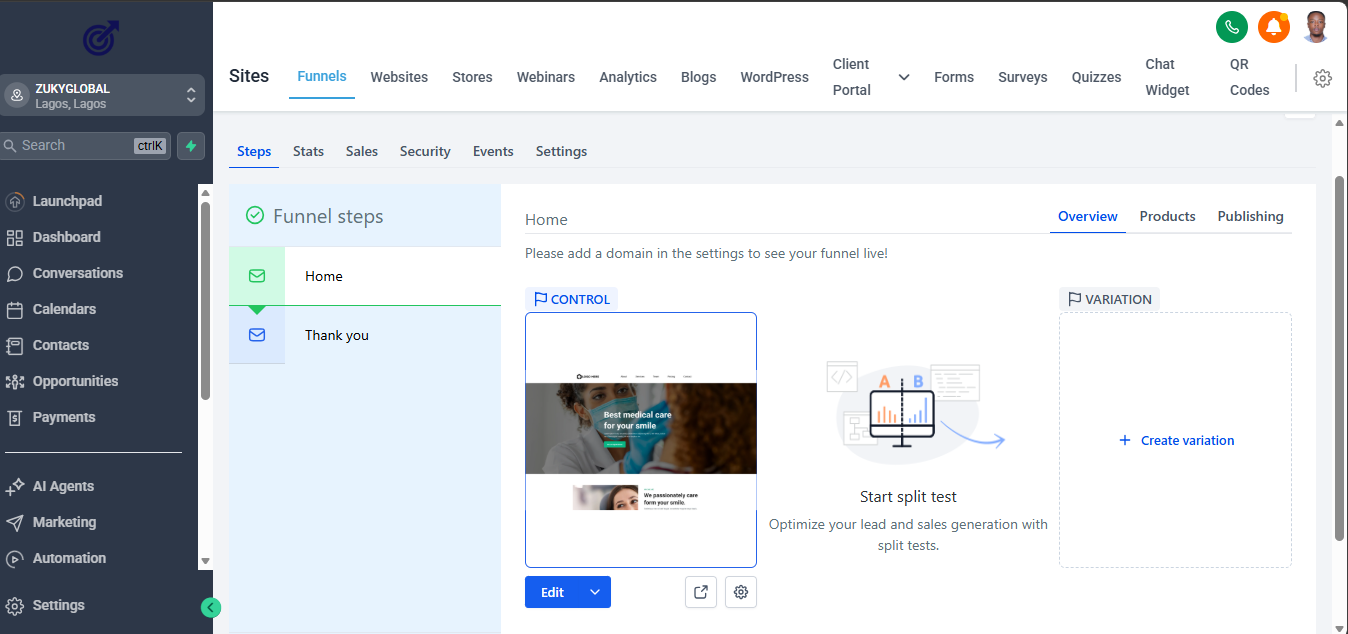
Builders View
The Copy Problem That Matters More Than the Automation
Before touching a single GoHighLevel workflow, the most important decision in this project was a copywriting one.
Patients who have not visited a practice in over twelve months carry a specific psychological weight, the mild guilt about the gap. The instinct of most marketing copy would be to ignore this entirely and lead with urgency, “Book Now,” “Limited Slots Available,” “Don’t Wait.” That framing works poorly for a lapsed audience because it treats the gap as invisible when the patient is acutely aware of it.
The approach taken instead was to name the gap and remove the guilt directly. The headline became: “It’s Time For Your Free Cleaning Check-Up.” The subhead addressed the audience specifically and acknowledged the time that had passed without framing it as a failure.
This is a conversion decision, not a minor copywriting choice. Lapsed patients who feel judged by the outreach will not book. Lapsed patients who feel welcomed back will.

The Form: Four Fields, Intentionally
The opt-in form was built with four fields: name, phone, email, and last visit date.
The four-field limit was deliberate. Every additional field on a form is a reason for a lapsed, slightly-guilt-ridden patient to abandon it. The goal was to minimize that friction while capturing the one additional data point that has genuine operational value: last visit date. That field gives the front desk useful clinical context before the appointment even happens.
A mobile preview check during the build caught something that would have quietly damaged conversions: the call-to-action button on the original template dropped below the fold on smaller screens. Fixing this before launch is worth highlighting because it represents the gap between a funnel that looks correct in a desktop builder and one that actually converts on the devices real patients use.
The Five-Day Sequence: Designed as a Decay Curve
The automation sequence was designed around a specific behavioral insight: a patient’s intent is highest immediately after they submit the form and decays over the following days. The sequence structure reflects this.
Day 0- SMS immediately. Intent is at its peak, the channel is fast, the message is short. This is the highest-converting touch in the sequence.
Day 1- Email. More detail than an SMS can carry, sets expectations about what the appointment involves, begins building the relationship.
Day- SMS nudge. Short, low-pressure, keeps the practice present without being intrusive.
Day 4- Email. Reframes the offer, introduces any additional context that might move a hesitant patient.
Day 5- Final SMS. Creates a genuine endpoint to the sequence, “last chance” messaging that gives the patient a reason to decide now rather than continue deferring.
The wait steps between each touch, 24 to 48 hours were deliberate. The sequence should read as a human follow-up pattern, not an automated delivery dump. Pacing is a signal of respect.

5 Day Sequence
The Pipeline and the Number That Matters
The pipeline built for this project. Reactivation Lead → Booked → Showed, is where the operational value becomes quantifiable.
Without it, the campaign produces results that are difficult to evaluate: “we sent some texts” is a report, not a metric. With the pipeline, the practice can answer the question that actually drives business decisions: of the patients who entered the sequence, how many became a Showed? That number, not messages sent, not emails opened, but patients who returned to the chair is the metric the practice can act on.
The calendar integration at the end of the sequence matters for a related reason. A patient who reaches the end of the sequence with intent to book should be able to complete that booking immediately, in the same session, without waiting for a callback that may never come. Embedding the calendar on the confirmation page captures intent at its peak rather than asking the patient to maintain motivation across a gap.
The Cybersecurity and Data Lens
Healthcare context introduces specific data considerations.
A dental practice collecting patient names, phone numbers, email addresses, and visit history through a web form is handling protected health information in some regulatory frameworks including HIPAA in the United States and equivalent frameworks in other markets. GoHighLevel’s terms of service and data processing agreements should be reviewed for healthcare compliance before this system goes live with real patient data. The form, the SMS sequence, and the pipeline all handle this data, which means all three require data governance attention.
SMS opt-in consent is a separate consideration: in most markets, patients must explicitly consent to receive SMS marketing before a sequence like this can be sent legally. The form design should make this consent clear and documented.
What Would Improve This Build
Testing the Day 0 SMS copy with an A/B variant would be the highest-value improvement. The first-touch message matters most for a list this cold, and a single tested variant leaves conversion potential on the table. Segmenting the sequence by last-visit-date, different messaging for a patient inactive for 13 months versus one inactive for 3 years would further sharpen relevance. And a no-show recovery step after the Showed stage would close the pipeline rather than leaving it at resolution.
Verdict
The dental recall funnel demonstrates something generalizable beyond healthcare: the most effective reactivation campaigns address the emotional state of the lapsed audience before asking them to take action. The copy decision that named the gap and removed the guilt was worth more than any automation step in the sequence.
GoHighLevel provided the infrastructure, pages, forms, workflows, calendar, pipeline to deploy that insight as a working, measurable system. The result is a funnel that turns a passive list of over 1,000 patient records into an active reactivation campaign with a trackable outcome.
메타데이터
- post_id
- e9c610fa3a06
- slug
- reactivating-over-1-000-active-patients-with-a-5-day-funnel-a-gohighlevel-build-e9c610fa3a06
- url
- https://medium.com/@achusidesmond4/reactivating-over-1-000-active-patients-with-a-5-day-funnel-a-gohighlevel-build-e9c610fa3a06
- canonical_url
- https://medium.com/@achusidesmond4/reactivating-over-1-000-active-patients-with-a-5-day-funnel-a-gohighlevel-build-e9c610fa3a06
- author_url
- https://medium.com/@achusidesmond4
- status
- ok
- fetched_at
- 2026-08-17 01:30:46



