The S-Class Now Thinks in Mandarin
Friedrich Merz climbed in. Ola Källenius sat beside him. Suzhou drove. The premium German promise has just been quietly retired.
Made in China, Driven Everywhere
The S-Class Now Thinks in Mandarin
Friedrich Merz climbed in. Ola Källenius sat beside him. Suzhou drove. The premium German promise has just been quietly retired.

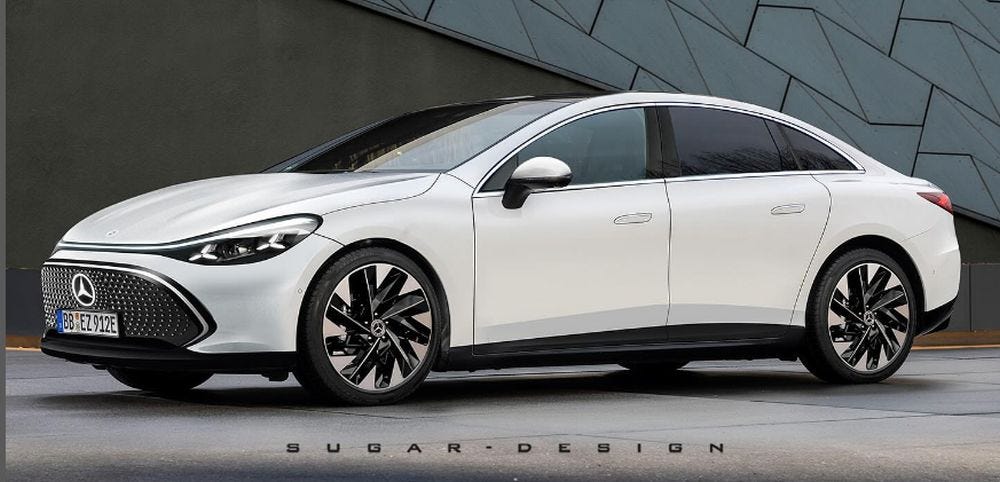
The 2027 Mercedes-Benz S-Class interior debuts a standard MBUX Superscreen, extending a seamless glass panel across the dashboard to create a, digital-first “third place” cabin
On a winter morning in Beijing in late February, Friedrich Merz climbed into the front passenger seat of a new Mercedes S-Class and let it drive itself. The German Chancellor was on his first official visit to China; beside him sat Ola Källenius, chairman of Mercedes-Benz Group. The car circled the Hilton near Beijing Capital International Airport. The software steering it was written by a company called Momenta, headquartered in Suzhou. Mercedes had just confirmed that the Momenta-co-developed driver-assistance stack would ship across nine 2026 models, including the electric GLC and the S-Class itself.
“This is amazing,” Merz said, according to Xinhua reporters on the spot. “I think it’s one of the future technologies for mobility.”
This is the car that has, for sixty years, sold itself on the absolute superiority of German engineering. Now its eyes belong to someone else.
The story being told in Stuttgart is that this is China-specific — a regional adaptation, tuned for local traffic, kept inside the Chinese border. The story being told by the show floor at Auto China 2026, which closed last weekend, is different. The long-wheelbase BMW iX3 was unveiled with around seventy per cent of its software developed locally — Huawei HarmonyOS NEXT, voice assistants from Alibaba and DeepSeek, navigation by Amap, ADAS by Momenta. SAIC-Volkswagen launched the ID. ERA 9X, its first extended-range electric SUV, with Momenta’s driving stack and a 192-line LiDAR sensor on the roof. The new Audi A6L e-tron, built at FAW-Audi’s electric plant in Changchun, ships with Huawei’s Qiankun ADS as primary autonomy. Reuters, reporting from Beijing, named all three of Volkswagen, Mercedes and BMW as “increasingly leaning on Chinese suppliers to catch up.”
These are not regional carve-outs. They are admissions.
This publication is reader-funded — no ads, no sponsors, no brand deals. If you want more long-form writing like this to exist: **☕ Buy me a coffee** — it funds the next one directly.
The reverse joint venture
For thirty years, the deal between Western premium carmakers and China was simple. Foreign firms got market access; Chinese partners got the technology. SAIC-Volkswagen, BMW Brilliance, Beijing Benz — each was a tutorial in how to build a modern car, conducted in the open, paid for in shared profits. The Germans taught. The Chinese learned.
Frank Han, the chief executive of CARIAD China — Volkswagen’s software subsidiary — said the quiet part out loud. The China Electronic Architecture, the central nervous system of every new VW-brand electric car sold in China this year, was delivered with XPeng’s help in eighteen months. Without that help, he told reporters ahead of the show, the same job in Germany would have taken three to four years. Zhang Yu of Shanghai consultancy Automotive Foresight gave the situation its name. Reverse joint venture. The teacher is now the student.
Some of this is well-trodden ground for trade journalists. Mercedes first invested in Momenta back in 2017. The China-built CLA has been running Momenta-developed ADAS for some months. The BMW–Huawei tie-up has been signposted in trade press since at least 2024. None of this was hidden. What was missing was the moment when the strategic compromise stopped being a regional tweak and became the product.
That moment arrived in February in the front passenger seat of an S-Class, and was confirmed in Beijing last weekend. The S-Class is not a regional model. It is the Mercedes flagship, the car the brand uses to define what Mercedes is. When the next-generation electric S-Class rolls out from late this year — Mercedes has named nine 2026 models in the rollout, the S-Class among them — it will, in its most important market, be running software Mercedes did not write. And the global pipeline is not separate from the Chinese pipeline. It is the same pipeline.
Yes, but
The strongest objection comes from inside the German camp. China-specific software stays in China; the global S-Class will, where it matters, ship with Stuttgart-built code. There is some truth in this. Mercedes has confirmed it will use Nvidia, not Momenta, for its US-market driver-assistance system, MB.Drive Assist Pro, which lands in the facelifted S-Class and the new CLA. Two stacks, two regions, two suppliers. Tidy on a slide.
Less tidy in practice. The Mercedes–Momenta partnership began in 2017, with joint engineering teams in both China and Germany and an end-to-end large-model architecture trained on Chinese driving data. The Audi A6L e-tron now rolling out of Changchun runs Huawei’s Qiankun ADS. CATL batteries — and the cells from CATL’s Super Technology Day on 21 April, including the new Shenxing and Qilin generations and the Naxtra sodium-ion stack — sit under the floor of much of the German EV lineup. The infrastructure is integrated.
The economics make the bifurcation harder still. If a German OEM has paid for Momenta development and has it working in cars it ships across the world’s largest auto market, the cost of maintaining a parallel German-built stack for European sales becomes a board-level question. Boards have been answering that question quietly for some time. The A6L e-tron is the answer.
A second objection: this is just business. Apple uses Foxconn. Boeing uses Mitsubishi. The S-Class has never been all-German anyway — its tyres come from France, its chips from the Netherlands, its leather from Italy. Why should the ADAS be different? Because the ADAS is what Mercedes has been selling. Tyres are commodities. Software-defined driving is the product. The premium German promise has always implied that the parts you cannot see are the ones the engineers cared about most. That promise is the one being quietly retired.
What you actually get for the money
Imagine the buyer in Knightsbridge, or Toorak, or the wide leafy bend of a Surrey driveway, who has just specced a 2027 S-Class for well into six figures. The customer, broadly, has paid for an idea: that Mercedes engineers, in a long building outside Stuttgart, have spent a decade making sure this car is better than any its competitors could build, and that every component has been chosen, tested, and signed off by the people whose names are on the doorplate. Some of this is still true. The chassis is theirs. The interior is theirs. The badge, very much, is theirs.
What is not theirs, in the new car: the ADAS stack in the largest market, increasingly the infotainment, parts of the powertrain electronics, the battery cells. In the long-wheelbase iX3, by BMW’s own count, the proportion of locally-developed software is around seventy per cent. The voice assistant talks to Alibaba’s large language model. The maps are Amap’s. The driving system is Momenta’s. The luxury experience is delivered through a stack of suppliers most premium-car owners have never heard of, and which the marketing department would prefer not to dwell on.
This is not a quality complaint. The Chinese stacks are, by most expert accounts, very good — Momenta’s end-to-end Flywheel model handles dense urban traffic better than most German equivalents, which is precisely why Mercedes is buying it. CATL’s batteries are the global reference standard. Huawei’s vehicle software is, on benchmarks, ahead of most Western suppliers. The point is not that the parts are worse. It is that the marketing always implied they would be Mercedes’s.
The premium proposition, redrawn
There is a version of this story that ends well for Mercedes, and it goes like this: the brand was always about coachwork, ride, finish, and the long lineage of decisions that produce a recognisably Mercedes car. The bits that move are the bits that move; what matters is the experience of being in it. If Momenta makes a better lane-keep assist than Stuttgart, fine — Mercedes has bought the better part, the way it has always bought Bilstein dampers or Recaro seats. The luxury proposition is not less luxurious for being assembled from world-class suppliers. It might even be more.
The version that ends badly is the one in which the customer notices. Premium pricing has always rested on a slight, useful mystery — the customer believes the cheque they have just signed is buying something invisible and irreplaceable, even if they cannot quite articulate what. Once the components have visible names, and those names belong to companies the customer can also buy from for a tenth of the price, the mystery thins. A 2027 BYD or Xpeng with the same Momenta stack and a similar CATL pack will, one suspects, drive perfectly well. At what point does the badge become the only differentiator left? At what point does it stop being enough?
The German premium brands have time to work this out. Their dealer networks, their finance arms, their service infrastructure, their badge equity — these things compound, and they take a generation to erode. But the trade press has been counting Chinese market share and missing the actual story, which is not that Chinese cars are arriving in Europe. The Chinese parts are arriving inside the European cars first.
The mood in Beijing
Robert Cisek, the China CEO of the Volkswagen brand, told Reuters in Beijing that some younger Chinese consumers “perceive us as the brand for the parents.” Volkswagen was the number-one carmaker in China for a quarter of a century. It was overtaken by BYD in 2024 and pushed into third by Geely in 2025. Mercedes’s Chinese sales fell nineteen per cent in 2025; BMW’s by twelve and a half. There is something in Cisek’s sentence that the marketing brochures cannot reach.
Hyundai’s chief executive walked the show floor and told Chinese press that China was now defining the future of mobility. That is not a sentence a Korean OEM CEO would have said two years ago. Tesla did not show up. Ford did not show up. Of the major Western brands, only the Germans were there in force, and they were there because they have nowhere else to go. The market they once defined now defines them.
The Chancellor in the front seat
Back to that Beijing morning in February. Friedrich Merz, sixty-eight, conservative, by some accounts the most pro-business Chancellor Germany has elected in a generation, sat in the front passenger seat of the new electric S-Class while it took itself for a drive. Mercedes published the photographs the same day. The car looks, in those frames, like every Mercedes flagship for sixty years — the long bonnet, the upright grille, the sense that the people who built it knew exactly what they were doing.
The brain of the car was thinking in a language Stuttgart did not write. Nobody on the stand mentioned it. Somewhere in Suzhou, an engineer at Momenta who has never seen a Mercedes dealership watched the data come back from the demo unit and wondered, perhaps, what to have for lunch.
Three publications. Pick the ones that fit.
***The Strategic Edge — Geopolitics, war economy, trade, and macroeconomics. Numbers that explain what’s actually happening. [The Civic Ledger](https://civicledger.brianiselin.com/) — Policy, politics, culture, and society. Charts and cost curves you can use at work and in arguments. [Torque & Theory](https://torqueandtheory.brianiselin.com/)* — EV, hybrid, and ICE: the maths, the documents, and how to save money on the decisions that matter.
Follow one. Follow all three. Either way, you’re reading work that isn’t written for the algorithm.
메타데이터
- post_id
- e9d20caeb8df
- slug
- the-s-class-now-thinks-in-mandarin-e9d20caeb8df
- url
- https://torqueandtheory.brianiselin.com/the-s-class-now-thinks-in-mandarin-e9d20caeb8df
- canonical_url
- https://torqueandtheory.brianiselin.com/the-s-class-now-thinks-in-mandarin-e9d20caeb8df
- author_url
- https://medium.com/@brianiselin67
- status
- ok
- fetched_at
- 2026-06-09 15:37:30